
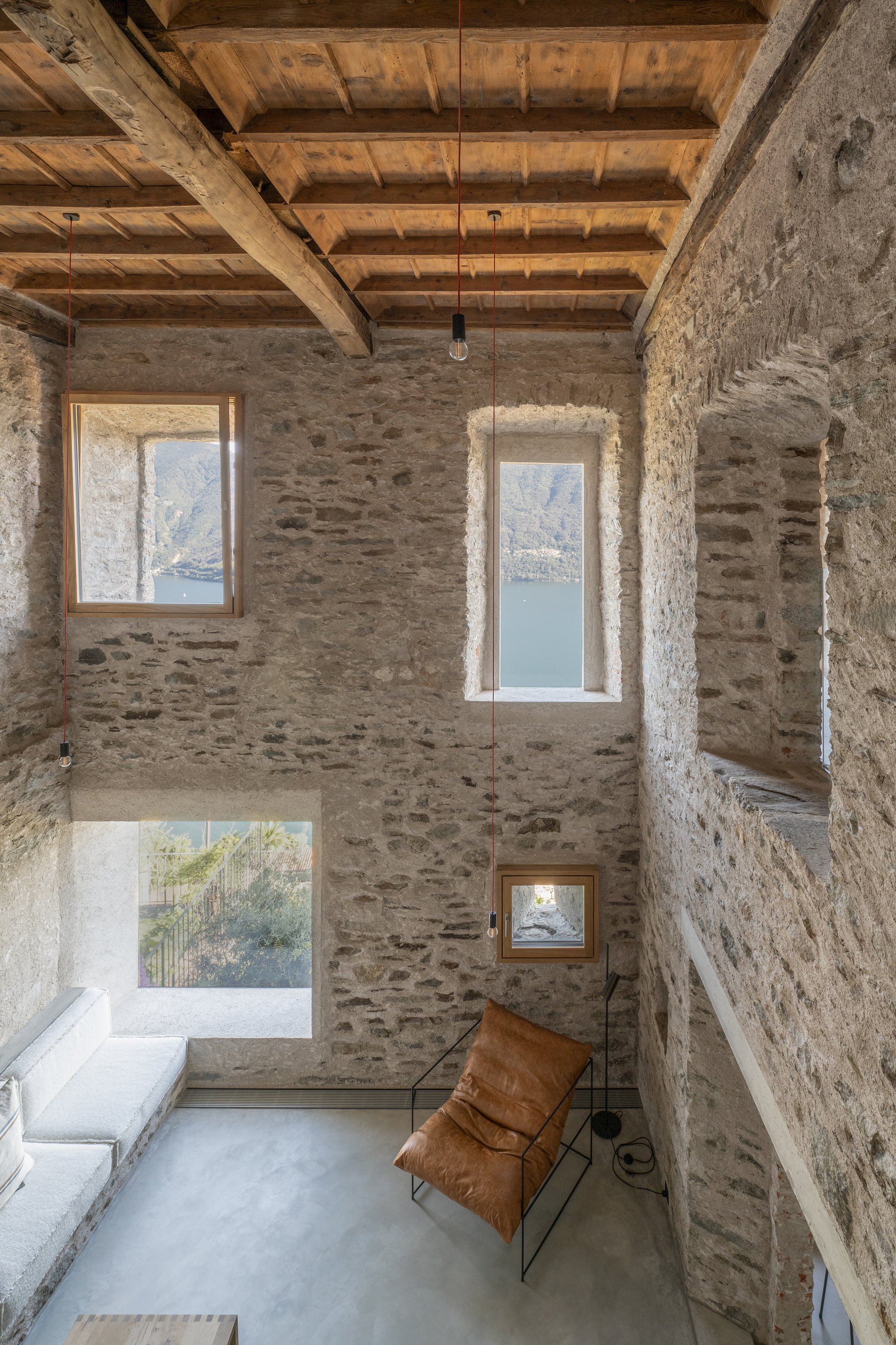
Wespi de Meuron Romeo Architects Strip a Ticinese Farmhouse Back to Its Stone Bones
A careful transformation in Brissago reconnects a historic vineyard house to Lake Maggiore through restraint and revelation.

Above the village of Brissago Piodina, where terraced vineyards step down toward Lake Maggiore, an old farmhouse sat behind layers of plaster and a clumsy oversized terrace propped on three pillars. The building had been altered so many times that its original character was nearly illegible. Wespi de Meuron Romeo architects, a practice deeply rooted in Ticino's building culture, took on the transformation not as a renovation but as an act of architectural archaeology: peeling away what didn't belong and reinforcing what did.
What makes this 310 square meter project compelling is its refusal to perform. There is no grand gesture, no inserted glass box screaming "contemporary intervention." Instead, the architects worked within the logic of the existing stone masonry, exposing original walls, preserving timber beams, and inserting new elements with a quietness that lets the building's centuries-old material presence do the talking. The living areas were relocated to the basement level to connect directly with the vineyard garden, a simple spatial inversion that fundamentally changed the house's relationship to its extraordinary site.
Village Context and Site
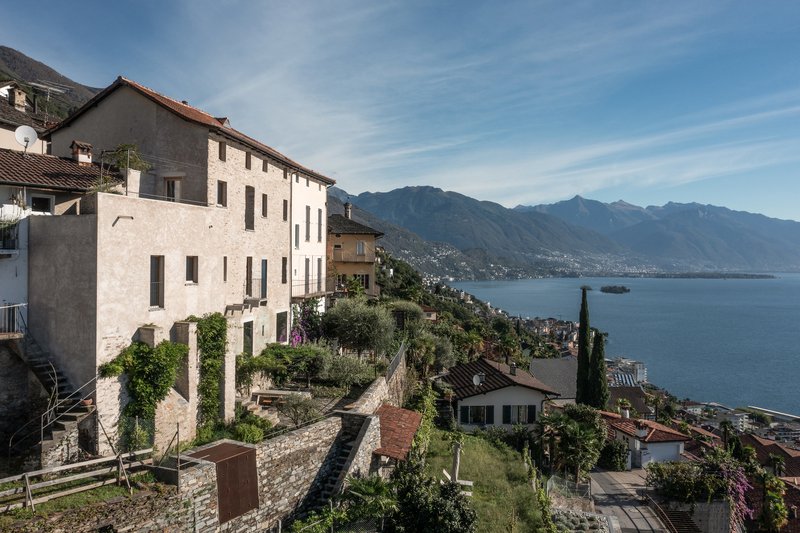
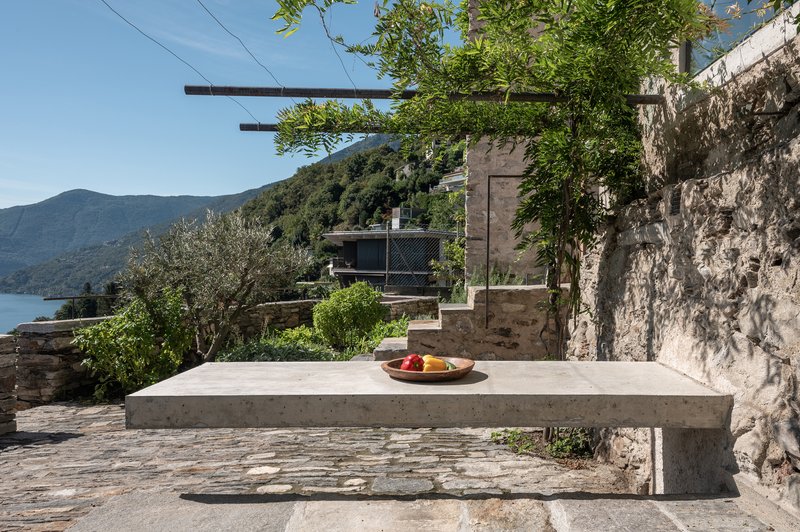
The house sits within a tight cluster of stone buildings that tumble down the hillside, accessible on foot from below and by car from a road above. The village fabric is compact and mineral: stone walls, narrow passages, terraced ground. From the property, Lake Maggiore stretches out in an unobstructed panorama framed by mountains. A projecting reinforced concrete table on the terrace, cantilevered over the slope, distills the entire project philosophy into a single object. It is new, unapologetic in its materiality, and completely subservient to the view.
Stone Revealed
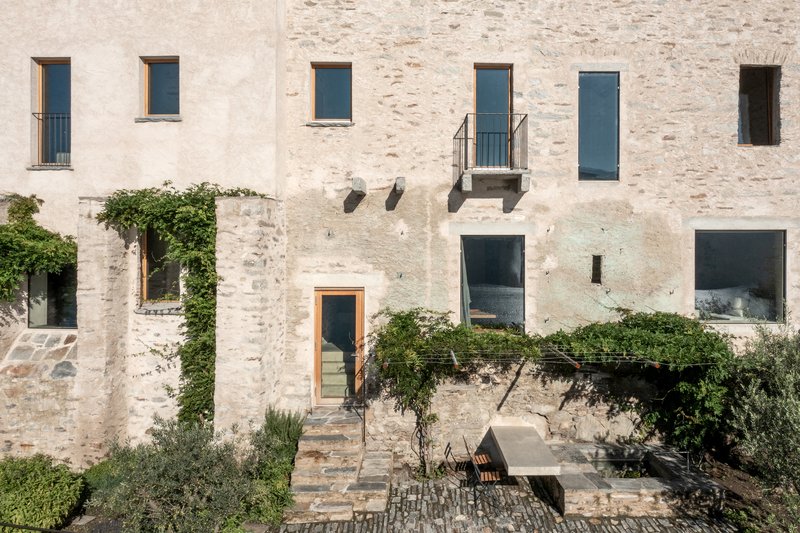
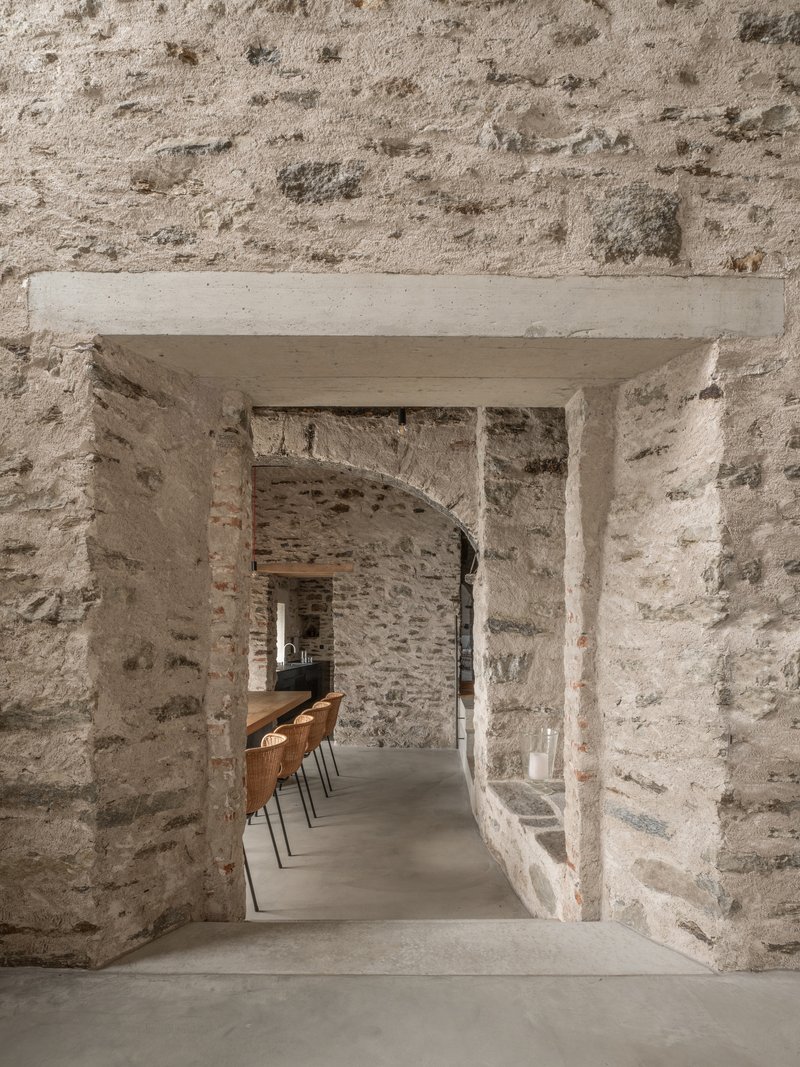
Stripping away non-historic plaster coatings exposed the building's original stone masonry, an irregular patchwork of rough-cut blocks that reads like a geological cross-section. The architects then applied partial re-plastering guided by the construction logic visible in neighboring village houses, not a wholesale limewash but selective interventions that reinforce structural junctions and leave the most expressive stonework bare.
The result is walls that tell a story. You can read the thickness of the masonry in the deep window reveals, see where arches spring from bearing points, and trace the history of openings that have been added, filled, and reopened over centuries. New windows were inserted at garden level to flood the relocated living spaces with light, but their steel and timber frames are scaled to complement, not compete with, the massive stone surrounds.
Living Under Stone Arches
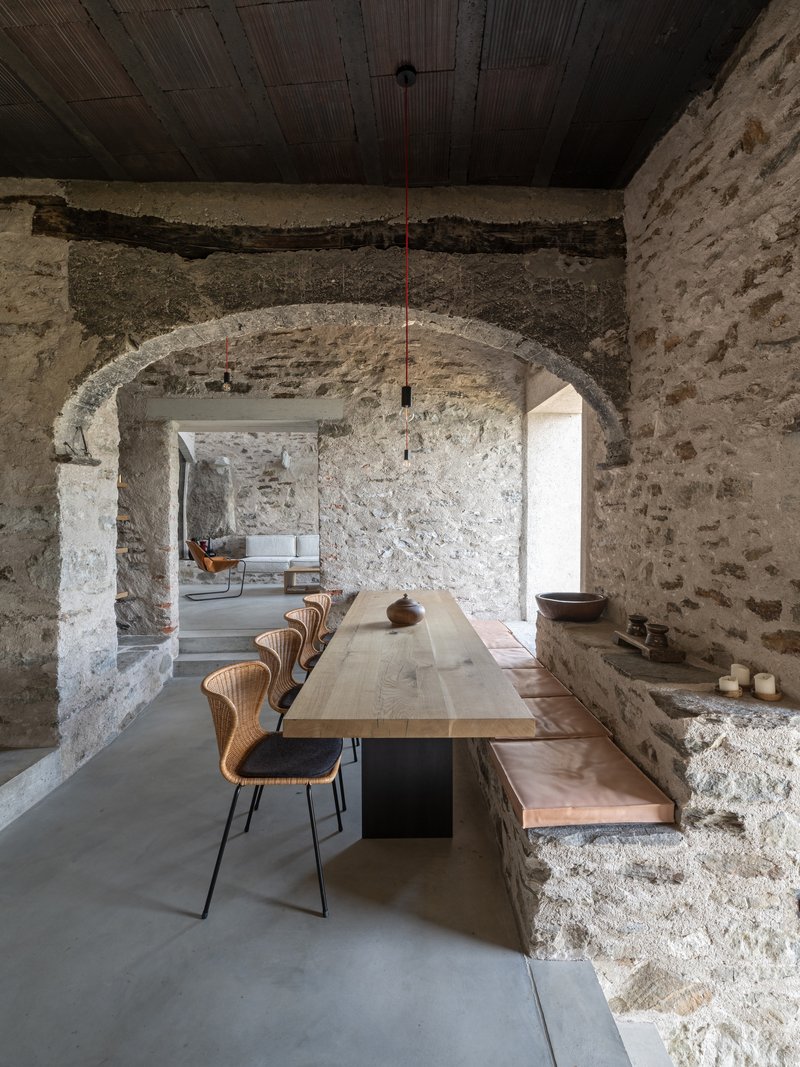
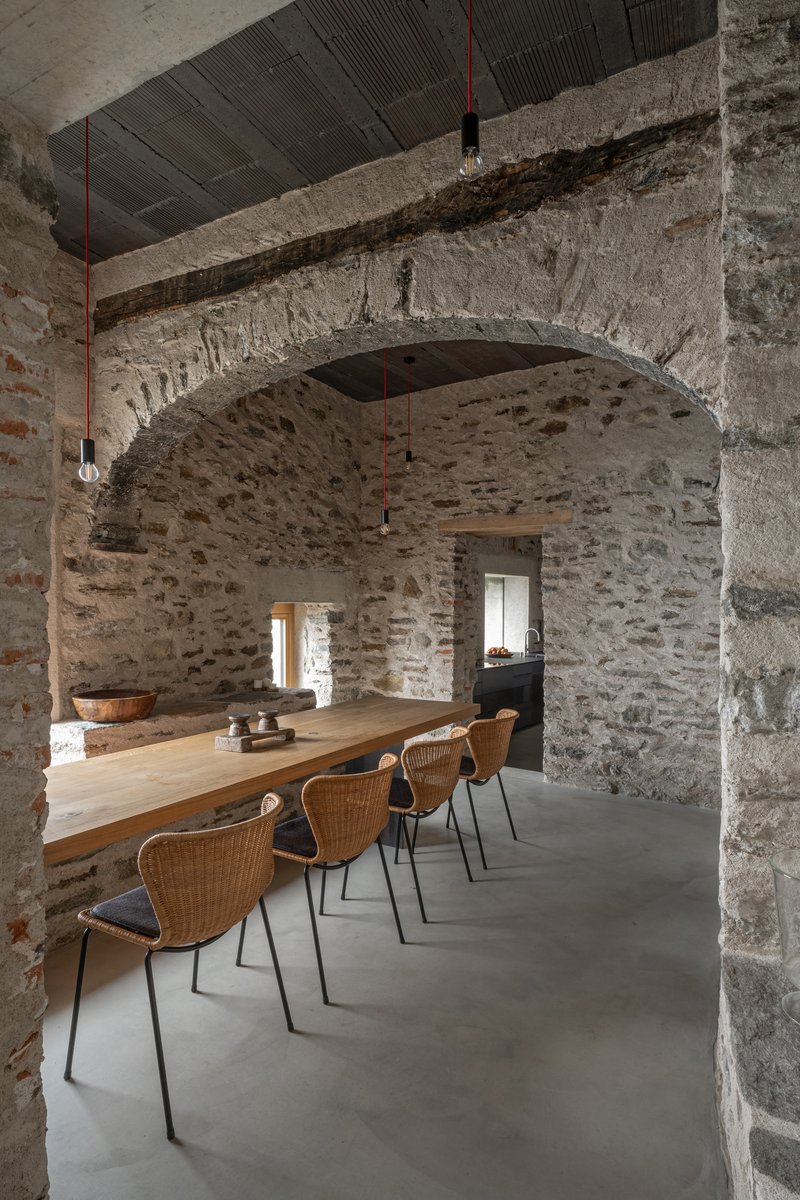
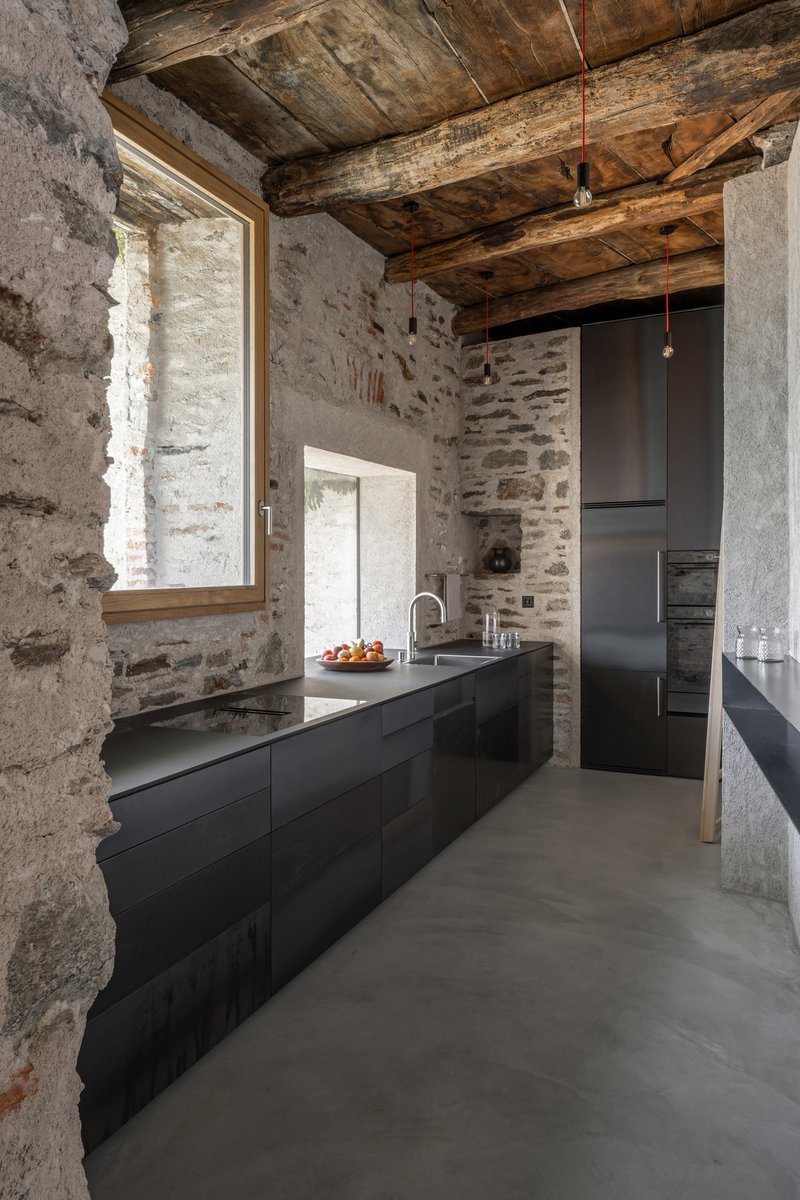
Moving the primary living spaces to the basement level was the project's most consequential decision. What had been a cellar now holds the kitchen, dining room, and main gathering areas, all directly connected to the garden and vineyard. Stone arches that once framed storage bays now define a generous dining room where a custom-designed timber table sits beneath a corrugated metal ceiling. The kitchen, fitted with dark cabinetry designed by the architects, tucks under the timber plank ceiling with a single casement window framing the hillside.
A reinforced concrete slab replaced an old vault in the basement to accommodate a new elevator, the kind of structural surgery that is invisible in the finished space but essential to making the house work for contemporary life. The spatial sequence through arched openings creates a procession that feels almost monastic, rooms unfolding one after another through thick stone portals.
Vertical Light and Framed Views
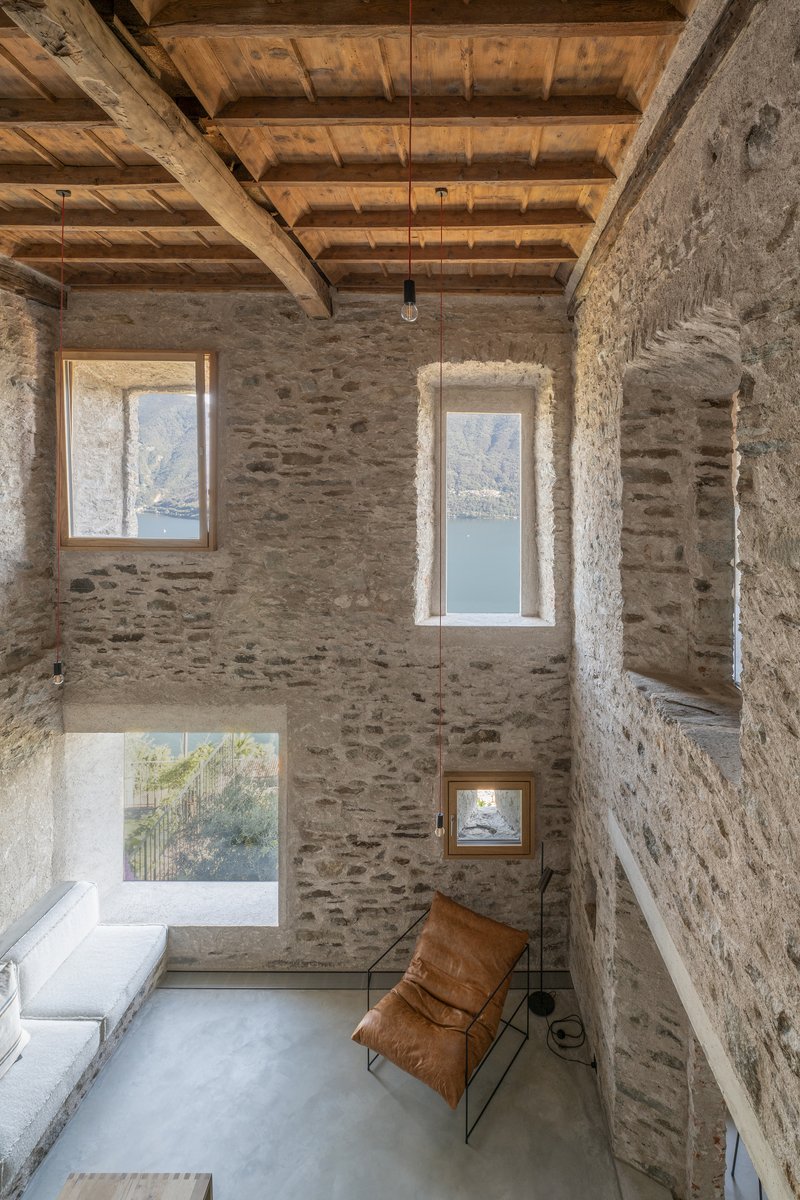
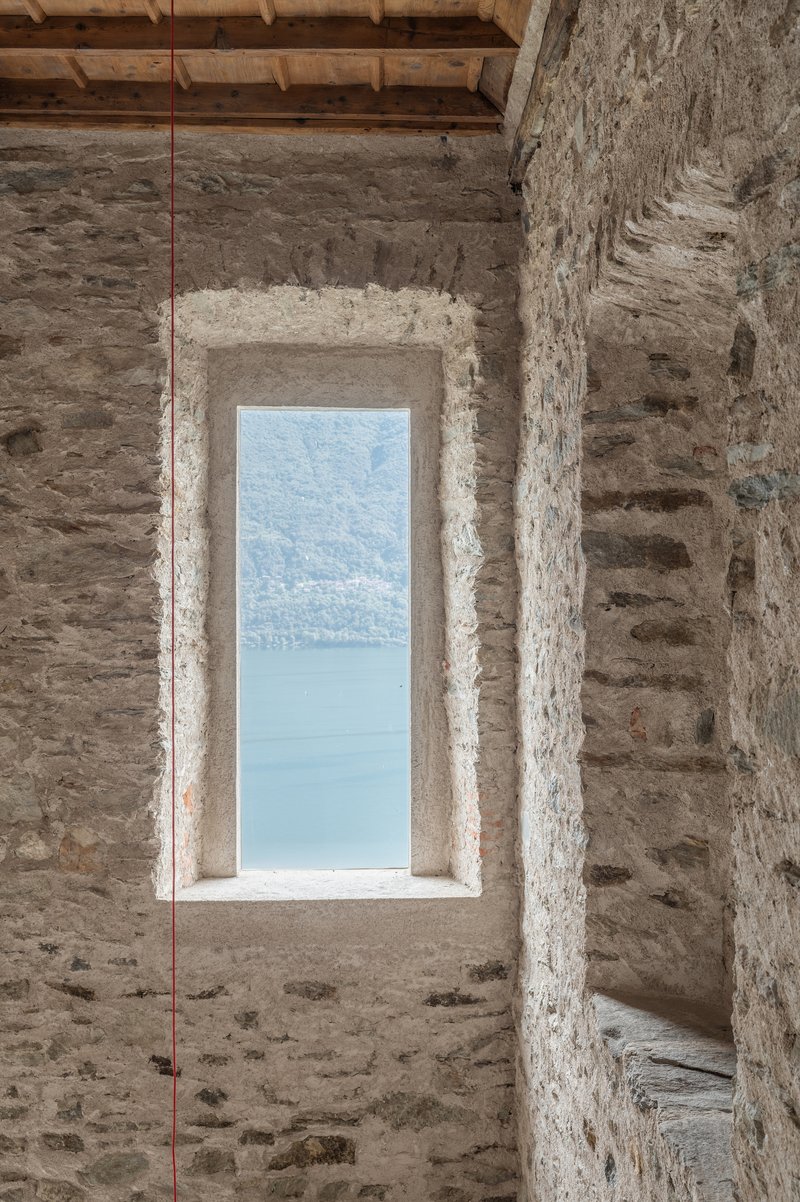
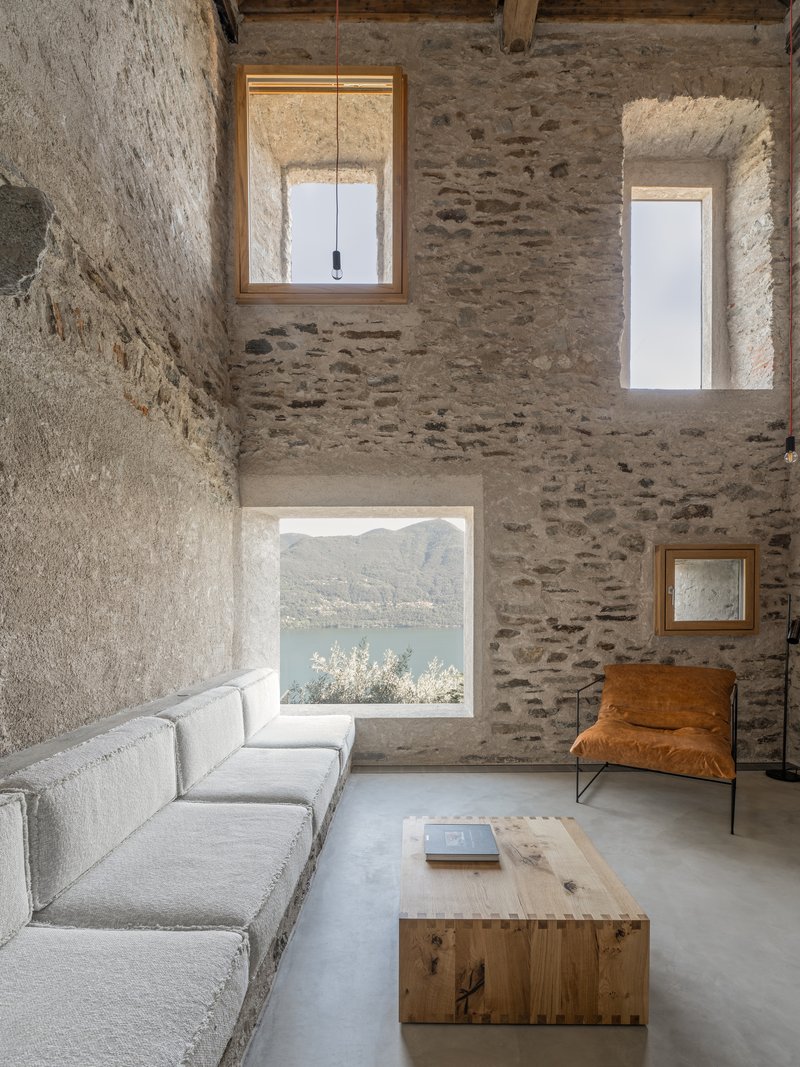
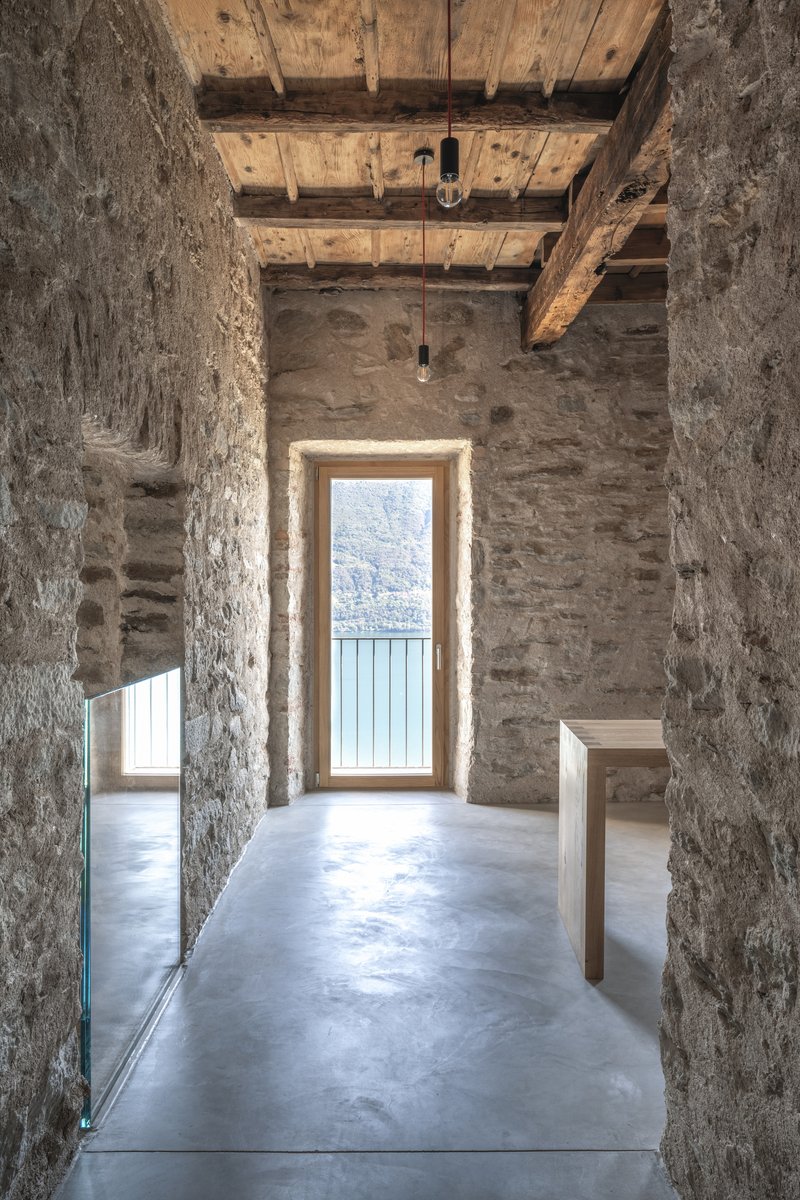
The upper floors are organized around the play of light through deep-set openings. Tall rooms with exposed timber beams channel daylight from windows that punch through the substantial masonry walls, each one framing a specific slice of lake and mountain. The proportions are vertical, the light theatrical. One narrow window, cut through stone easily a meter thick, isolates a rectangle of water and sky so precisely it reads like a photograph mounted on the wall.
A sitting area on an upper level captures this quality at its most distilled: a single window, diffused daylight, stone on every surface, and the lake beyond. The restraint here is the architecture. There is nothing else to look at, and nothing else is needed.
Timber, Concrete, and the Palette of Intervention
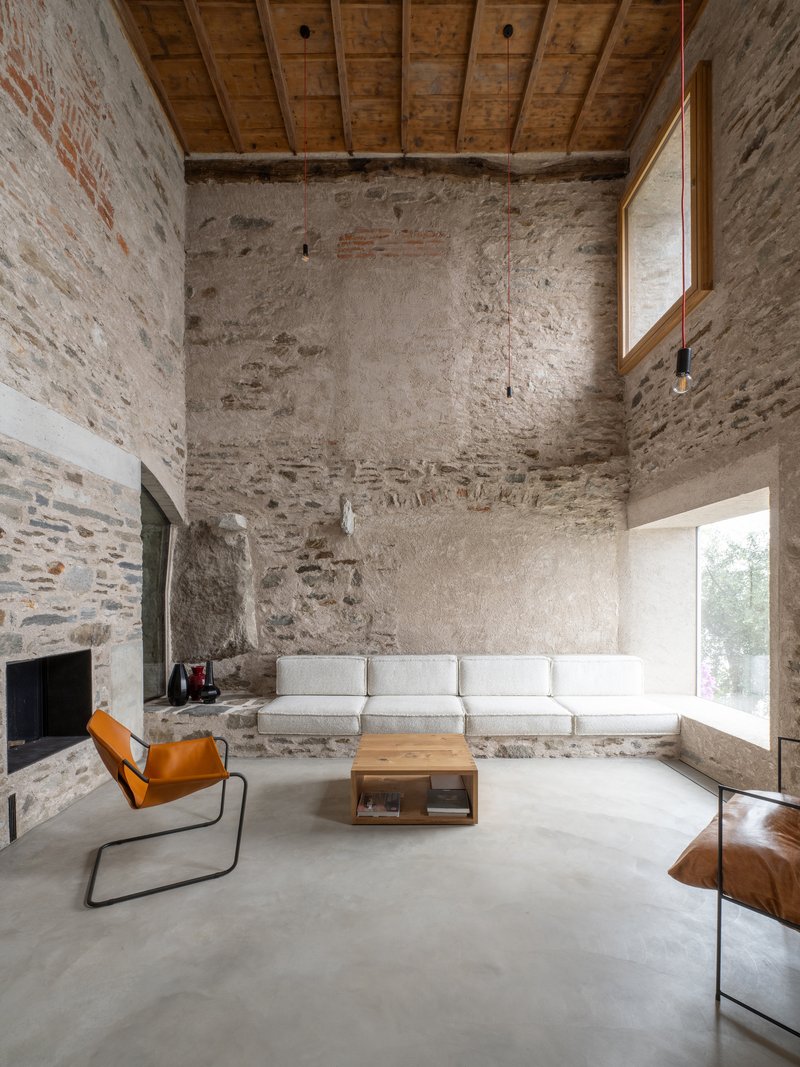
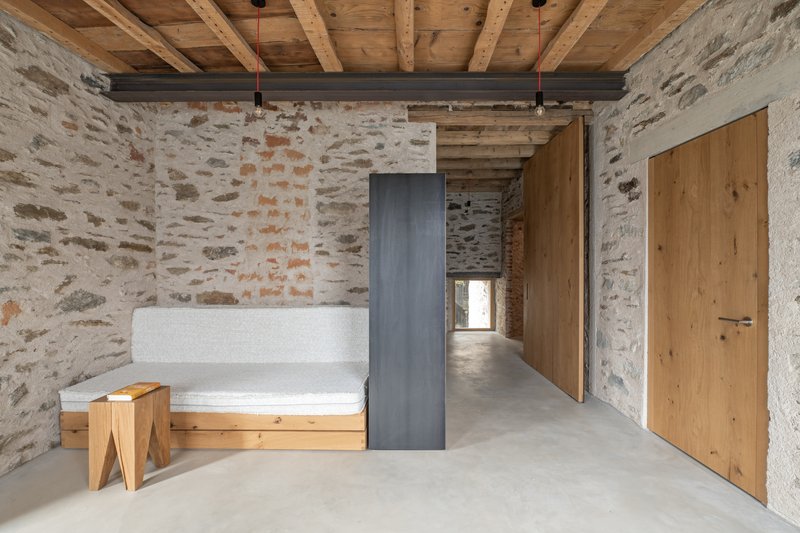
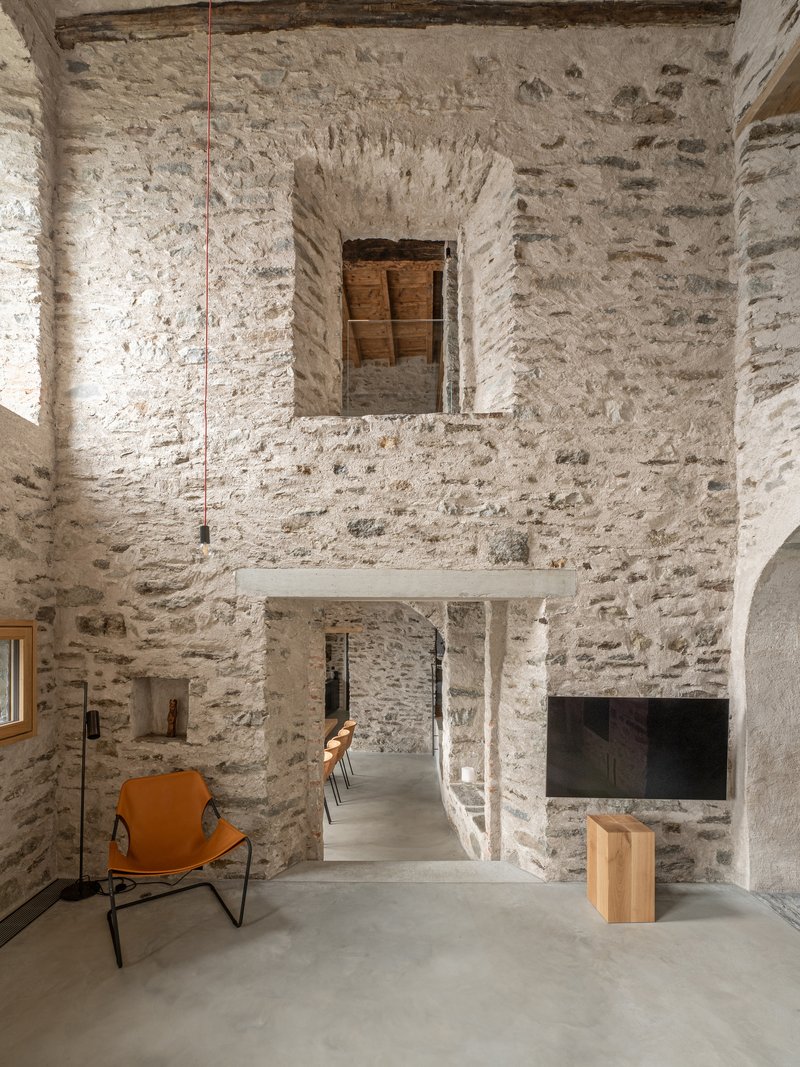
The material language of the new work is deliberately limited: polished concrete floors, exposed original timber beams, whitewashed stone where plaster was applied, raw stone where it was removed, and occasional steel columns where structural reinforcement was required. A double-height space on the upper level, its walls partially whitewashed, suspends a mezzanine slab that hovers between pendant lights and ancient masonry. The juxtaposition is precise without being precious.
Original wooden beams throughout the house were preserved and left exposed, their patina and irregularity providing warmth against the cool mineral surfaces of stone and concrete. Where a steel column appears, it is slender and painted dark, an honest structural member rather than a decorative element. The architects understood that the existing building already had enough character; the new work simply needed to hold the frame.
Circulation and the Cellar Below
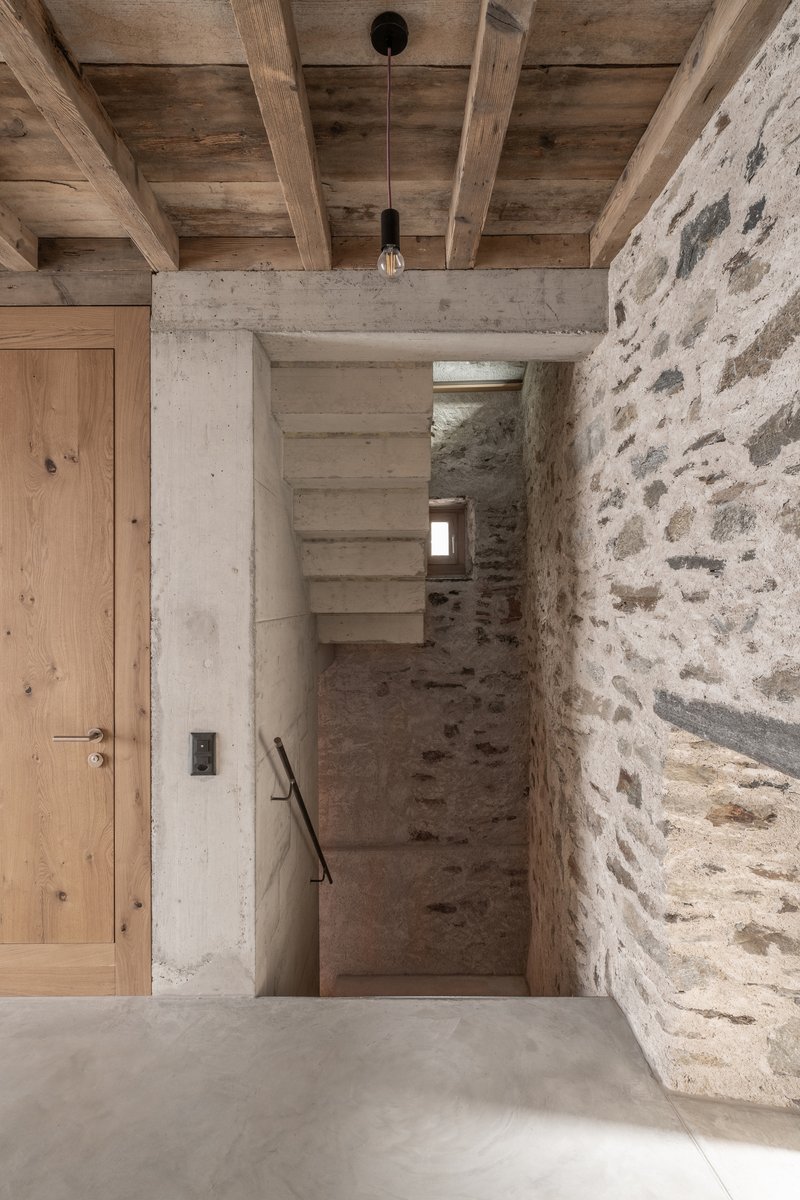
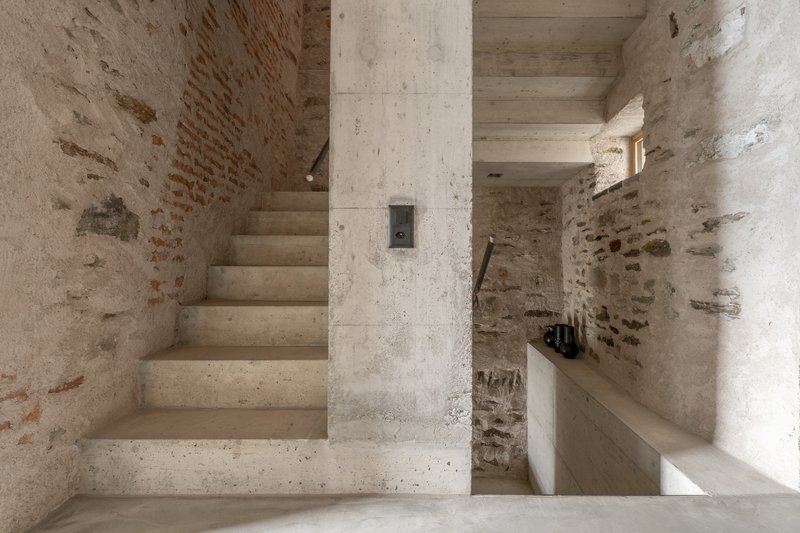
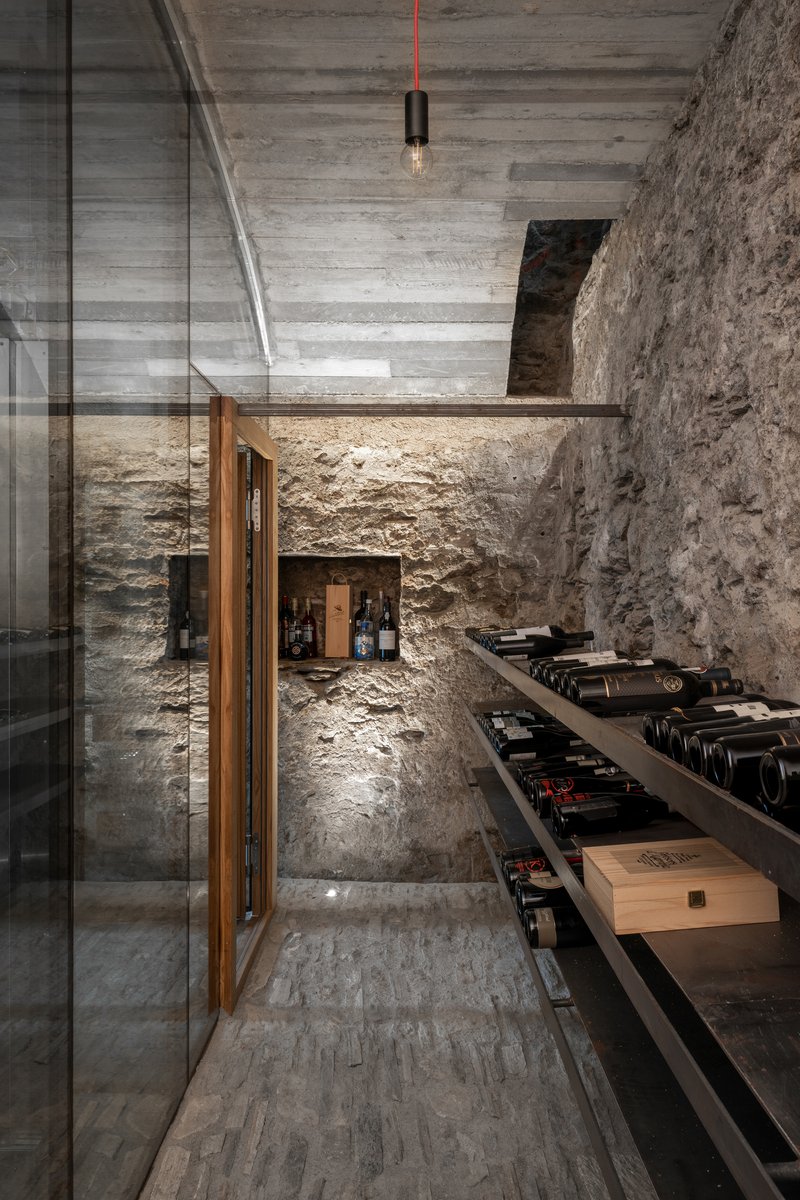
A new concrete staircase threads through the building alongside a structural column, its board-formed surfaces providing tactile contrast to the rubble masonry of the original walls. The entry hall, with its timber ceiling and pendant fixture, establishes the transition between old and new from the first step inside. Below, a wine cellar passage, fitted with a timber-framed glass door and floating shelves under a board-formed concrete ceiling, connects the building to its agricultural past while serving a decidedly contemporary purpose.
Private Rooms and the Skylit Bath
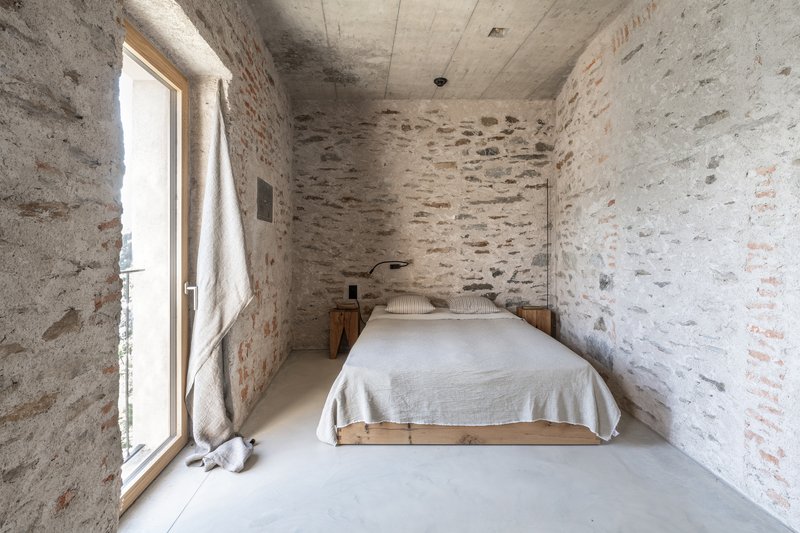
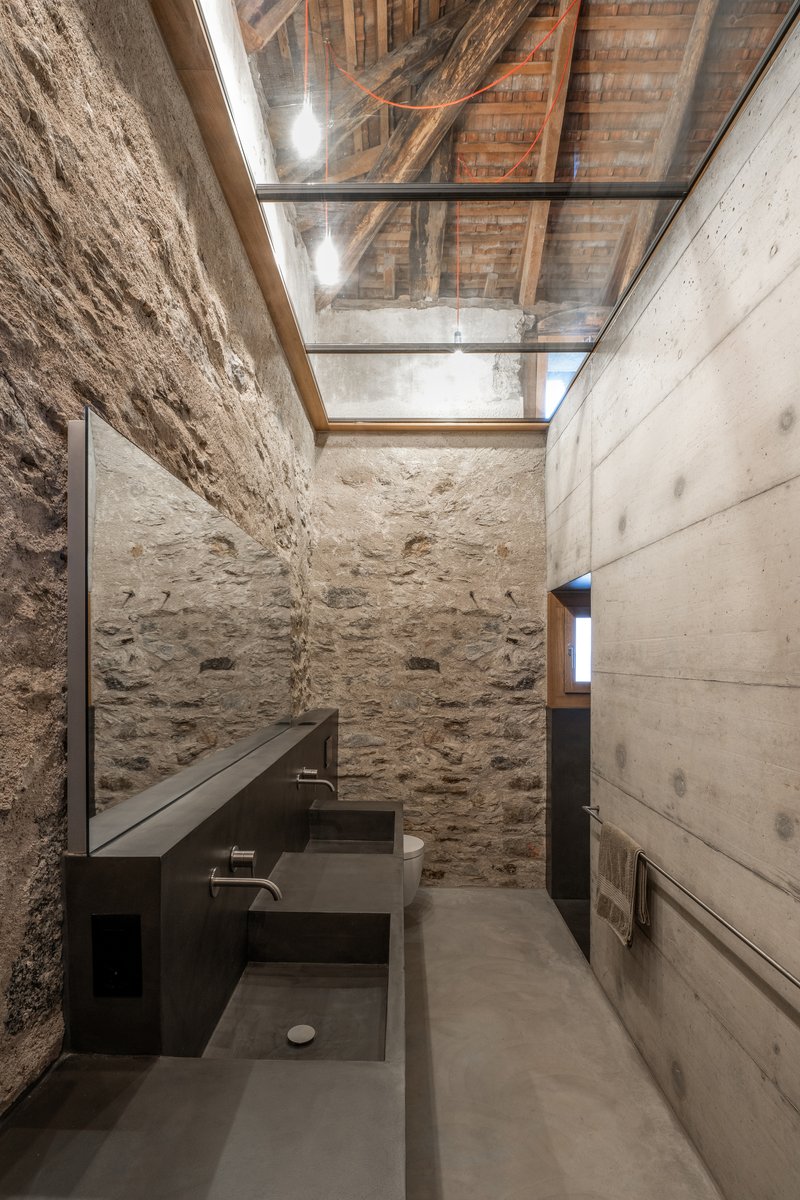
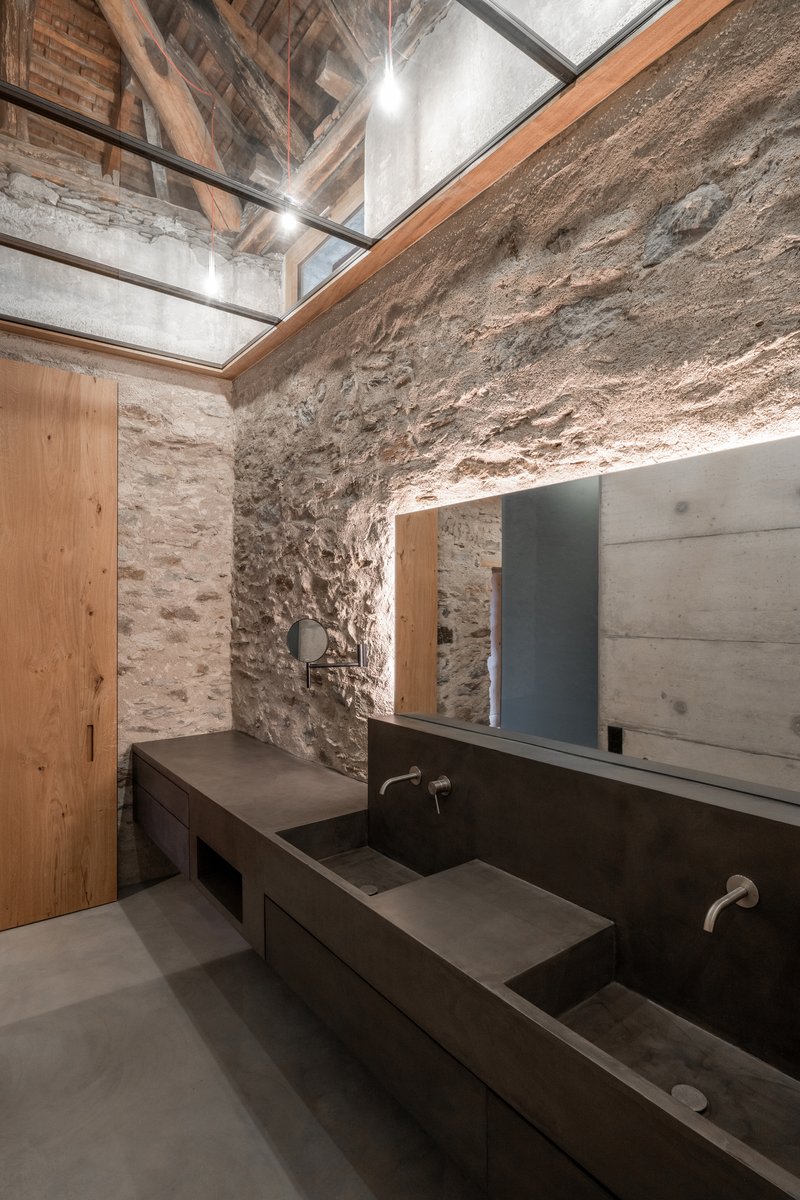
The bedrooms continue the language of whitewashed stone and concrete, with floor-to-ceiling windows replacing what were likely smaller openings. A timber bed frame, presumably designed by the architects alongside the other custom fixtures, sits low against the masonry. But the real surprise is a bathroom nestled under the roof, where a corner skylight opens the timber structure to the sky. A concrete vanity counter sits beneath exposed rafters, and daylight pours down onto stone walls. It is the kind of room that makes you reconsider the entire hierarchy of domestic spaces.
Corridors and In-Between Spaces
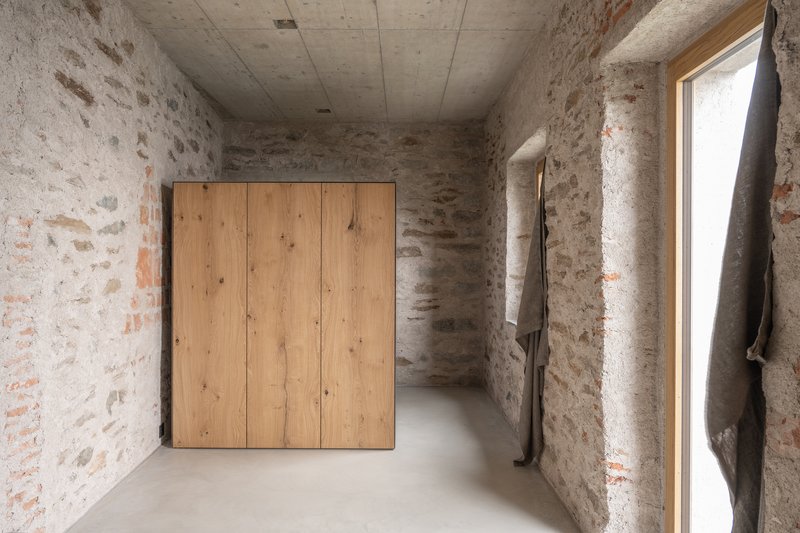
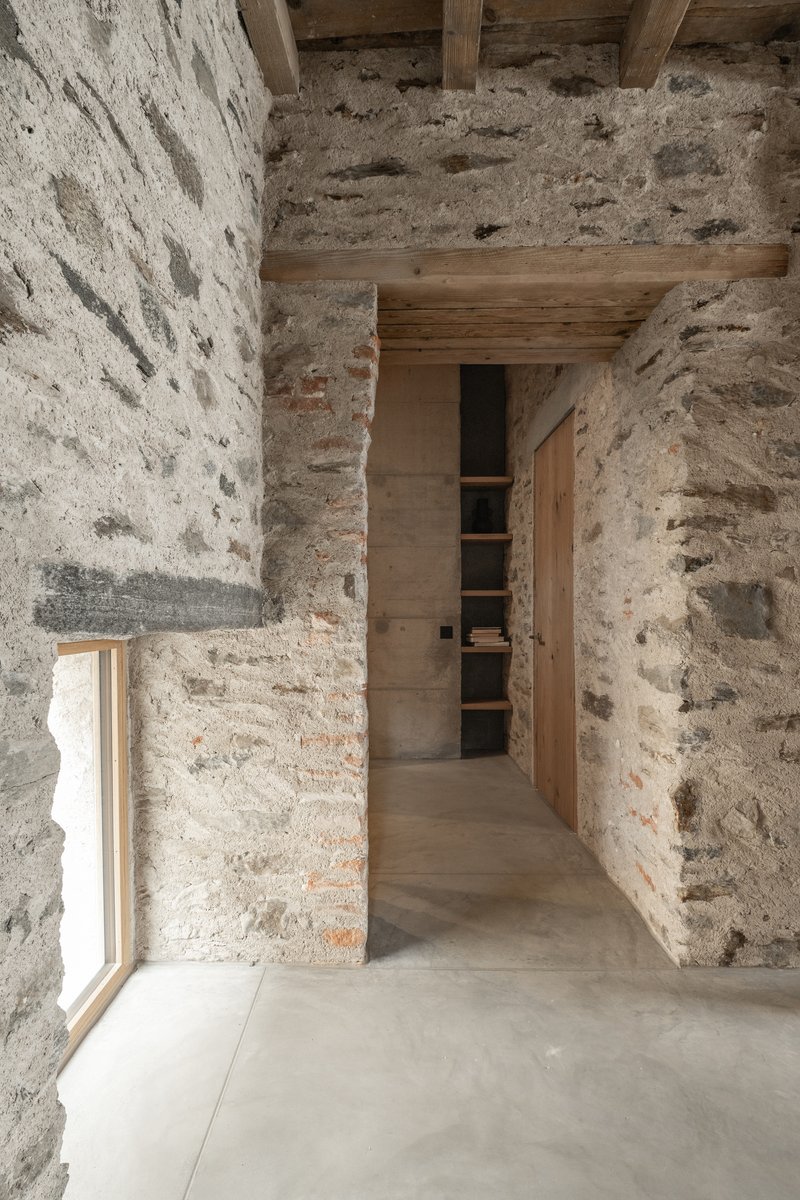
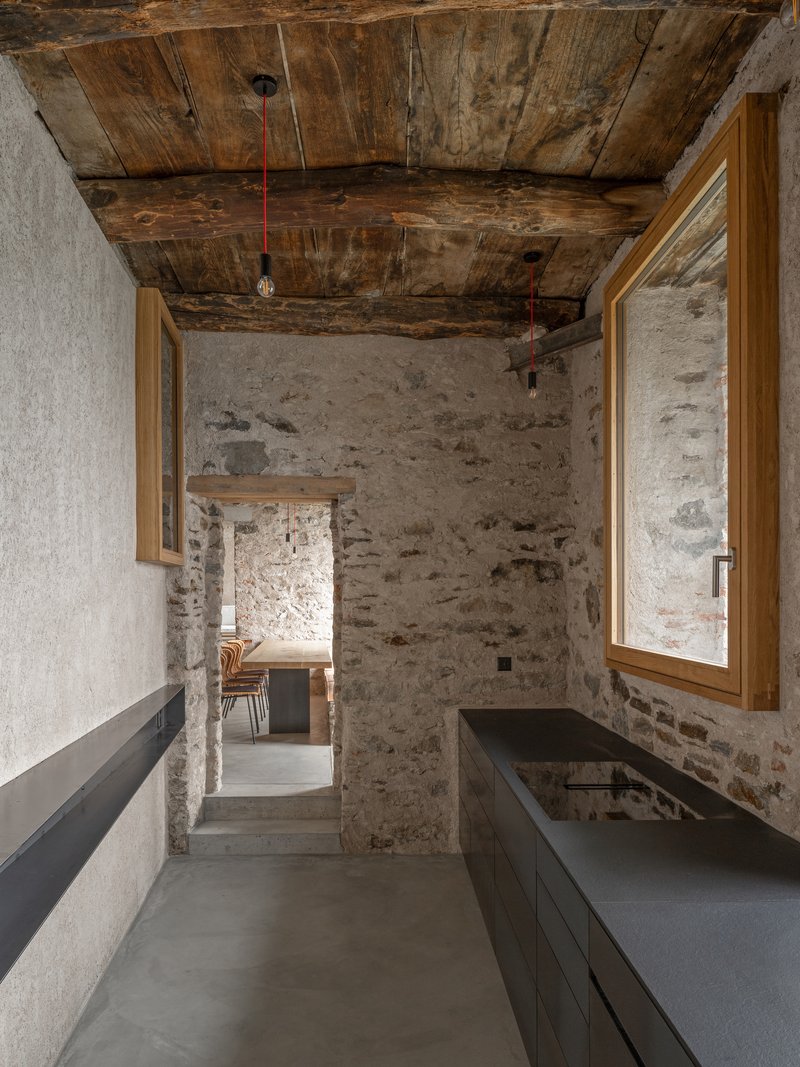
Some of the most atmospheric moments occur in the passages between rooms. Corridors lined with exposed stone masonry and timber wardrobes, lit by pendant fixtures, feel like inhabitable walls rather than mere connectors. Dark cabinetry running along rough stone surfaces under timber plank ceilings creates a compression that makes the rooms they lead to feel all the more expansive. These thresholds reveal the building's enormous wall thickness and turn a structural fact into a spatial experience.
Plans and Drawings
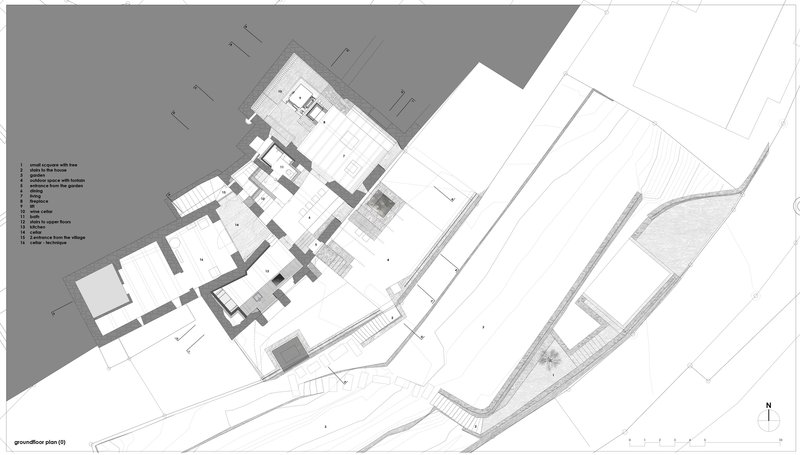
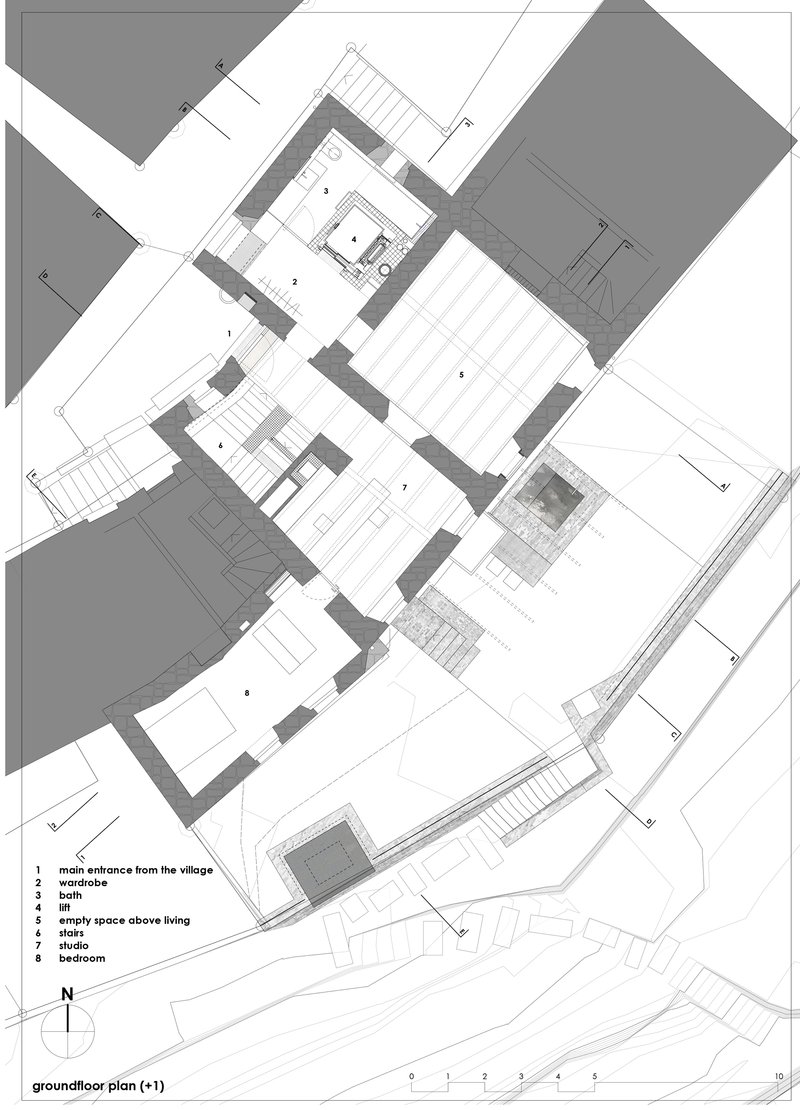
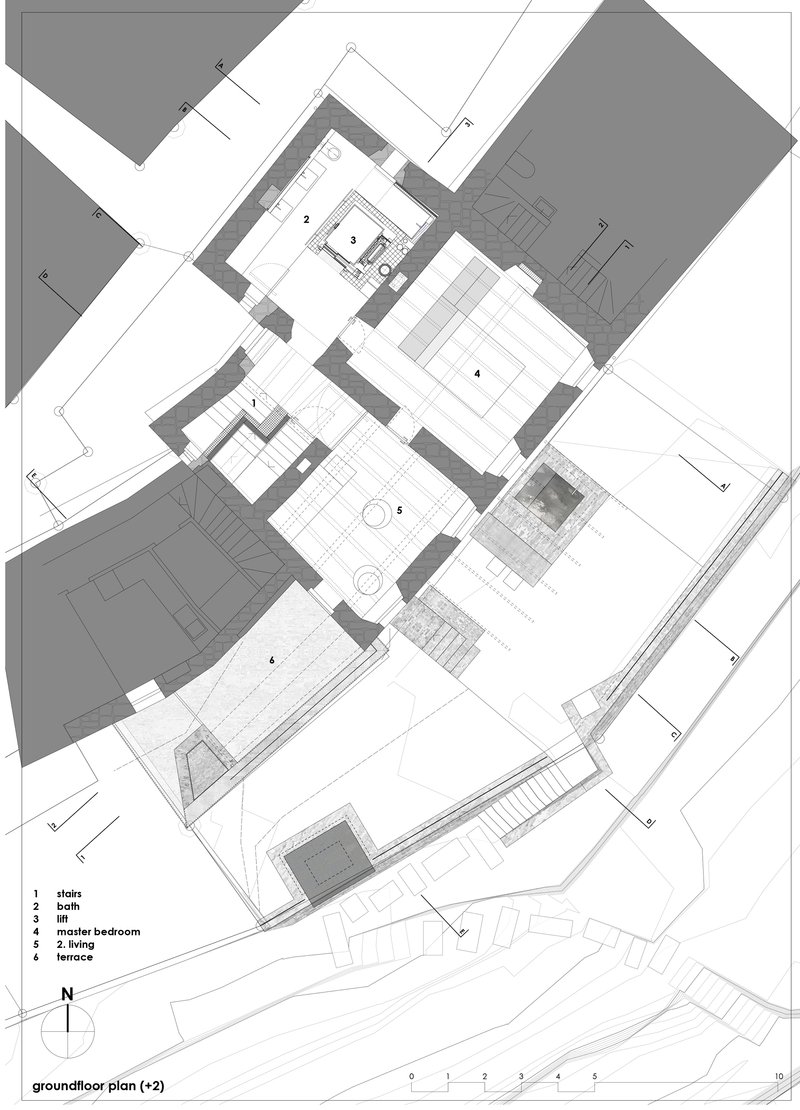
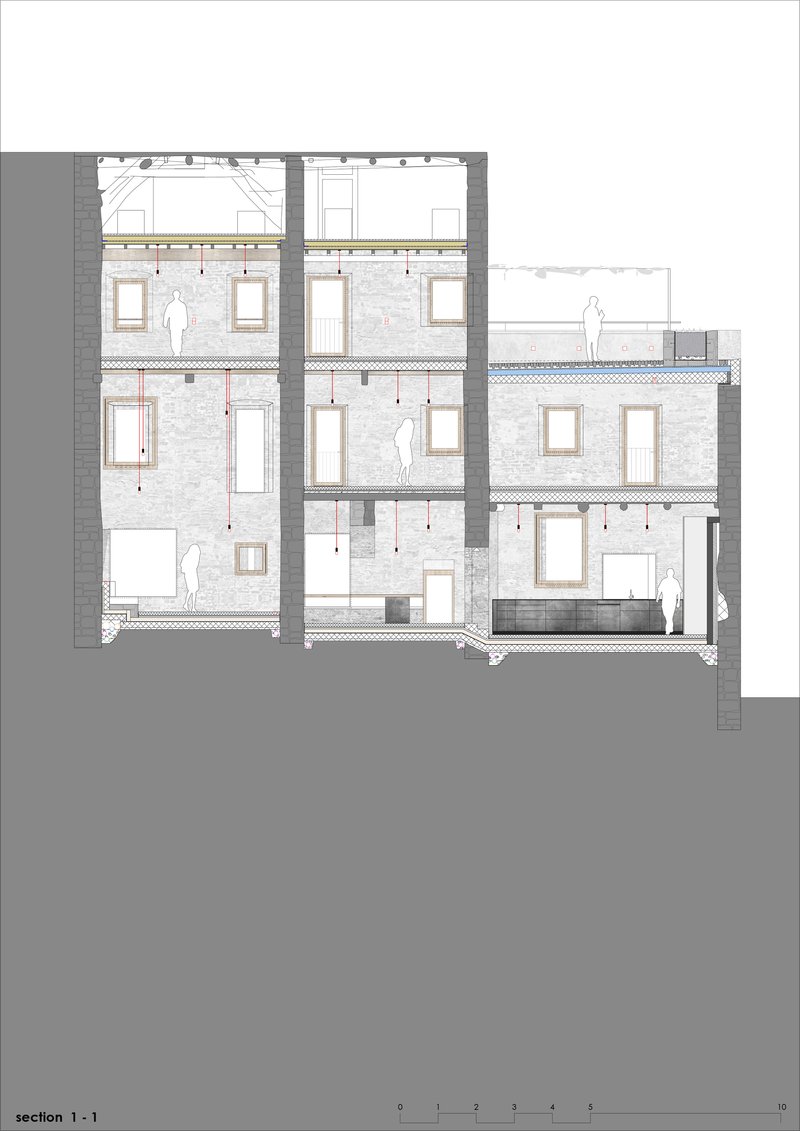
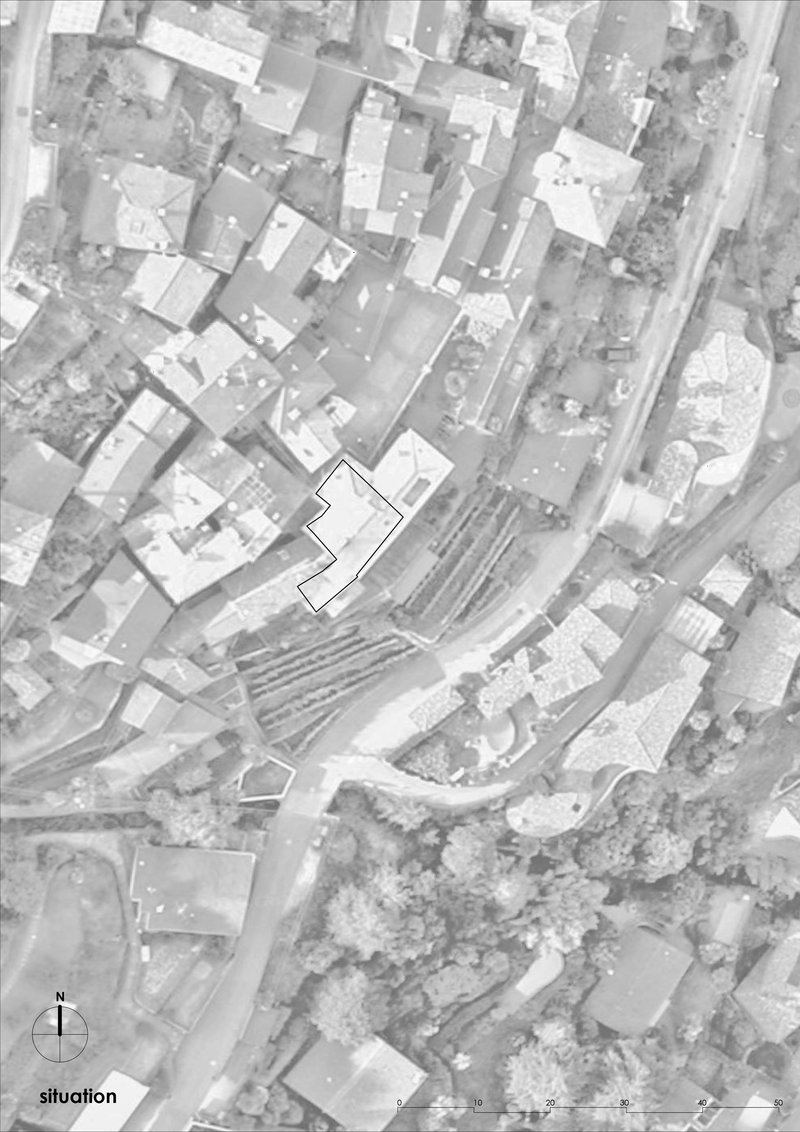
The plans reveal the building's irregular geometry, a product of centuries of accretion rather than any single compositional idea. Thick masonry walls define rooms of varying proportion, organized around stairs and small courtyards. The section drawing shows how the new timber framing and concrete insertions integrate within the restored stone envelope across multiple levels, from cellar to roof truss. The site plan positions the house within the village's dense fabric, surrounded by residential structures and heavy tree cover, confirming that this is a building shaped by its neighbors as much as by its architects.
Why This Project Matters
Renovation projects in picturesque lakeside villages often fall into one of two traps: either a timid preservation that embalms the building in its least interesting state, or a showy contemporary insertion that treats the old structure as a backdrop for new spectacle. Wespi de Meuron Romeo architects avoided both by treating the existing farmhouse as a collaborator rather than a canvas. Their method, stripping away layers to reveal authentic material qualities and then making surgical insertions guided by vernacular construction logic, produced a house that feels simultaneously ancient and absolutely current.
The decision to relocate living spaces to the ground floor and connect them directly to the vineyard garden is the kind of move that seems obvious in retrospect but requires real confidence to execute. It reorganized the entire domestic experience around landscape rather than view, even though the view is spectacular. That willingness to privilege the relationship between body, ground, and garden over the panoramic postcard is what separates thoughtful transformation from mere upgrading. The house in Brissago is not a before-and-after story. It is an argument for architecture as careful listening.
Transformation House ME. in Brissago by Wespi de Meuron Romeo architects. Located in Brissago, Switzerland. 310 m². Completed in 2023. Photography by Giacomo Albo.
About the Studio
Share Your Own Work on uni.xyz
If projects like this are the kind of work you want to make, uni.xyz is a place to publish your own, find collaborators, and enter design competitions.




Popular Articles
Popular articles from the community

Shinkō Komyuniti: Public Space Architecture Reimagining Sport, Culture and Community in Tokyo
Shinkō Komyuniti transforms sports spectatorship into public space architecture that reconnects play, culture, community and Tokyo life now.
Community Library in Girona: A Replicable Model for Inclusive Library Architecture
A modular community library in Girona transforms learning, culture, and climate-responsive design into a shared civic network for all users.

Terra e Tuma Scatters Four Concrete Pavilions Through the Atlantic Forest in Mairiporã
A fragmented compound of music studio, art studio, chapel, and living quarters preserves every tree on a steep forested hillside near São Paulo.
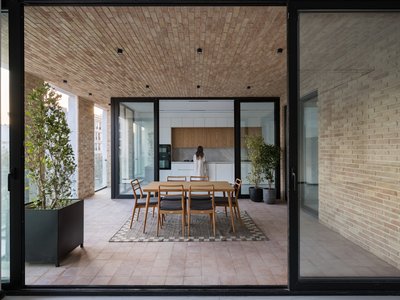
DIM Architecture Studio Revives the Iranian Courtyard Inside a Mashhad Apartment Building
A 2,500-square-meter mid-rise infill project reinterprets the traditional hashti and central courtyard within the dense urban fabric of Mashhad, Iran.


Similar Reads
You might also enjoy these articles
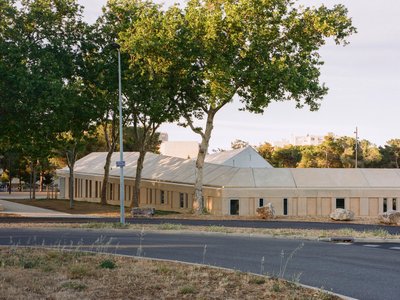
School Group Samuel Paty in Béziers: A Contemporary Educational Campus by Ateliers O-S Architectes and NAS Architecture
Samuel Paty School in Béziers features concrete massing, porous courtyards, metal structures, and landscaped playgrounds, creating a child-scaled, light-filled learning environment.
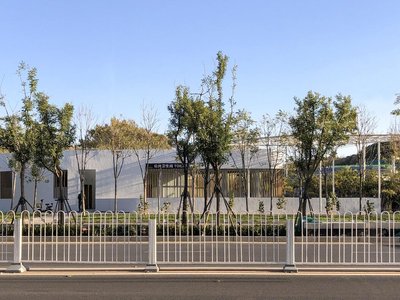
Four Public Pavilions in Beijing by Aurélien Chen and CSCEC
Four park pavilions in Beijing combine public services with floating roofs, acting as subtle urban signals integrated into landscape contextually.
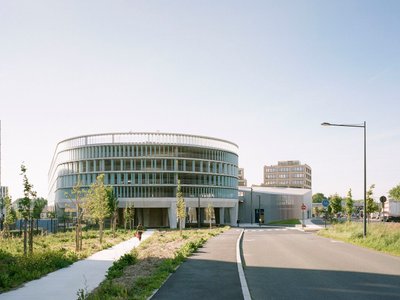
LÁ-SÁCH House by Atelier tho.A
Compact tropical tube house-library with polycarbonate louvers, flexible interiors, concrete core, crafted materials, and community-focused alley setback.
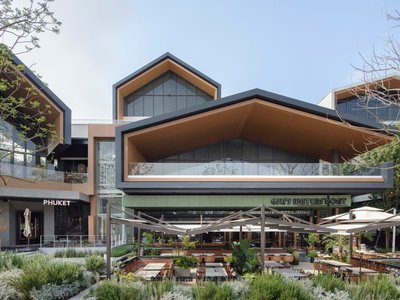
Luxelakes Tianfu Food Island Phase II: A Contemporary Lakeside Commercial Hub in Chengdu
Lakeside commercial complex in Chengdu featuring cascading terraces, sloped roofs, and public waterfront spaces, blending restaurants, retail, and community interaction.


Explore Landscape Design Competitions
Discover active competitions in this discipline




The Global Benchmark for Architecture Dissertation Awards


Challenge to design mud housing for contemporary communities
Comments (0)
Please login or sign up to add comments
No comments yet. Be the first to comment!