
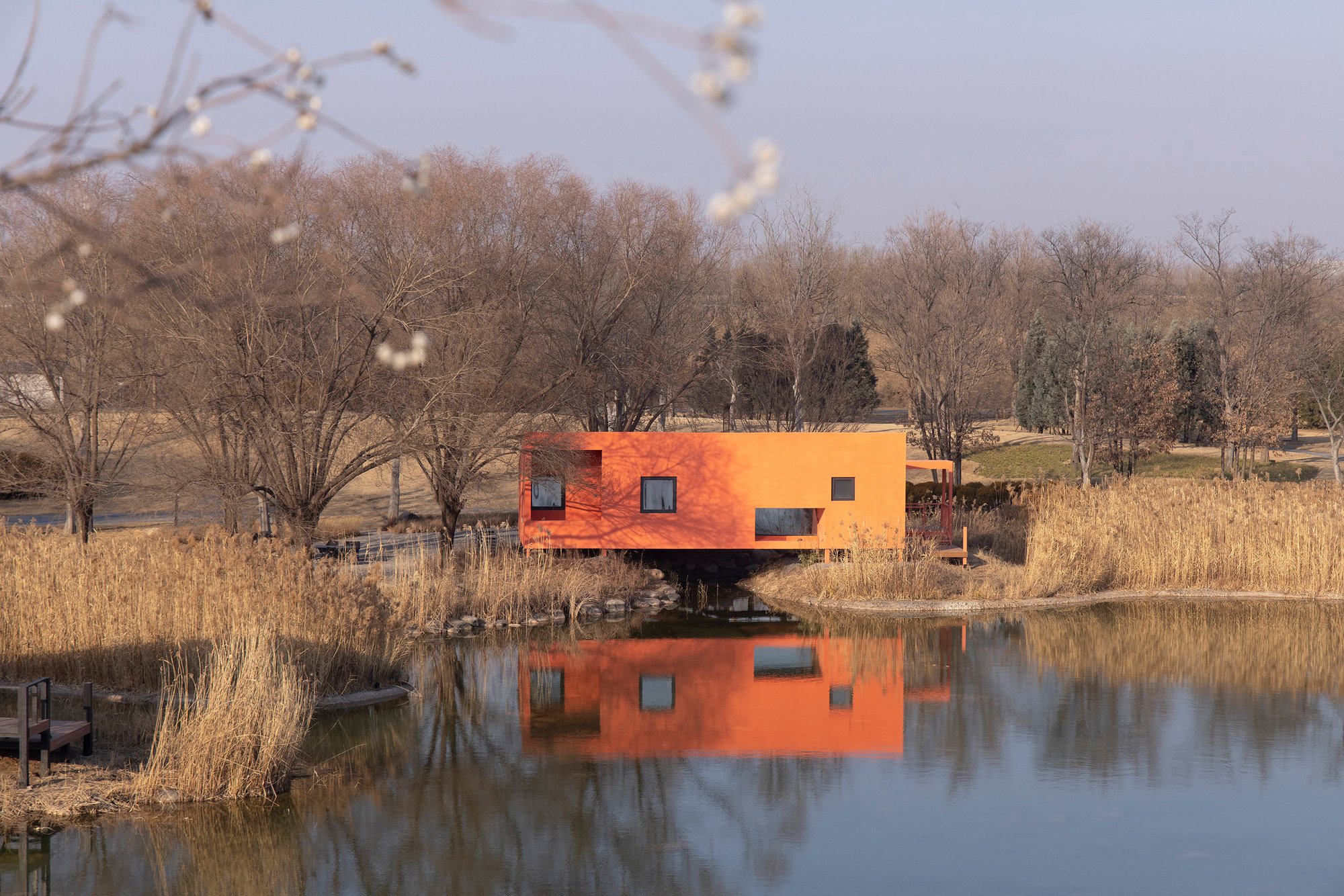
Wiki World and Advanced Architecture Lab Float a 79 m² Timber Cabin Over a Zhengzhou Pond
A fully prefabricated, disassemblable laminated timber cabin bridges land and island inside a historic cultural park in central China.

There is a particular species of small building that refuses to sit still conceptually. It is a cabin, but also a bridge. It is a gallery, but also a dock. At 79 square meters, the Red Bridge Cabin by Wiki World and Advanced Architecture Lab is smaller than most city apartments, yet it manages to compress more spatial ambiguity into its footprint than projects ten times its size. Elevated on stilts above a pond within Zhengzhou's Yuancheng Cultural Park, the cabin sits on a small island, connected to the mainland by a narrow bridge-like corridor that doubles as its entrance sequence. Nothing about the building's relationship to the ground is passive: it hovers, it reflects, it barely touches.
What makes the project genuinely interesting is its insistence on reversibility. Every laminated timber component was digitally modeled, custom-fabricated, and assembled on site with small metal connectors. The entire structure can be taken apart and reassembled elsewhere without scarring the terrain. On a nationally protected cultural heritage site built around the Yuanling Ancient City ruins, that restraint is not a design preference; it is an ethical position. The existing trees, bamboo, and pathways were left untouched. No new boundary walls, no artificial landscaping. The cabin arrived like a careful guest and could, in theory, leave without a trace.
A Box That Barely Lands
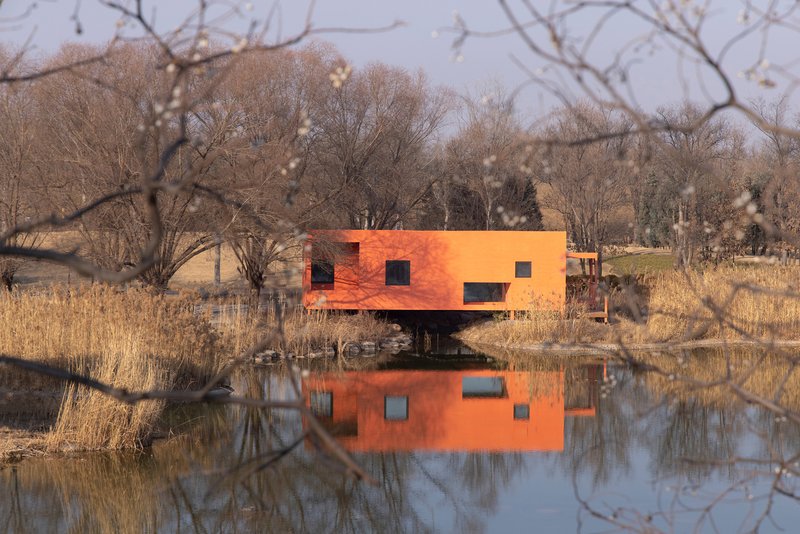
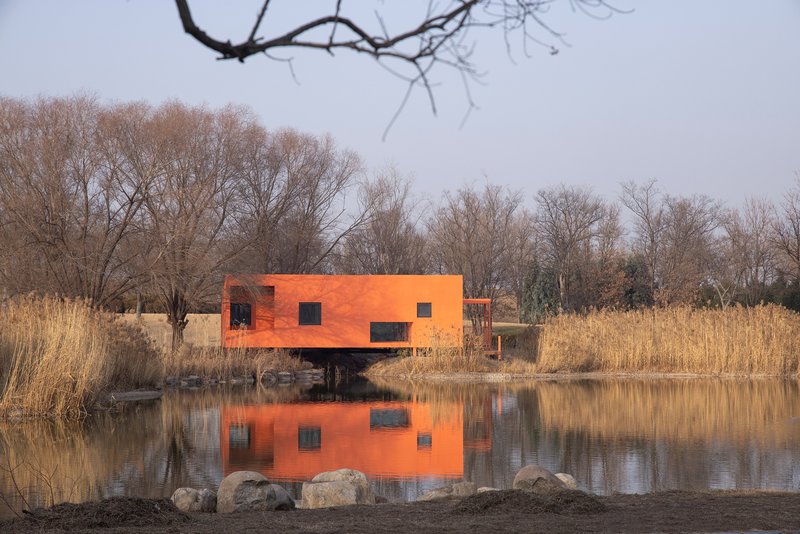
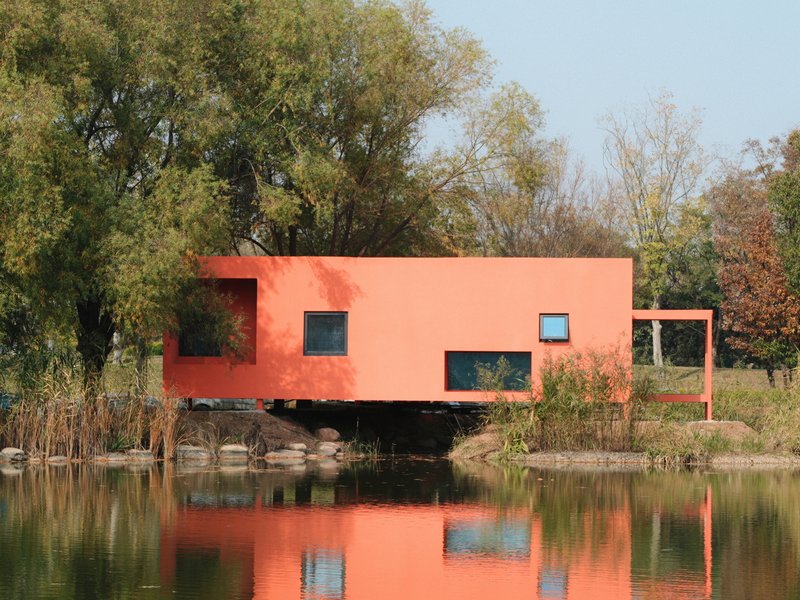
The cabin's most striking gesture is its relationship to the water. Raised on a single central pedestal and slender stilts, the orange-clad volume appears to levitate above the pond's surface. In still conditions the reflection doubles the building, producing a symmetry that makes the structure seem less like an object placed on a site and more like something that grew out of the water itself. The elevation strategy is practical as much as poetic: it minimizes the building's physical footprint on the island, protecting root systems and existing vegetation beneath.
From the shoreline, the cabin reads differently depending on your angle of approach. Head-on, it is a bold coral rectangle punched with square openings. From the side, it dissolves into a thinner profile of steel framing and glass. The architects clearly understood that a building this small on a body of water would be seen from every direction simultaneously, and they designed each elevation to hold its own.
Color as Material Strategy
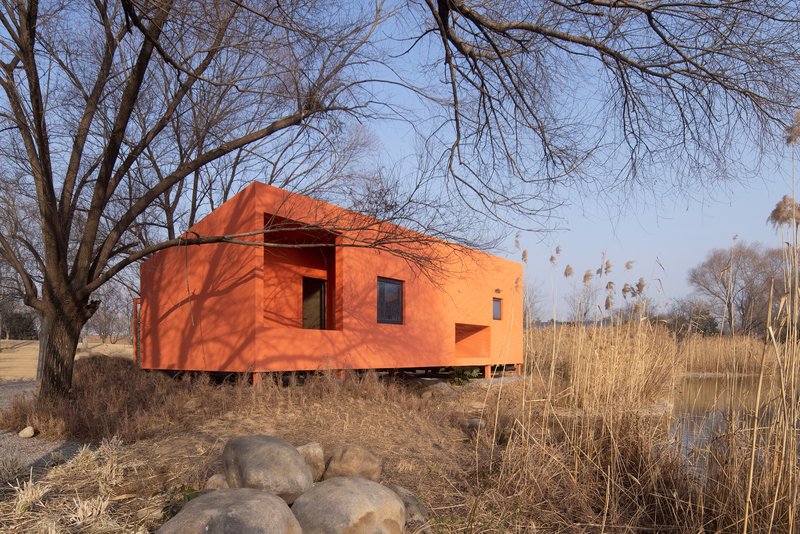
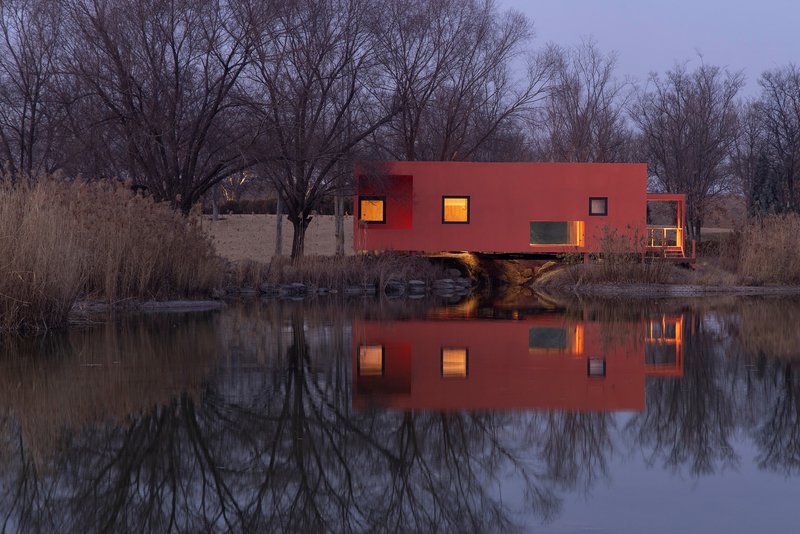
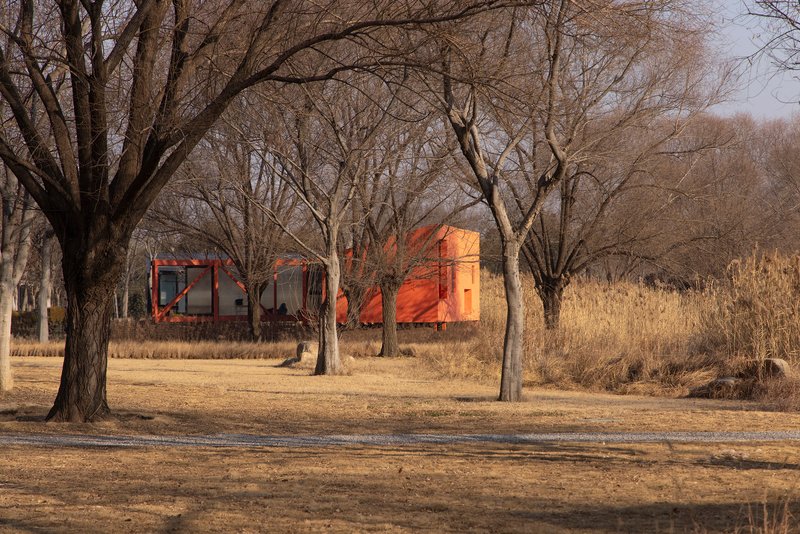
The red-orange cladding is not decorative. Against the muted palette of dormant winter reeds, bare deciduous trees, and grey pond water, the color turns the cabin into a landmark without relying on scale. It is a wayfinding device: you know exactly where you are in the park the moment you spot it. At dusk, when the illuminated square windows begin to glow against the deepening sky, the building shifts from a solid object into something closer to a lantern. The warmth of the color reinforces the cabin's identity as shelter, as hearth.
What keeps it from feeling garish is the restraint everywhere else. The steel framing is painted the same red-orange, unifying structure and skin into a single tonal field. The roof, the walls, the balcony railings: everything reads as one continuous surface. Against the complexity of the timber interior, this monochromatic exterior acts as a clean container, simple on the outside, spatially rich within.
The Bridge as Threshold
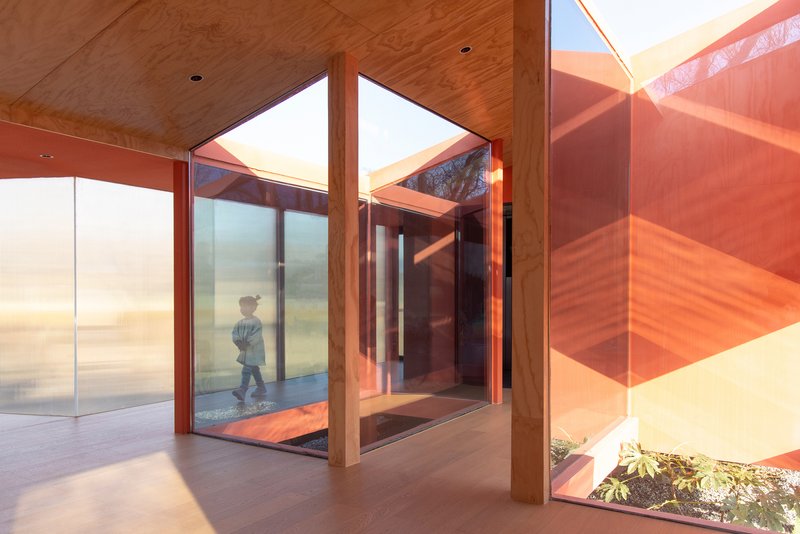
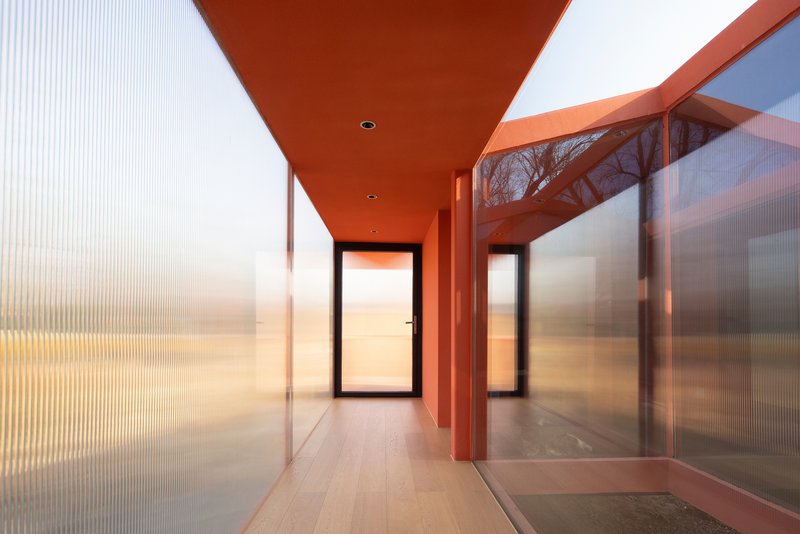
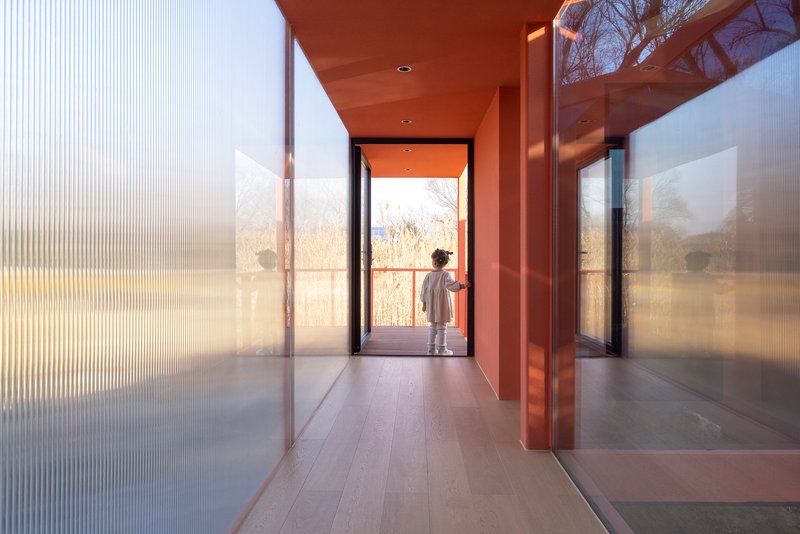
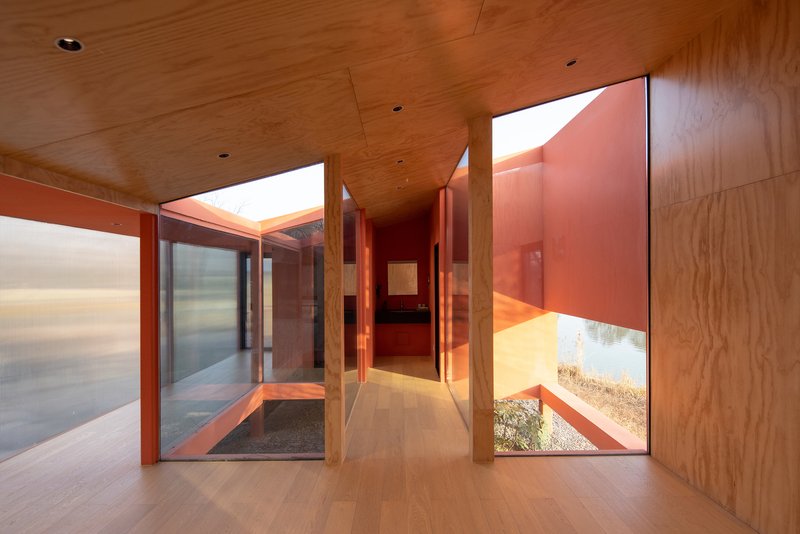
The narrow corridor that connects the mainland to the island cabin is the building's most loaded piece of architecture. Lined with ribbed polycarbonate walls and a warm timber ceiling, it compresses your field of vision and filters the landscape into soft, milky light. You cannot see clearly through the translucent walls, only sense movement, color, and the presence of water on either side. It is a decompression chamber: you enter it from the park's open landscape and arrive inside the cabin having already been spatially recalibrated.
The corridor also resolves a practical problem. On a protected heritage site, a conventional foundation and approach path would require excavation. By treating the entry as an elevated bridge, the architects kept the ground plane intact. The corridor touches down lightly, carries you across, and delivers you into the interior without disrupting a single reed.
Courtyards Cut Into 79 Square Meters
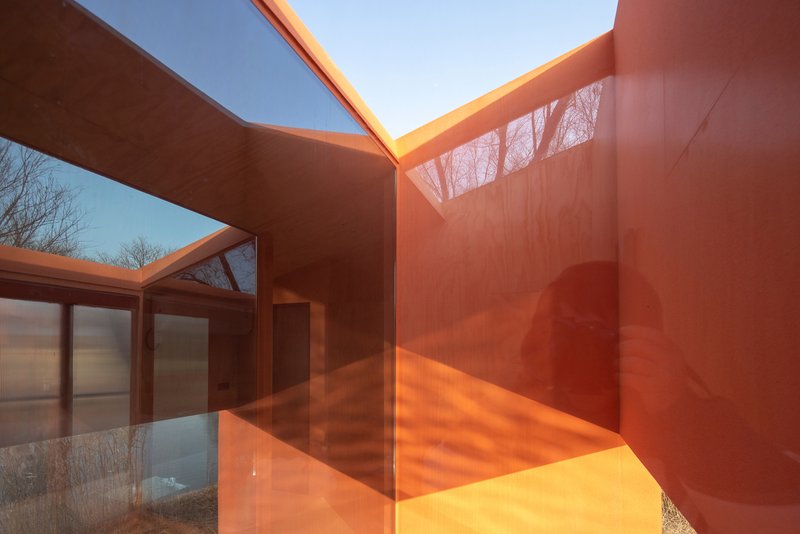
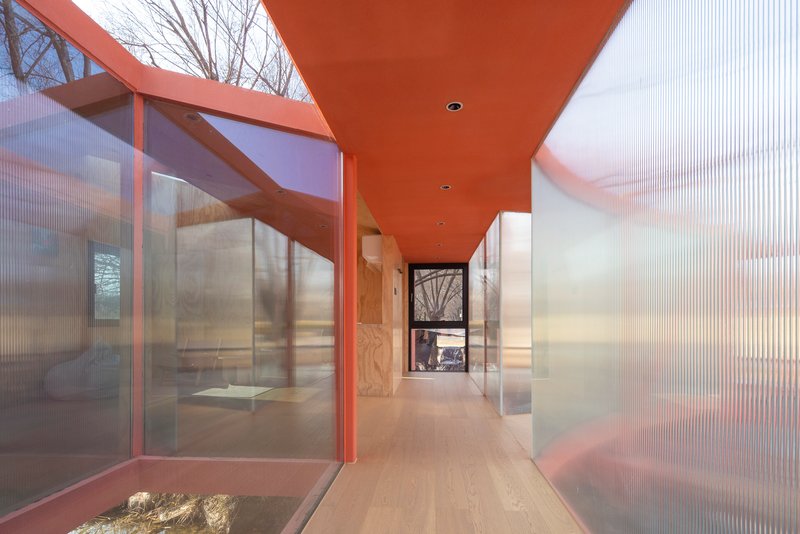
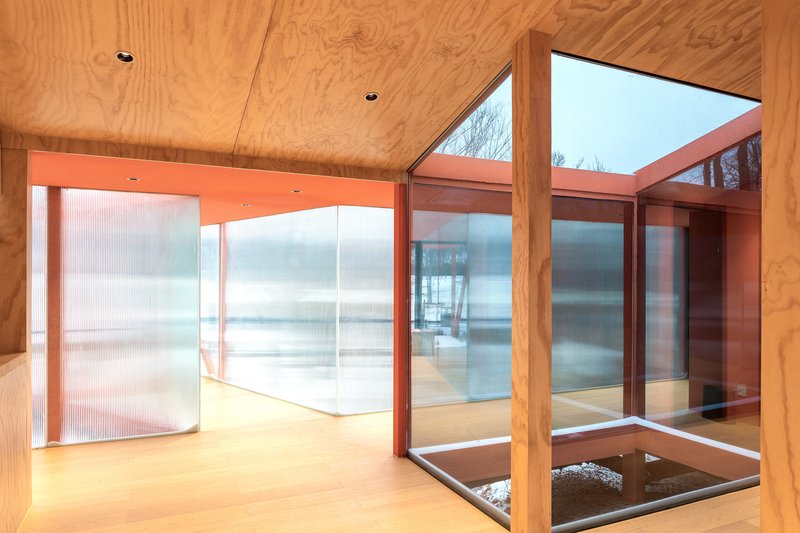
The most counterintuitive move in the project is the decision to carve two courtyards and a large skylight out of a building that is already tiny. In a 79 square meter cabin, every square meter given to void is a sacrifice. But the result justifies the trade-off completely. The courtyards bring daylight deep into the plan, create cross-ventilation paths, and establish a rhythm of compression and release that makes the interior feel far larger than its dimensions suggest.
Framed by red-painted steel walls and narrow rooflights, the courtyards function as vertical rooms open to the sky. They are not residual outdoor space; they are the building's primary spatial events. Plants occupy their floors, softening the geometry and connecting the interior back to the landscape it floats above. The translucent corrugated panels that line the adjacent corridors catch and scatter the courtyard light, filling interstitial spaces with a gentle, diffused glow.
Timber Interior, Warm and Precise
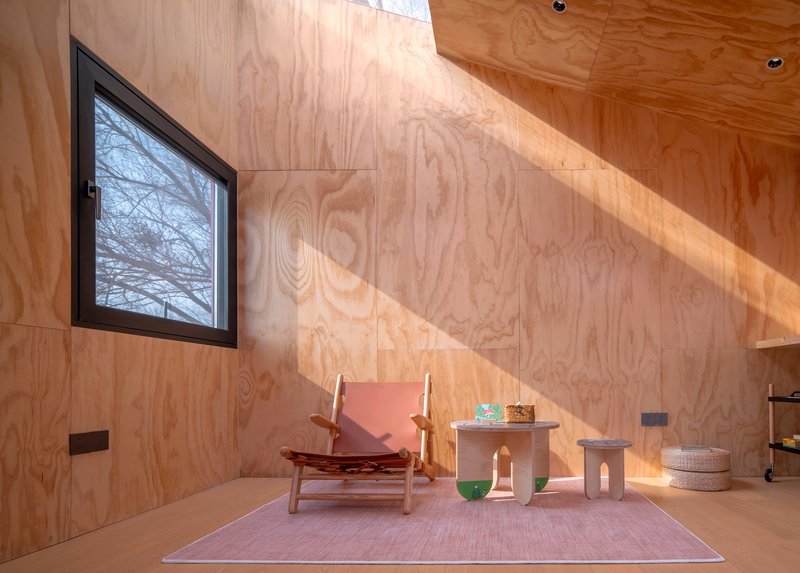
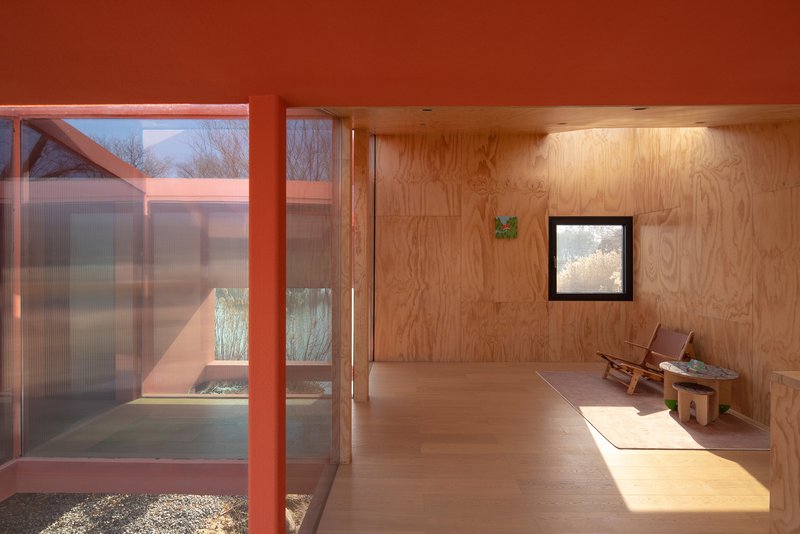
Step inside and the material world flips. The monochrome metal exterior gives way to plywood and laminated timber in every direction: walls, ceilings, sleeping nooks, floors. The warmth is immediate and enveloping. Angled ceilings follow the irregular roof geometry, creating intimate pockets of space, like the sleeping nook where a square window frames a single composition of bare winter branches. These are not large rooms; they are carefully tuned enclosures where every surface has been considered.
The precision of the timber joinery reflects the project's digital fabrication process. Every component, including the irregular geometries produced by the angled roof planes, was modeled and cut before arriving on site. The result is a fit and finish that belies the building's prefabricated assembly. There are no filler pieces, no awkward transitions. The interior reads as carved from a single block of wood, even though it was shipped in parts and bolted together.
Living at the Water's Edge
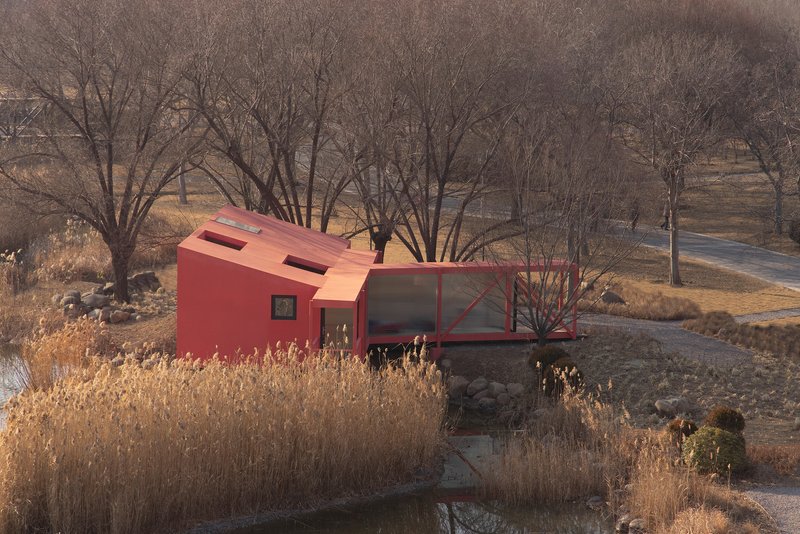
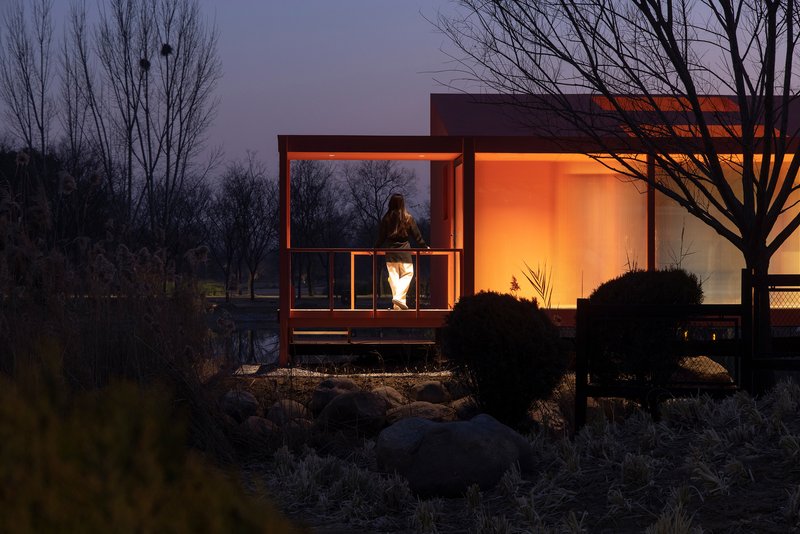
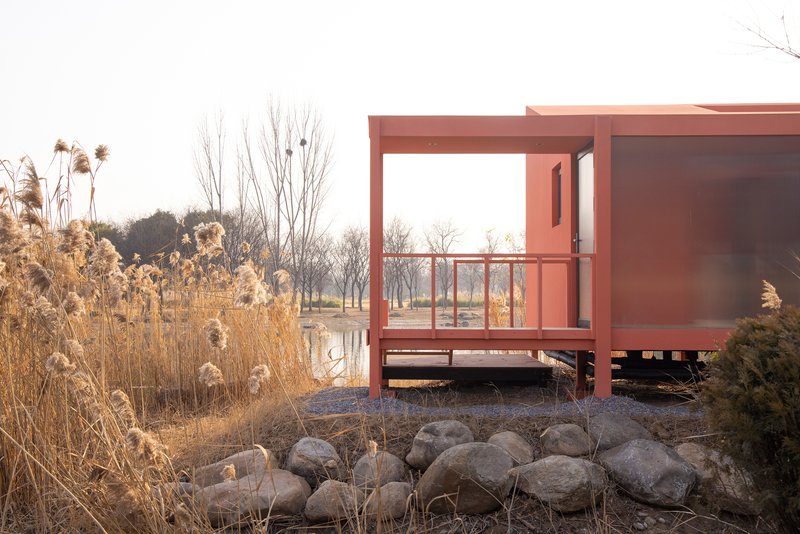
The cabin's terraces and glazed enclosures orient the inhabitant toward the pond with deliberate intensity. A curved-roof terrace overlooks the water's edge at dusk. A steel-framed balcony extends over dormant grasses. A glass-walled corner opens onto gravel and winter trees. Each threshold offers a different kind of looking: panoramic, intimate, filtered. The translucent screens that appear throughout the building are not about privacy so much as about controlling which views you get and when you get them.
At night, the dynamic reverses. The cabin becomes the thing being looked at. Warm interior light spills through the glass walls and steel framing, turning the building into a glowing object among the bare trees. The relationship between cabin and landscape is never static; it oscillates between watching and being watched, between shelter and spectacle.
Seasonal Shifts
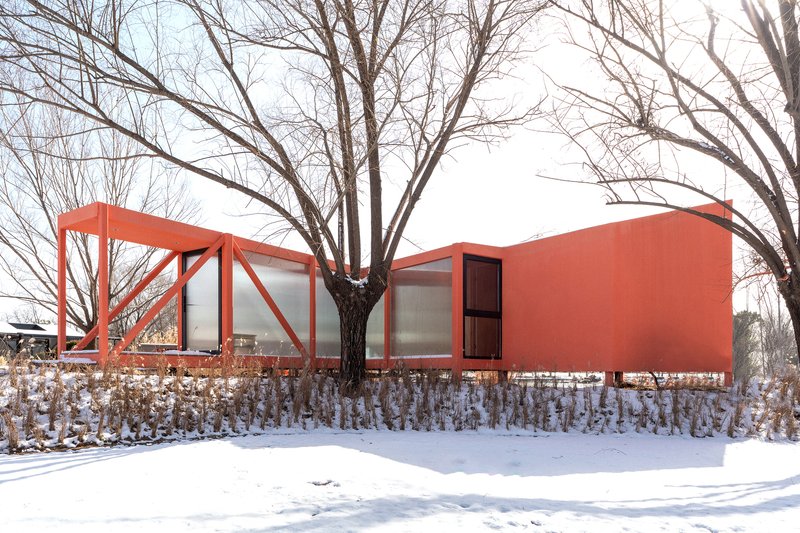
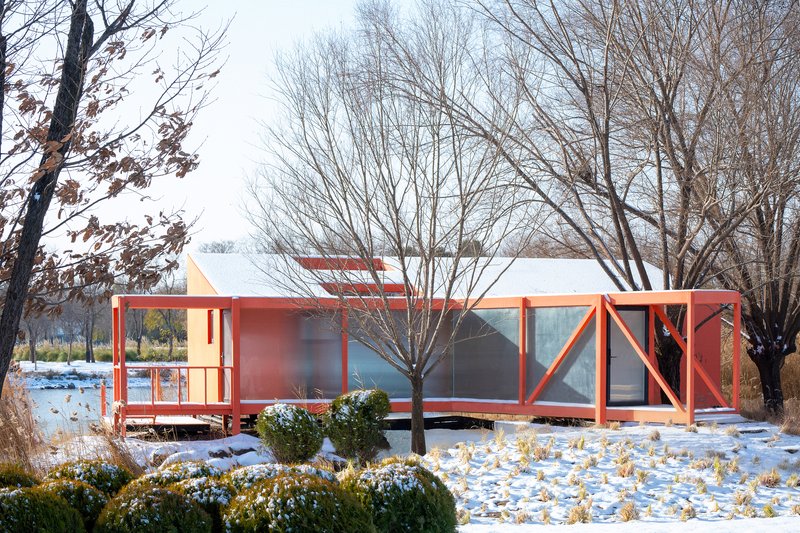
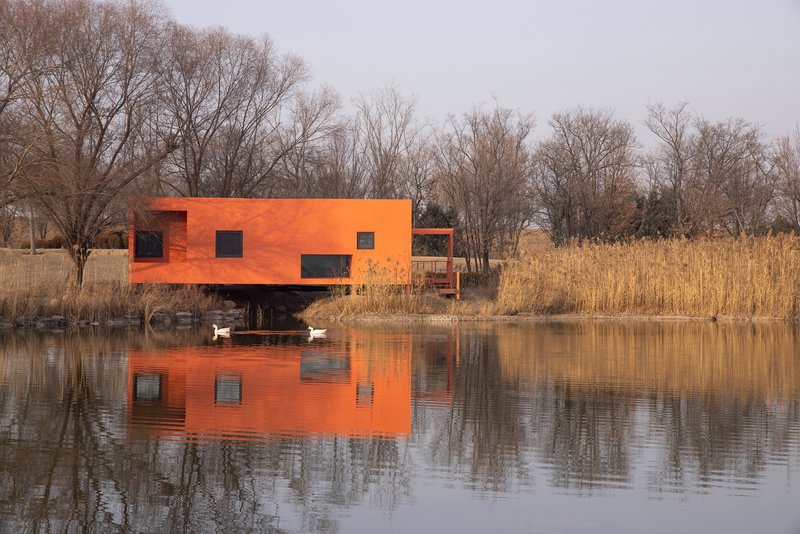
The photographs capture the cabin across winter conditions, from light snow to frozen reeds to geese paddling through cold water, and the building performs well in every frame. The coral volume reads most powerfully against snow-covered ground, where its warmth feels almost defiant. The steel-framed glazed enclosure, partially transparent and partially screened, takes on different qualities depending on the light: opaque and sheltering under overcast skies, luminous and open on clear days.
One imagines the building in summer, when the dormant grasses turn green and the bare trees fill with leaves, and the cabin would largely disappear into the foliage. That seasonal oscillation, visible in winter, hidden in summer, gives the project a temporal dimension that most small buildings never achieve. It is designed not just for a site but for a site's full calendar.
Plans and Drawings
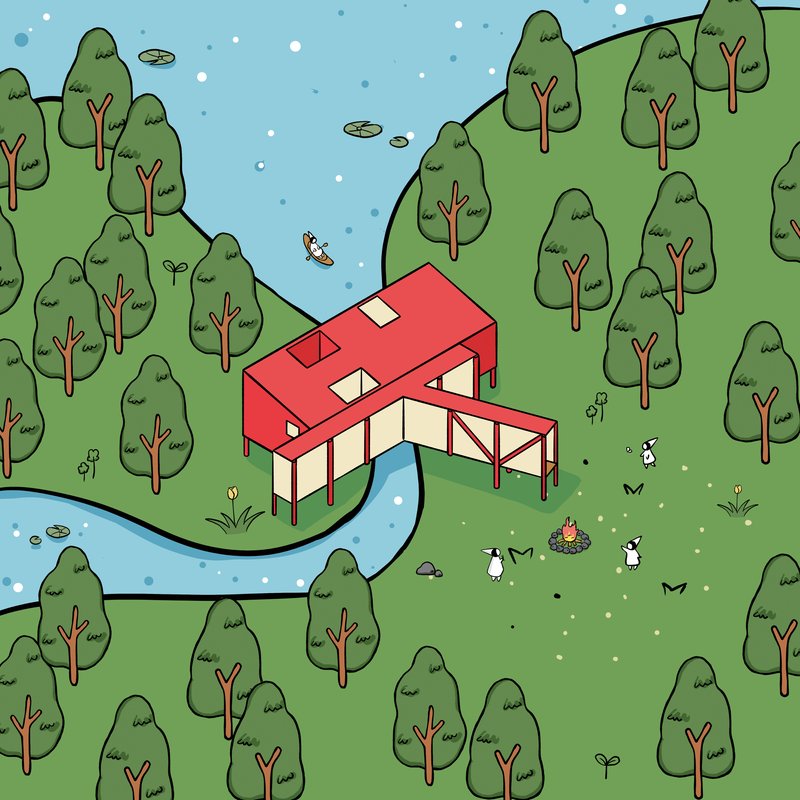
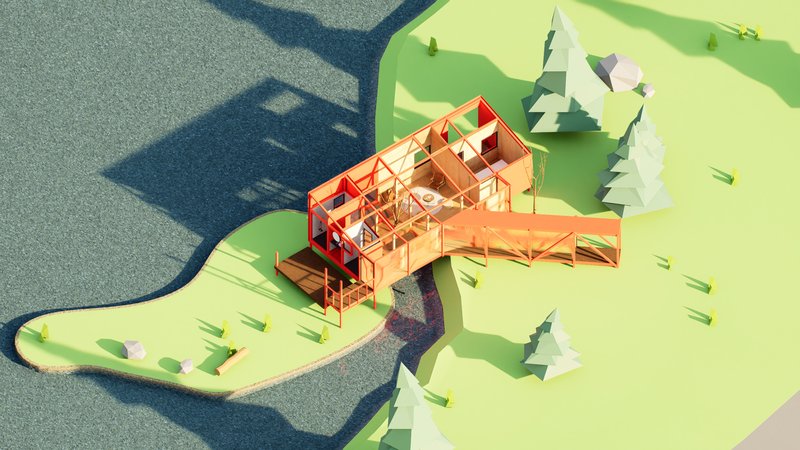
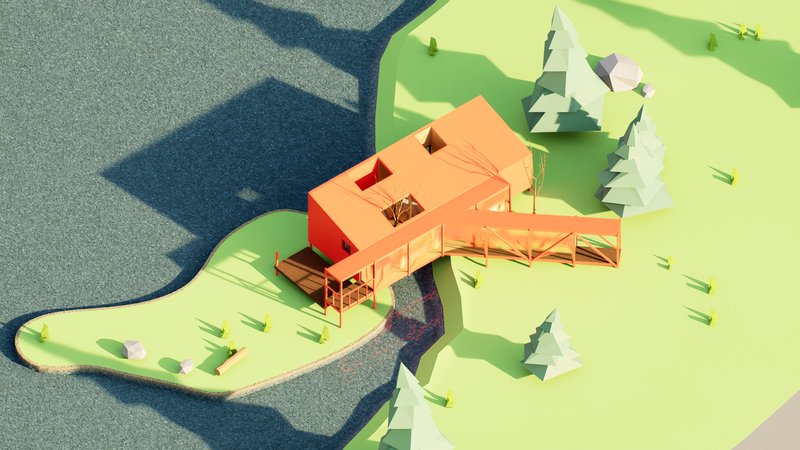
The axonometric drawing reveals what the photographs only hint at: the cabin's full relationship to the winding stream, the island, and the surrounding tree canopy. The structure sits at the intersection of water and land, its bridge-corridor reaching across the gap like an extended arm. The model views are equally telling. From above, the two courtyards read as clean rectangular cuts in the peachy orange roof plane, their proportions balanced against the solid mass surrounding them. The exposed timber framing visible in the aerial model shot confirms the structural logic: a laminated timber skeleton wrapped in metal cladding, with glass and polycarbonate filling the gaps between solid and void.
Why This Project Matters
The Red Bridge Cabin belongs to a growing body of work that asks what architecture owes to sensitive sites. On a nationally protected heritage landscape, the answer here is clear: touch lightly, leave no permanent mark, and make the temporary intervention worth the visit. The fully disassemblable construction system is not a gimmick; it is the logical conclusion of building on borrowed ground. Every joint, every connector, every digitally modeled timber member was designed with removal in mind. That discipline shapes the architecture itself, producing a building that is precise, legible, and honest about its own impermanence.
More broadly, the project demonstrates that 79 square meters is not a constraint so much as a provocation. By introducing courtyards, a skylight, a bridge corridor, and multiple terraces into a footprint most developers would fill with a single open-plan room, Wiki World and Advanced Architecture Lab prove that spatial richness has nothing to do with area. The cabin is part of their ongoing Wiki Building School initiative, which explores alternative approaches to small-scale living. If this is any indication, the initiative is producing buildings that punch well above their weight.
Red Bridge Cabin by Wiki World and Advanced Architecture Lab. Zhengzhou, China. 79 m², completed 2026. Photography by Arch-Exist.
About the Studio
Share Your Own Work on uni.xyz
If projects like this are the kind of work you want to make, uni.xyz is a place to publish your own, find collaborators, and enter design competitions.




Popular Articles
Popular articles from the community

RDTH architekti Rips Out Nearly Every Wall in a Prague Apartment and Replaces Them with Furniture
A 101-square-meter post-war flat in Prague trades rigid partitions for a single rotated furniture block, curtains, and glass concrete.

20 Most Popular Office Building Projects of 2025
From biophilic workspaces in India to net-positive energy offices in New Delhi, 20 office building projects that defined architecture in 2025.
Rojkind Arquitectos and Think Parametric Build a Glueless Pavilion from 67 Interlocking Panels
A serpentine fiber-cement installation in Chapultepec Park celebrates a decade of architectural media in Mexico City.
Fausto Terán and Toro Fuse Japanese Craft with Mexican Tradition in a Lakeside Retreat
Nakamura House pairs Shou-Sugi-Ban charred pine with handmade clay tile at the foot of Atlangatepec Lagoon in Mexico.


Similar Reads
You might also enjoy these articles

127af Flips a Tiny Bagnolet Rowhouse Upside Down with a Handcrafted Roof Extension
A 55-square-meter terraced house on the edge of Paris gains a luminous upper living floor through lightweight timber and steel.
1.61 Design Workshop Wraps a 600-Square-Meter Café in Vietnam in Sculptural Burgundy Drama
Reden Café & Bistro pairs a helical staircase, mosaic floors, and deep red interiors to rethink Vietnamese hospitality space.
The Unbound Brain: A School Shaped by Cognitive Architecture
Cylindrical learning pods radiate like neurons from a central cortex, turning the floor plan into a spatial model of human thought.
Revival Vernacular Architecture: Rammed Earth Settlements for the Sahara
A modular desert community in Mauritania that fuses passive cooling techniques with earthen construction and local craftsmanship.

Explore Residential Building Competitions
Discover active competitions in this discipline




The Global Benchmark for Architecture Dissertation Awards


The Global Benchmark for Graduation Excellence


Challenge to design an urban locus of culture and heritage


Challenge to design mud housing for contemporary communities
Comments (0)
Please login or sign up to add comments
No comments yet. Be the first to comment!