

WINDBREAK SHELTER
The design focuses on a structure that is easy to build and transport, and can be constructed using local and recycled materials. Created structure is temporary, mobile and resistant to climatic conditions.
LOCATION AND PROBLEMS
The target country of the proposed temporary shelter is Bangladesh, which has been struggling with migration and displacement problems for years. The current refugee camps are overcrowded, there is poverty and a high percentage of deaths. One of the largest camps in Bangladesh is Cox's Bazar, which provides shelter for about one million refugees of the Rohinga ethnic group fleeing Burma.
Moreover, Bangladesh's climate is not conducive to temporary settlers. Heavy rains and winds regularly hit the country, destroying buildings and depriving local people of their belongings.
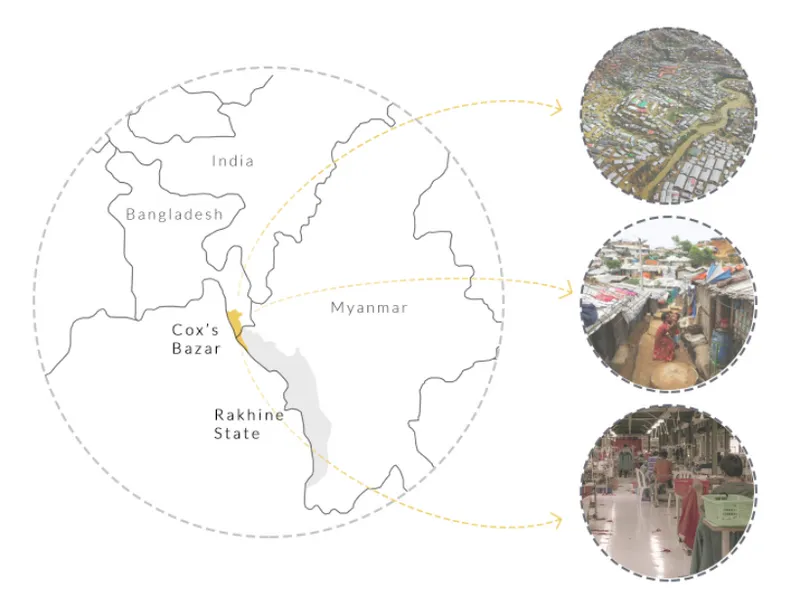
Fig. 1 – Location scheme.
INSPIRATION
The design was inspired by the functional solutions of residential buildings in the Myanmar and Bangladesh regions. Special attention was paid to ventilation and shading solutions. In addition, inspiration was drawn from houses built on water and ways of using it.
In construction, inspiration was drawn from local and traditional ways of building and connecting elements such as bamboo with ropes.
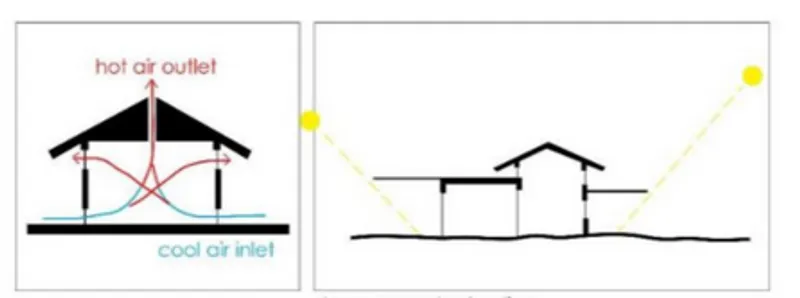
Fig. 2 – Schemes of inspiration.
PROJECT CONCEPT
The Windbreak shelter is designed as a temporary structure that can be set up in a short time and with little effort. Mobility and easy transport is an important consideration. An important aspect of the design is also the use of local materials such as bamboo and recycled materials such as membrane, tyres and leftover materials from Bangladeshi garment factories.
The shape and form of the building depend on the weather conditions and the relatively small space on which the shelter can be located. The rectangular projection allows for convenient use of space in the building, allows for modular combination of units and does not take up much space. In addition, the segmented nature of the walls makes it possible to create any size of object adapted to the needs and location.
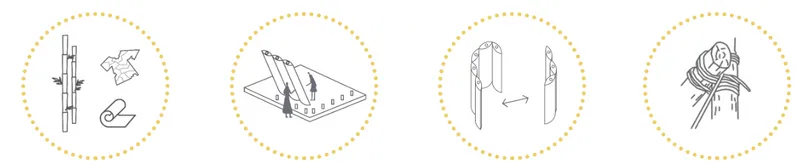
Fig. 3 – Idea schemes
CLIMATE RESISTANT
In a tropical climate, air circulation in buildings is very important. To ensure this, a monopitch roof with air inlets and outlets in the side walls was proposed.
An additionally attached mesh, at the top of the walls, made of cut-out plastic bottles speeds up the exchange of air by compressing the particles in the neck of the bottle, which causes them to move faster outside the building. Plastic bottles were also used for rainwater storage.
In order to ventilate the building properly, additional air inlets were located in the wall where the entrance is located. These were covered with a mesh material to protect the object from animal access.
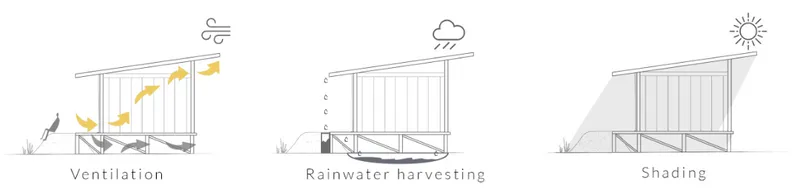
Fig. 4 – Climatic schemes.
MATERIALS AND CONSTRUCTION
The building was founded on piles anchored in the ground with tyres filled with mortar. The elevation of the building above ground level is also due to climatic conditions. Frequent and heavy monsoon rains wash away the buildings, creating flowing streams of dirty water and mud. The floor at +1.0m from ground level consists of rope-connected bamboo, which is then covered with plywood.
The wall and roof construction also consists of bamboo supporting elements connected by rope and covered by a waterproof tarpaulin. Additional stiffening and insulation is provided by a layer filling the space between the bamboo and the membrane - recycled materials from clothing factories. The membrane wall covering is connected by welding and allows the form to be shaped in any way desired. Two types of wall segments have been designed for the facility - opaque tarpaulin and translucent transparent foil, which act as lighting for the interior.
The construction of the entire premise ensures mobility, ease of space separation and does not take up much space during transport.
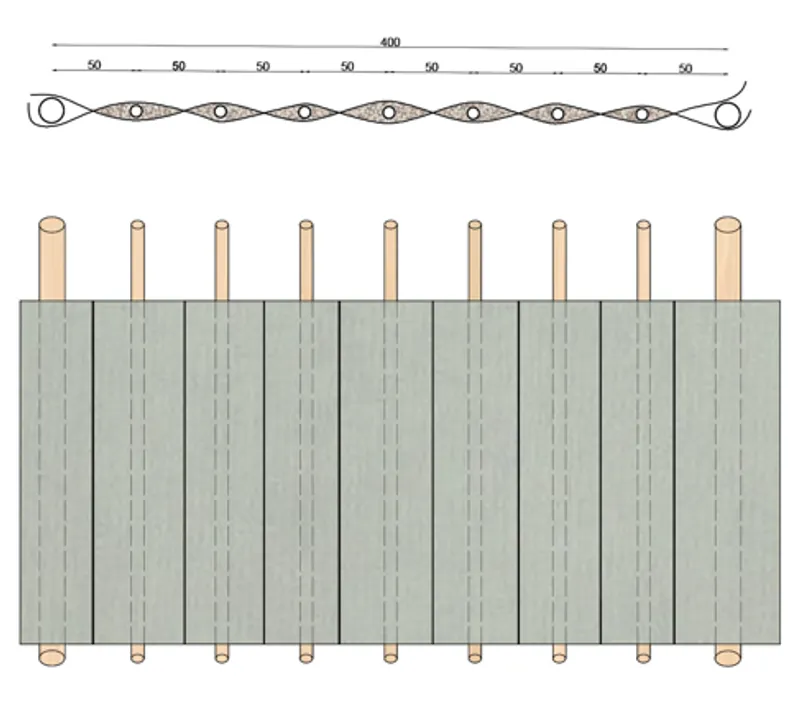
Fig. 5 – Scheme of walls and roof.
In order to test whether the idea of shaping the form of the walls and roof using segments composed of bamboo beams covered with a membrane is successful, a working mock-up was made, which is shown in the photo below.
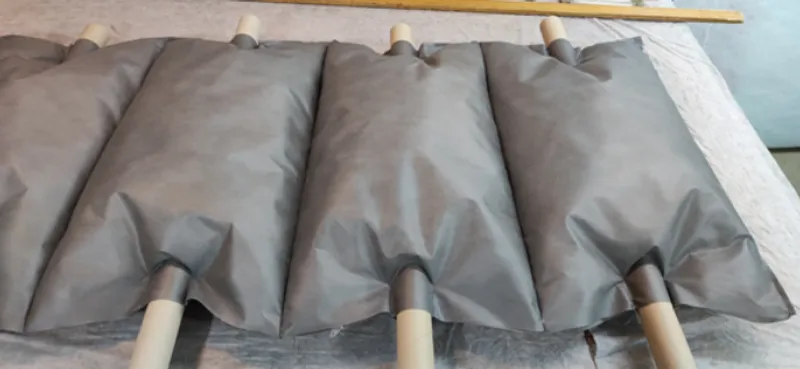
Fig. 6 – A sample model showing the idea of creating walls and a roof.
As a result, we were able to convince ourselves that the construction is stable and mobile.
SUMMARY
In summary, the design primarily focuses on a structure that is easy to build and transport, and can be constructed using local and recycled materials. Moreover, based on the competition guidelines and the difficult weather conditions of the study area, a structure was created that is temporary, mobile and resistant to climatic conditions.
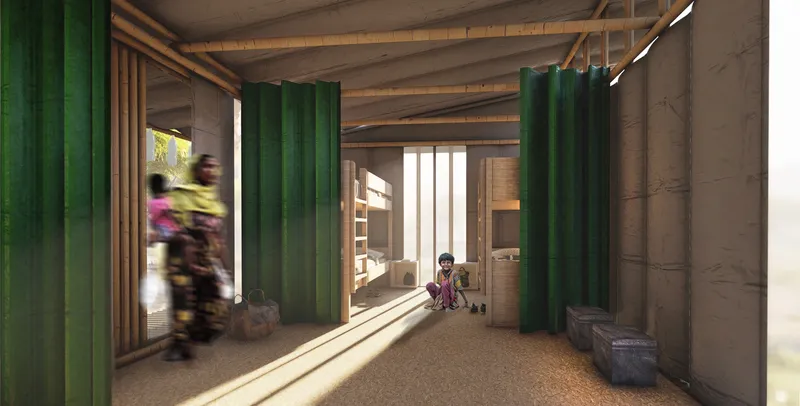
Fig. 7 – Interior visualization.

Popular Articles
Popular articles from the community

Cloaked Colonization: A Mobile Underwater Habitat That Moves Like a Fish
Micah Abaya's shortlisted EHC Pacific entry reimagines ocean settlement as a dispersed network of self-sustaining architectural organisms.

Singing Woman: An Opera House That Performs Before the Curtain Rises
Ovidiu Cristian Pavel's conceptual opera house translates Estonia's choral identity into a sculpted waterfront landmark facing the Baltic Sea.
Tsunami Convergenics: Turning Catastrophic Ocean Forces into Underwater Housing Infrastructure
A speculative underwater settlement off the coast of Onagawa, Japan, treats tsunamis and typhoons as energy sources rather than threats.
Faces of the Soviet Avant-Garde: Turning Moscow's Street Names into an Open-Air Museum
A network of sculptural installations across a Moscow residential district transforms forgotten architect names into spatial encounters with cultural memor

Similar Reads
You might also enjoy these articles

The Rhythm of Seasons
A Farmers' Market Connecting Nature and the City

More Than a Building-Designing a Living System
More Than a Building-Designing a Living System
Base Beyond
DESERT COMPOUND ARID: TOURISM OF ABSENCE AND ABUNDANCE

Explore Portable Shelter Competitions
Discover active competitions in this discipline


Challenge to reimagine the Iron Throne

Photograph architecture without architects

Illustrate the lost glory of Angkor Wat - Render Challenge

Design challenge to reuse E-waste
Comments (0)
Please login or sign up to add comments
No comments yet. Be the first to comment!