
WORKac and ESTUDIO Ignacio Urquiza Stack a Blue Concrete Community Hub on a Mexico City Corner
A slender three-story center in Lomas de Becerra wraps robotics labs, workshops, and a cyberschool around a single staircase carved in light.


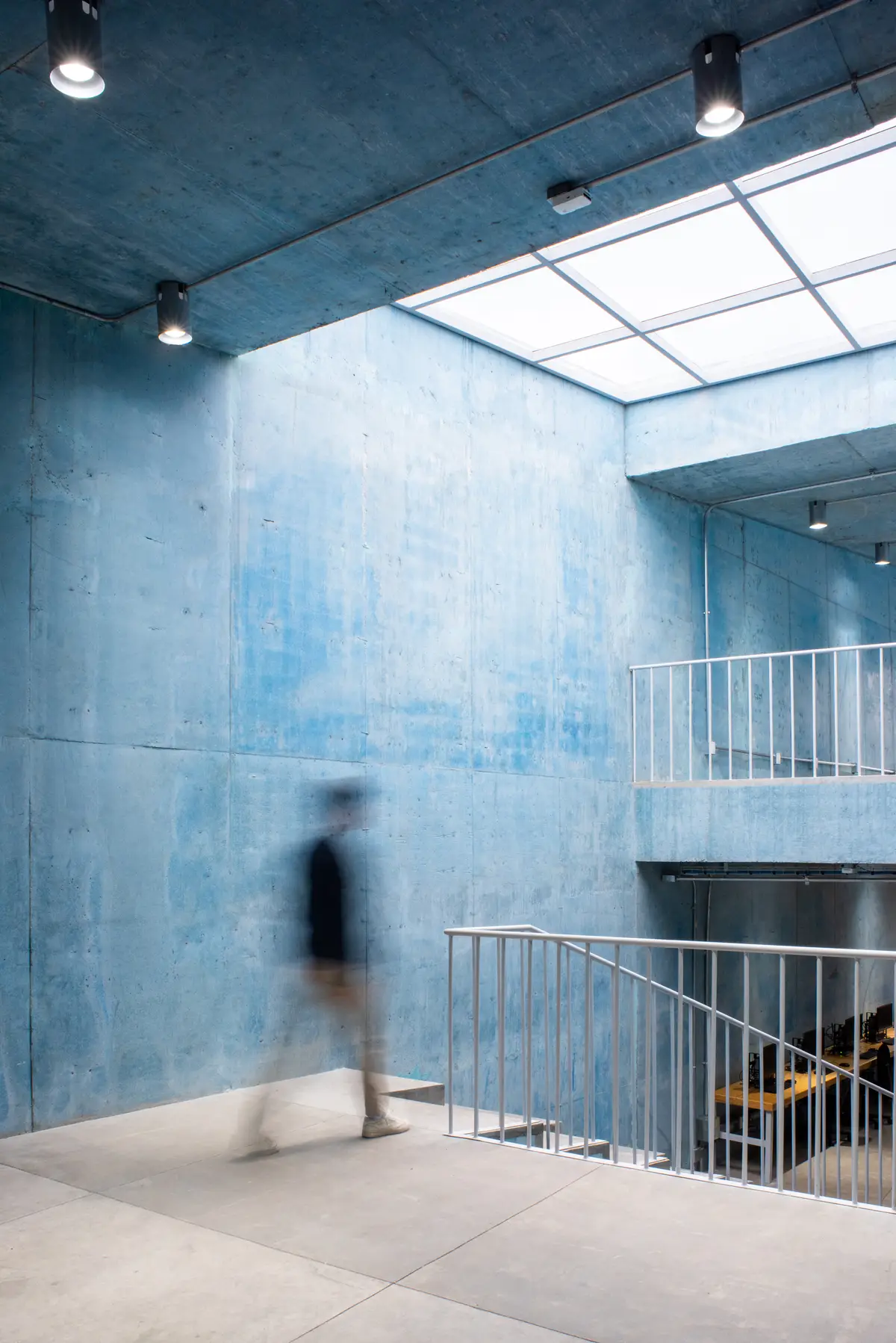
Community centers in underserved neighborhoods tend to fall into one of two traps: either they play it safe with a utilitarian box, or they parachute in a flashy form that bears no relationship to the street. The Pilares Lomas de Becerra Community Center, a collaboration between New York's WORKac and Mexico City's ESTUDIO Ignacio Urquiza Ana Paula de Alba, avoids both. Completed in 2022 in a hilly, densely packed corner of western Mexico City, the 470-square-meter building is compact, vertical, and saturated in a blue-tinted concrete that recalls the bold palette of its surrounding neighborhood while nodding to the chromatic legacy of Luis Barragán and Juan O'Gorman.
What makes the project genuinely interesting is its refusal to treat compactness as a limitation. The architects organized three floors into four interconnected platforms that spiral around a central staircase, turning the entire section into a single continuous social space. Ramps double as gathering areas. The ground floor glass facade swings open to merge interior and street. Diagonal cuts through the building mass create free-flowing pedestrian routes that connect the surrounding intersection in every direction. It is a building that earns its presence not through scale but through spatial generosity on a site that offers almost none.
A Blue Monolith at the Intersection
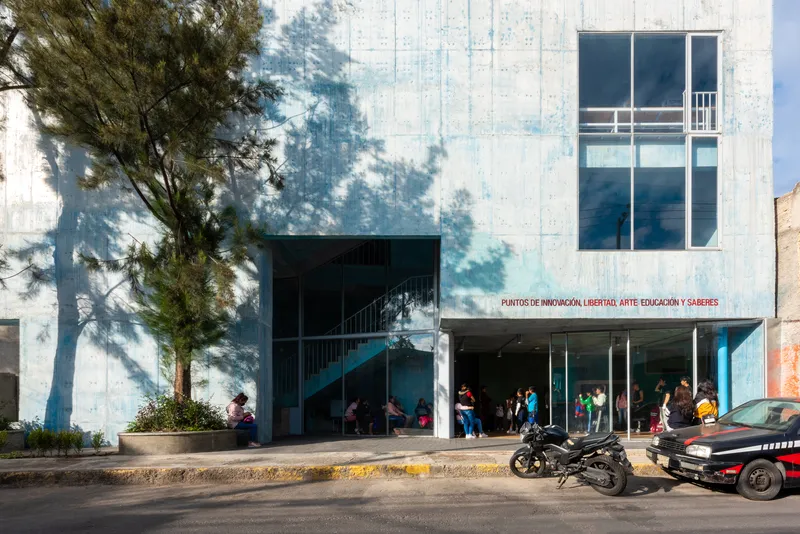


The building rises from a busy corner where mature trees, overhead power lines, and dense foot traffic set the terms. Rather than competing with that visual noise, the architects chose a single strong gesture: board-formed concrete washed in a deep blue that reads as confident without being confrontational. The formwork texture gives the surface a grain that catches afternoon light and accepts the dappled shadows of preserved trees, making the facade change character throughout the day.
At street level, the mass is pulled back and undercut. A glazed ground floor tucks beneath the heavier concrete volume above, creating a covered threshold that blurs the line between sidewalk and interior. Circular planters at the base preserve existing vegetation, a small move that signals the building was designed around the site rather than imposed on it.
Concrete Surface and Preserved Trees
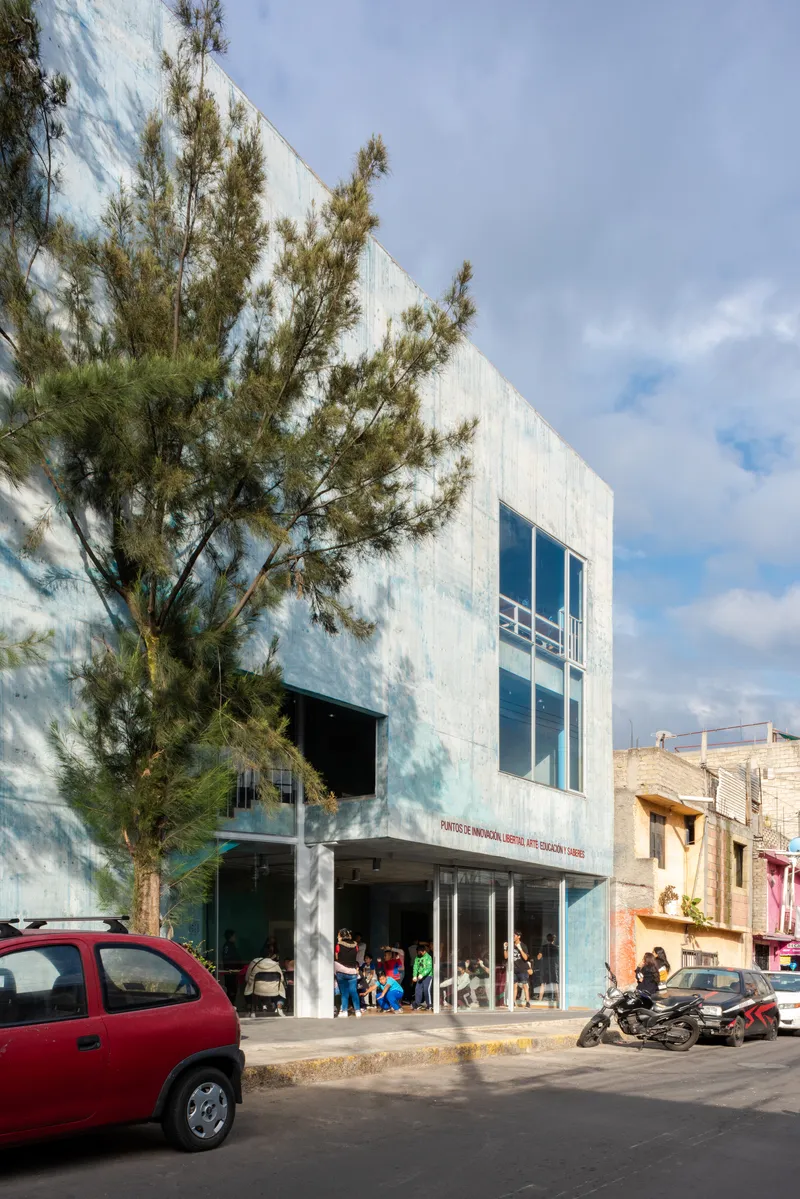

The relationship between building and tree is worth pausing on. Vertical slot openings in the facade are cut precisely beside existing trunks, framing them as compositional elements rather than afterthoughts. A pine tree throws dappled shadows across one full face of the building, its silhouette nearly functioning as ornament. The architects clearly mapped the canopy before settling the building's final geometry, and the result is a structure that feels as though it grew alongside its neighbors.
The Central Staircase as Social Engine
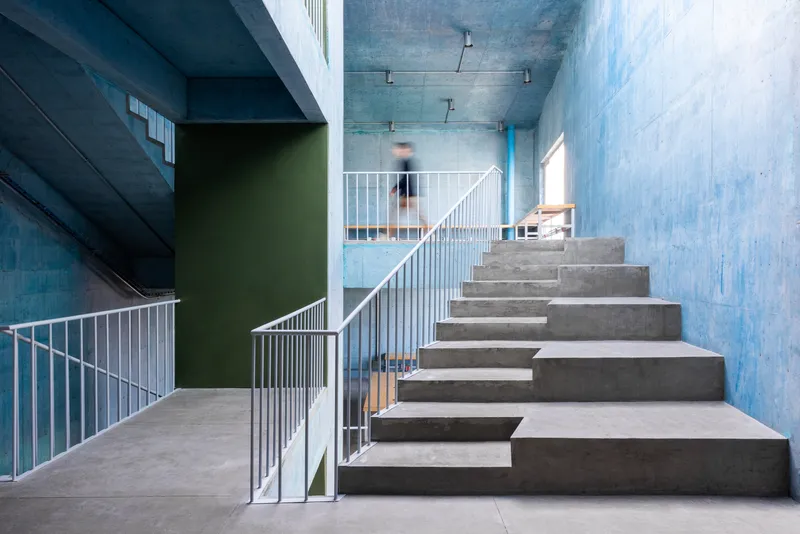


On a site this slender, you cannot afford to waste the staircase on mere circulation. Here the stair is the building's primary social space, a triple-height void that pulls natural light and ventilation through the section from a geometric skylight at the top. White metal railings contrast sharply with the blue concrete walls, keeping the vertical core legible and open even as it threads through multiple levels.
The stair also doubles as an auditorium at ground level, where it widens into a set of steps that can seat an audience for cultural events. That dual function is typical of the project's economy: every element earns its keep twice. Ramps connecting platforms serve as informal gathering areas. The polished concrete floors are left bare so they can accommodate robotics equipment one week and a screenprinting studio the next.
Light from Above, Views from Within
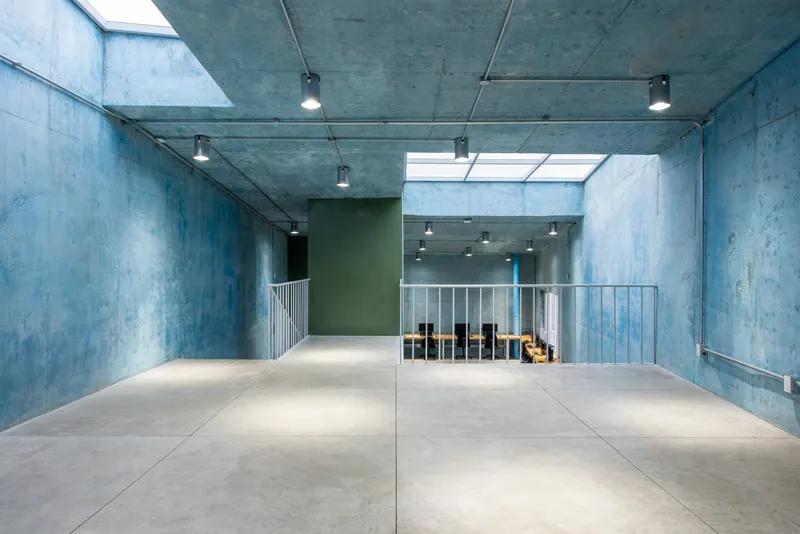


The skylight above the stair void is the building's primary lighting device, washing blue-tinted walls with natural light that shifts from warm to cool as the sun tracks overhead. Looking down through the void from the upper level, you can see computer workstations on the floor below, a reminder that the building's primary mission is education. Track lighting supplements daylight on upper floors, but the architects clearly designed the section to minimize dependence on artificial illumination.
Full-height glazing at stair landings frames street views through the concrete mass, giving users a constant visual connection to the neighborhood outside. These apertures are not decorative. They orient you within the building and within the city simultaneously, a useful trick in a structure where the compact footprint could easily feel disorienting.
Ground Floor Porosity
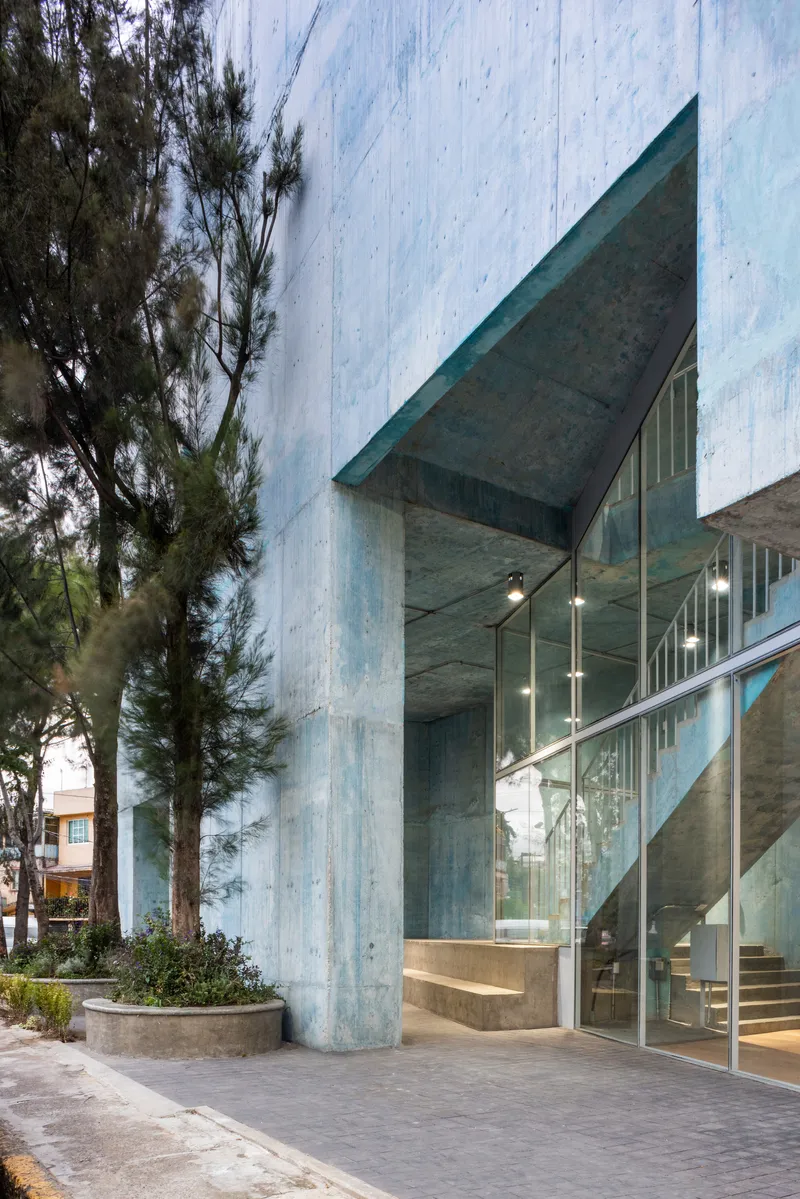
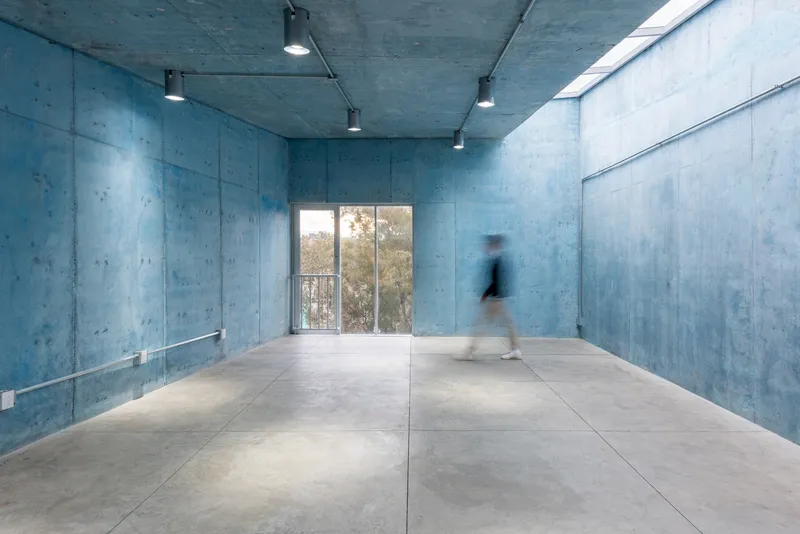
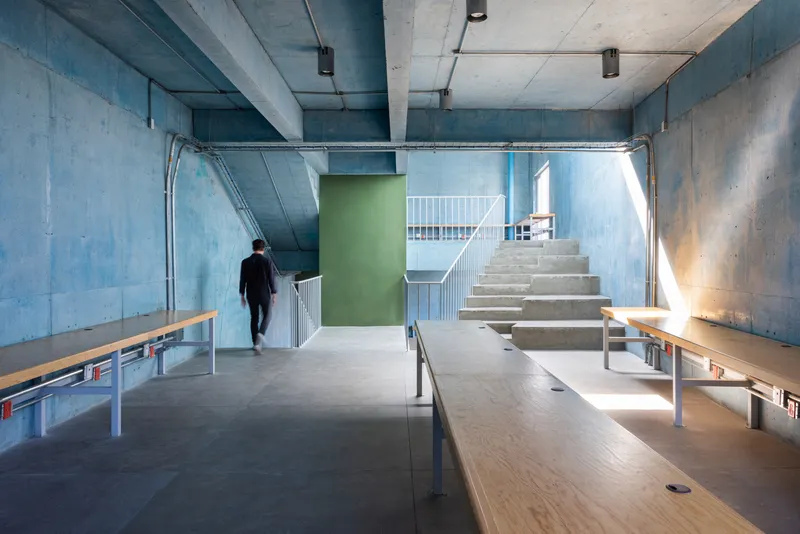
The ground floor is where the building's civic ambition is most legible. A glass-enclosed stairwell with pendant lights welcomes visitors into the central void, while diagonal walls at the plaza level serve as transitional curtains between exterior and interior. These angled surfaces direct pedestrian flow through the site, allowing people to cut through the building in multiple directions without ever feeling like they have entered a restricted space.
The glass facade can open outward, literally expanding the interior into the street. Timber benches line the stair edges, inviting people to sit and linger. A person walking toward the glazed opening sees trees framed in concrete, a carefully composed threshold that makes entering the building feel like stepping into a garden rather than an institution.
Workshop Spaces and Flexible Platforms

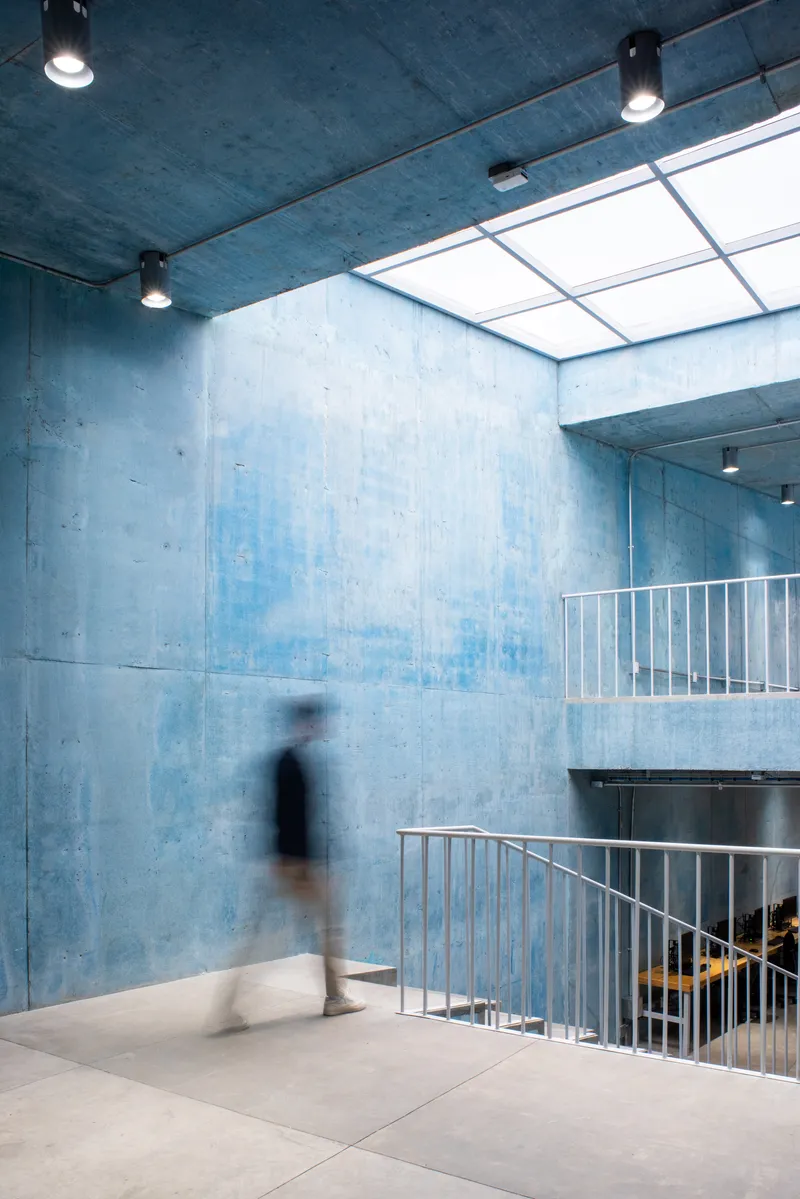
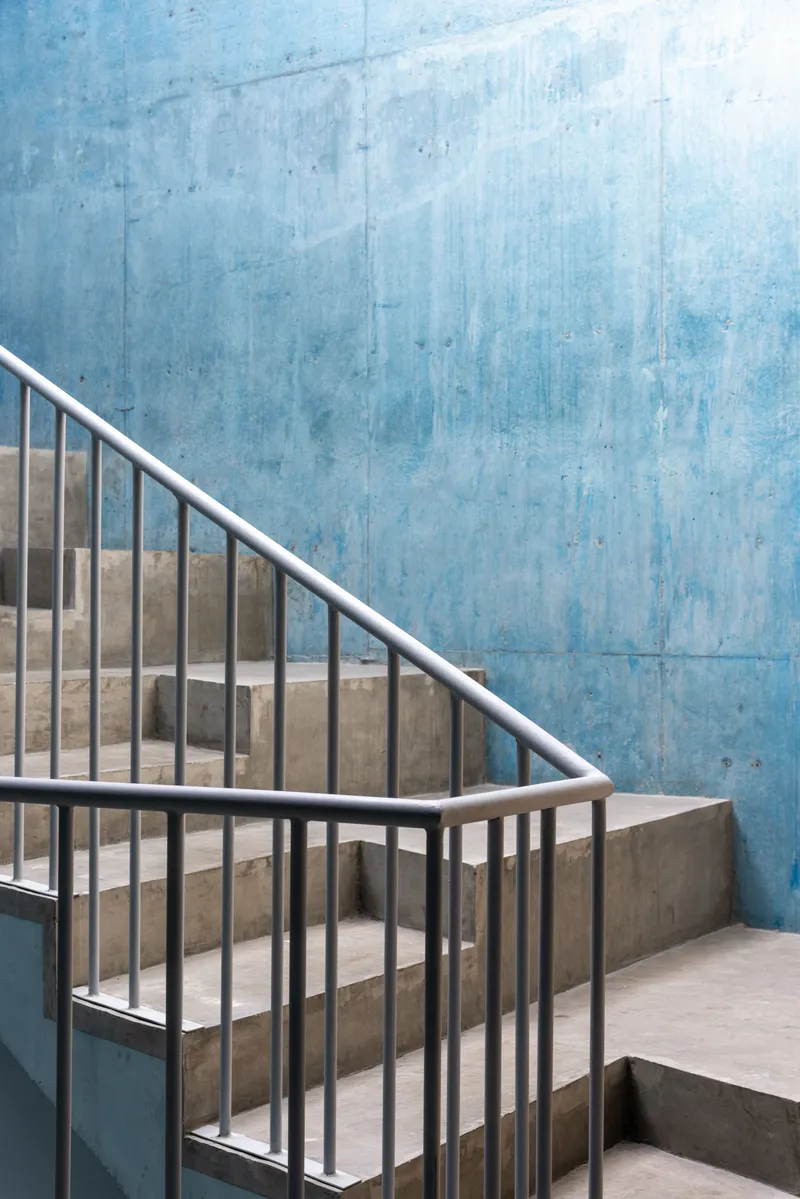
The upper platforms house the building's working programs: a cyberschool, a robotics lab, cookery and jewelry workshops, and an electricity studio. Plywood work tables and glass partitions keep things open and reconfigurable, while the interconnecting staircases ensure that no floor feels isolated from the rest. The architects describe the goal as complete flexibility, and the built result supports that. Walls are few, doors are fewer, and the concrete structure does most of the spatial defining.
The blue concrete interior has a particular quality that photographs only partially convey. The tint is subtle, closer to a cloudy dusk than to a saturated primary color, and it lends the interiors a quiet weight that frames activity without overwhelming it. The weathered texture of the formwork, visible in staircase corners and wall returns, adds a tactile roughness that resists the polished neutrality of most educational interiors.
Plans and Drawings


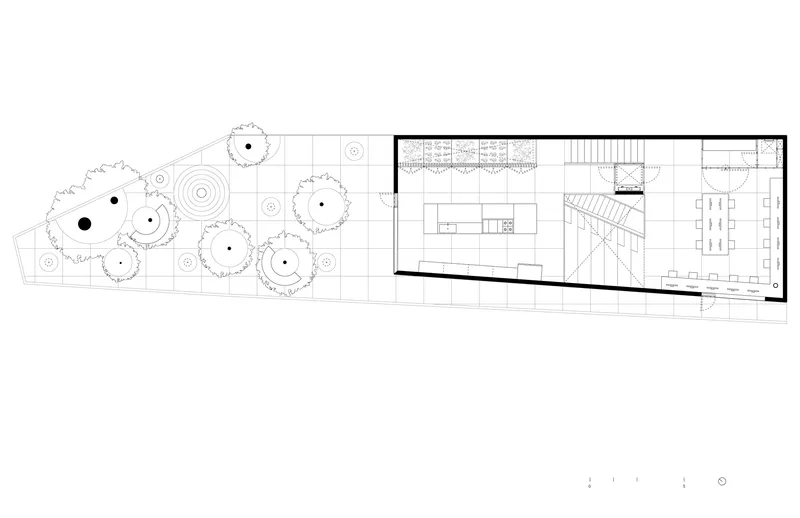
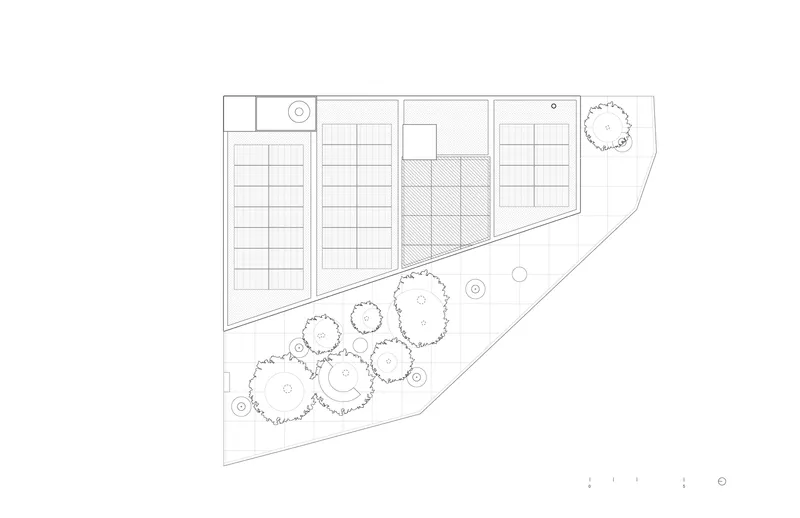

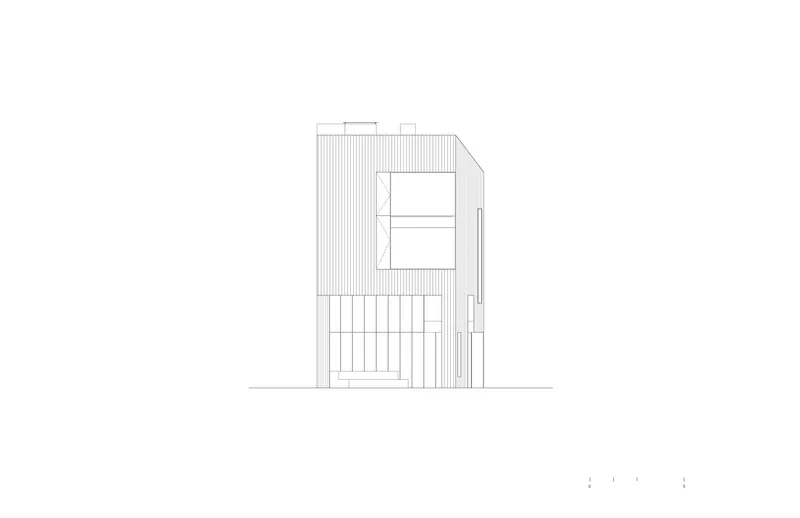


The floor plans reveal how the architects negotiated an angled, irregularly shaped site. The central staircase anchors every level, with workspaces and open areas fanning out asymmetrically to fill the available footprint. The ground floor plan shows diagonal cuts that align with pedestrian desire lines from the surrounding intersection, while upper floors consolidate into more regular platforms for programmed use. The sections are especially revealing: the triple-height stair void reads as a continuous shaft of light and air, with floor plates staggered at half-levels to maximize usable area within the compact envelope.
The elevations confirm the building's taut volumetric discipline. Asymmetric window openings are placed precisely where interior programs require light or views, not according to any decorative logic. The roof plan shows the relationship between the building footprint and the tree canopies it was designed to preserve, a negotiation that likely drove many early design decisions.
Study Models and the Design Logic

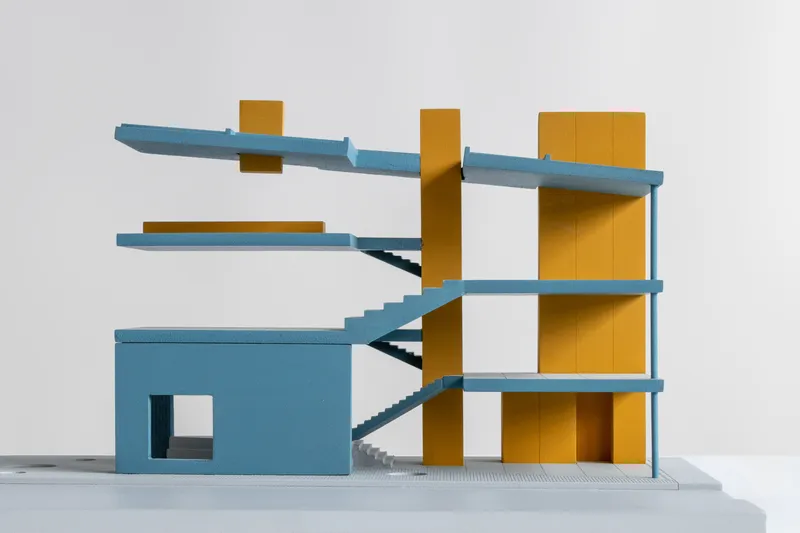
The physical models offer a revealing look at the design process. Blue corrugated cladding wraps the exterior of one massing model, with yellow volumetric elements punching through the facade to mark points of programmatic intensity. The sectional model makes the stacking strategy legible: interconnected floor plates with diagonal staircases threading through colored cores, a spatial diagram that translates directly into the built work's experience of continuous vertical flow.
Why This Project Matters
Mexico City's PILARES program, which funds community learning centers in areas of high vulnerability, has produced dozens of buildings. Most are competent. Few are genuinely spatial. Pilares Lomas de Becerra stands out because its architects treated the constraints of the program, the site, and the budget not as obstacles but as generators. The result is a building that packs a cyberschool, multiple workshops, and a public auditorium into less than 500 square meters, all organized around a single staircase that doubles as the building's primary social, environmental, and structural spine.
The collaboration between WORKac and ESTUDIO Ignacio Urquiza Ana Paula de Alba produced something that neither firm would likely have made alone. The formal ambition and sectional complexity recall WORKac's research-driven approach, while the chromatic boldness and material directness feel rooted in the Mexican practice's sensitivity to local context. That partnership is visible in the building itself, which manages to be simultaneously cerebral and warm, rigorous and welcoming. In a neighborhood that lacks civic infrastructure, that combination is not a luxury. It is the point.
Pilares Lomas de Becerra Community Center, designed by WORKac and ESTUDIO Ignacio Urquiza Ana Paula de Alba. Mexico City, Mexico. 470 square meters. Completed 2022. Photography by Arturo Arrieta Structural.
About the Studio
Share Your Own Work on uni.xyz
If projects like this are the kind of work you want to make, uni.xyz is a place to publish your own, find collaborators, and enter design competitions.


Popular Articles
Popular articles from the community


Cube Design Draws an Ecological Corridor Between Two Shenzhen Hills with the Nankai Building
Beside Shenzhen's container docks, the Nankai Building pairs stacked balconies with a climbing green screen to connect two hillsides across its height.

LT2A and OPEN Architectes Thread a Brick and Glass High School Through a Wooded Belgian Campus
In Braine-l'Alleud, a 3,000 m² wing for Collège Cardinal Mercier pairs pale brick with a glazed colonnade, deferring to a small chapel and a dense wood.

David Ortega Stacks a Two-Story Mexico City Penthouse Around a Steel Stair and a Pergola-Shaded Roof Terrace
In Colonia Roma, a 300 m² penthouse uses oak joinery, a planted steel stair and a slatted roof pergola to make a new-build apartment feel like a house.

David Macias Steps a Doorless Stone and Plaster House Down a Tropical Colombian Hillside
In the humid hills of Colombia, Threshold House replaces the front door with an open void and terraces its 850 m² down the slope instead of fighting it.

Similar Reads
You might also enjoy these articles


LAVA Architecten Gives Vocational Education a Sawtooth-Roofed Face on a Mechelen School Campus
In Mechelen, Belgium, a 2,053 m² STEM school on a 6×6 m grid turns workshops and classrooms into rooms that can be rearranged as teaching changes.

KEMA Studio Turns a Derelict Marvila Attic into a 60 m² Lighthouse Apartment Above Lisbon
In Lisbon's Marvila district, a rebuilt roof, four skylights and two plywood volumes turn an unlivable attic into a bright home facing the Tagus.

Pixel Gardens: One Repeated Module Stacked Into a Terraced Social Housing Tower for Famagusta
Salem Bader's shortlisted housing tower builds a vertical neighbourhood from one repeated module, offsetting units to carve terraces, light and air.

Bao Huynh Watercolor Atelier: A Serene Art Retreat in Hội An
Bao Huynh Watercolor Atelier in Hội An blends multifunctional art spaces, sustainable design, local materials, and family-friendly living in a serene environment.

Explore Community Center Competitions
Discover active competitions in this discipline

Challenge to design locus for the upliftment of human rights

Challenge to reimagine the Iron Throne

Photograph architecture without architects

Illustrate the lost glory of Angkor Wat - Render Challenge
Comments (0)
Please login or sign up to add comments
No comments yet. Be the first to comment!