

WORMHOLE – The Swampgate: A Bunker for Ecological Survival in Birmingham's Wetlands
An underground seed vault and water purification lab, buried beneath the wetlands east of the River Tame, reframes doomsday architecture as ecological hope


What if the entrance to a better future looked like a descent into the earth? WORMHOLE – The Swampgate takes the architectural trope of the bunker, a symbol of civilizational collapse, and recasts it as a space of ecological learning and regeneration. Located in the wetlands east of the River Tame near Birmingham, the project operates on a provocative dual register: visitors can walk above ground through permaculture gardens and light installations, or plunge underground into a seed vault and water purification laboratory that confronts them with humanity's environmental failures. The result is less a visitor center and more a spatial argument about survival.
Designed by Anja Nedeljkovic and selected as an Editor's Choice entry for the Wetland Interpretation Center (WIC) competition, the project draws explicit parallels to the Svalbard Seed Vault and the UK's 2010 Seed Cathedral Pavilion. Its ambition is broad: a speculative prototype for climate-resilient architecture that treats wetlands not as marginal landscapes but as essential infrastructure for filtering water, supporting biodiversity, and regulating climate at a planetary scale.
A Ribbed Tunnel as Threshold Between Dystopia and Possibility
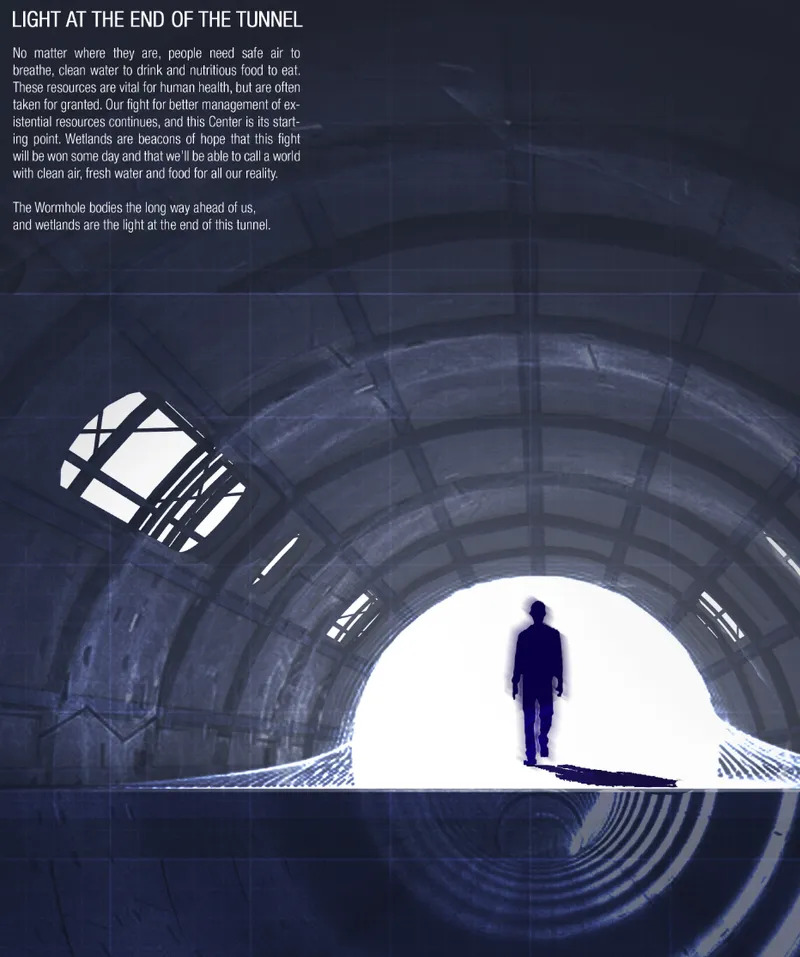
The interior of the "wormhole" itself is the project's most arresting spatial proposition. A circular tunnel with pronounced ribbed walls draws a solitary figure toward a luminous exit, collapsing the distance between the familiar and the unfamiliar. The form is described as bridging ecological time and space, a metaphorical passage that channels visitors from one state of awareness to another. The ribbing is structural but also deeply atmospheric, evoking the cross-section of a seed pod or the gut of some vast organism. It is architecture performing its narrative role without signage or explanation.
Multilevel Labs and Natural Water Filtration Below the Wetland Surface
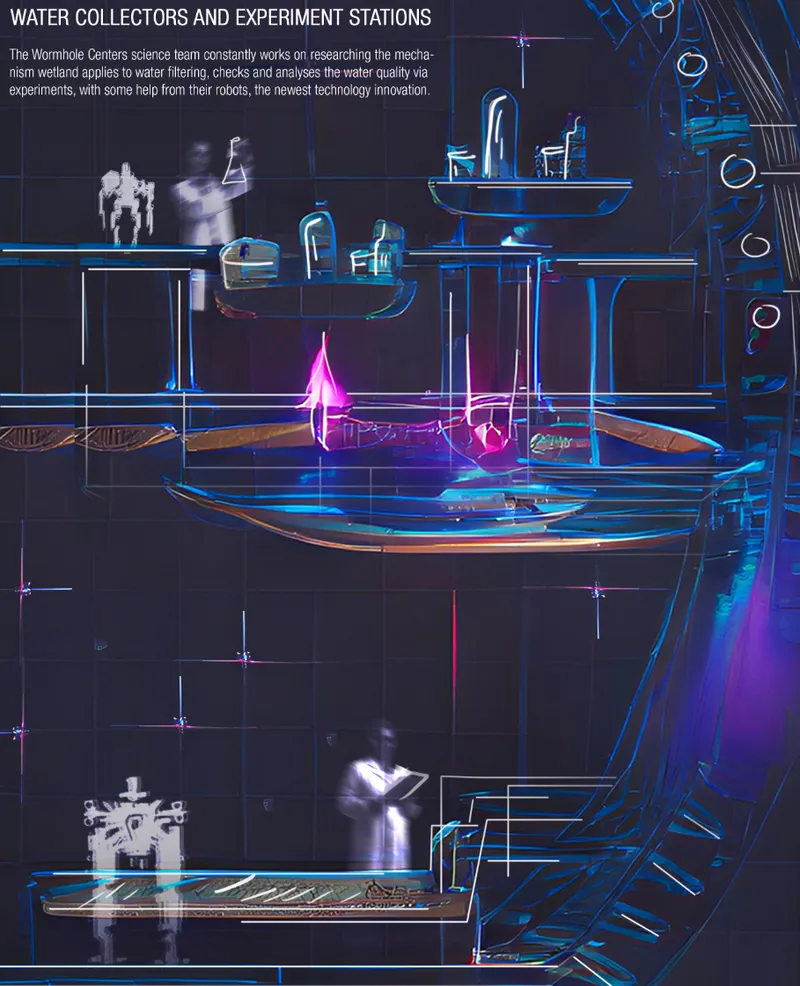
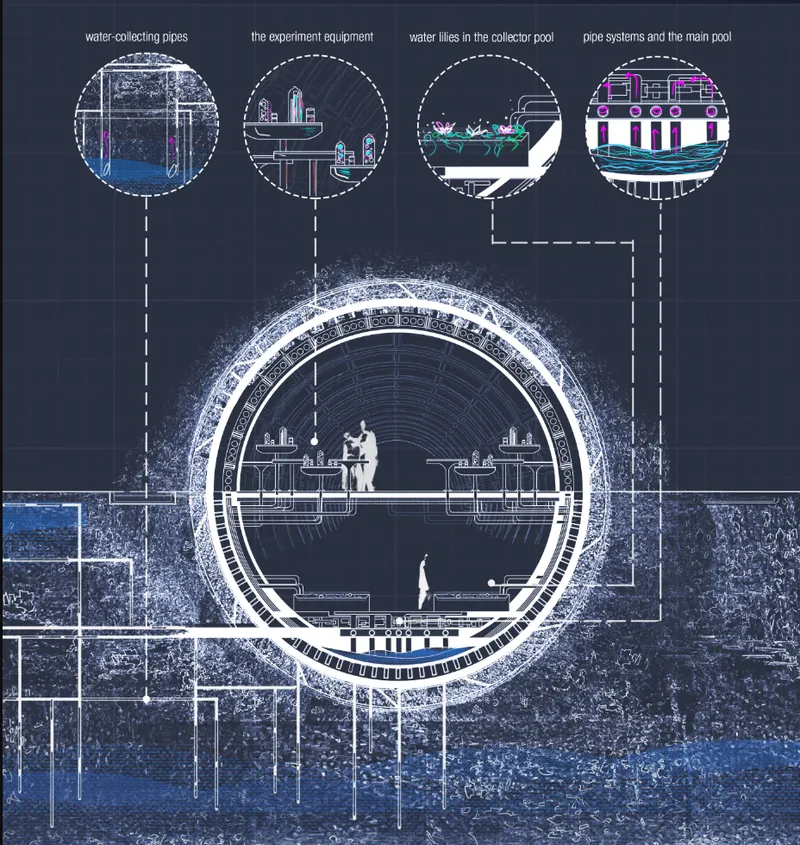
The sectional drawings reveal the true complexity of the underground programme. Multilevel laboratory platforms are stacked within the subterranean chambers, equipped with water collection systems that exploit natural wetland sedimentation and filtration methods. Blue accent lighting reinforces the aquatic character of these spaces, making the presence of water feel constant and immersive. The circular tunnel facility appears in cross-section with labeled callouts detailing water systems and mechanical equipment, showing how the building is less a container and more a machine for processing the landscape's own hydrology.
This is where the doomsday architecture framing becomes genuinely productive. The underground level (Level -1) doesn't merely symbolize collapse; it houses functional infrastructure for water purification, seed banking, and climate adaptation research. The design insists that confronting worst-case scenarios is not nihilism but preparation.
Education Chambers and Research Workstations Carved into the Earth
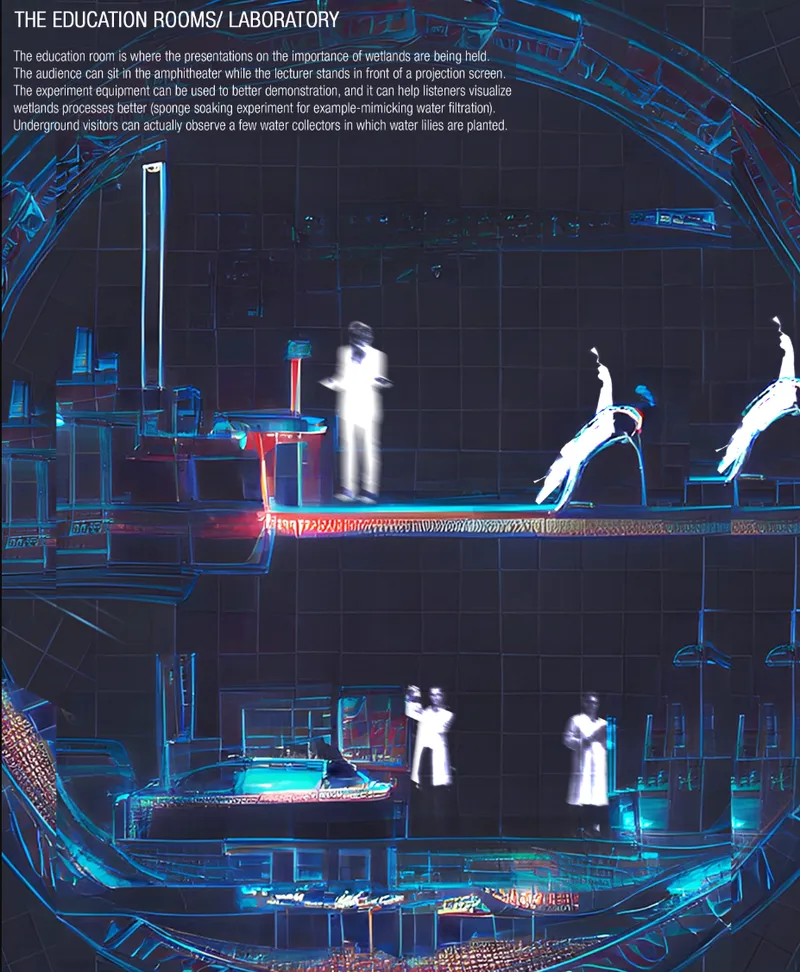
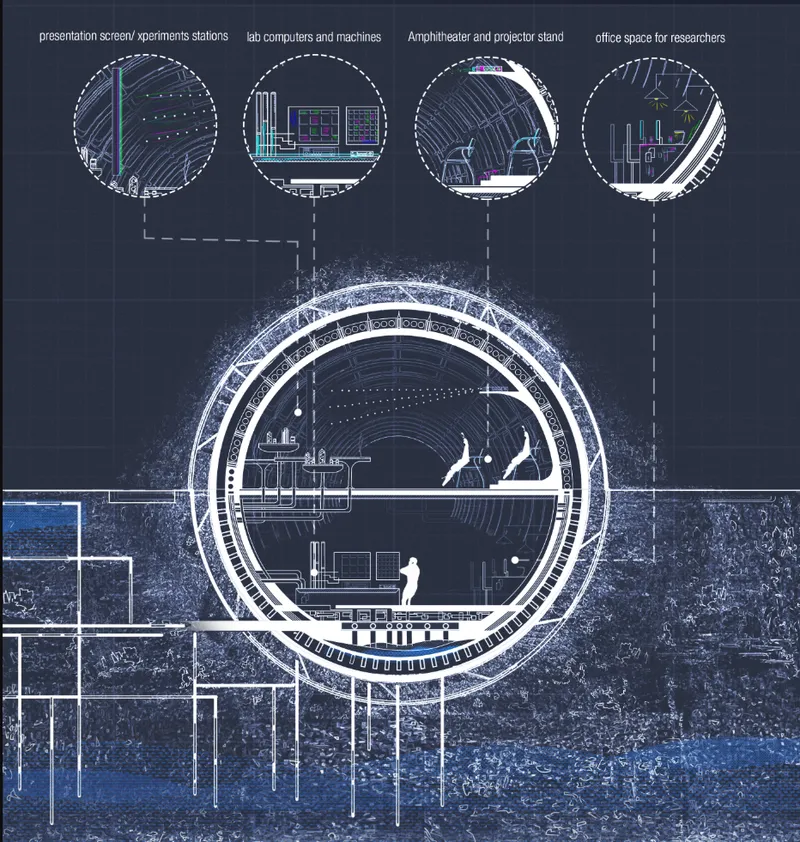
Two further sectional drawings unpack the educational and research programmes embedded within the facility. One shows an education chamber with tiered platforms where figures observe experimental water filtration equipment, recalling the spatial logic of a lecture theatre turned inside out. The other details the laboratory chamber with annotated vignettes of individual workstations and research equipment. Both drawings are dense with information, demonstrating a careful integration of programmatic function and experiential narrative.
The programmatic mix is deliberately eclectic: water purification labs sit alongside a seed bank, permaculture pathways, and a café that serves tea brewed from purified wetland water and locally cultivated plants. That last detail is the kind of closed-loop thinking that elevates the project from speculative concept to demonstrable system. Visitors don't just observe ecological processes; they drink them.
An Undulating Glass Roof That Dissolves into the Wetland Horizon
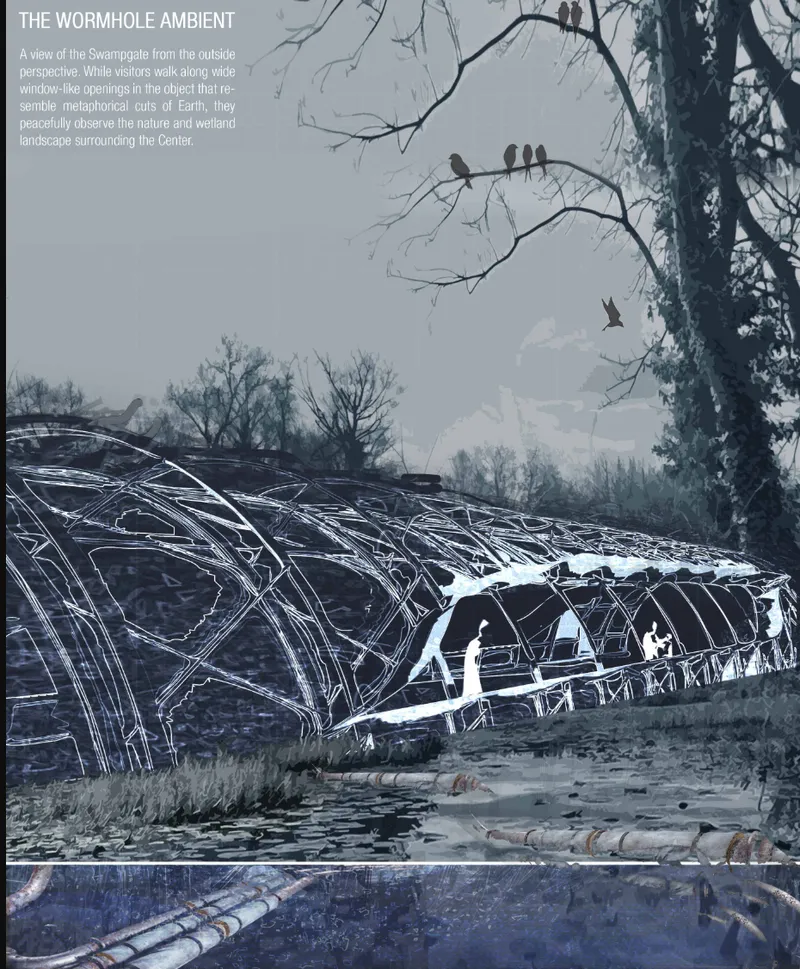
At ground level, the architecture takes a radically different tone. An undulating glass roof structure sits low beside the wetland, its organic curves derived from satellite imagery and topographical mapping of the site. Bare trees and wading birds populate the foreground, and the building appears almost reluctant to announce itself, preferring to register as another contour in the landscape. This is the Ground Level (Level 0) experience: panoramic views of light installations, permaculture gardens, and natural habitats representing the hope of climate restoration. The contrast with the bunker-like intensity below is deliberate and effective.
Why This Project Matters
WORMHOLE – The Swampgate succeeds because it refuses to separate the poetic from the operational. The tunnel is a powerful piece of atmospheric design, but it leads somewhere functional: labs, seed vaults, purification systems. The dual-path visitor experience, splitting between above-ground optimism and underground reckoning, is a spatial strategy that forces engagement rather than passive consumption. Too many ecological buildings settle for green roofs and timber cladding; this one insists on confrontation.
Nedeljkovic's work also points to a critical shift in how we value wetland landscapes. By placing a seed vault and research facility within a wetland, the project reframes these ecosystems as active participants in climate resilience rather than picturesque backdrops. The architecture serves the ecology, not the other way around. As the pressures of climate adaptation intensify, this kind of thinking, grounded in real systems and speculative courage in equal measure, will be essential.
View the Full Project
About the Designers
Designer: Anja Nedeljkovic
Enter a Design Competition on uni.xyz
uni.xyz runs architecture and design competitions year-round that reward proposals with spatial conviction and real site intelligence.
Project credits: WORMHOLE – The Swampgate by Anja Nedeljkovic WIC (uni.xyz).


Popular Articles
Popular articles from the community


Manzana Morphosis: Stretching Barcelona's Grid into a Living Landscape for 2050
A radical reworking of the Eixample manzana turns density into a tool for generous public space, vertical ecology, and environmental performance.

Singing Woman: Contemporary Architecture Inspired by Estonia’s Voice and the Sea
Singing Woman turns Estonia’s song culture into flowing opera house architecture, blending public life, landscape, sea, and national memory.

Tsunami Convergenics: Turning Catastrophic Ocean Forces into Underwater Housing Infrastructure
A speculative underwater settlement off the coast of Onagawa, Japan, treats tsunamis and typhoons as energy sources rather than threats.

Opera on the Sea: Driftwood Logic Shapes a Timber Opera House on Estonia's Coast
Trevor Orgill's opera house translates the entangled drift of floating timber into a civic building where wood, water, and music converge.

Similar Reads
You might also enjoy these articles

Day and Night Park: A Time-Based Urban Newsstand in Beijing
A temporary urban newsstand in Beijing blending travel, light, and reading through poetic colors, compact form, and community-focused design.

Modernist Patio Renovation in El Masnou, Barcelona by Oliver Segura Arquitectura + Cebrià Arquitectura
Modernist patio renovation blending tradition and innovation with a movable pool, leveled floors, and Catalan materials in El Masnou.

Alto Residencial Coop: Cooperative Housing Development in Santiago de Compostela by Carbajo Barrios Arquitectos
A linear cooperative housing complex blending white volumes and perforated metal façades, enhancing community living, natural light, privacy, and urban integration.
Vil Genis School by BPA ARCHITECTURE – Massy, France
Vil Genis School in Massy, France, features sustainable design, south-facing classrooms, community integration, accessible spaces, and modern educational architecture.

Explore Waterscape Competitions
Discover active competitions in this discipline

Challenge to design public laboratory

Challenge to reimagine the Iron Throne

Photograph architecture without architects

Illustrate the lost glory of Angkor Wat - Render Challenge
Comments (0)
Please login or sign up to add comments
No comments yet. Be the first to comment!