ZENITH
Creating the contemporary place of worship
Reflections on the idea began with the pursuit of a proper architectural analogy, a philosophical thought, a concept of world perception, which would allow to adequately capture the image of digital art in the very fabric of the building. In the concept, three main aspects were recognized: digital art, the concept of Plato's Cave, and humanity's approach to places of worship and sacred spaces.
The main idea behind the project is based on the nature of digital art - its translucency and constant pushing of the boundaries. By immersing into an interactive environment, modern technologies create a kind of impact on the viewer that was not possible before. In the digital world, the limitations of reality do not exist. This approach has been embraced in the design and mapped out in a visitor path that both metaphorically and literally. Interactive art allows the viewer to be engaged directly with the artwork, which can respond to their movement and touch. It allows a new, closer relationship between the viewer and the artist. It can be presented in a wide spectrum of formats: paintings, videos, sounds, animations, 3D objects and integrated art, combining different technologies, media and techniques to provide the most exciting, unique experience. The project combines a whole range of art types, each with its own section. The art is omnipresent, a living tissue that binds the building together. It will be exhibited in halls of various sizes and functions, but also in the main hall, by the communication areas and outside the building at night.
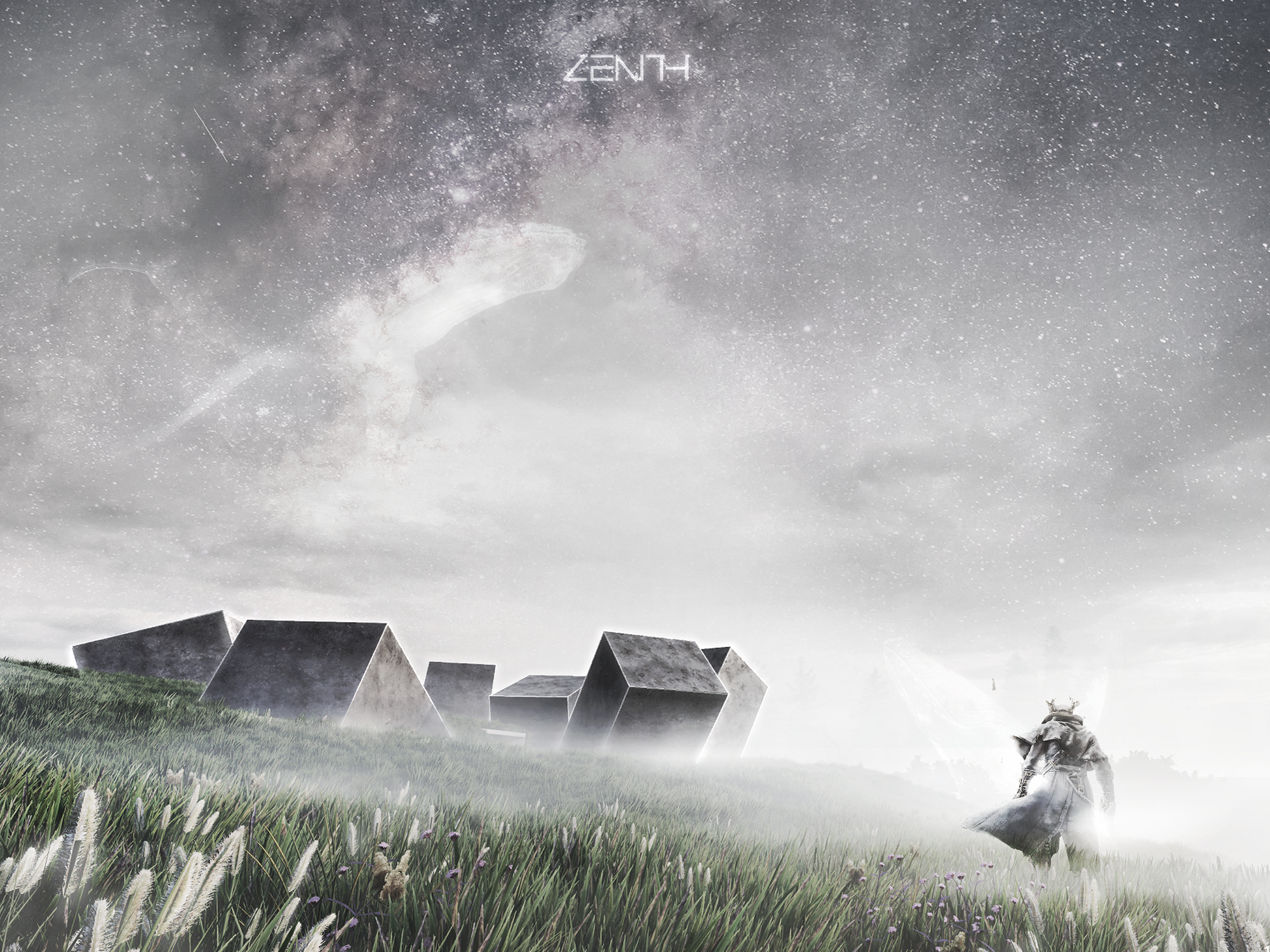
Today, digital culture has been elevated to the status of a cult, playing a major role in our lives. Sacred places of worship have stood out in the landscape since neolithic times, and although their forms have changed throughout history, they have remained monumental, mystical, seemingly standing on the border between the reality and spirituality. From the megalithic tradition come, among others, menhirs (from Celtic maen - stone and hir - high, long) - usually rough stone blocks, placed vertically. A circle, on the other hand, signified processions during rituals, a closed cycle. These are essential, primal elements in ancient representations of places of worship. The circle has been present throughout many cultures and religions and, though its meaning varied, it always held an important message. In the designed building, menhirs, arranged in a circle, lead to the central entrance to the building, further enhancing the connection to places of worship. On the exterior, they are pitched, so that inside the building they gather around its core - the central exhibition hall. Monolithic cuboids are cutting through all rooms, regardless of their function and design. This heightens the impression of them being alien, timeless elements, having always existed in this place. They are the main elements of the building and the exhibitions located inside them are unique, highlighting and adapting to their unique shape.
The boundary between reality and virtuality is nowadays becoming increasingly blurred as. The philosopher that first described the reality/virtuality dualism is Plato. Today, it is difficult to separate these aspects, since part of our lives has moved to the virtual world. The project attempts to contradict the idea of Plato's cave - the user, fully aware of their existence in the real world, sinks into the unreal virtual world, the land of shadows. The building also refers to the idea of a cave more literally. Placing the structure underground and blocking off the sunlight, narrow corridors opening to greater halls of varying, unexpected dimensions, huge spaces with monolithic blocks hanging from above like stalactites – they all evoke feelings of to being inside a cave. The darkness is illuminated not by a campfire, but by artificial light, which instead of shadow play creates ephemeral projections of virtual art.
The study area is in a rather unusual location for a Digital Art Exhibition Centre - the plot seems to be on the border between the city and greenery. The proposed building has been located underground, so it does not interact too heavily with its surroundings visually. It was important not to dominate over or lose the character of the city and to show great respect for nature.
Functionally, a representative staircase located in one of the menhirs leads to the core of the centre. Upon exiting it, the visitor collides with a monolithic mystical hall, resembling a cave. At the heart of the building are the colossal menhirs illuminating the main hall, surrounded by a ring in form of a corridor that connects the exhibition spaces with each other. The idea is that the further you descend into the building, the more you immerse yourself in the virtual world. On the lowest level there are exhibition spaces connected to the virtual world - VR rooms, multimedia rooms. The floor is covered with illuminated geometrical patterns reminiscent of a chip.
The materials for the exterior were chosen so that the menhirs would form a monolithic structure, aging well, increasingly blending with the natural space, and to make a visual reference to ancient ritual monuments. Concrete was used, as with its texture and color it creates a contemporary analogy of stone megaliths. Inside, the main spotlight is created by the luminous surfaces of the menhirs, visible in the highly reflective surfaces of the ceiling and floors. In addition, the walls in the main hall and exhibition corridors are covered with sculpted acoustic panels mimick the uneven, organic surface of a cave.
Before the final version of the design was achieved, other similar designs were also considered, but they did not manage to evoke the atmosphere of prehistoric religious structures. The first concept was to create a single cuboid menhir and place all functional zones inside it - externally, the form was well suited to the premise, but internally it did not create the right impact. Then, it was determined to divide the building into several menhirs, initially arranged vertically, then diagonally. Finally, they were increased to six, arranged in a circle-like formation and connected underground.

Popular Articles
Popular articles from the community


The Amber Palace Opera: A Geological Fiction Surfaces on Tallinn's Baltic Waterfront
Pierre Brillard reimagines a Baltic legend as a public landscape, opera house, and waterfront promenade rooted in Tallinn's coastal identity.

Manzana Morphosis: Stretching Barcelona's Grid into a Living Landscape for 2050
A radical reworking of the Eixample manzana turns density into a tool for generous public space, vertical ecology, and environmental performance.
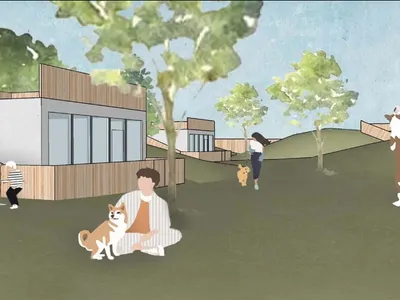
Temporary Home for Dogs: A Reversed Zoo Rethinks Animal Shelter Architecture
In Bucharest, a sinuous corridor and freed landscape flip the logic of containment, designing a shelter that works to make itself unnecessary.

Faces of the Soviet Avant-Garde: Turning Moscow's Street Names into an Open-Air Museum
A network of sculptural installations across a Moscow residential district transforms forgotten architect names into spatial encounters with cultural memor

Similar Reads
You might also enjoy these articles
The Rhythm of Seasons
A Farmers' Market Connecting Nature and the City

More Than a Building-Designing a Living System
More Than a Building-Designing a Living System
Base Beyond
DESERT COMPOUND ARID: TOURISM OF ABSENCE AND ABUNDANCE

Explore Exhibition Space Competitions
Discover active competitions in this discipline


Challenge to reimagine the Iron Throne

Photograph architecture without architects

Illustrate the lost glory of Angkor Wat - Render Challenge

Design challenge to reuse E-waste
Comments (0)
Please login or sign up to add comments
No comments yet. Be the first to comment!