
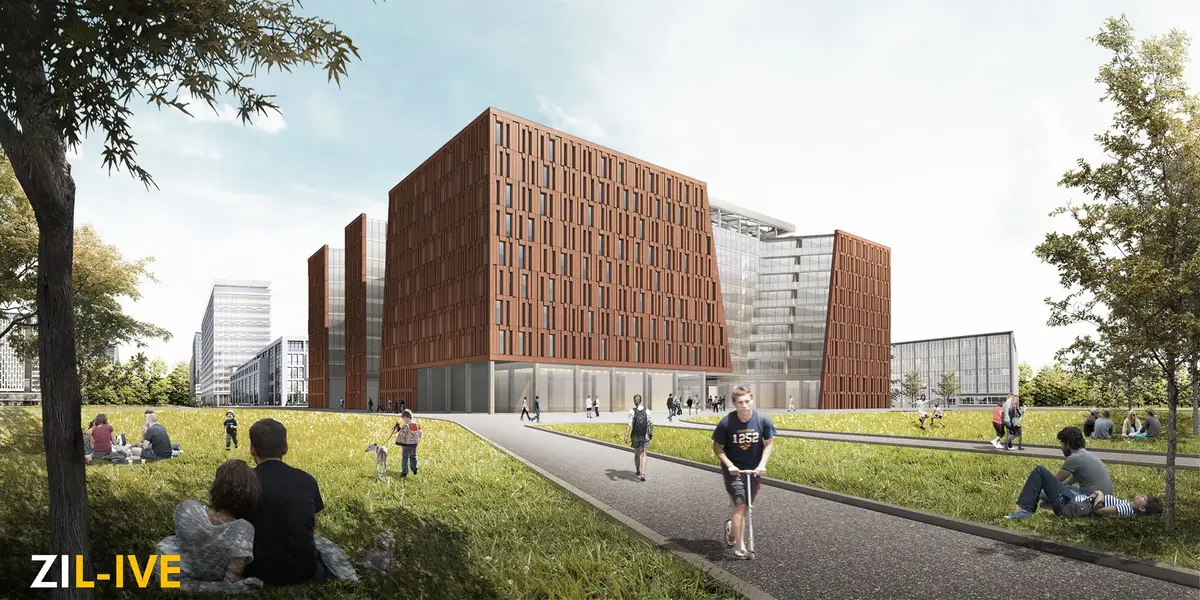
ZIL-IVE: Transforming Moscow's Industrial Legacy into a Co-Living Commons
A shortlisted Hustle Hub entry plants a courtyard-centered co-living complex in Moscow's post-industrial ZIL district, connected by a suspended public ramp


What happens when you carve a communal courtyard into the belly of a post-industrial district and let a suspended ramp spiral residents up to a rooftop garden? In Moscow's ZIL district, a zone still shaking off decades of factory pollution, the ZIL-IVE project answers that question with a co-living and co-working complex that treats vertical circulation as public spectacle and terracotta balconies as the connective tissue of community life.
Designed by Silvia Lintas, Ting Wang, and Zhu Yuanzheng, ZIL-IVE was shortlisted in the Hustle Hub 2019 competition. The brief called for a new typology of urban hustle space geared toward young professionals. The team responded by anchoring their proposal in the ZIL site's master plan, which introduces green corridors and cultural buildings to reclaim a landscape scarred by industrial obsolescence. Positioned between residential neighborhoods and newly landscaped parklands, the complex reads as a spatial hinge: part housing, part public amenity, entirely oriented toward collective energy.
A Courtyard Under Glass: Terracotta Balconies and a Triangulated Canopy
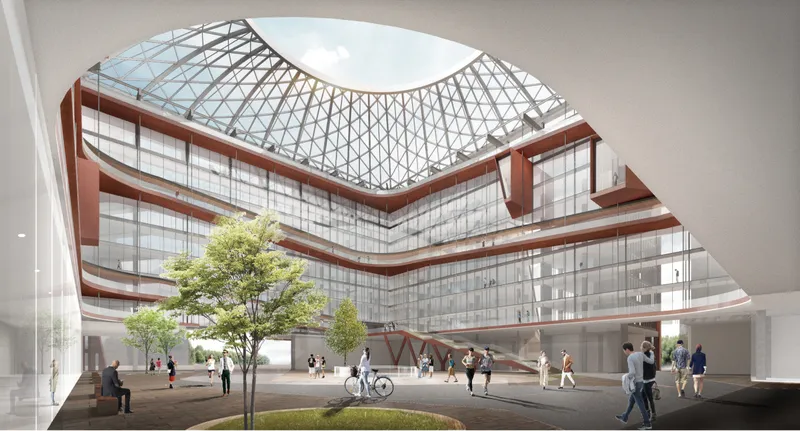
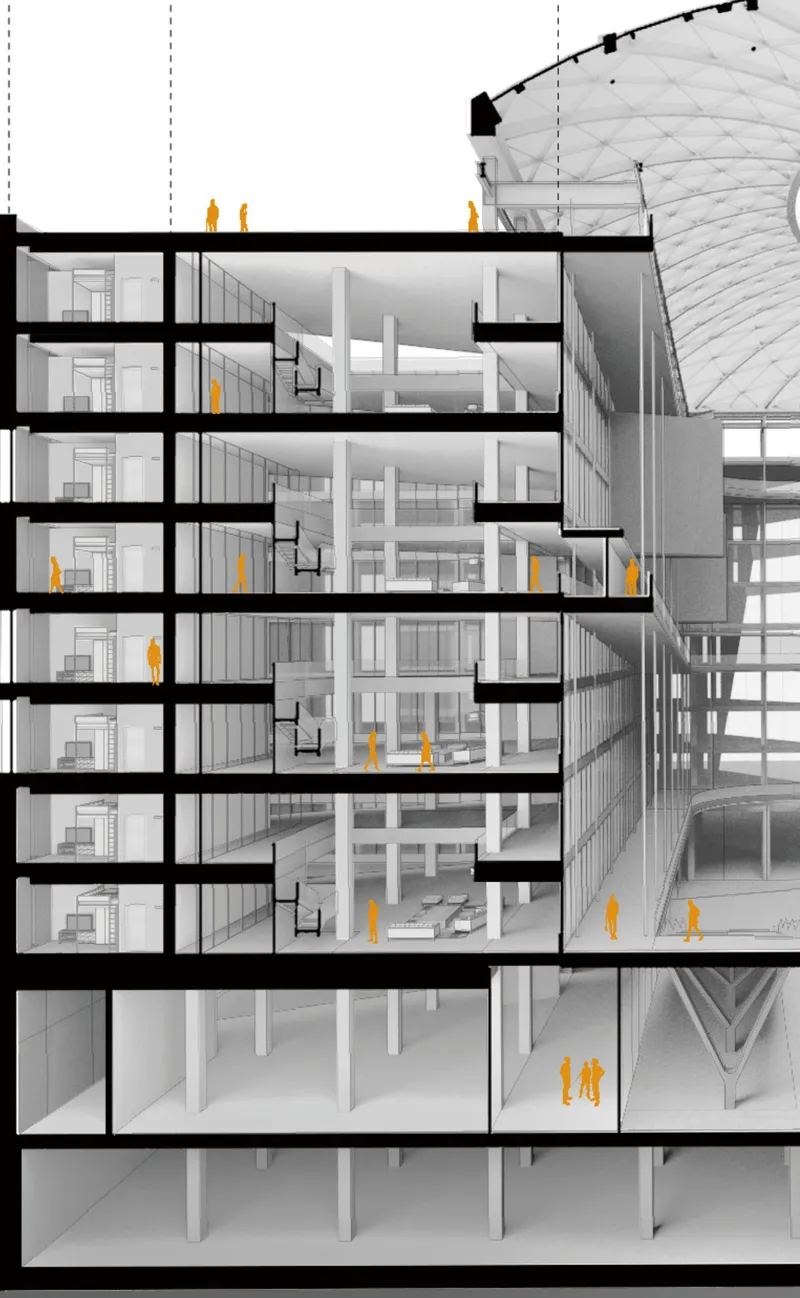
The interior courtyard is the project's spatial engine. Layered terracotta balconies ring the void on all sides, stacking private and semi-private thresholds around a shared ground plane flooded with daylight through a curved, triangulated glass roof. The section drawing reveals just how much vertical variety the designers pack into the envelope: double-height lobbies, mezzanine co-working levels, and compact residential floors all orbit this central atrium. Yellow silhouette figures scattered through the section give a sense of scale and density, showing the courtyard as a place where chance encounters between residents, workers, and visitors become inevitable rather than designed.
The glass canopy does more than shelter. Its geometry, a faceted dome rising above the roofline, acts as a beacon in the surrounding low-rise urban fabric. From outside, it signals public program. From inside, it bathes the deep plan in even, diffused light, reducing the need for artificial illumination in communal zones below.
Ground-Level Permeability: Concrete Columns and Color-Coded Wayfinding
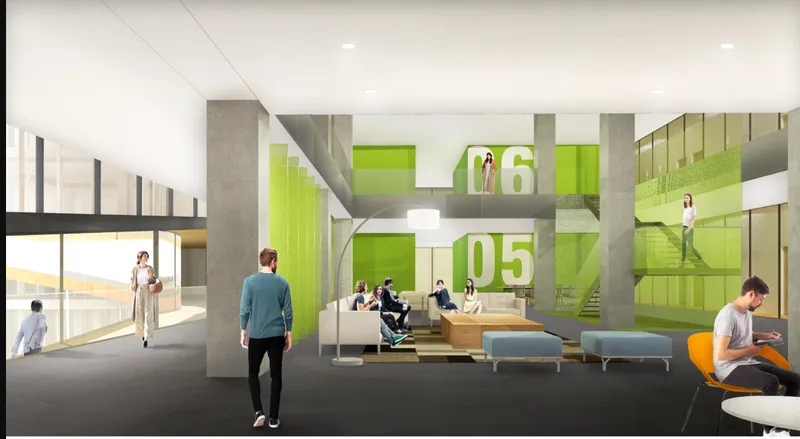
At street level, ZIL-IVE dissolves the boundary between building and city. The ground plane is deliberately permeable, inviting passersby into the courtyard and its surrounding amenities: culinary spaces, a library, co-working hubs, and recreational zones. The lobby render shows this strategy in action. Exposed concrete columns establish a raw, industrial rhythm that nods to the district's heritage, while lime green partition walls marked with bold floor numbers serve as intuitive wayfinding devices. Scattered seating clusters suggest informal occupation rather than rigid programming, reinforcing the idea that the ground floor belongs as much to the neighborhood as to the residents above.
Living Small, Living Well: Compact Residential Typologies
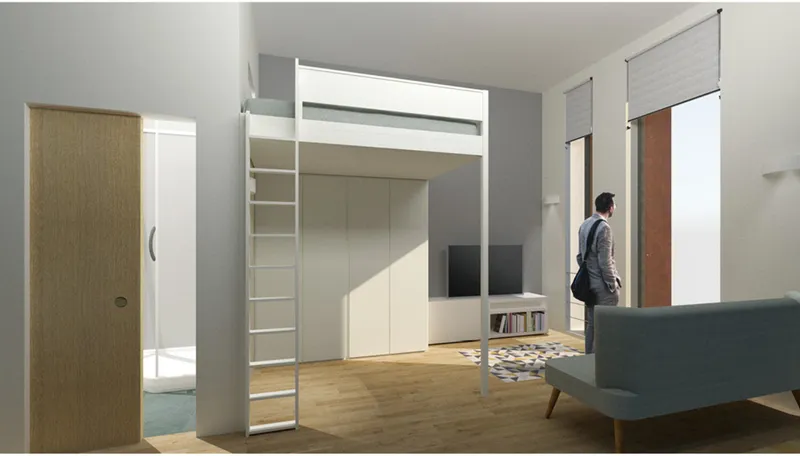
The unit interiors reveal a thoughtful calibration of space for a young demographic that values flexibility over square footage. The small single-occupancy unit features a white lofted bunk bed over a work surface, with light wood flooring and minimal furnishing keeping the room open and uncluttered. It is tight, but it works because the courtyard, the rooftop, and the co-working floors absorb the social and professional life that a micro-unit cannot contain on its own.
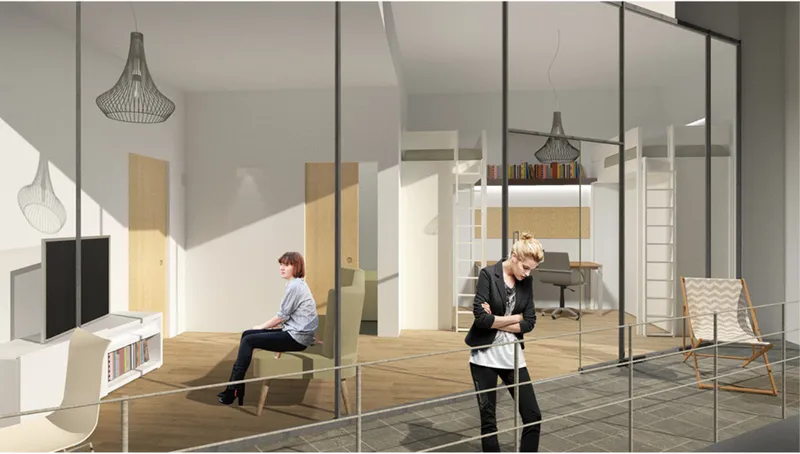
The medium unit, designed for single or double occupancy, introduces a glass partition wall that separates sleeping and living zones without sacrificing visual continuity. Pendant lighting and a lofted bed structure give the room a domestic warmth that the concrete public spaces deliberately avoid. Across three accommodation typologies, from compact singles to generously proportioned family units, the design maintains a consistent logic: private space is for rest and retreat, while shared space carries the social weight of daily life.
Rooftop Commons and a Suspended Ramp as Architectural Centerpiece
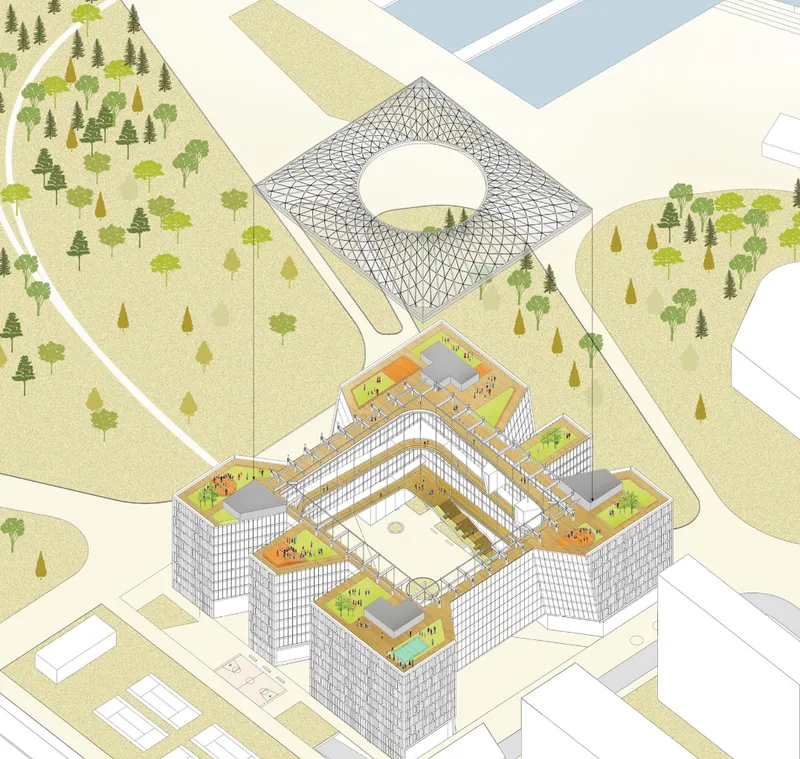
The axonometric drawing pulls the full composition into view: wing-shaped residential volumes wrap around a central courtyard, while rooftop gardens and a latticed dome structure crown the complex. The continuous ramp that ascends from the permeable ground plane to this elevated public realm is both an engineering gesture and a social device. It gives visitors who may never rent a unit a reason to move through the building, blurring the line between resident and guest, private investment and public amenity.
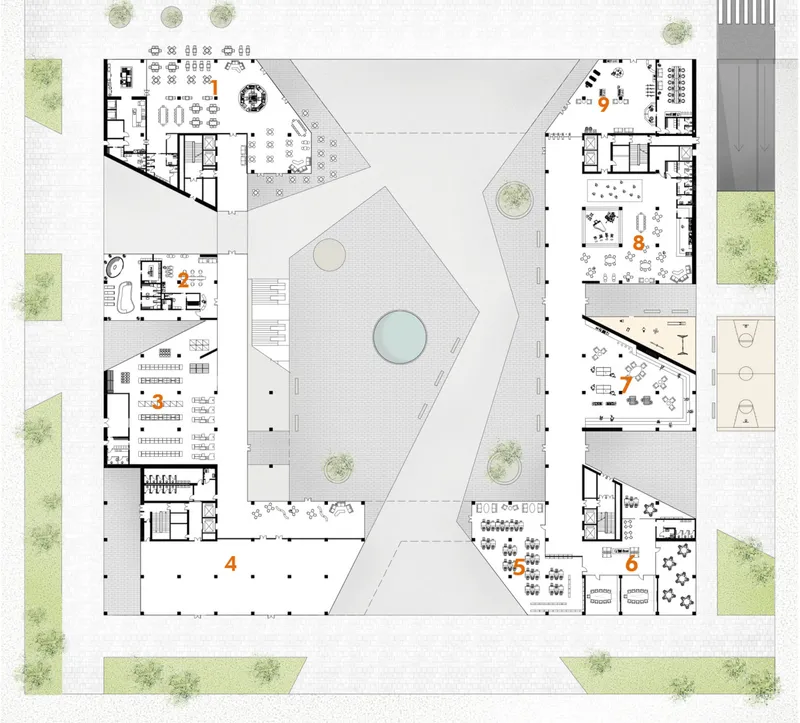
The floor plan clarifies the courtyard's geometry. Rectangular wings extend outward from a central open space anchored by a circular water feature, creating sheltered microclimates at ground level and framing views toward the surrounding parklands. The plan's bilateral symmetry keeps orientation intuitive, while the courtyard's proportions ensure that even on Moscow's short winter days, sunlight penetrates deep into the communal core. It is a plan that rewards both the quick pass-through and the slow, deliberate occupation.
Why This Project Matters
ZIL-IVE takes a familiar co-living brief and roots it in a specific urban condition: a polluted industrial district undergoing ecological and cultural reclamation. Rather than dropping a generic mixed-use block onto the site, Lintas, Wang, and Zhu build their program around a single architectural move, the central courtyard, and let everything else radiate from it. The suspended ramp, the permeable ground floor, the rooftop garden: each element reinforces the courtyard's role as a social condenser, pulling public life upward through the section.
What distinguishes the project is its refusal to treat co-living as simply a real estate product. The flexible unit typologies are economical and well resolved, but the real design energy goes into the shared spaces, the thresholds, ramps, and gardens where individual routines overlap and collective life takes shape. For a district transitioning from industrial production to urban habitation, that emphasis on commons over commodity feels exactly right.
View the Full Project
About the Designers
Designers: Silvia Lintas, Ting Wang, Zhu Yuanzheng
Enter a Design Competition on uni.xyz
uni.xyz runs architecture and design competitions year-round that reward proposals with spatial conviction and real site intelligence.
Project credits: ZIL-IVE by Silvia Lintas, Ting Wang, Zhu Yuanzheng Hustle Hub 2019 (uni.xyz).


Popular Articles
Popular articles from the community


LT2A and OPEN Architectes Thread a Brick and Glass High School Through a Wooded Belgian Campus
In Braine-l'Alleud, a 3,000 m² wing for Collège Cardinal Mercier pairs pale brick with a glazed colonnade, deferring to a small chapel and a dense wood.

David Macias Steps a Doorless Stone and Plaster House Down a Tropical Colombian Hillside
In the humid hills of Colombia, Threshold House replaces the front door with an open void and terraces its 850 m² down the slope instead of fighting it.

David Ortega Stacks a Two-Story Mexico City Penthouse Around a Steel Stair and a Pergola-Shaded Roof Terrace
In Colonia Roma, a 300 m² penthouse uses oak joinery, a planted steel stair and a slatted roof pergola to make a new-build apartment feel like a house.

Cube Design Draws an Ecological Corridor Between Two Shenzhen Hills with the Nankai Building
Beside Shenzhen's container docks, the Nankai Building pairs stacked balconies with a climbing green screen to connect two hillsides across its height.

Similar Reads
You might also enjoy these articles


Vereda Arquitetos Renovates a 40-Square-Meter Apartment Inside Niemeyer's Copan Building
A compact unit in São Paulo's most iconic residential tower gets a material overhaul that pairs exposed concrete with bold blue Formica.

Shakur's House: Exposed Brick as an Interior Organiser in a 168 m² Mashhad Residence
Brick moves indoors in this Mashhad residence, where masonry walls, glass partitions and teal planes sequence a compact home without closing it off.

Day and Night Park: A Time-Based Urban Newsstand in Beijing
A temporary urban newsstand in Beijing blending travel, light, and reading through poetic colors, compact form, and community-focused design.

Modernist Patio Renovation in El Masnou, Barcelona by Oliver Segura Arquitectura + Cebrià Arquitectura
Modernist patio renovation blending tradition and innovation with a movable pool, leveled floors, and Catalan materials in El Masnou.

Explore Vertical Zoning Competitions
Discover active competitions in this discipline

Comments (0)
Please login or sign up to add comments
No comments yet. Be the first to comment!