

Bab Al-Atlal: Weaving War Debris into a Living Archive for Aleppo
A shortlisted proposal transforms the ruins of Aleppo's Grand Serail into a hybrid landscape where crushed stone, poetry, and collective grief become archi


What happens when a city refuses to erase its wounds? In Aleppo, where the Grand Serail once anchored civic life, a new proposal treats rubble not as waste but as raw material for public memory. Bab Al-Atlal rejects reconstruction in the conventional sense. Instead of rebuilding the Serail to its pre-war form, the project sorts, crushes, decomposes, and cultivates the debris into new spatial forms: plazas of crushed stone, benches cast from old concrete, paths paved with reclaimed rubble. Memory is literally embedded in the ground underfoot.
Designed by Sarah Lily Yassine and shortlisted in the Memory competition on uni.xyz, Bab Al-Atlal takes its name and conceptual framework from Ahmad Nagi's poem "el Atlal," a work centered on ruins and nostalgia. The design strategy mirrors a poetic act of erasure: fragments of text are redacted, and new meanings surface from the gaps. Applied to architecture, this means scars of war are highlighted rather than concealed, and the resulting spaces are deliberately layered, incomplete, and emotionally charged.
Erasure as Spatial Practice: From Poetry to Built Form
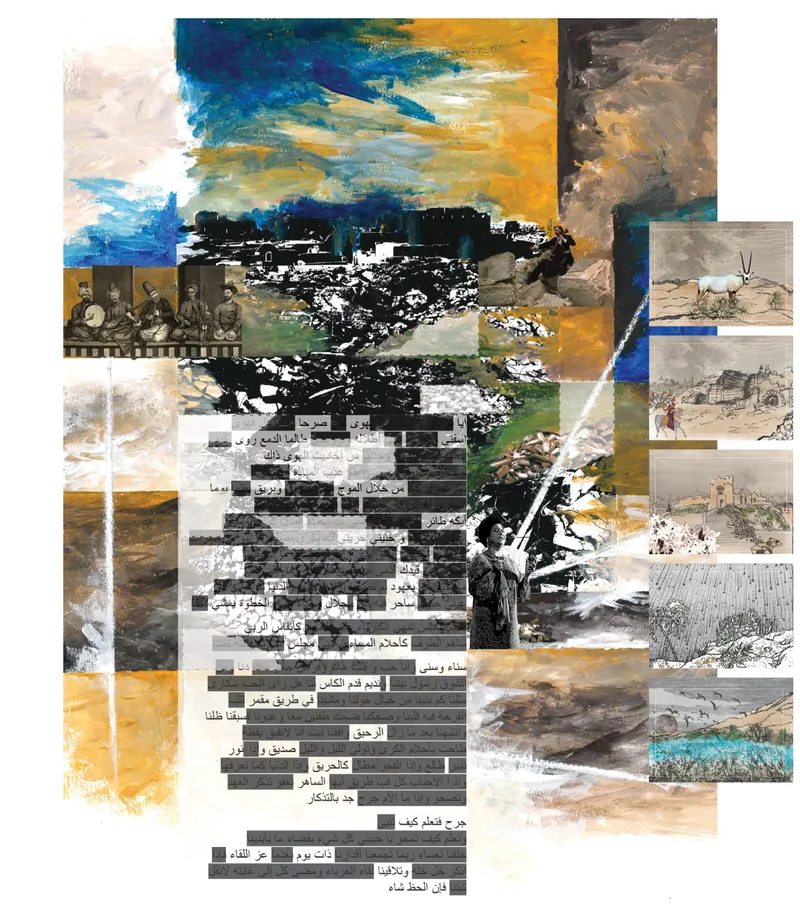
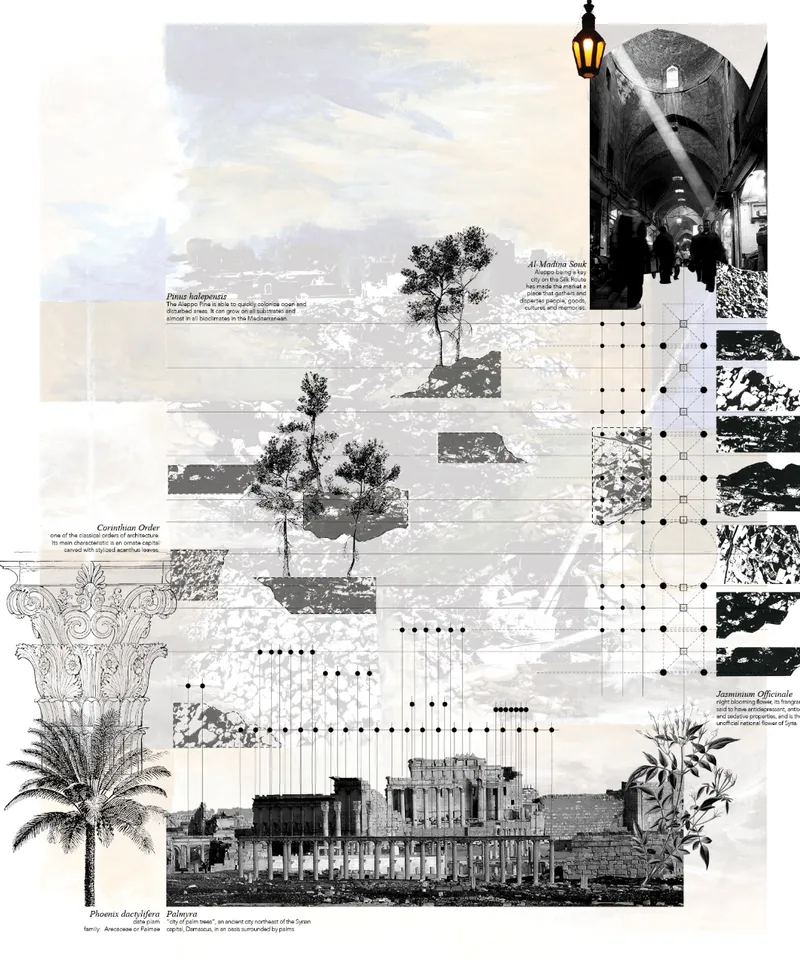
The opening collage boards establish the project's conceptual lineage with striking clarity. Painted sky fragments, blocks of Arabic text, archival photographs, and landscape sketches are layered and overlapped in a technique that parallels the poetic erasure at the heart of the design. Historic photographs of Aleppo sit alongside ruined colonnades and palm trees, creating a visual palimpsest where past and present coexist without hierarchy. These boards are not decorative; they are methodological. They demonstrate how Yassine reads the site: as a collage of competing memories, where the deliberate redaction of some elements allows others to speak.
The connection to Ahmad Nagi's poem goes beyond metaphor. The design adopts erasure as a literal spatial practice: visitors engage with fragments of built form rather than polished surfaces. Architecture becomes an act of rewriting. Remnants of history and the physical residue of conflict are not masked but foregrounded, prompting reflection and reinterpretation. The site transforms into a medium of healing and communal reckoning where music, poetry, and space converge across time.
Reading the Circular Void: Site Analysis and Process
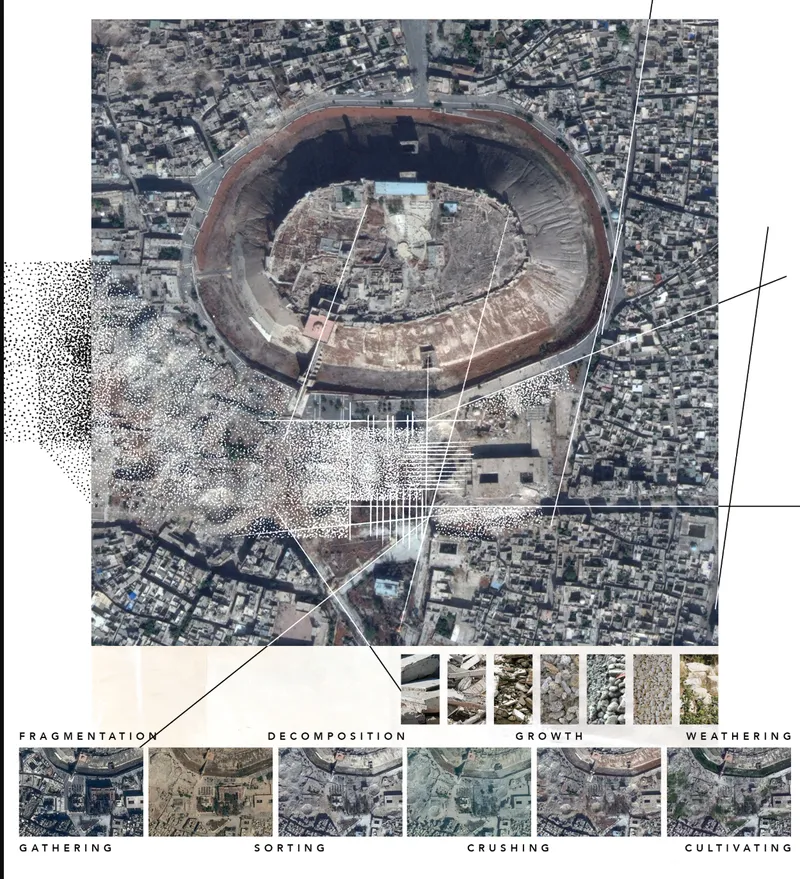
The aerial site analysis diagram reveals the project's physical context: a circular amphitheater form surrounded by dense urban fabric, with overlaid labels mapping the transformation processes that will unfold on the site. The circular geometry is significant. It organizes the debris transformation sequence, from sorting and fragmenting to decomposing, crushing, and eventually cultivating new spatial forms. Some of these processes are immediate; others unfold over years, building temporal depth into the architecture itself.
The diagram also underscores a key decision: the project does not impose a foreign order on the site. It reads the existing urban grain and works within it, allowing hybrid architectural typologies to emerge organically from the land. Domes and colonnades rise amidst palm trees; arches blend into trellised gardens; light posts become part of the forest canopy. The result is an architecture that coexists with its terrain rather than dominating it.
Public Platforms: Where Gathering and Grieving Overlap
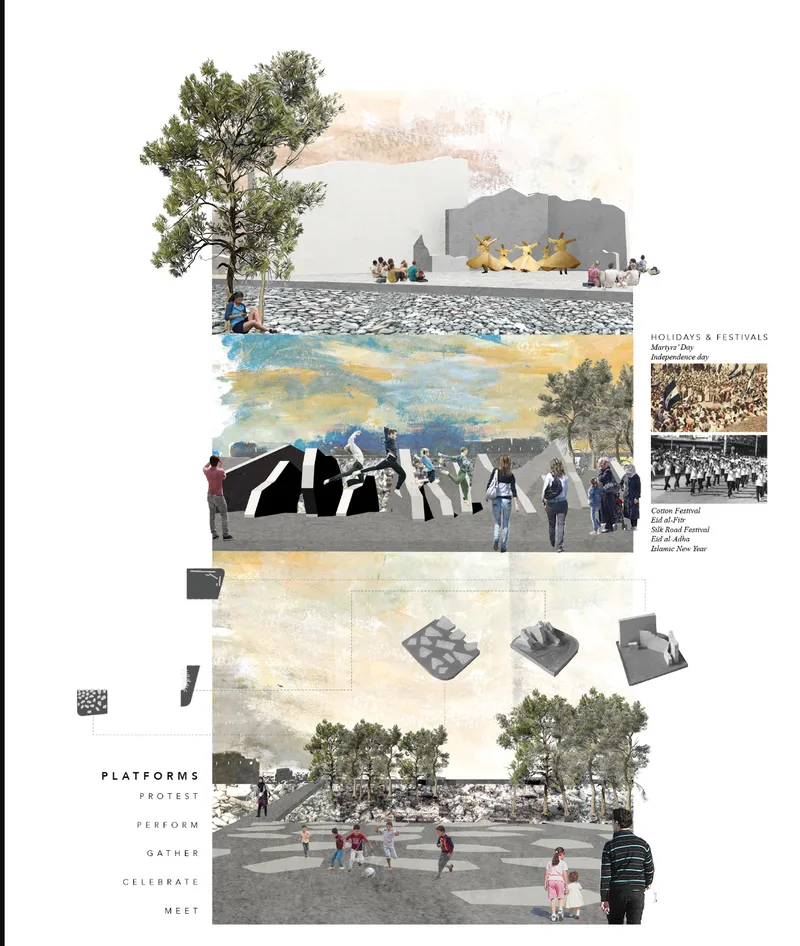
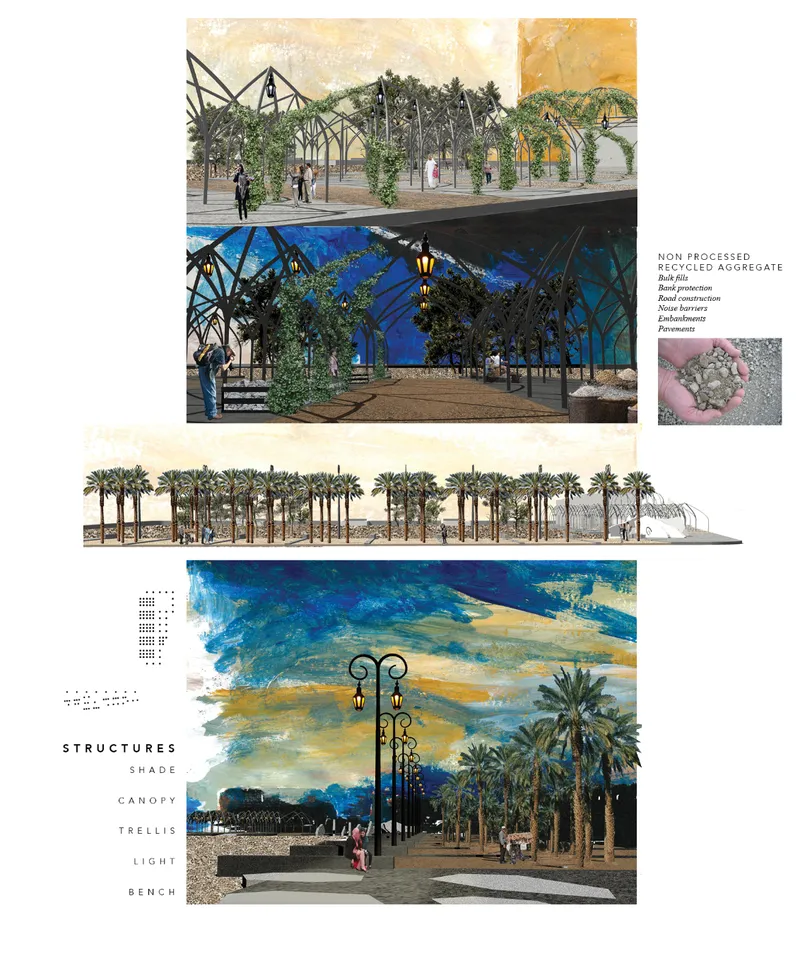
Two composite renderings show the project's proposed public life in action. The first depicts gathered people on stone-paved platforms beneath hazy skies, with trees punctuating the assembly space. The second reveals a green canopy structure and a palm-lined promenade with lampposts along what appears to be a waterfront edge. These are not pristine civic plazas. They carry the material weight of the site's history: crushed stone underfoot, reclaimed rubble forming paths, benches cast from the concrete of destroyed structures.
Programmatically, the project proposes a memory market, performance platforms, and cultivated fields. Each emerges from what Yassine calls "material alchemy," the active transformation of debris into purposeful civic space. The shift from passive ruin to purposeful renewal is not merely technical but deeply symbolic. These spaces invite encounter, mourning, storytelling, and, eventually, the ordinary rhythms of daily life. Architecture here serves as both witness and host.
Landscape as Resilience: Gravel Terraces and Aleppo Pines
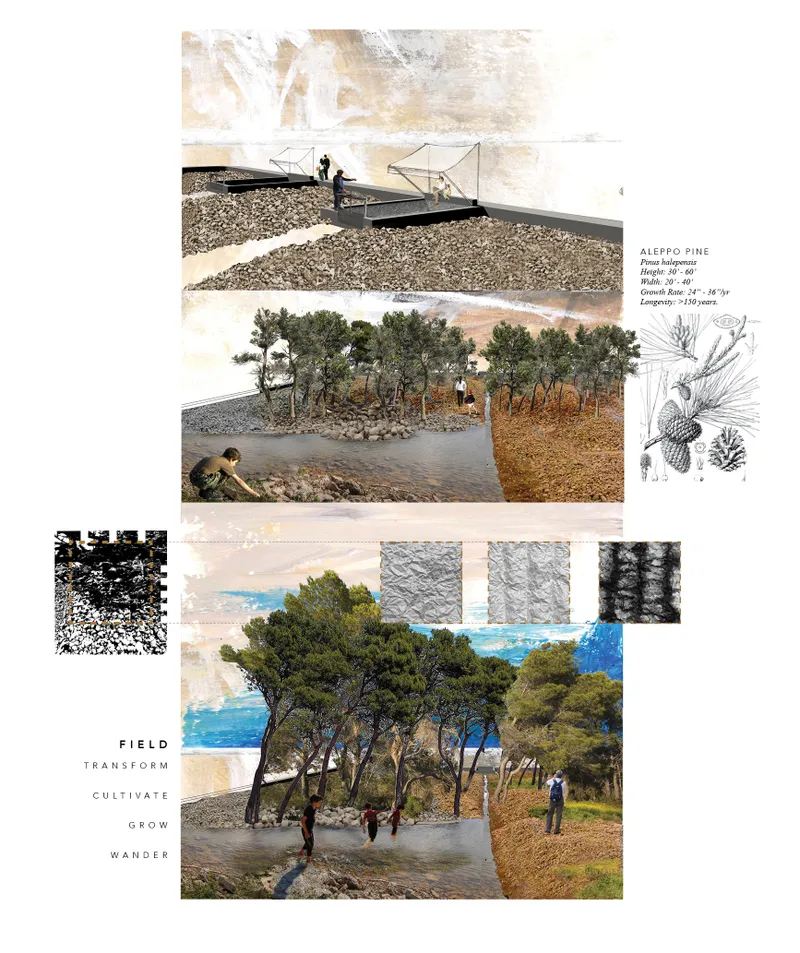
The final design board makes the project's argument about landscape persistence visible. Gravel terraces, Aleppo pine groves, and walking figures populate layered landscape vignettes that feel simultaneously ancient and newly planted. The choice of Aleppo pines is pointed: a species named for the city itself, capable of regenerating after fire and drought, serving as a living metaphor for the resilience the project seeks to embody.
Yassine's proposal bridges the ephemerality of architecture and the persistence of landscape by designing hybrid spaces where neither dominates. Nature infiltrates and animates the ruins. Growth and decay become part of the spatial language, ensuring the site remains adaptable across generations. The architecture is rooted in place yet refuses to fix a single reading of the past, allowing future inhabitants to add their own layers of meaning.
Why This Project Matters
Post-conflict reconstruction typically faces a binary: restore what was lost or clear the site and start over. Bab Al-Atlal rejects both options. By treating debris as generative material and poetic erasure as a design method, the project proposes a third path where the trauma of destruction is neither denied nor fetishized but woven into the fabric of a living civic space. Plazas, markets, performance platforms, and planted groves grow directly from the material residue of conflict, giving physical form to the messy, non-linear work of collective memory.
Sarah Lily Yassine's contribution to the Memory competition is significant because it operates simultaneously as a material strategy and a philosophical position. The insistence that architecture can be an act of redaction and rewriting, that incompleteness is not a failure but a condition of honesty, speaks to reconstruction debates well beyond Aleppo. For any city grappling with the aftermath of violence, Bab Al-Atlal offers a provocation: the most respectful thing you can do with ruins might be to let them remain visible, transformed but not erased, as the ground on which a new public life takes root.
View the Full Project
About the Designers
Designer: Sarah Lily Yassine
Enter a Design Competition on uni.xyz
uni.xyz runs architecture and design competitions year-round that reward proposals with spatial conviction and real site intelligence.
Project credits: Bab Al-Atlal: Remembering Through Debris by Sarah Lily Yassine Memory' (uni.xyz).


Popular Articles
Popular articles from the community


Opera on the Sea: Driftwood Logic Shapes a Timber Opera House on Estonia's Coast
Trevor Orgill's opera house translates the entangled drift of floating timber into a civic building where wood, water, and music converge.

The Amber Palace Opera: A Geological Fiction Surfaces on Tallinn's Baltic Waterfront
Pierre Brillard reimagines a Baltic legend as a public landscape, opera house, and waterfront promenade rooted in Tallinn's coastal identity.


ETEH Reworks the Shared Spaces of São Domingos School in Brazil Around Timber, Color and Hanging Plants
At São Domingos School in Brazil, 436 m² of hall, refectory and library are recast with timber joinery, a yellow and blue code and trailing greenery.

Singing Woman: An Opera House That Performs Before the Curtain Rises
Ovidiu Cristian Pavel's conceptual opera house translates Estonia's choral identity into a sculpted waterfront landmark facing the Baltic Sea.

Similar Reads
You might also enjoy these articles

Vereda Arquitetos Renovates a 40-Square-Meter Apartment Inside Niemeyer's Copan Building
A compact unit in São Paulo's most iconic residential tower gets a material overhaul that pairs exposed concrete with bold blue Formica.

Shakur's House: Exposed Brick as an Interior Organiser in a 168 m² Mashhad Residence
Brick moves indoors in this Mashhad residence, where masonry walls, glass partitions and teal planes sequence a compact home without closing it off.

Day and Night Park: A Time-Based Urban Newsstand in Beijing
A temporary urban newsstand in Beijing blending travel, light, and reading through poetic colors, compact form, and community-focused design.

Modernist Patio Renovation in El Masnou, Barcelona by Oliver Segura Arquitectura + Cebrià Arquitectura
Modernist patio renovation blending tradition and innovation with a movable pool, leveled floors, and Catalan materials in El Masnou.

Explore Remembrance Pavilion Competitions
Discover active competitions in this discipline

Deconstructivism - Illustration Design Challenge

Challenge to illustrate a Contemporary Castle

Challenge to design locus for the upliftment of human rights

Illustrate the lost glory of Angkor Wat - Render Challenge
Comments (0)
Please login or sign up to add comments
No comments yet. Be the first to comment!