
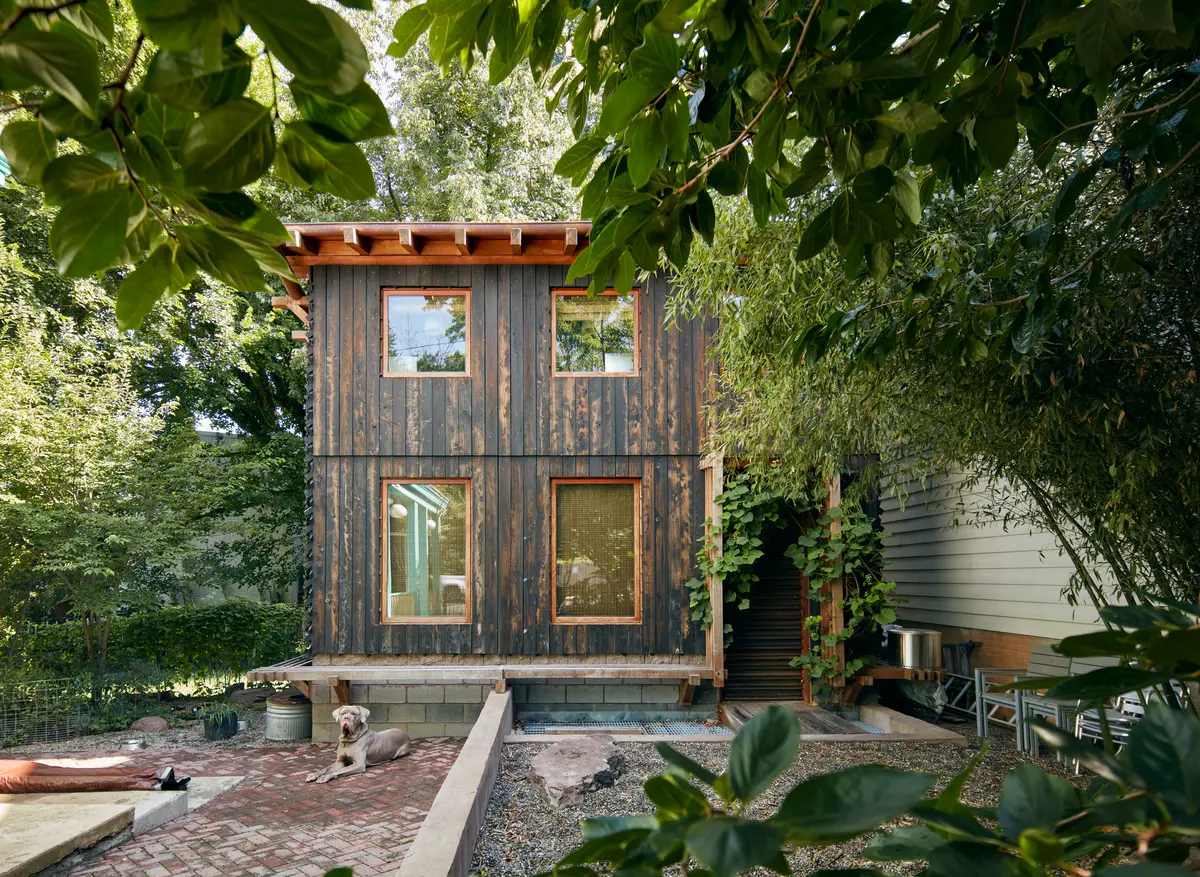
BLDUS Builds a Bamboo Counterpoint to Philip Johnson's Glass House in Historic Anacostia
A 700-square-foot LEED Platinum structure in Washington D.C. rethinks transparency through willow, wool, and bamboo.


Philip Johnson's Glass House proposed radical transparency as architecture's highest aspiration. BLDUS looked at that proposition and asked: transparent to whom, and at what cost? Their Grass House, a 700-square-foot accessory structure tucked behind an 1892 Victorian in Washington D.C.'s Historic Anacostia neighborhood, answers with opacity, warmth, and a material palette drawn almost entirely from fast-growing, low-impact sources. Bamboo frames the walls. Sheep's wool insulates them. Willow branches line the interior. The name is not a metaphor for lawn but for an entire philosophy of building with grasses.
What makes the Grass House genuinely significant is not just its environmental ambition, which earned LEED Platinum certification, but its proof of concept. When it was completed in 2019, it became the first code-compliant bamboo building on the East Coast, using BamCore hybrid bamboo-wood-eucalyptus panels for its structural frame. That it sits across the street from the Frederick Douglass House, in D.C.'s only residential historic district east of the Anacostia River, adds a layer of cultural weight. The project is as much about who gets access to healthy, sustainable construction as it is about material innovation.
A Dark Volume Among Victorians
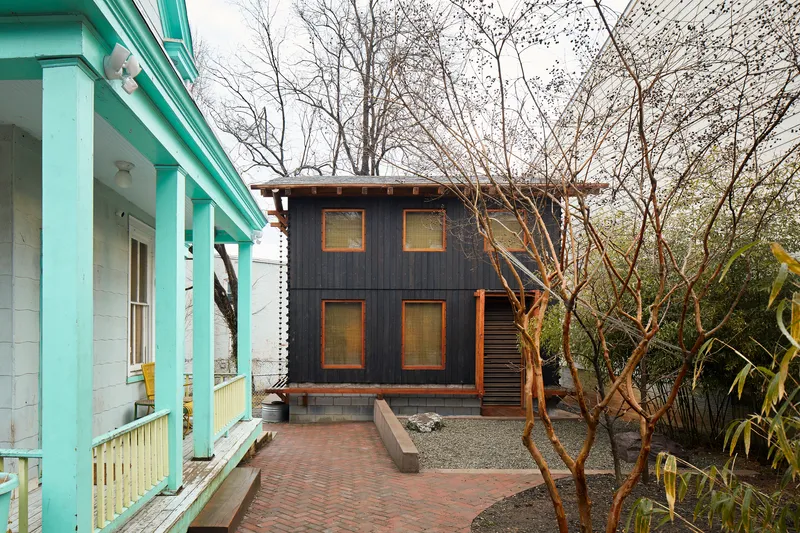
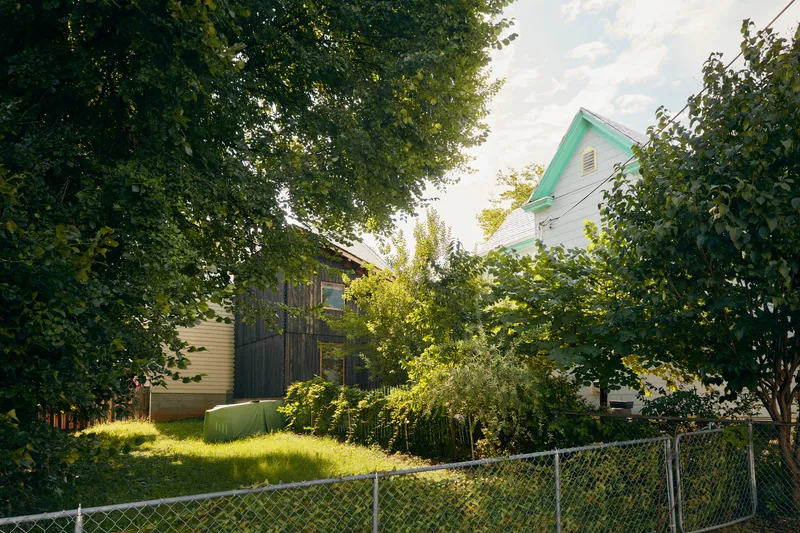
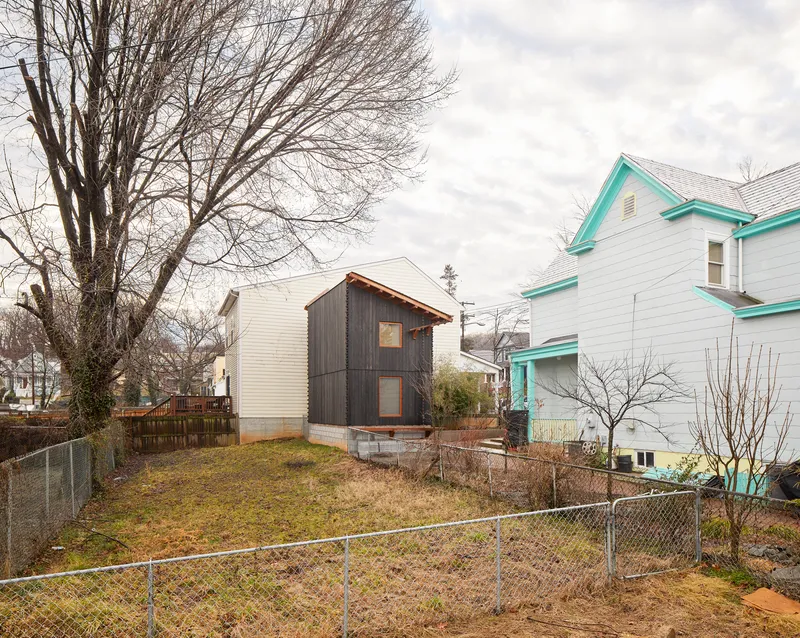
The Grass House borrows its proportions from the 19th century homes around it, a two-story volume with a pitched presence that reads as familiar from a distance. Up close, the resemblance dissolves. Charred vertical boards of black locust, cedar, and cypress clad the exterior in deep, absorptive black, a stark counterpoint to the mint greens and whites of its neighbors. The shou sugi ban-like treatment is not decorative posturing; it extends the lifespan of the wood and eliminates the need for chemical finishes.
On its sloped lot, the structure appears compact but deliberate, sitting lightly between neighboring clapboard houses and mature deciduous trees. BLDUS shaped the form to defer to the existing Victorian while maintaining its own identity. The building is clearly new, clearly different, but never confrontational.
Charred Skin, Gentle Joints
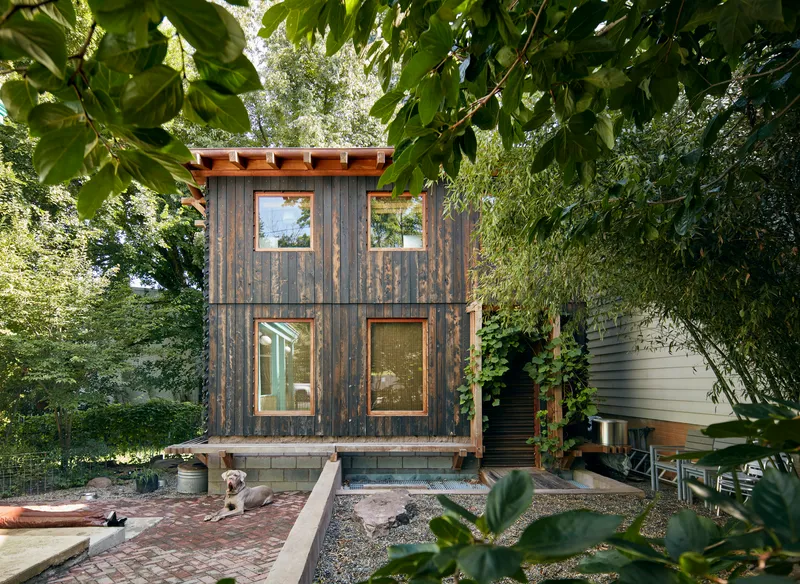
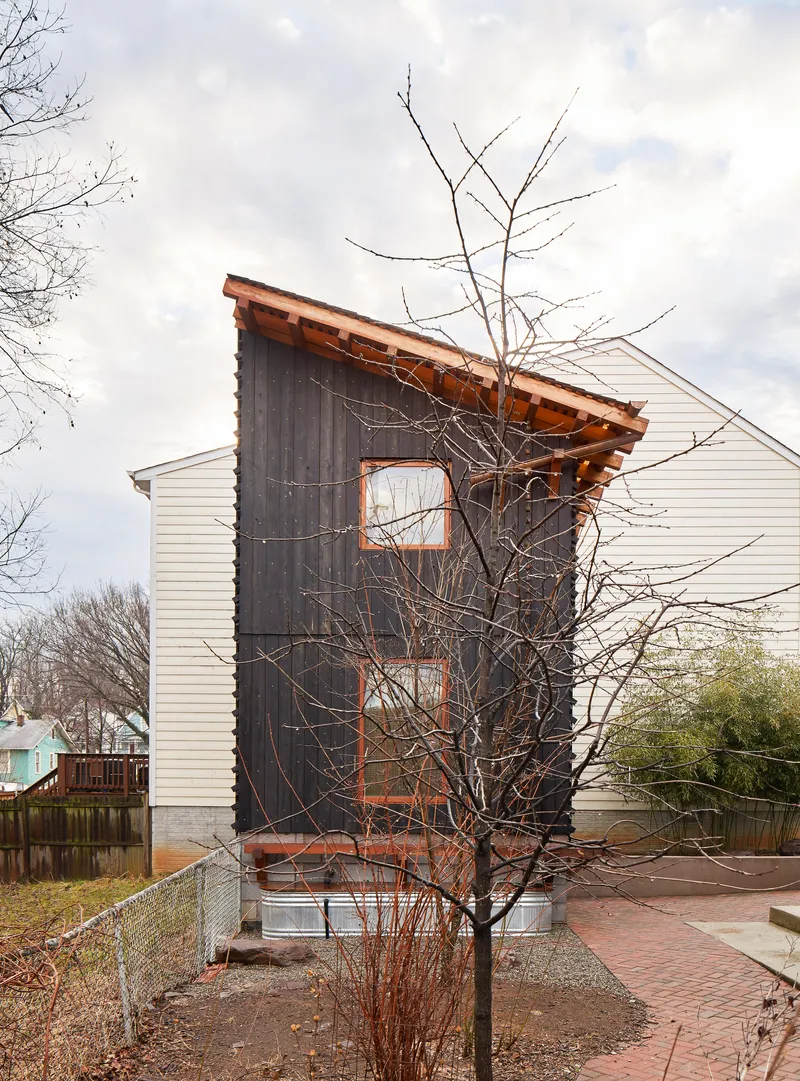
The front facade arranges four symmetrical windows within a field of dark vertical boards, a composition that is almost austere in its discipline. Garden foliage softens the edges in warmer months, but in winter the building stands exposed, its deep tones absorbing whatever light reaches Anacostia's back lots. A white horizontal siding element at one junction signals the transition between old and new, marking where the addition meets the context of the existing property.
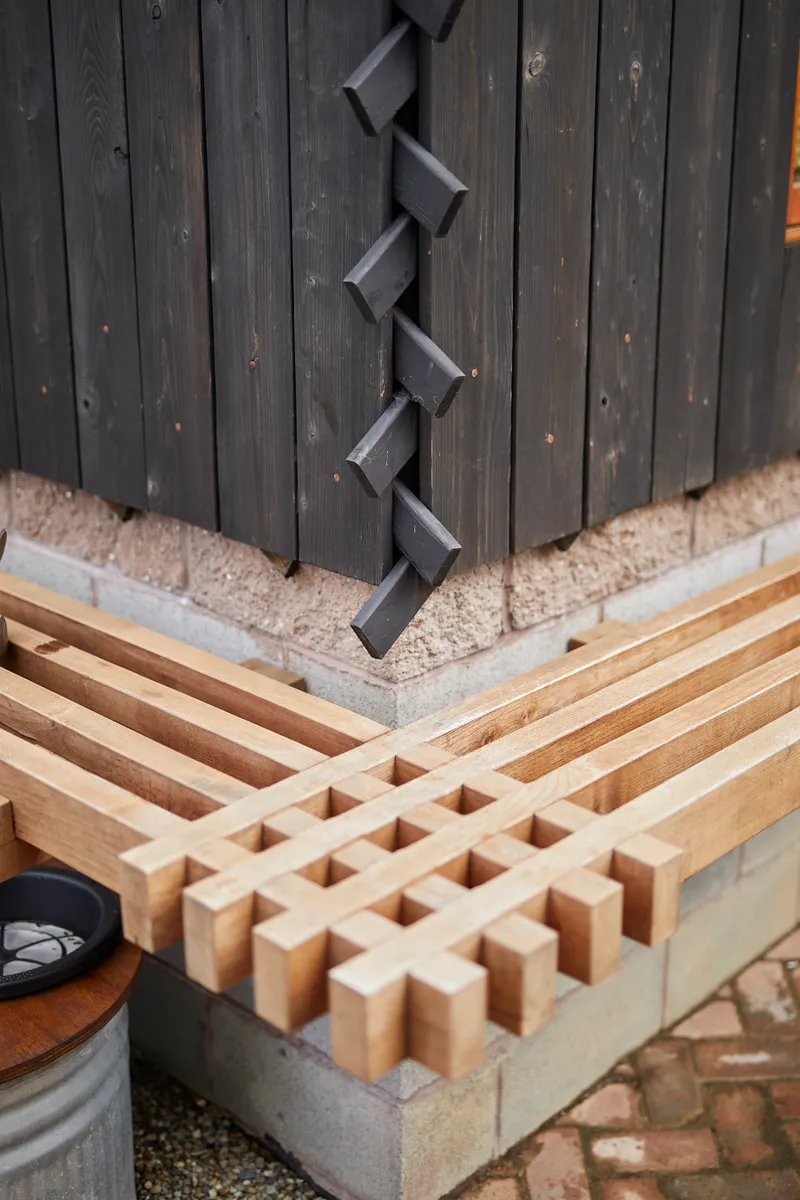
A corner detail reveals how carefully the charred boards are resolved: vertical cladding meets a timber gridded bench on a concrete base, each material articulated distinctly. There is no attempt to blend or conceal. The bench reads as furniture and threshold simultaneously, a small gesture that tells you BLDUS designed this building at the scale of a joint, not just a plan.
Woven Walls and Wool Cavities
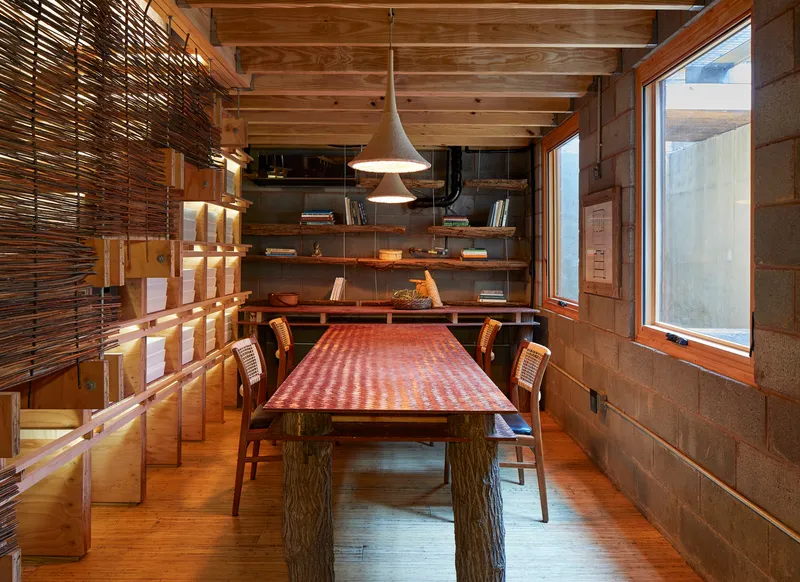
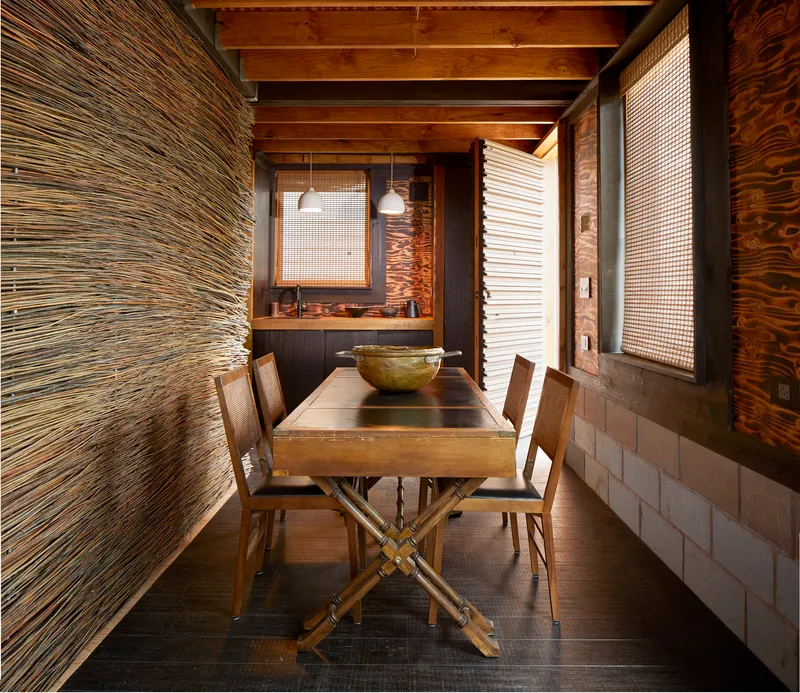
Step inside and the material logic inverts. Where the exterior is dark and closed, the interior is golden, layered, and textured. Exposed timber ceiling beams span the dining area, while walls cycle through treatments of woven willow screens, plywood panels, and horizontal wood shelving. The willow partitions are the most striking element: they filter light without blocking it, creating a diffuse privacy that glass could never achieve. Here is BLDUS's answer to Johnson's transparency, a screen that admits light but withholds the gaze.
Behind those woven surfaces, sheep's wool fills the wall cavities. It does not absorb moisture, eliminating the mold and mildew problems that plague conventional insulation in humid Mid-Atlantic climates. Combined with Loewen triple-pane windows and a Lunos energy recovery ventilator, the building envelope performs at a level that most residential projects in D.C. do not even attempt. The Grass House is warm in winter, cool in summer, and breathable year-round.
A Workspace Lined in Light
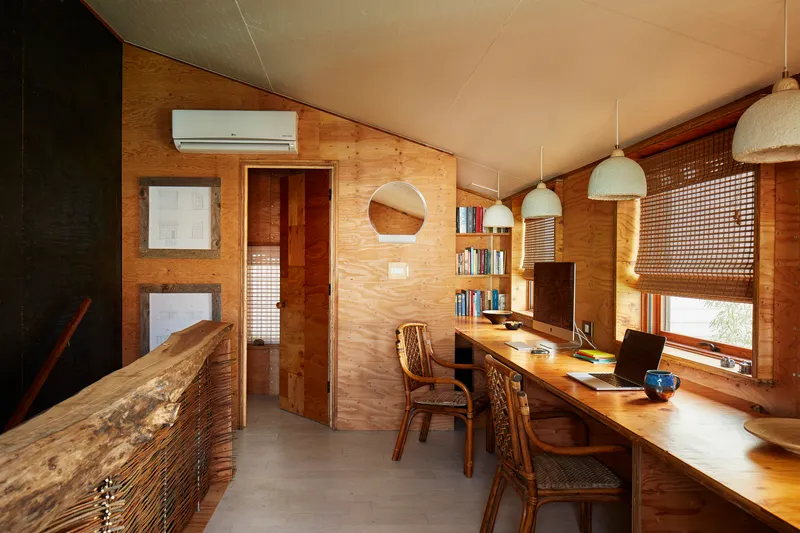
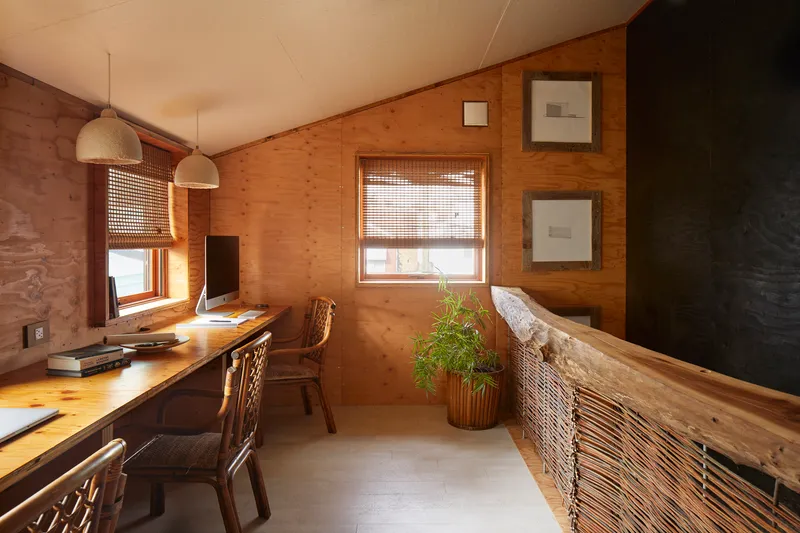
The Grass House serves triple duty: office for BLDUS, guest house, and art studio. The study area on the upper level shows how tightly the program is resolved. A built-in desk runs along a plywood wall beneath woven lattice window shades that modulate afternoon sun. Cork flooring absorbs sound and softens footfall. Woven pendant lights hang in the workspace below, casting pools of warm light across the timber surfaces.
Every surface does work. The shelving doubles as display and storage. The screens double as light control and spatial division. In 700 square feet there is no room for single-purpose elements, and BLDUS treats that constraint as a design driver rather than a limitation. The result is a space that feels generous despite its modest footprint, because each material and detail has been considered at full resolution.
Plans and Drawings
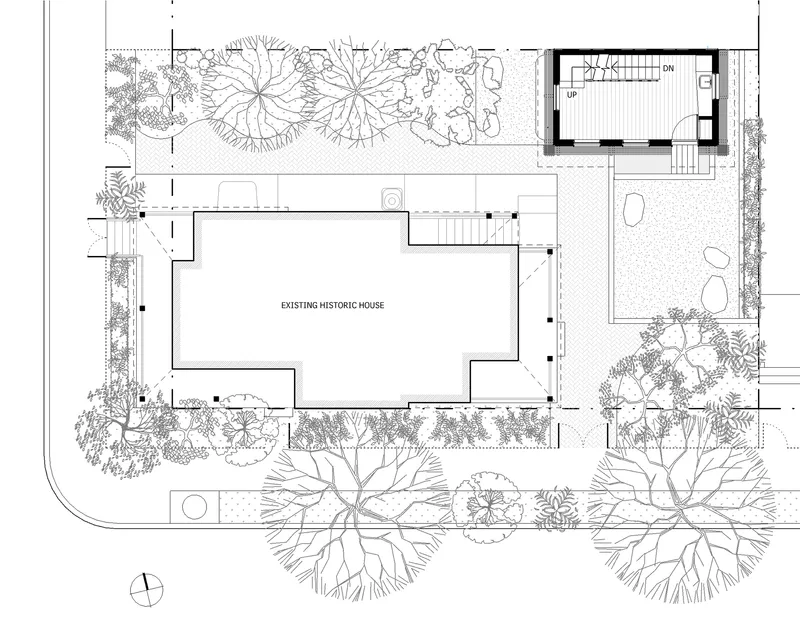
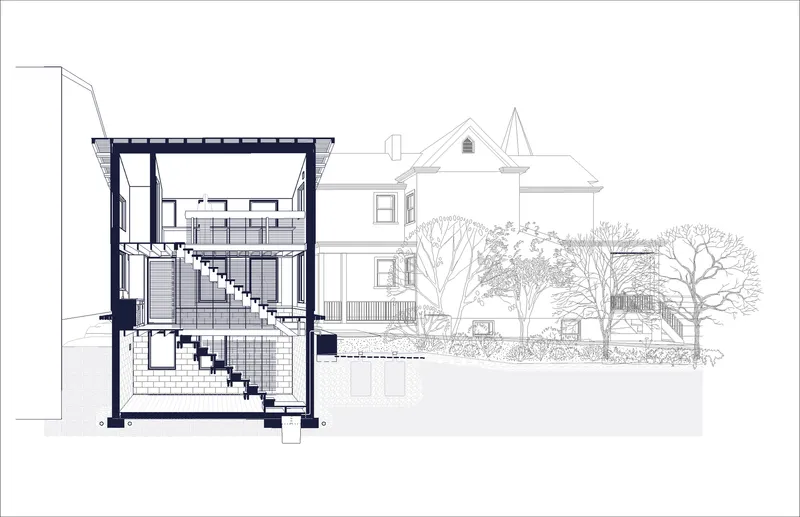
The site plan clarifies the relationship between the existing Victorian house and the new addition, connected by a stair and framed by landscaping that softens the boundary between the two structures. The section drawing reveals the vertical organization: two compact floors stacked within the pitched volume, with stairs linking the addition to the existing house beyond. The drawings confirm what the photographs suggest, that the Grass House is not an isolated object but a carefully grafted extension of a 19th century lot.
Why This Project Matters
The Grass House matters because it collapses the distance between material research and lived architecture. BamCore's bamboo panels were, at the time, a product without a precedent on the East Coast. BLDUS did not just specify them; they proved that code-compliant bamboo construction could work in a historic district, in a humid climate, at a residential scale. That is the kind of risk that shifts an industry. Every bamboo project that follows on the Eastern Seaboard will owe something to this 700-square-foot proof.
But the deeper contribution is philosophical. By naming the project against Philip Johnson's Glass House, BLDUS reframes the conversation about what progressive architecture looks like. It does not have to be transparent. It does not have to be white. It can be woven from willow, insulated with wool, and clad in charred locust. It can sit at the foot of Frederick Douglass's house in a historically Black neighborhood and propose that sustainability is not a luxury amenity but a right. The Grass House is small. Its argument is not.
Grass House by BLDUS, located in the Historic Anacostia neighborhood of Washington D.C., United States. Approximately 700 square feet. Completed in 2019. Photography by Ty Cole.
About the Studio
Share Your Own Work on uni.xyz
If projects like this are the kind of work you want to make, uni.xyz is a place to publish your own, find collaborators, and enter design competitions.


Popular Articles
Popular articles from the community

Temporary Home for Dogs: A Reversed Zoo Rethinks Animal Shelter Architecture
In Bucharest, a sinuous corridor and freed landscape flip the logic of containment, designing a shelter that works to make itself unnecessary.

Opera on the Sea: Driftwood Logic Shapes a Timber Opera House on Estonia's Coast
Trevor Orgill's opera house translates the entangled drift of floating timber into a civic building where wood, water, and music converge.
Faces of the Soviet Avant-Garde: Turning Moscow's Street Names into an Open-Air Museum
A network of sculptural installations across a Moscow residential district transforms forgotten architect names into spatial encounters with cultural memor
Tsunami Convergenics: Turning Catastrophic Ocean Forces into Underwater Housing Infrastructure
A speculative underwater settlement off the coast of Onagawa, Japan, treats tsunamis and typhoons as energy sources rather than threats.

Similar Reads
You might also enjoy these articles

Bao Huynh Watercolor Atelier: A Serene Art Retreat in Hội An
Bao Huynh Watercolor Atelier in Hội An blends multifunctional art spaces, sustainable design, local materials, and family-friendly living in a serene environment.

Atelier Macri Concept Store Interior Design by CASE-REAL
Atelier Macri store features a "ko" counter, walnut wood details, cork displays, blending retail, gallery, and seamless customer experiences.

Manuel Vargas Izquierdo Stadium and High-Performance Sports Center: Architectural Excellence in Jalpa de Méndez
The Manuel Vargas Izquierdo Stadium blends sustainable design, inclusive sports facilities, and cultural-inspired architecture, revitalizing Jalpa de Méndez’s public spaces.

KAKR Buluh Awar Hall: Revitalizing Community and Ecology Through Bamboo Architecture
Community built bamboo hall revitalizes Buluh Awar village, empowering youth, restoring ecology, celebrating vernacular craftsmanship through sustainable architecture and culture.


Comments (0)
Please login or sign up to add comments
No comments yet. Be the first to comment!