
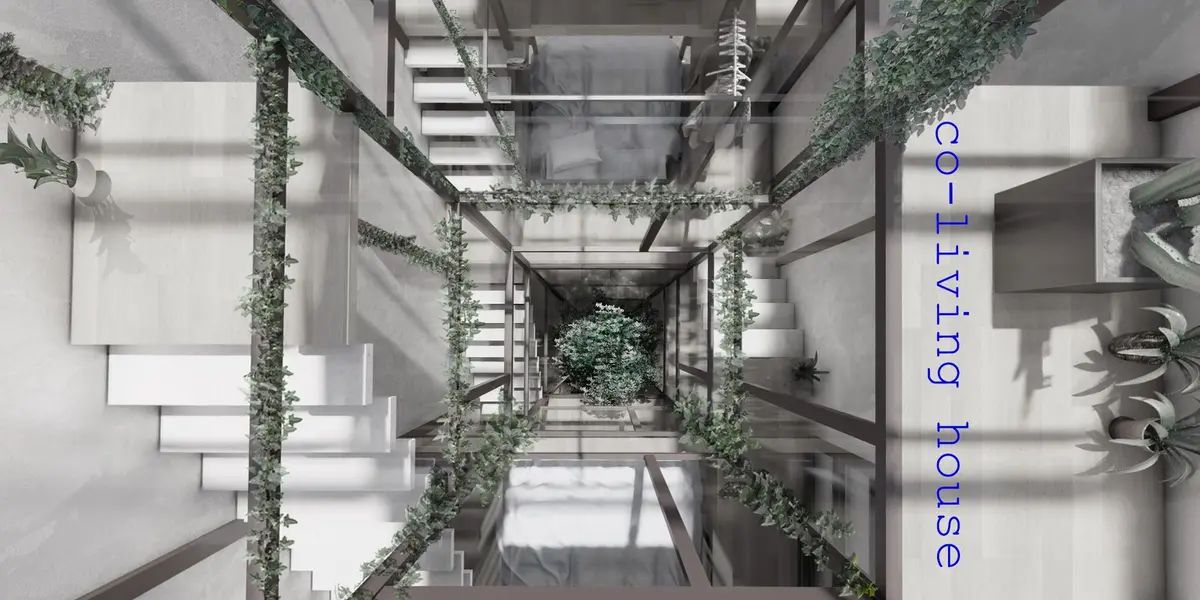
Co-Living House: A Wall-less Vertical Home for Three Generations in Thessaloniki
Six residents, zero interior walls, and a scaffolding grid that turns a narrow urban lot into a shared vertical landscape of light and air.


What happens when you strip a house of every interior wall except the ones around the bathrooms? For six people living together across three generations, the answer is a radical experiment in transparency: a scaffolding-framed vertical dwelling where every floor plate floats in open air, connected by ladders, stairs, and two daylight-channeling atriums that run the full height of the building. Privacy is traded for proximity. Isolation is replaced by mutual visibility. The result is a co-living prototype that treats architecture itself as a social contract.
Designed by Misak Terzibasiyan and awarded Honorable Mention in the Nano Nest 2020 competition, the project is sited in central Thessaloniki, just 100 meters from the sea. Wedged between existing apartment blocks in one of northern Greece's most densely built coastal cities, the house occupies a narrow lot and responds directly to the Mediterranean climate, local material economies, and the pressing need for compact yet dignified urban housing.
Split Levels, Shared Air: A Section That Reads Like a Community
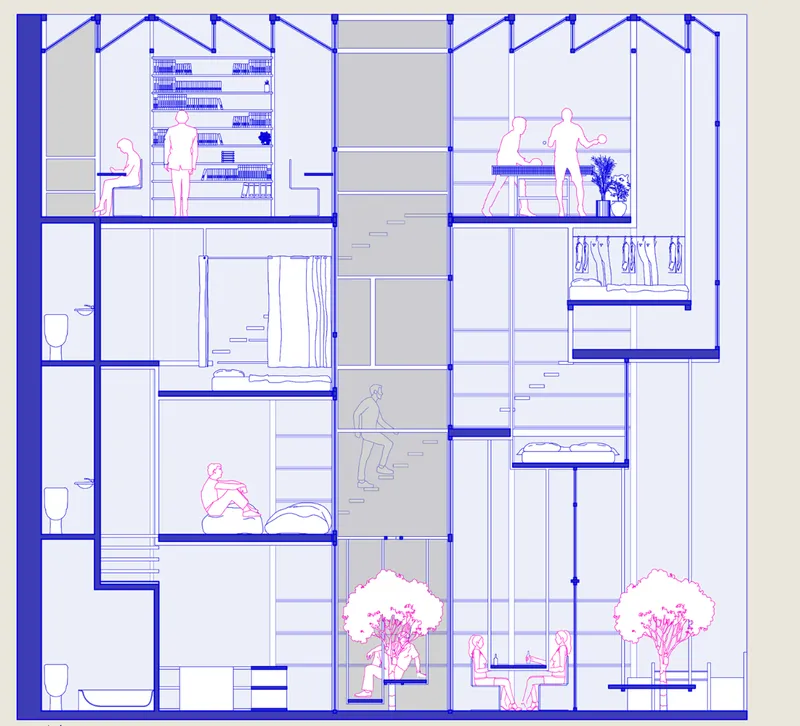
The section drawing reveals how the house actually works as a social instrument. Split-level platforms stagger vertically, each one accommodating a different domestic function: sleeping, cooking, reading, gathering. Human figures appear at varying heights, connected by ladders and open stairs rather than corridors. Planting occupies the gaps between levels, softening the steel structure and introducing living material into the spatial sequence. There are no hallways, no doors to close. The section is legible as a single continuous room organized by elevation.
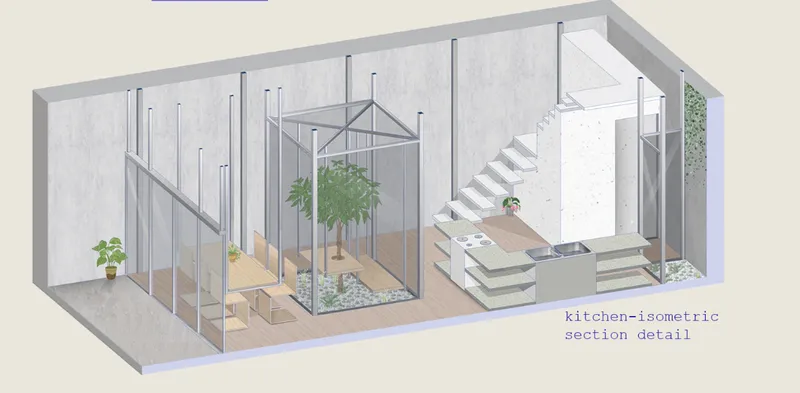
The isometric cutaway further clarifies the relationship between enclosed and open. A kitchen occupies one level, stairs wind through the core, and an interior tree grows within a courtyard carved into the building's volume. The courtyard is not decorative; it serves as a light well and ventilation channel, one of two vertical atriums that pull daylight from roof openings down to the lowest floor. These voids make the narrow footprint breathable, both literally and psychologically.
A Scaffolding Grid Instead of Walls
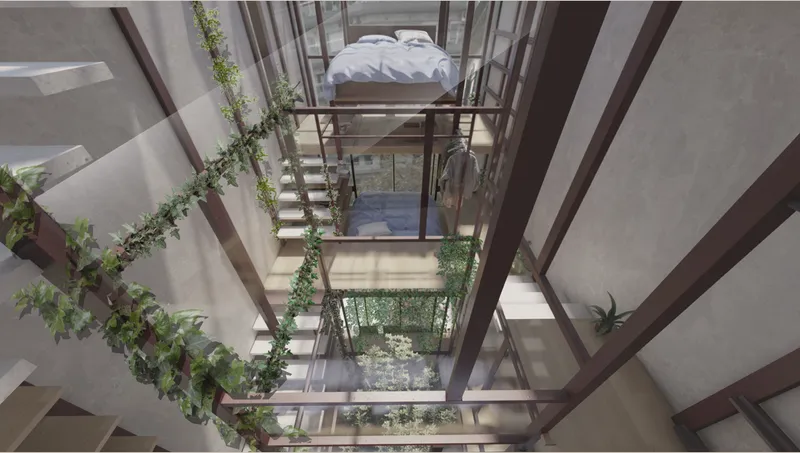
Looking upward through the interior void, the structural logic becomes visceral. Steel columns form a modular scaffolding grid that replaces load-bearing walls entirely. Floor slabs appear to hang in space, supported by this skeletal framework. A suspended bedroom platform occupies one of the upper levels, with climbing plants threading through the open structure below it. Polycarbonate and glass panels on the facade and roof let natural light flood in from all sides, while movable skylights and operable windows create a responsive internal climate without mechanical systems.
The scaffolding concept does more than hold the building up. It enables adaptability. Foldable desks and seats slot directly into the steel columns and can be stowed when not in use, freeing floor area for movement or entirely different activities. A dining table becomes a reading desk. A living room converts into a projector room. Furniture is not placed in the architecture; it is embedded in it. For three couples spanning ages 20, 40, and 60 who share interests in hiking, reading, and sustainable living, this flexibility is not a luxury but the operating system of daily life.
Narrow Lot, Dense Neighborhood, Maximum Porosity
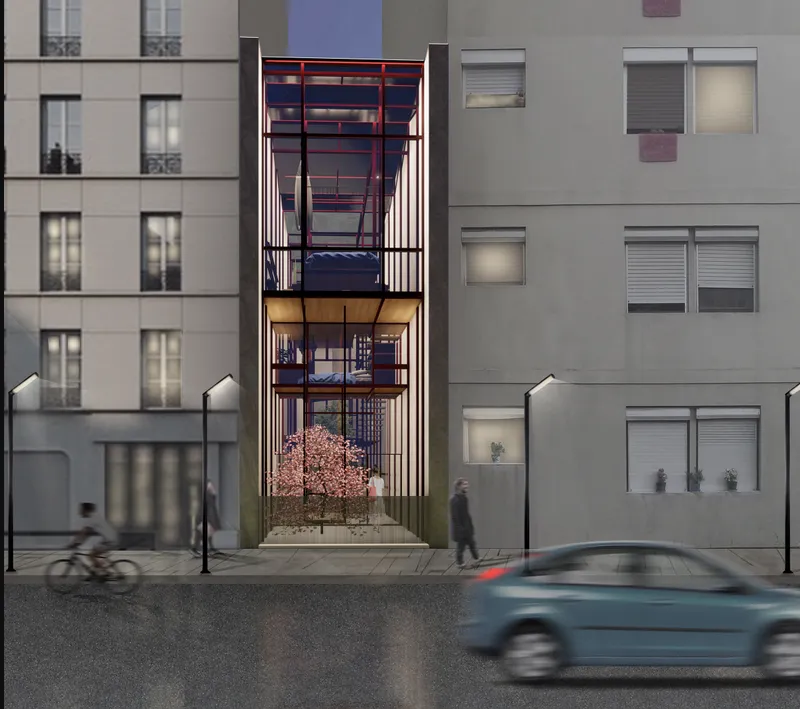
The facade view at dusk reveals the building's urban condition with stark clarity. The house is inserted into a gap between existing apartment blocks, its narrow profile barely wider than a single room. A cyclist and a passing car establish the street scale. Where the neighboring buildings present solid, repetitive facades, the co-living house glows: its translucent skin of polycarbonate and glass transforms the structure into a lantern, broadcasting the life inside to the street. The contrast is pointed. Density does not have to mean opacity.
Thessaloniki's Mediterranean climate, with its abundant sunlight and mild winters, makes this level of openness viable. Large openings enable cross-ventilation, and rooftop apertures reduce dependence on artificial lighting and temperature control. The material palette reinforces this logic of efficiency: locally sourced wood, concrete, and steel keep the supply chain short and the embodied energy low. The building is designed to be circular, not just sustainable in the passive sense but materially recoverable.
Stacked Plates, Pink Cores, and the Logic of Assembly
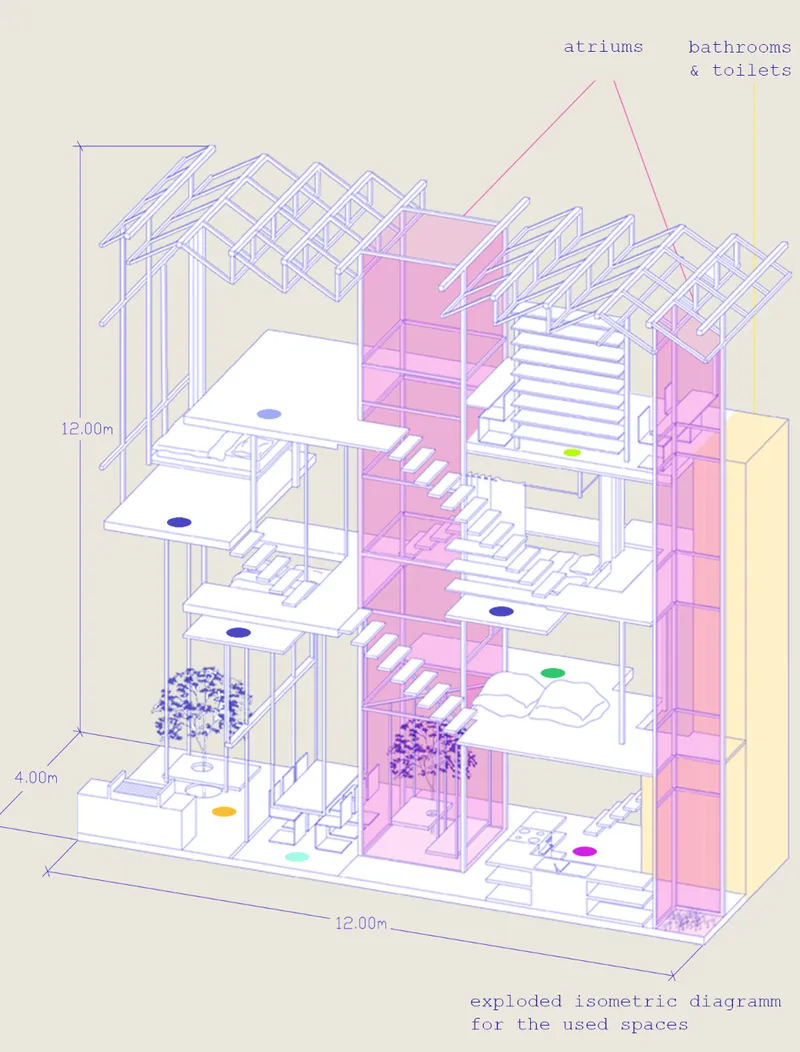
The exploded axonometric strips the project down to its organizational DNA. Floor plates separate vertically, exposing the atrium voids and the service cores, highlighted in pink, that anchor plumbing and bathrooms to specific positions in the plan. Everything else is free. The diagram makes legible what the sections imply: the only fixed elements in the entire building are the wet rooms. Every other square meter is negotiable, adjustable, and open to reinterpretation by the residents who inhabit it.
Greenery appears on multiple levels in the exploded view, reinforcing its role not as ornament but as environmental infrastructure: improving air quality, moderating temperature, and contributing to the psychological well-being of residents who live without the buffer of private enclosure. The integration of planted zones throughout the vertical stack turns the building into something closer to a terraced garden than a conventional apartment.
Why This Project Matters
Co-living projects often default to shared kitchens and common rooms bolted onto otherwise conventional apartment plans. Terzibasiyan's proposal goes further by questioning the wall itself as a default element of domestic architecture. The decision to eliminate interior partitions is not naive utopianism; it is calibrated to a specific household of six people who already live as a unit. The architecture does not impose communality. It spatializes a social reality that already exists, giving it vertical dimension, natural light, and room to evolve.
More broadly, the project demonstrates that density and quality of life are not opposing forces. On a narrow lot in one of Greece's most compressed urban centers, the design achieves porosity, daylight penetration, natural ventilation, and embedded greenery without sprawling outward. It treats the constraints of the site as generators of the architectural idea, not obstacles to overcome. For students and young designers working on housing, this is a useful provocation: the most interesting solutions often begin by removing what everyone assumes is required.
View the Full Project
About the Designers
Designer: Misak Terzibasiyan
Enter a Design Competition on uni.xyz
uni.xyz runs architecture and design competitions year-round that reward proposals with spatial conviction and real site intelligence.
Project credits: CO-LIVING Housing by Misak Terzibasiyan Nano Nest 2020 (uni.xyz).


Popular Articles
Popular articles from the community


Lunar Spiral: Space Architecture Shaped by the Mathematics of the Universe
Lunar Spiral reimagines space architecture through Fibonacci geometry, lunar regolith, levitating habitats, and self-sustaining Moon living.

ALGAL REALM: A Bio-Integrated Lunar Habitat Design for Life Beyond Earth
ALGAL REALM reimagines lunar habitat design with algae-powered life support, 3D-printed regolith, and vertical living for a lunar future.

The Ocean Hive: Sustainable Architecture for a Self-Sufficient Civilization at Sea
The Ocean Hive imagines sustainable architecture at sea, where modular habitats, algae, wave power and ocean waste sustain a growing colony.

Co-life: Sustainable Architecture for Age-Friendly Community Living
Co-life reimagines sustainable architecture for seniors through courtyards, rammed earth, shared gardens, and spaces designed for belonging.

Similar Reads
You might also enjoy these articles

Day and Night Park: A Time-Based Urban Newsstand in Beijing
A temporary urban newsstand in Beijing blending travel, light, and reading through poetic colors, compact form, and community-focused design.

Modernist Patio Renovation in El Masnou, Barcelona by Oliver Segura Arquitectura + Cebrià Arquitectura
Modernist patio renovation blending tradition and innovation with a movable pool, leveled floors, and Catalan materials in El Masnou.

Alto Residencial Coop: Cooperative Housing Development in Santiago de Compostela by Carbajo Barrios Arquitectos
A linear cooperative housing complex blending white volumes and perforated metal façades, enhancing community living, natural light, privacy, and urban integration.
Vil Genis School by BPA ARCHITECTURE – Massy, France
Vil Genis School in Massy, France, features sustainable design, south-facing classrooms, community integration, accessible spaces, and modern educational architecture.

Comments (0)
Please login or sign up to add comments
No comments yet. Be the first to comment!