
EUNOIA
Beautiful thinking

Eunoia [yoo-noy-uh] Greek
A pure and well-balanced mind, a good spirit.
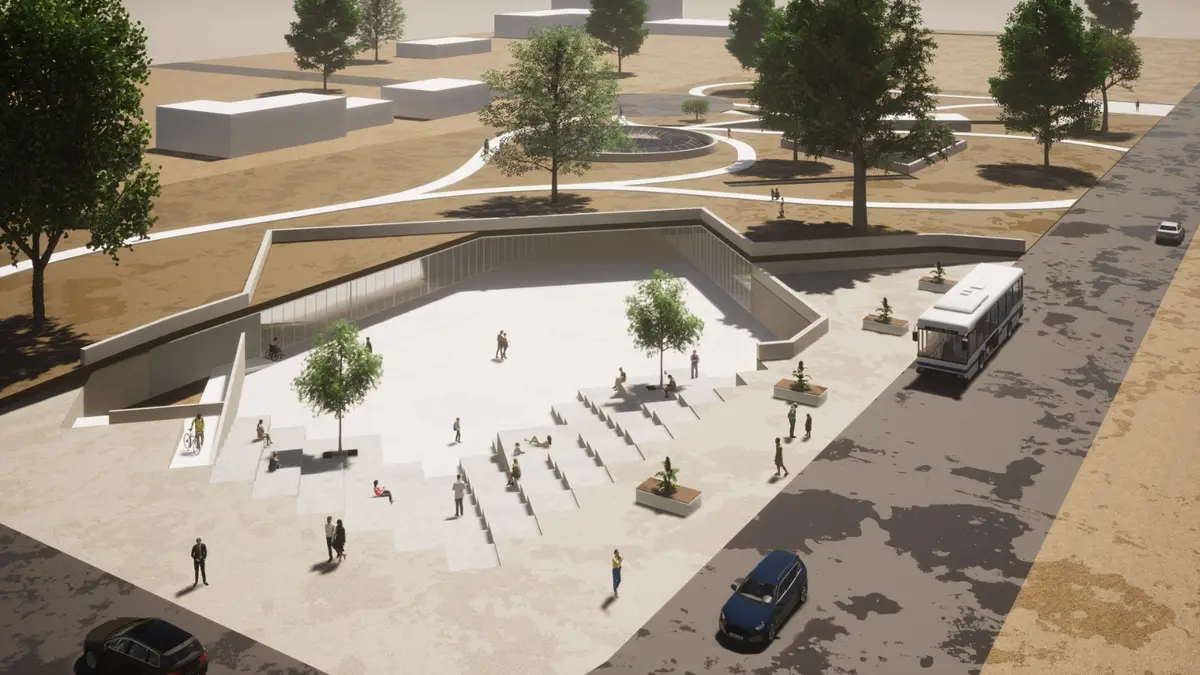
‘Slowing down, experiencing, and thinking’ are the parts of the methodology that is accepted and embraced while recreating the faded-green Nuestro Park, located in the hot-arid climatic conditions of Phoenix, Arizona. When Nuestro Park and its surroundings are analyzed, apart from the plenty of open areas, mostly reserved for housing, it is found out that the region is full of junkyards, related with the car rentals and related repair shops, serving all to the airport at a short distance. Another distinct data found out is the existence of many worship places of different religions scattered in the region.
Although the project area is located nearby downtown Phoenix, the neighborhood of the project area carries low-density suburban characteristics in a grid-iron plan in rectangular building blocks, with dispersed, mostly single-story individual residential buildings in their gardens, lacking an urban focal point to bring the inhabitants together. The project area has a character that does not have much attraction power with any reference related to the environment, vegetation, or topography.
While implementing the requirements of the project, the approach of creating an environment that would fulfill the users' both physical and mental needs (200 visitors daily) is preferred. The main intention is to provide a linear route experience where individuals can reach their inner cores, be alone with their thoughts, and disconnect from the rest of the world, but in a way unifying the inhabitants of the neighborhood in this new focal point. The design of the project is aimed to give the visitor the opportunity to experience it with his/her body, as it is thought that spiritual experiences.
To blend the project requirements with the new perspective brought, three phases are formulated and designed where the experiences and the activities will differentiate from each other. Phase I is an answer for the commercial requirements of the area as an attraction point for the neighborhood at a sunken plaza. Phase II is the first step of separation from the outer world where the underground art studios are located. Phase III (or the Eunoia) is to meet people’s spiritual needs, as a subterranean space at the end of the aimed narrative where they can both experience, relax and later reconnect with the nature above in the reorganized/redesigned Nuestro Park. By the way, as the hot-arid climatic conditions are challenging to keep a park green, more appropriate climate-friendly landscape options are searched and proposed. Thus, the project will add vitality to both the city and the region offering a different spiritual experience to both the local inhabitants and the visitors of the area. Depending on the junkyards of rental cars in the region, it is believed to be decent and appropriate to use scrap materials at the interior installations, upper structures, and façade elements recycling and upcycling them. In addition, one of the studios is proposed to be an artisanal workshop using these scrap metals in and around the project area with the intent to decrease the environmental pollution in the district. Although the proximity of the project area to the airport and the presence of scrap materials cause pollution in various ways, it is believed that sustainability can still be achieved for the city and the district.

Popular Articles
Popular articles from the community


Juan García Correa, John González and Claudia Rueda Sink a Circular Amphitheater into a Manizales Engineering Building
On the La Nubia campus in Manizales, Colombia, the S1 Building folds labs and offices into a hillside of ramped lawns that double as a campus route.

ETEH Reworks the Shared Spaces of São Domingos School in Brazil Around Timber, Color and Hanging Plants
At São Domingos School in Brazil, 436 m² of hall, refectory and library are recast with timber joinery, a yellow and blue code and trailing greenery.

David Ortega Stacks a Two-Story Mexico City Penthouse Around a Steel Stair and a Pergola-Shaded Roof Terrace
In Colonia Roma, a 300 m² penthouse uses oak joinery, a planted steel stair and a slatted roof pergola to make a new-build apartment feel like a house.

Cube Design Draws an Ecological Corridor Between Two Shenzhen Hills with the Nankai Building
Beside Shenzhen's container docks, the Nankai Building pairs stacked balconies with a climbing green screen to connect two hillsides across its height.

Similar Reads
You might also enjoy these articles


Vereda Arquitetos Renovates a 40-Square-Meter Apartment Inside Niemeyer's Copan Building
A compact unit in São Paulo's most iconic residential tower gets a material overhaul that pairs exposed concrete with bold blue Formica.

Shakur's House: Exposed Brick as an Interior Organiser in a 168 m² Mashhad Residence
Brick moves indoors in this Mashhad residence, where masonry walls, glass partitions and teal planes sequence a compact home without closing it off.

Day and Night Park: A Time-Based Urban Newsstand in Beijing
A temporary urban newsstand in Beijing blending travel, light, and reading through poetic colors, compact form, and community-focused design.

Modernist Patio Renovation in El Masnou, Barcelona by Oliver Segura Arquitectura + Cebrià Arquitectura
Modernist patio renovation blending tradition and innovation with a movable pool, leveled floors, and Catalan materials in El Masnou.


Comments (0)
Please login or sign up to add comments
No comments yet. Be the first to comment!