

From Myth to Matter
Rejuvenating the flowing sanctity of panatirtha: Enhancing the natural and cultural tourism of panatirtha, tahirpur through architectural and planning intervention

Abstract
According to a popular adage, "sava tirthe varvar, pana tirthe ekvar," states that the same purity that can be obtained by bathing in other holy locations for periods of time can be obtained by bathing in "Panatirtha" only once. Therefore, the site holds a significance of great height for Hindu and Vaishnav followers. Sri Advaita Acharya, the 14th-century reformer of "Advaita Tattva; Non-Dualism" philosophy, was born in the holy site of Panatirtha, Tahirpur. Although the Panatirtha pilgrimage ceremony has been held on the banks of the Rakti River for over 500 years, with the belief that the seven sacred rivers (a reference to the Veda) have arrived together by the summoning of Advaita Acharya to fulfil his promise to his mother, the site has not yet been explored in terms of its future development. As devotees who travel to pray face obstacles, the spirituality of the place is eroding, and with it, the philosophy of Advaita Acharya, the rebirth of non-dualism is perishing. People are increasingly flocking to other spiritual sites in the area where better facilities have been established. Therefore, it is important to maintain spiritual areas and the underlying idea, while also improving areas where large numbers of people can congregate for rituals and incorporating these into regular user activities. Conservation and careful planning are required, as is the urgent search for untapped potential at the site. Beautiful, natural geology characterizes the area. Existing tourist attractions may be linked to the site, and the area might be transformed into a spiritual-based cultural tourism development area that could shine a light on the site all year long and preserve its ethos for future generations.
Keywords
Religion; Nature; Mythical; Tourism; Pilgrimage; Religious Tourism; Culture
INTRODUCTION
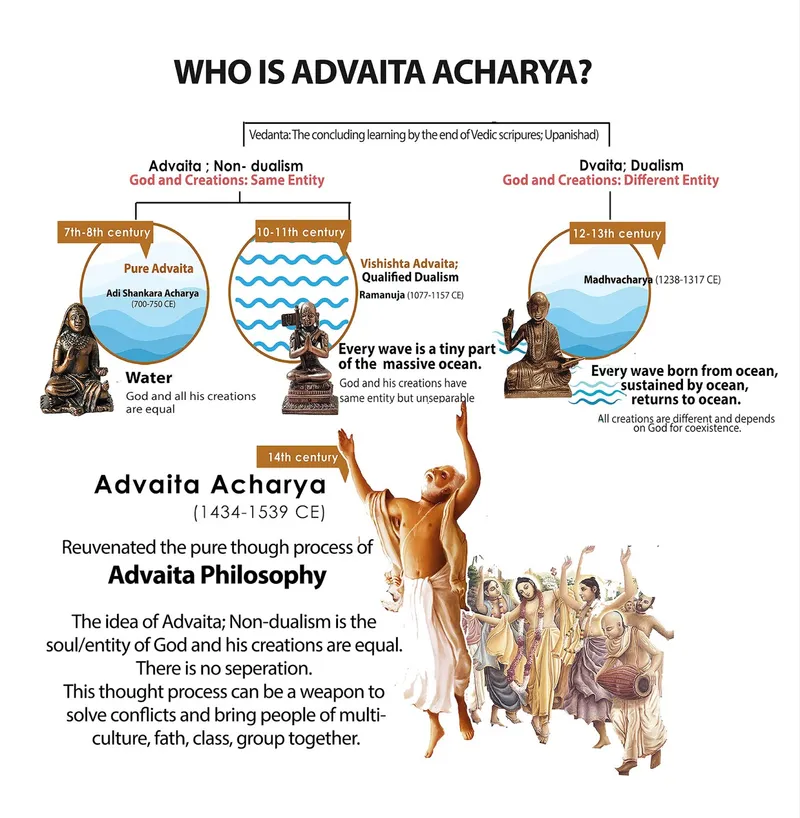
Panatirtha, a sacred pilgrimage site in the Sunamganj district of Bangladesh, holds deep spiritual significance for Sanatanis and Vaishnavas across South Asia. It is the birthplace of Advaita Acharya, the revered companion of Sri Chaitanya Mahaprabhu, the founder of Gaudiya Vaishnavism. Advaita Acharya revived the core Sanatan philosophy of Non-dualism, which teaches that the soul and the divine are one and the same- offering a timeless solution to social divisions through the realization of oneness in all beings.
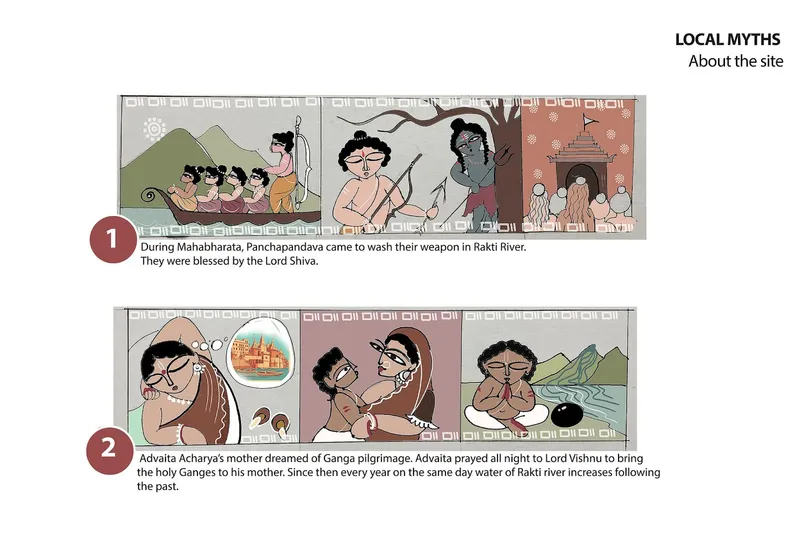
The site is steeped in myth and devotion, most notably the belief that during the Madhu-Krishna Trayodashi, the Rakti River (also known as Jadukata river) mysteriously rises, symbolizing the arrival of the Ganges. Legend says that as a child, Advaita prayed for the Ganges to appear so his ailing mother could bathe in its holy waters, and since then, the phenomenon recurs annually.
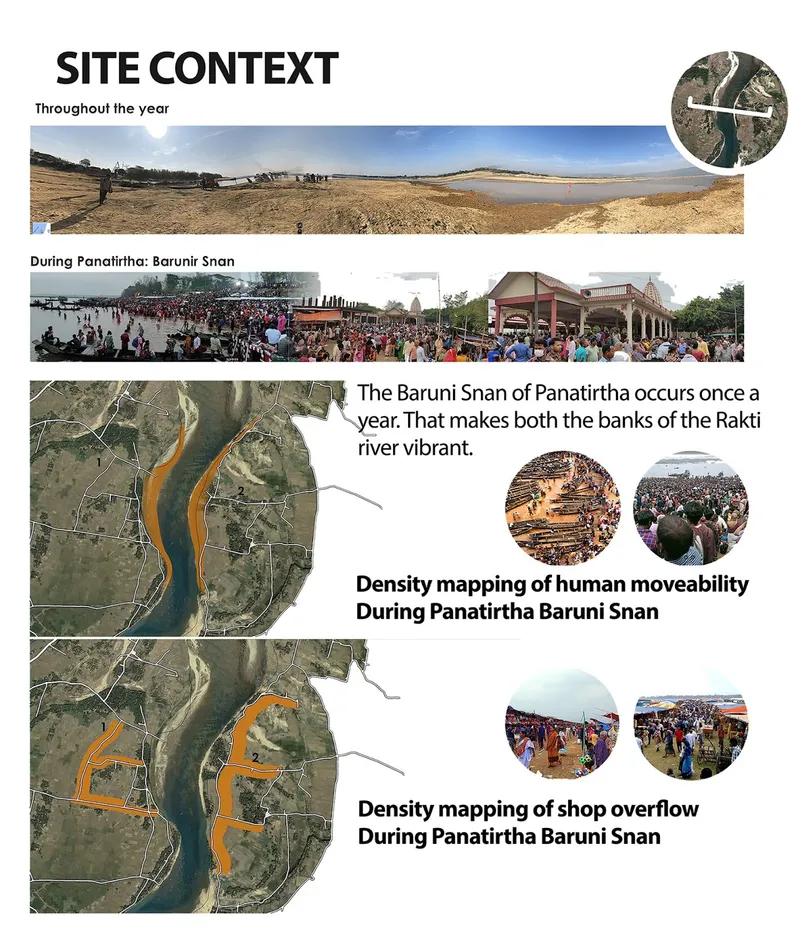
Thousands of devotees gather each year to perform the sacred Baruni Snan (a holy bath), seeking spiritual purification. Another ancient tale links the site to the Pandavas, who are believed to have worshipped Lord Shiva and cleansed their weapons in the Rakti before the Mahabharata war. Despite its profound cultural and spiritual value, Panatirtha faces significant challenges including lack of infrastructure, security, and growing philosophical shifts. A major concern is the rising influence of ISKCON across the river, where a large temple complex has been built, gradually overshadowing the original identity of Panatirtha. To preserve its legacy, a red ocean strategy is essential to reinforce its authenticity and unique place in spiritual history.
AIM OF THE PROJECT
This project seeks to evolve Panatirtha into a multi-functional social and spiritual complex that integrates the sacred identity with the existing natural and tourism pathways of the Tahirpur region. The aim was to design a fully operational, year-round facility to host spiritual and secular festivals, educational tourism, and cultural gatherings, strengthening Advaita Vedanta philosophy through architectural expression.
THE CHALLENGES: WHEN MYTH MEETS MARGINALIZATION
Several critical challenges shaped the project’s framework:
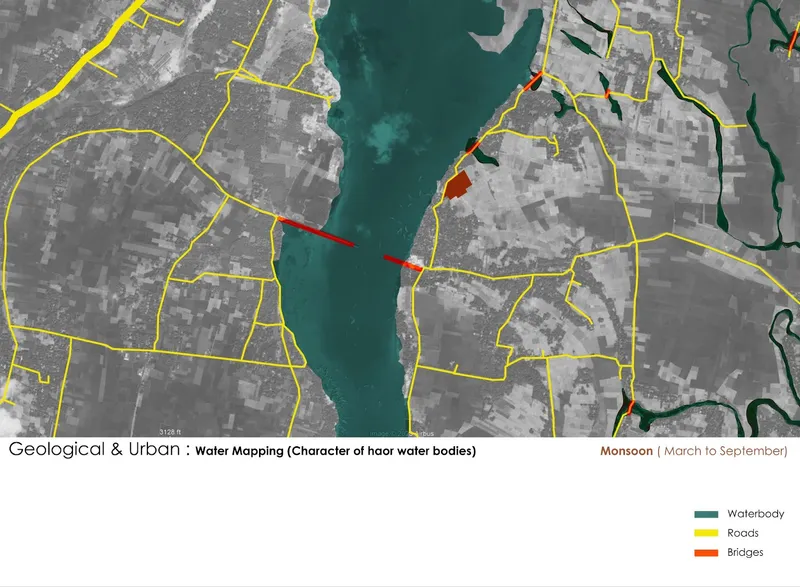
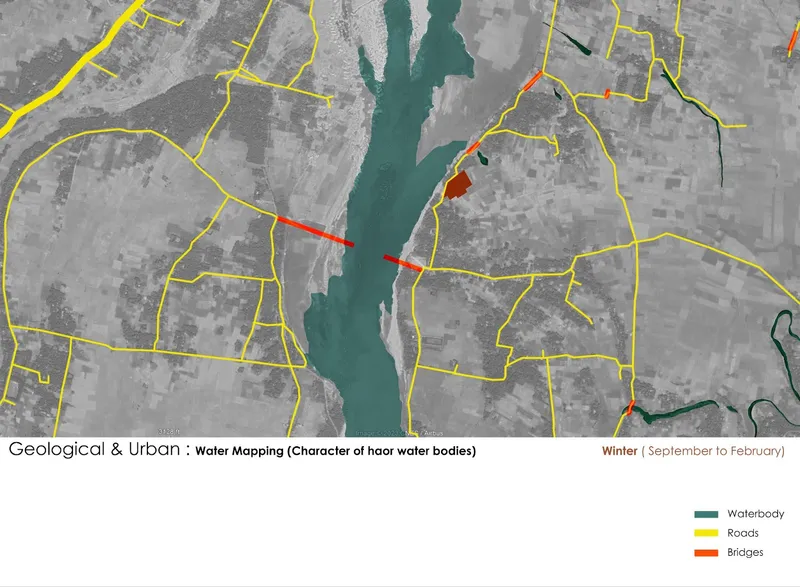
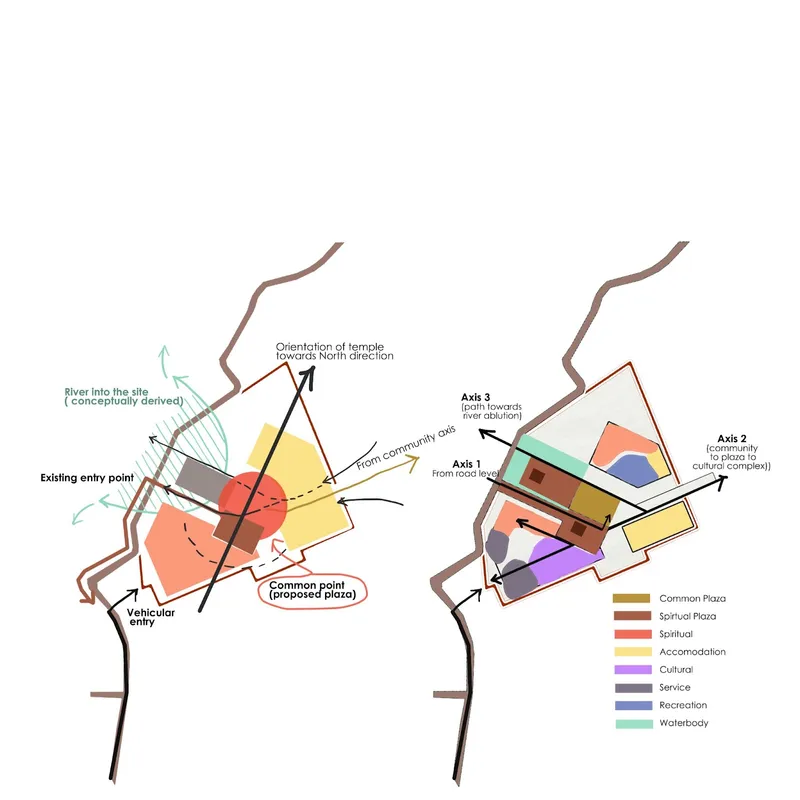
- Philosophical Dilution: As infrastructure deteriorates, spiritual engagement is eroded. Devotees encounter disorientation and discomfort, diluting the Advaita philosophy that underscores the site’s identity. The 3 diagrams below shows, without any intervention, the philosophy will continue to grow towards the west bank. Iskcon temple will grow as a new hub centering the philosophy. Thus with time, the originality of the myth and philosophy will be diluted.
- Lack of Social Safety: Border proximity has led to criminal occurrences around the site. This fear factor reduces visitation, especially during the off-season.
- Cultural Amnesia: Despite its rich spiritual lore, most citizens, even Hindus are unaware of Panatirtha’s significance. The traditions are at risk of fading.
- Underutilized Tourism Potential: Though the region is connected to Sylhet’s popular eco-tourism trail, Panatirtha remains underdeveloped, failing to tap into tourism-based economic growth.
- Ecological Fragility: Natural beauty and river ecology face threats from unplanned human encroachment and seasonal floods.
IDEA GENERATION
Grounded in New Contextualism, the design methodology followed the layered biography of Panatirtha, its myths, rituals, terrains, and transitions. The core design concept: “Walk Back in Time” guides users through a spatial narrative built on dual and non-dual philosophies, bringing myth and reality into architectural form.
To strengthen the spatial narrative, mythological, cultural, and philosophical layers were woven into the spatial design:
- Mythological Narratives such as the Pandavas washing their weapons in the Rakti River and Advaita Acharya summoning the holy rivers helped establish a sacred chronology across the site.
- Cultural and Historical Insights informed the preservation of folk traditions, interfaith harmony, and regional identity linked to the Sylhet-Assam cultural continuum.
- Tourism Potential was considered in activating the site both during the Baruni Snan season and the off-season ecotourism cycle. The site is seen not in isolation but as part of Sylhet’s broader tourism network.The site lies in the thoroughfare of 13 connected active tourism site of Sunamgonj, including Barek Tila, Shimul Bagan, etc.
- Design Strategy emphasized accessibility, seasonal adaptability, and inclusivity. Future infrastructural transformations such as a new bridge were anticipated and integrated into the planning.
CONCEPT: SPACE FOR ALL; ALL FOR ONE
- Part 1: Journey through Time
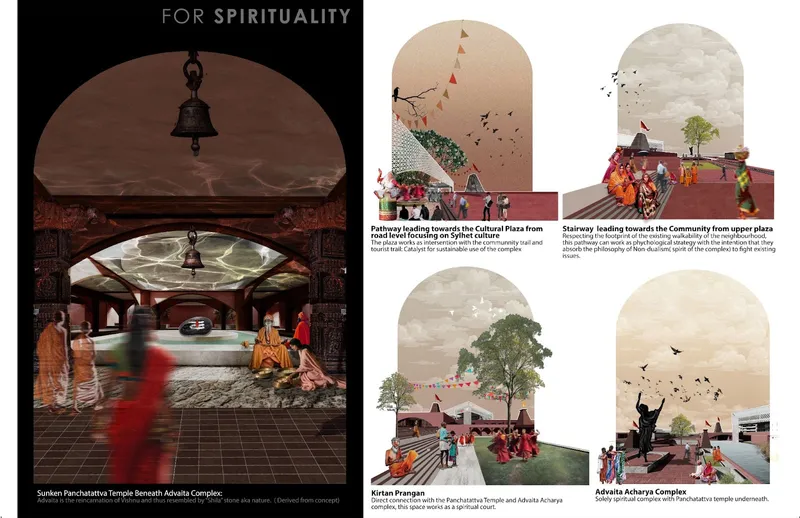
As per the mythological timeline, beginning with the myth of the Pandavas washing their weapons in the Rakti River, the journey emphasizes the oldest mythologies leading to the Shiva temple representing duality. The experience continues to Advaita Acharya’s tale of summoning holy rivers for his mother, creating the site’s spiritual magnetism.
- Part 2: Nogor Kirtan and Collective MemoryInspired by Advaita Acharya’s method of transmitting philosophy through Kirtan and spiritual song, a Kirtan Prangan was introduced designed for communal gatherings, festivals, and spiritual dialogue. This acts as a time relapse- a return to roots and revival of collective identity. Since the existing walkable path moves through and within the Kirtan Prangan, thus the community, tourist, and pilgrims moving on a daily and annual basis would intentionally and unintentionally be able to pass through the common ground. Thus, in the intervention, the people will move and revive towards the philosophy, while ages ago philosophy walked door to door with the steps of Advaita Acharya and his Gaudiya Vaishava movement.
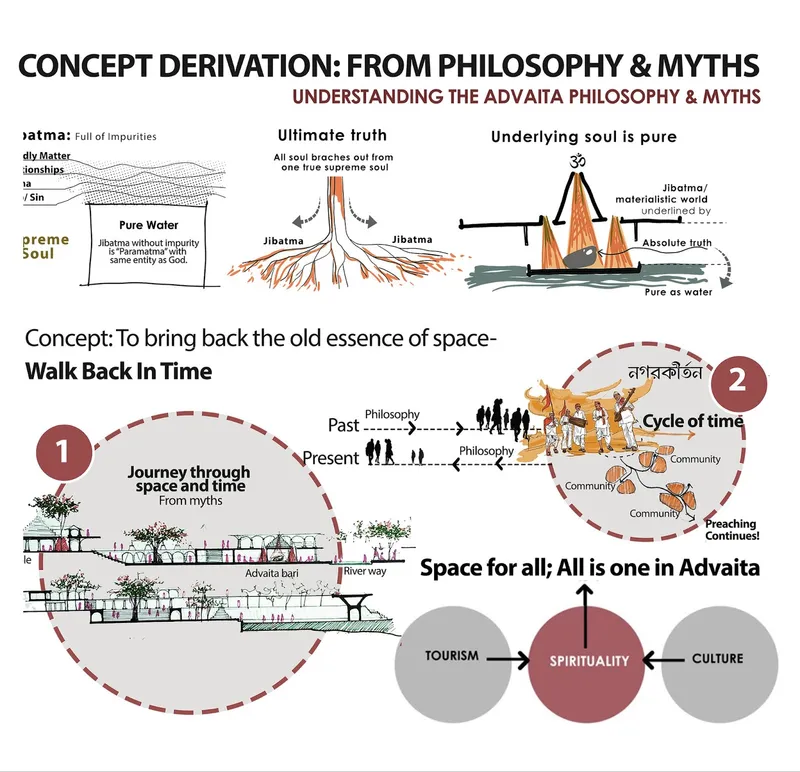
The Design Philosophy is reflected in sacred typologies: the Shiva Temple follows a dualistic path of redemption; the Advaita Complex and Pancha Tattva Temple illustrate non-duality. Sacred elements like Bel, Tulsi, and Banyan trees mark significant philosophical nodes in the spatial flow.
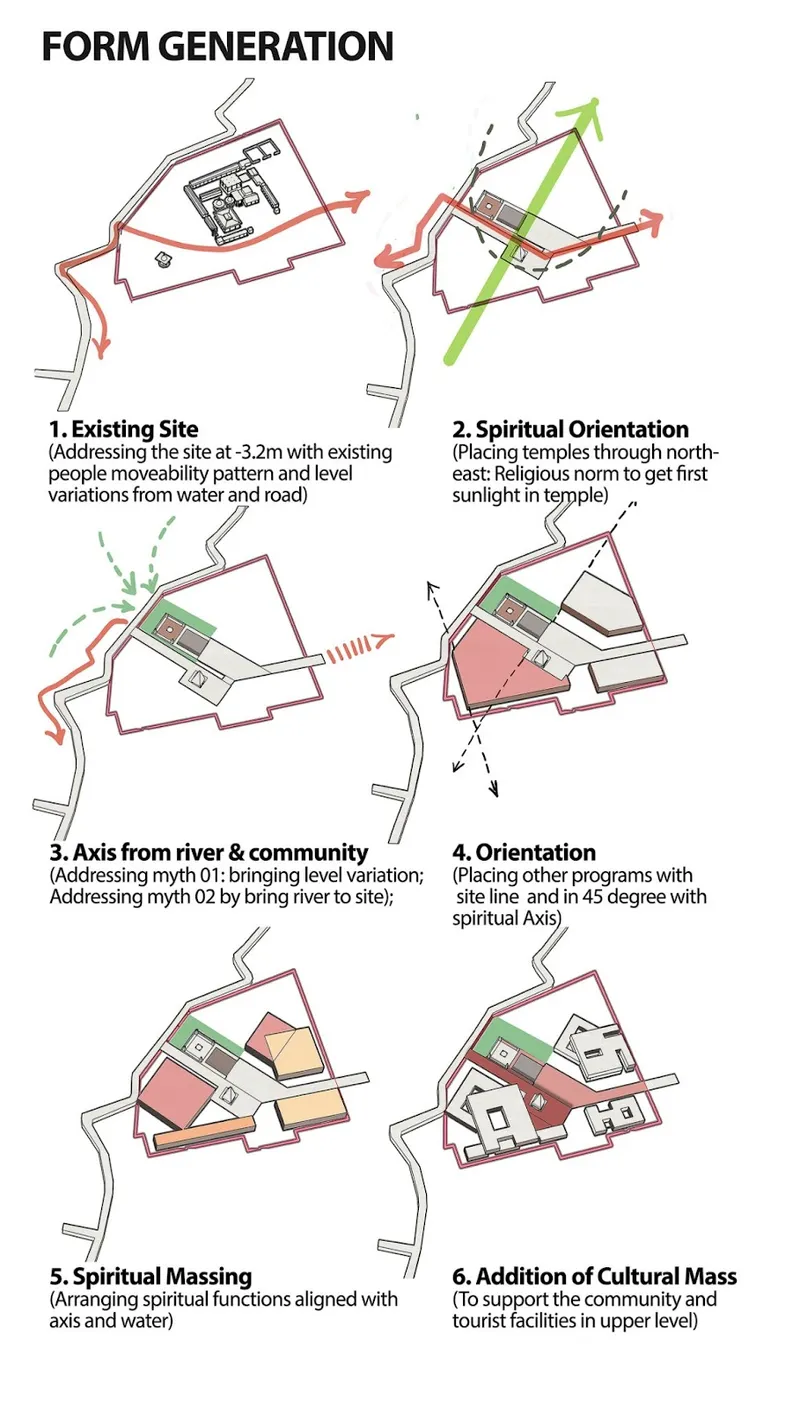
FORM GENERATION
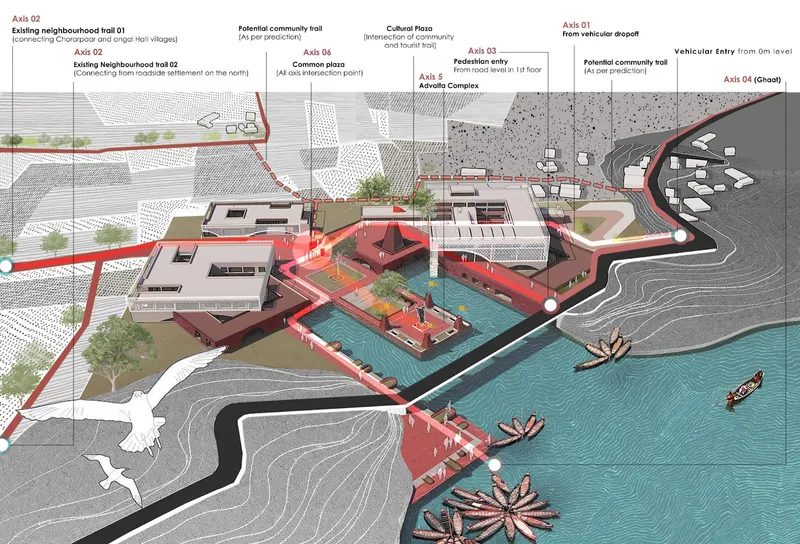
Space allocation has been guided by a detailed analysis of user groups and their presence throughout the year. Three primary target groups have been identified: Pilgrims (annual visitors). Tourists (seasonal visitors), and the Local Community (daily users). Based on their movement patterns and density, three distinct trails have been mapped out: T1 for pilgrims, T2 for tourists, and T3 for the local community. Pilgrims and tourists will enter from the road level, descending gradually through the site- experiencing the spatial narrative of myth and devotion, symbolizing the "Journey of Space."
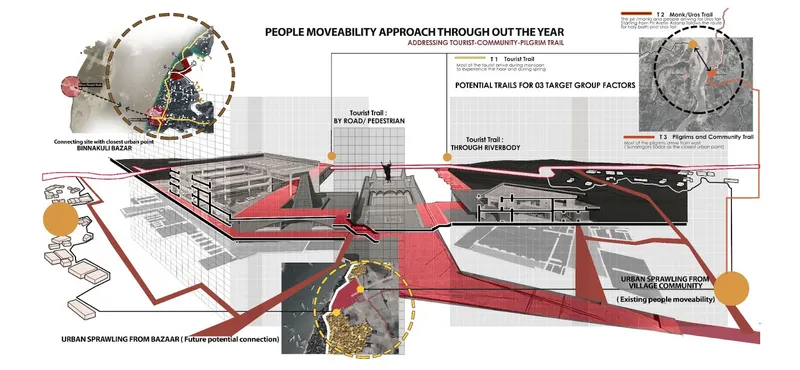
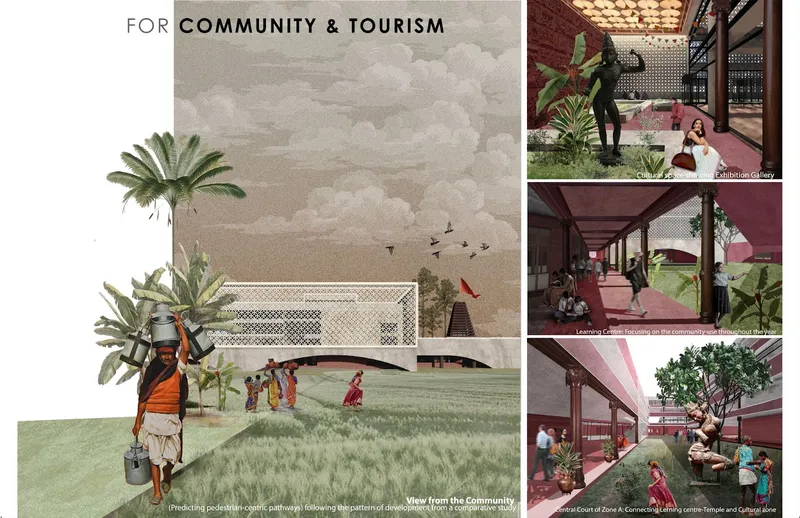
In contrast, the community trail connects current and potential future neighborhoods, representing a "Journey of Time"-from daily life to philosophical reflection. These three trails converge in a central courtyard, a communal point of intersection and harmony.Water plays a vital symbolic and spatial role throughout the project, representing the pure essence of nature. and by extension, the soul. This connection reinforces the core philosophy of Non-dualism, blending purity, unity, and the spiritual bond between humanity and nature.
THE PLAN: DESIGNING DEVOTION
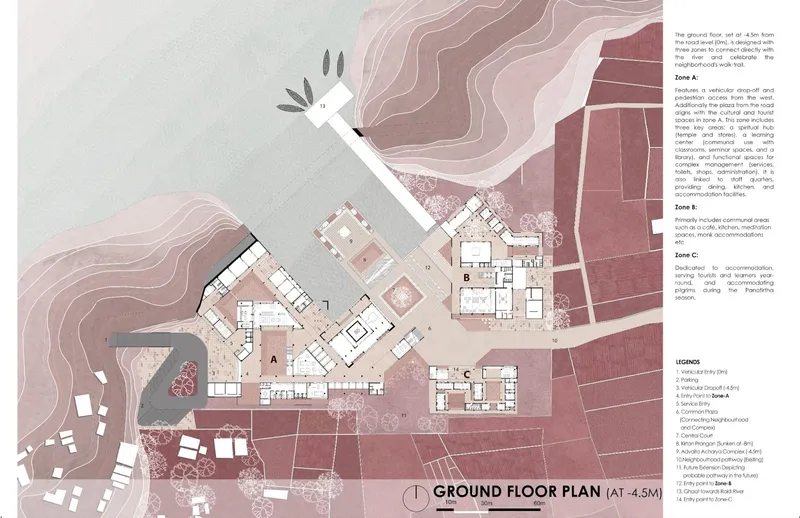
The ground floor, set at -4.5m from the road level (0m), is designed with three zones to connect directly with the river and celebrate the neighborhood's walk-trail.
Zone A
Features a vehicular drop-off and pedestrian access from the west. Additionally the plaza from the road aligns with the cultural and tourist spaces in zone A. This zone includes three key areas: a spiritual hub (temple and stores), a learning center (communal) with classrooms, seminar spaces, and a library, and functional spaces for complex management (services, toilets, shops, administration). It is also linked to staff quarters, providing dining, kitchen, and accommodation facilities.
Zone B
Primarily includes communal areas such as a café, kitchen, meditation spaces, monk accommodations ,etc.
Zone C
Dedicated to accommodation, serving tourists and learners year- round, and accommodating pilgrims during the Panatirtha season.
ADDRESSING THE CONTEXTUAL ANALYSIS
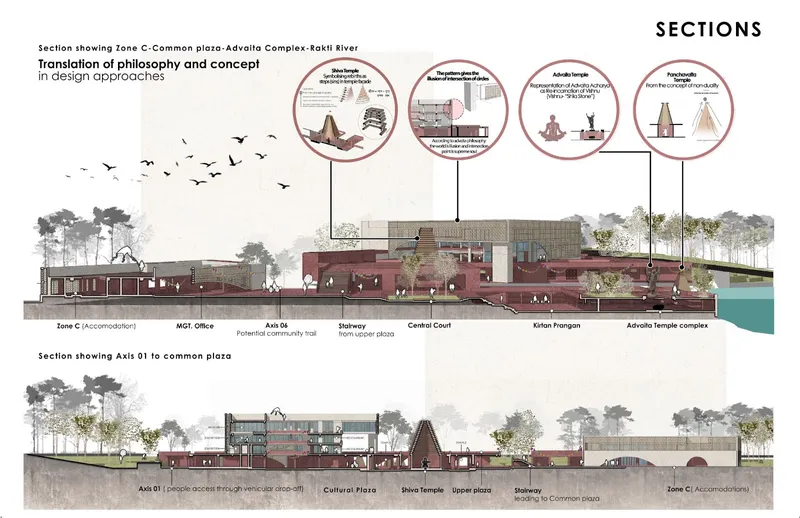
The project’s contextual response begins with the historical and mythological layer, where the myths of the Pandavas and Advaita Acharya shape spatial zoning- the Shiva Temple embodies the struggle of dualism, the Advaita Complex celebrates unity, and the Panchatattva Temple, rising without steps, symbolizes non-duality. Sacred trees such as Bel, Tulsi, and Banyan further root Vedic symbology in the landscape. The cultural dimension is reinforced through designated spaces for Baruni Snan, local melas, and revived folk practices like Haljatra and Dhamail, complemented by a cultural and research center that documents oral histories and exhibits heritage. From a social perspective, interventions prioritize inclusivity and year-round accessibility, with community programs, such as, markets, performances, and student exchanges ensuring locals remain stakeholders rather than bystanders, while trails connect the site to neighboring settlements. The environmental and ecological strategy preserves the sanctity of the river and natural topography, advocating water-sensitive design and non-invasive construction to sustain Panatirtha’s footprint. On the urban scale, the site functions as a node within Tahirpur’s pilgrimage and eco-tourism circuit, linking Advaita Bari and the ISKCON temple while anticipating future bridge infrastructure to manage visitor flows. The architectural expression integrates Bengal’s temple typologies like shikhara, jaali, courtyards into contemporary forms, favoring fragmented massing, varied rooflines, and intimate spiritual plazas that mirror organic ritual movement. Economically, the design
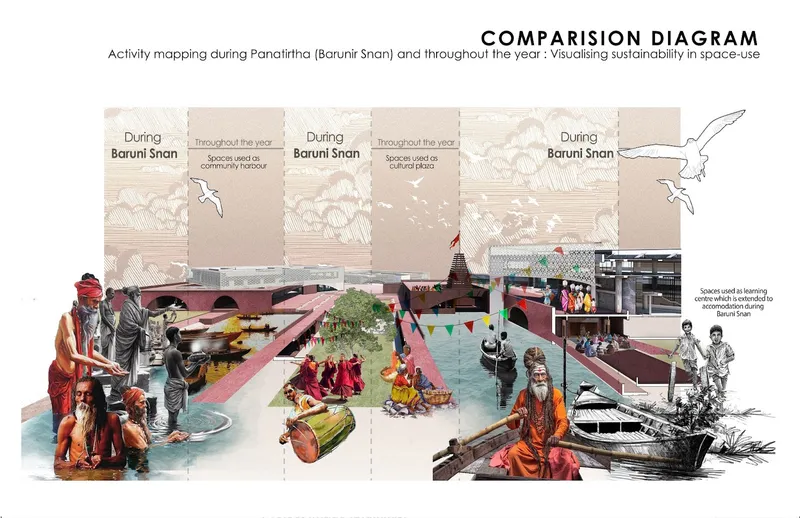
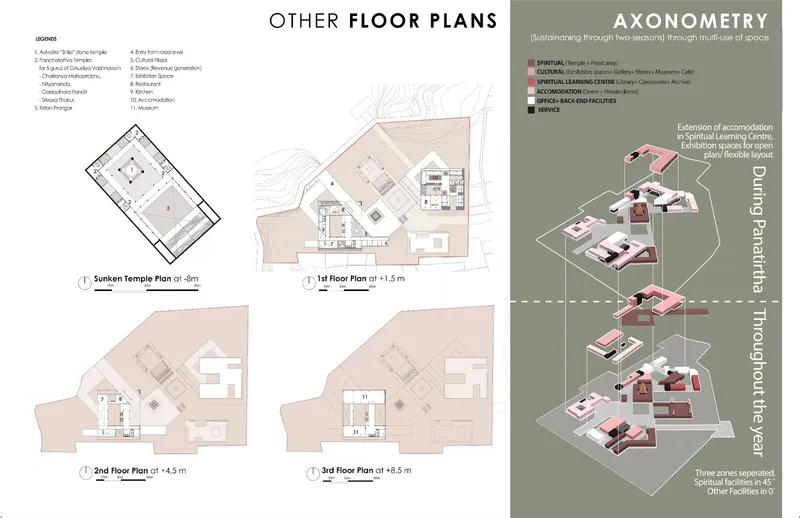
COMPARISON DIAGRAM: REVIVING THROUGH THE YEAR ROUND
A dedicated section of the project focuses on the temples, showcasing not only the diversity in temple typologies but also the intentional gradation of space- both spiritually and physically- from the upper to the lower levels.
This layering is deeply symbolic, mirroring the conceptual journey of descending into consciousness and connection, while also responding to the natural terrain of Sunamgani, characterized by its undulating landscape and the semi- flooded haor ecosystem. The gradual descent through these spaces allows visitors to move from the outer world into deeper layers of meaning, reflecting the inner journey from the material to the spiritual.
This spatial transition is not just conceptual- it also supports sustainability and contextual integration. The layout respects the ecological sensitivity of the region, with careful consideration given to topography, water flow, and local materials. Public zones are scaled down intentionally to match the everyday spatial perception of the local inhabitants. Large monumental forms are broken into smaller, people-centric zones, fostering a sense of comfort and familiaritv.
These spaces invite community interaction, pause. And reflection- making the experience inclusive and grounded.
CONCLUSION
The use of color and angular geometry in plans and massing further strengthens the narrative. The deep red brick masses embedded into the earth symbolize permanence rootedness and the Sacredness sacredness of spiritual practice. These structures house religious and contemplative functions, and their earthen character aligns with the core Non-dualistic philosophy where the soul and nature are one. In contrast, the shell-like structures, light in appearance and form, represent the contemporary outer world- open, fluid, and accessible, These host cultural, tourist, and entertainment facilities, bridging the local with the global, and tradition with modernity
Together, these architectural gestures create a dialogue between soul and shell, past and present. Ritual and recreation -offering visitors not just a space to witness, but a space to feel, reflect, and connect with the deeper essence of Panatirtha.


Popular Articles
Popular articles from the community


Singing Woman: An Opera House That Performs Before the Curtain Rises
Ovidiu Cristian Pavel's conceptual opera house translates Estonia's choral identity into a sculpted waterfront landmark facing the Baltic Sea.

Manzana Morphosis: Stretching Barcelona's Grid into a Living Landscape for 2050
A radical reworking of the Eixample manzana turns density into a tool for generous public space, vertical ecology, and environmental performance.
Temporary Home for Dogs: A Reversed Zoo Rethinks Animal Shelter Architecture
In Bucharest, a sinuous corridor and freed landscape flip the logic of containment, designing a shelter that works to make itself unnecessary.

The Amber Palace Opera: A Geological Fiction Surfaces on Tallinn's Baltic Waterfront
Pierre Brillard reimagines a Baltic legend as a public landscape, opera house, and waterfront promenade rooted in Tallinn's coastal identity.

Similar Reads
You might also enjoy these articles

The Rhythm of Seasons
A Farmers' Market Connecting Nature and the City


More Than a Building-Designing a Living System
More Than a Building-Designing a Living System
Base Beyond
DESERT COMPOUND ARID: TOURISM OF ABSENCE AND ABUNDANCE

Explore Urban Design Competitions
Discover active competitions in this discipline


Challenge to reimagine the Iron Throne

Photograph architecture without architects

Illustrate the lost glory of Angkor Wat - Render Challenge

Design challenge to reuse E-waste
Comments (0)
Please login or sign up to add comments
No comments yet. Be the first to comment!