
HIBINOSEKKEI and Youji no Shiro Wrap an Okayama Nursery in Copper-Dusted Timber Louvers
A nursery for 135 children in Okayama, Japan, uses vertical screens and temple adjacency to cultivate imagination and local identity.

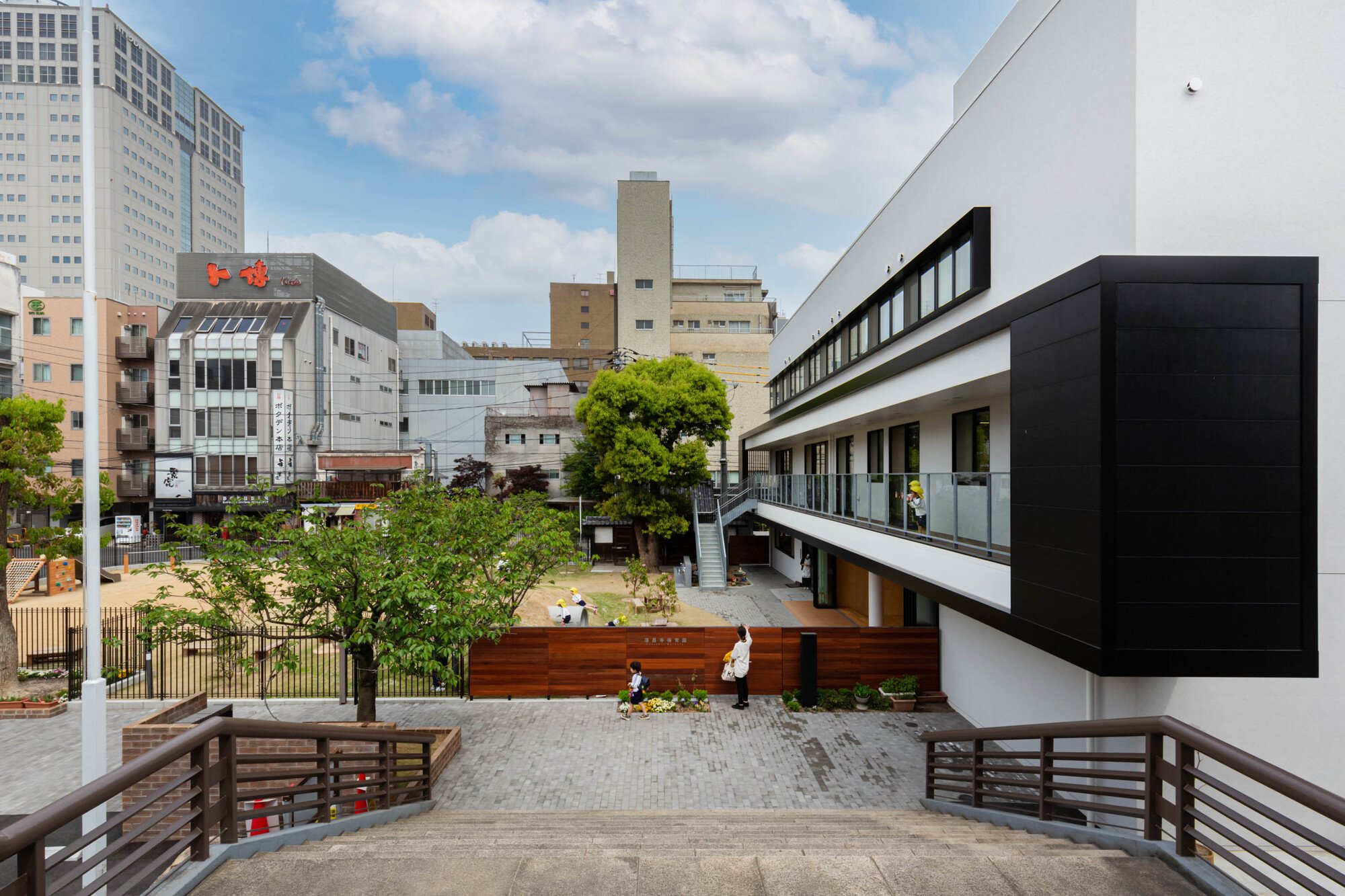
In Okayama, Japan, a nursery school sits directly beside a temple that has served its neighborhood for generations as a place for prayer, play, and communal gathering. That adjacency is not incidental. RJ Nursery, designed collaboratively by HIBINOSEKKEI, Youji no Shiro, and Kids Design Labo, was conceived under the principle of "cultivating imagination and hometown love," a phrase that could easily read as marketing if the architecture did not so thoroughly deliver on it. The nursery's owner also owns the neighboring temple, and the design team treated that connection as the project's generative engine: rooms face the temple's approach, the playground extends toward it, and the building's material palette borrows from its neighbor's vocabulary.
Completed in 2020 for 135 children, the 1,052 square meter steel and reinforced concrete structure rises three levels, each wrapped in dense vertical timber louvers finished with copper powder. The louvers are the building's signature gesture, but they are far more than a screen. They modulate sunlight into shifting shadow patterns across interior floors, they allow breezes to pass through, and they amplify the sound of rain into something audible and rhythmic. For children spending their formative years here, natural phenomena are not abstractions. They are daily companions.
A Permeable Facade Between Street and Sanctuary
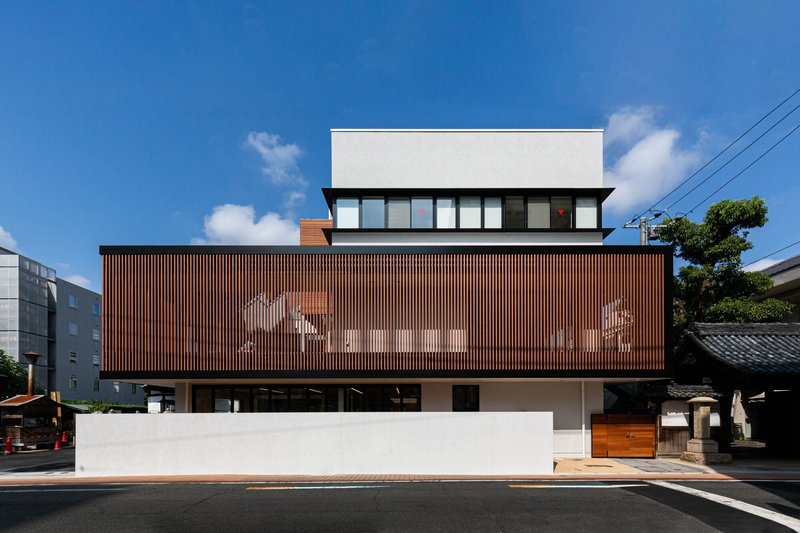
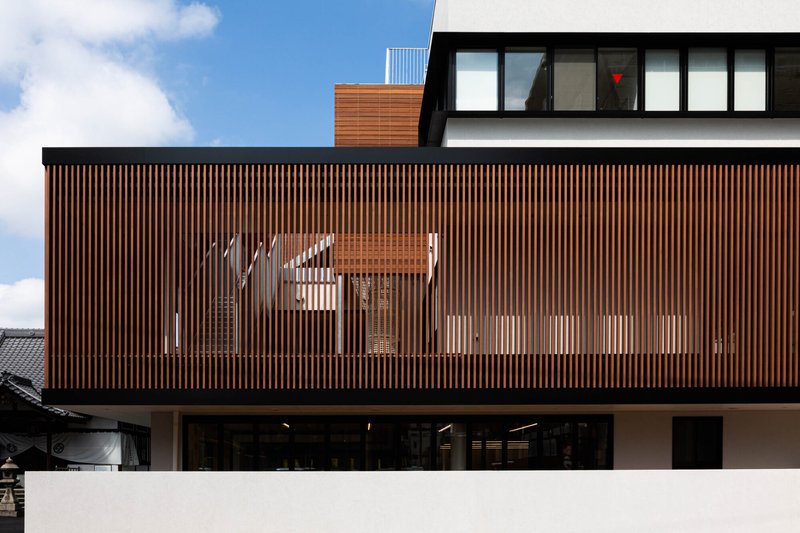
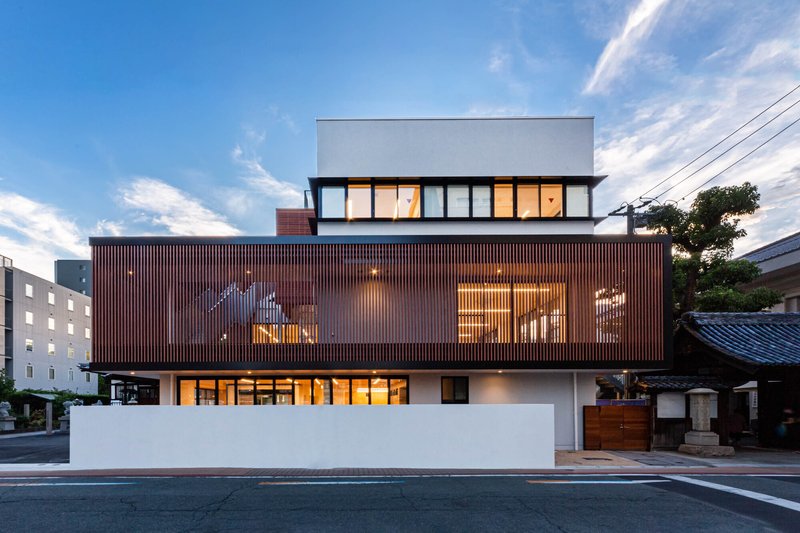
The street-facing elevation is the project's most legible statement. Vertical timber slats clad the middle volume, creating a layered screen that simultaneously conceals and reveals activity within. At dusk, interior lighting turns the louvers into a warm lantern, the nursery broadcasting its presence to the neighborhood rather than retreating behind opaque walls. The copper powder finish on the slats is a deliberate reference to Japanese traditional craft and to the temple's own material heritage, aging over time in a way that ties the nursery into the same temporal arc as its centuries-old neighbor.
Signage and wayfinding are integrated directly into the screen, visible through gaps in the slats rather than mounted on flat surfaces. It is a small detail, but it reinforces the architects' insistence that the building communicate through its material system rather than through applied graphics.
Courtyard as Classroom
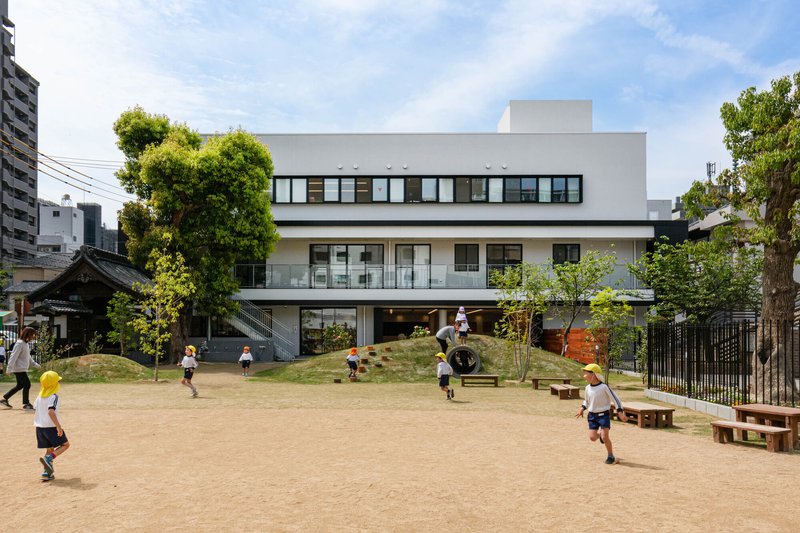
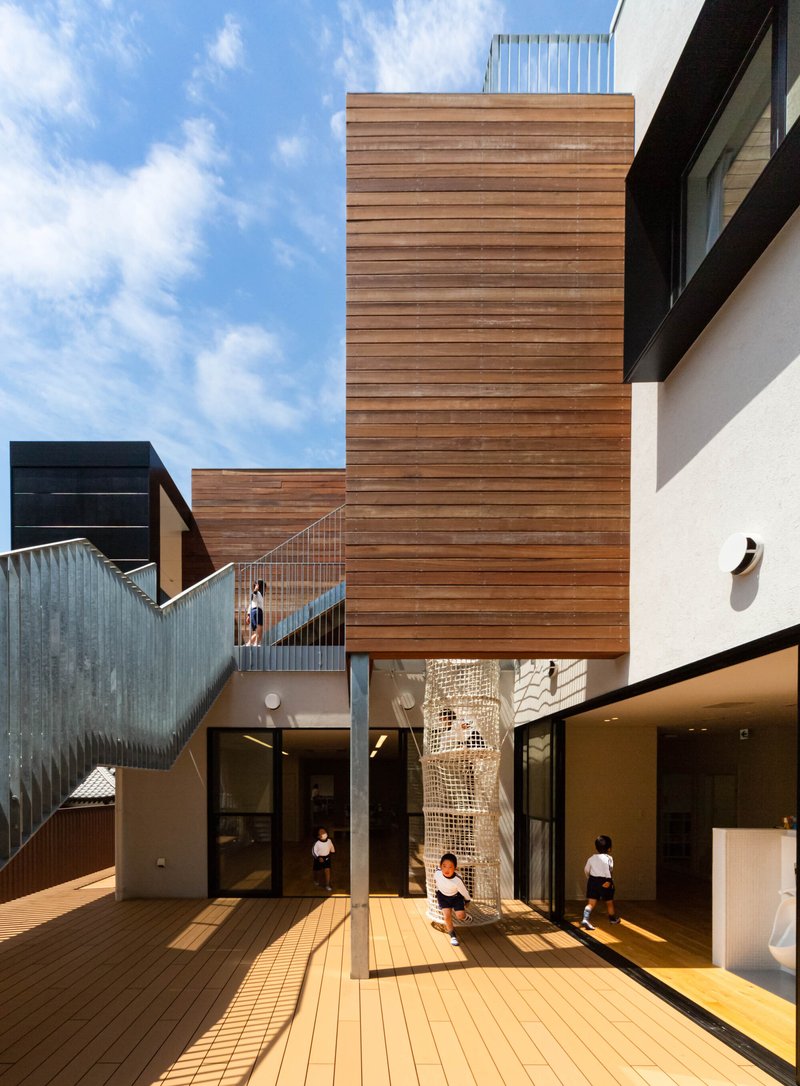
The playground and courtyard are not afterthoughts tucked behind the building. They sit at the front, facing the temple, positioned so that outdoor play and civic life share the same visual field. Children run beneath a raised white volume that creates covered play space below, while timber decking and planted greenery define softer zones for quieter activity. A timber-clad tower element rises above the courtyard, anchoring the composition vertically and giving children a landmark within their own territory.
Afternoon sunlight rakes across the courtyard at angles that shift with the seasons, and the louver system casts moving shadows onto the deck surfaces. The design team clearly understood that a nursery courtyard is not a miniature park. It is an environment where spatial awareness, social negotiation, and sensory engagement happen simultaneously. The scale of the spaces, low overhangs, tight passages between volumes, generous open ground, reflects a careful reading of how small children actually move through and claim territory.
Vertical Circulation as Adventure
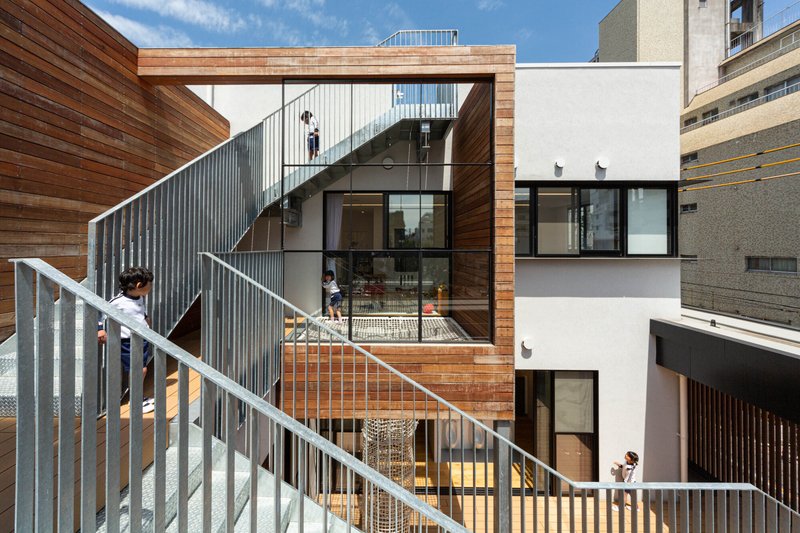
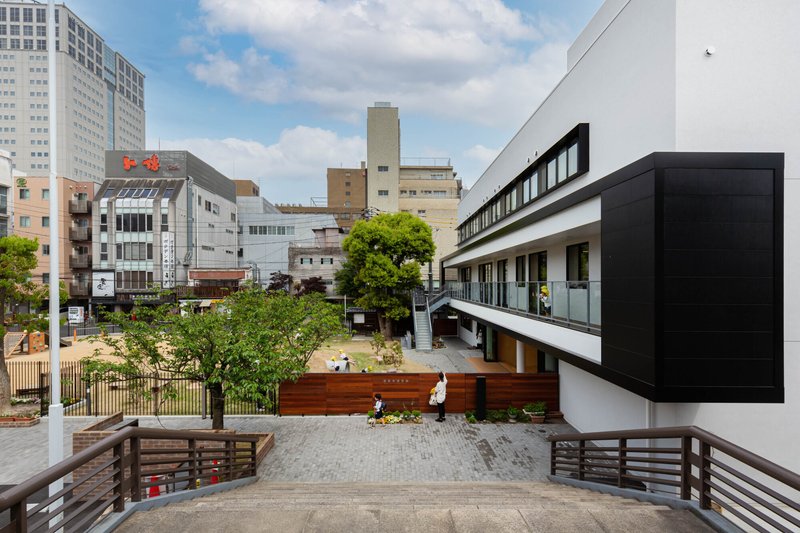
An exterior staircase wrapped in corrugated metal screen connects the building's levels and doubles as an elevated walkway that passes through the courtyard. Children are visible on it in several photographs, moving between floors with the kind of casual autonomy that suggests the circulation was designed to be used, not supervised. The staircase is a moment of controlled risk, open to the air and the view, that contrasts with the enclosed comfort of the interior rooms.
A climbing net reportedly connects the two main levels inside, though the exterior stair does the heavier architectural work of linking the building to its courtyard. The elevated walkway in particular reframes the nursery's section as a continuous landscape rather than a stack of floor plates, giving children aerial perspectives of their own playground.
Rooms Tuned to Activity
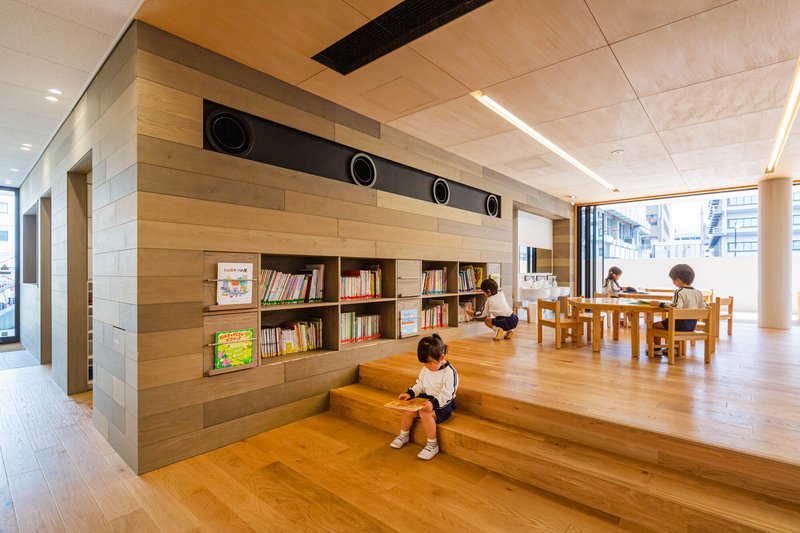
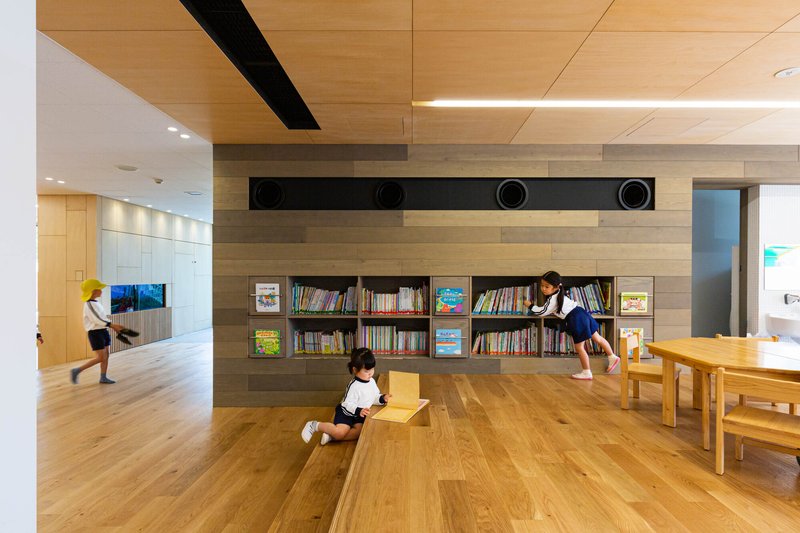
Inside, spaces are differentiated not by decoration but by spatial proportion and furniture configuration. A library area features built-in bookshelves that run floor to ceiling along one wall, with low timber tables and seating scaled precisely for small bodies. There is no whimsy in the joinery: the shelves are serious, well-proportioned, and clearly designed to make books accessible rather than decorative. Children sit and read in clusters, the room's proportions encouraging small-group activity without instructor intervention.
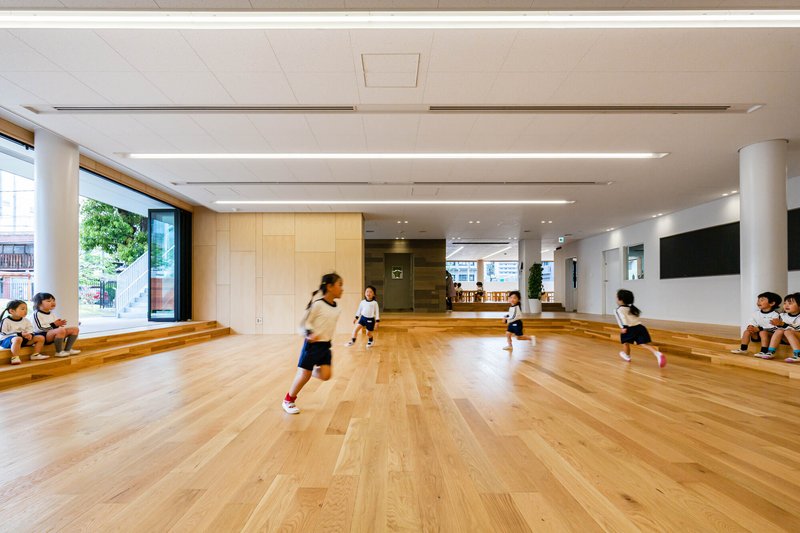
Elsewhere, a multi-purpose room uses stepped timber seating along an entire wall, creating an informal amphitheater that works equally well for group gatherings, solo climbing, or simply sitting and watching. The open timber floor stretches toward full-height glazing, pulling the outdoors into the room's visual field. These are not themed environments. They are well-proportioned rooms with strong material identity that trust children to invent their own uses.
Eating Together, Looking Out
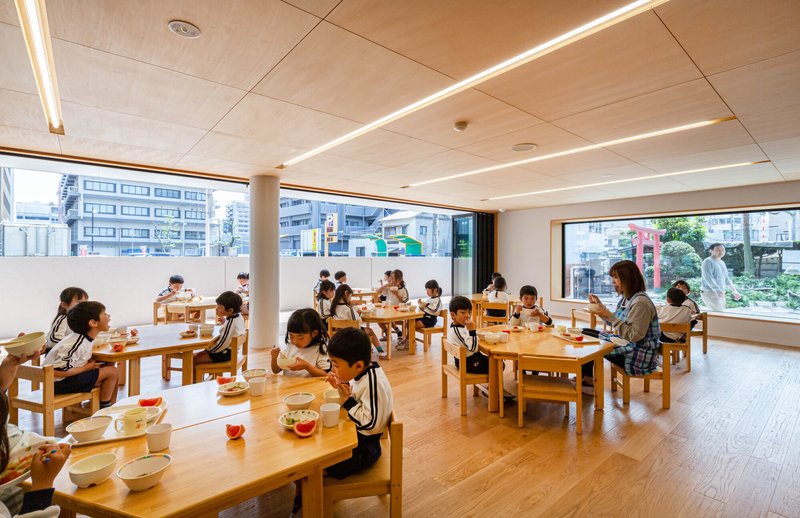
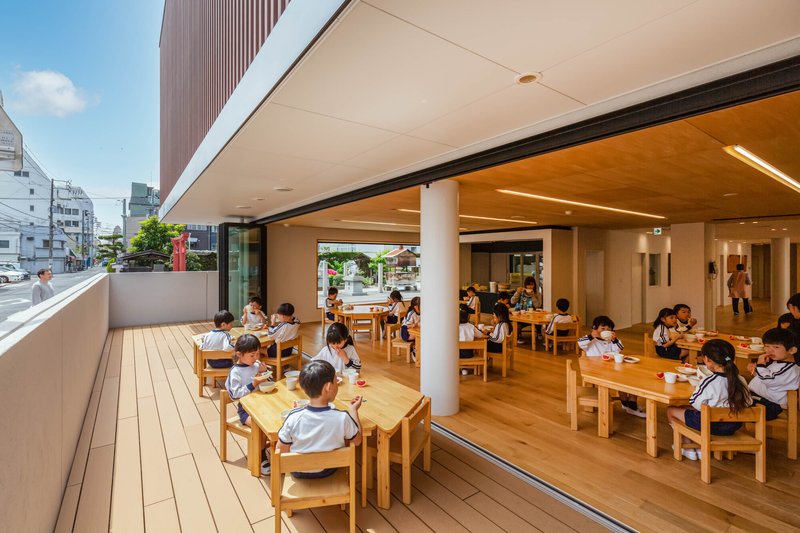
The dining spaces occupy some of the building's most privileged positions, with corner windows overlooking the street and sliding glass doors opening onto timber decks. Meals become social rituals tied to the outside world: children eat while watching the neighborhood, the temple, the weather. Ceiling-mounted linear lighting provides even illumination without cluttering the ceiling plane, and the timber tables are robust, simple, and unapologetically institutional in the best sense.
The decision to give dining rooms direct outdoor access, rather than burying them in the building's core, reflects the architects' broader commitment to porosity. Nearly every major room in the nursery has a visual or physical connection to the exterior, whether through the louver screen, full-height glazing, or operable doors.
Details That Teach Without Instructing
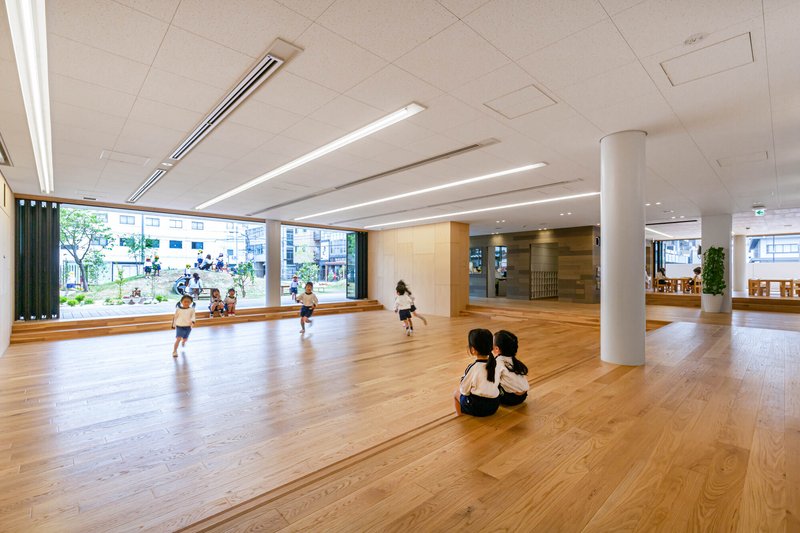
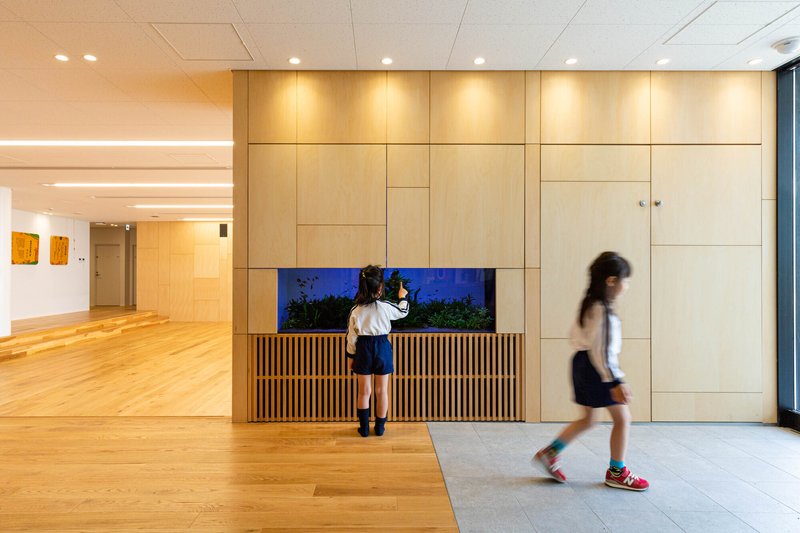
Two details stand out for their quiet intelligence. First, a narrow aquarium window set into a timber wall at child height: a slit of living water embedded in the architecture, visible to passing children without ceremony or signage. It treats curiosity as something that should be rewarded by the building itself. Second, a white cylindrical column in the open hall, left exposed and unadorned, serves as both structural element and spatial anchor. Children play around it instinctively, using it as a reference point, a hiding spot, a pivot. The column does not pretend to be anything other than what it is, and that honesty is itself a kind of pedagogy.
Temple and Nursery as Shared Ground
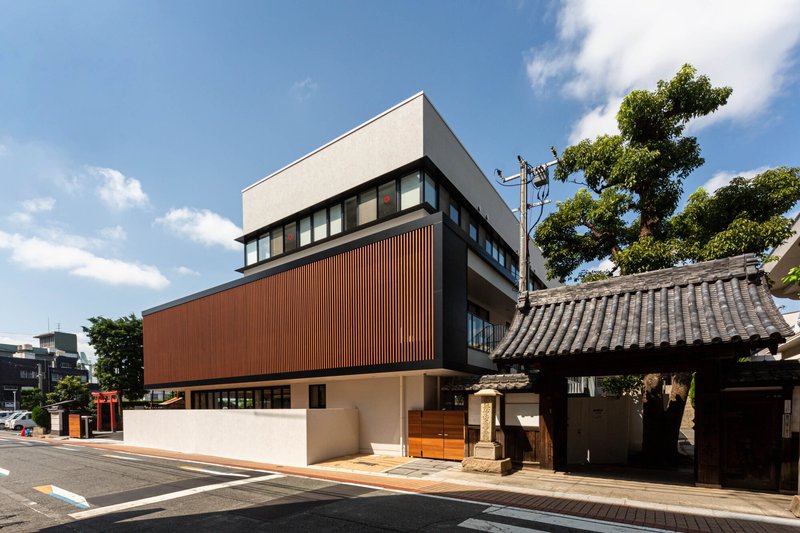
The most significant design decision may be the one you barely notice: the nursery does not compete with its temple neighbor. The traditional tiled roof structure is visible in several views, sitting comfortably beside the timber-clad volumes without either building deferring to the other. The copper-dusted finish on the louvers will patina over time, gradually closing the visual distance between old and new. The playground's orientation toward the temple grounds ensures that children grow up with the historic building as a daily presence, not a field-trip destination.
The owner's dual stewardship of temple and nursery makes this relationship possible, but the architects made it legible. By aligning sight lines, calibrating material palettes, and refusing to fence off the nursery from its context, they created an institution that is embedded in its neighborhood rather than merely located within it.
Plans and Drawings
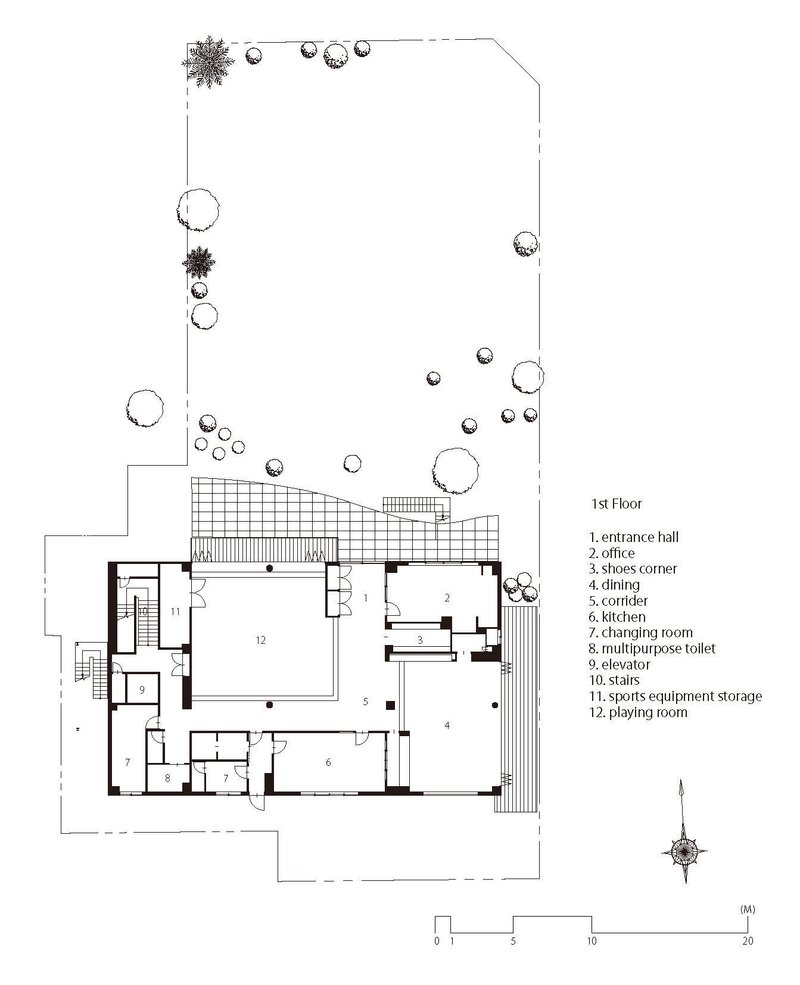
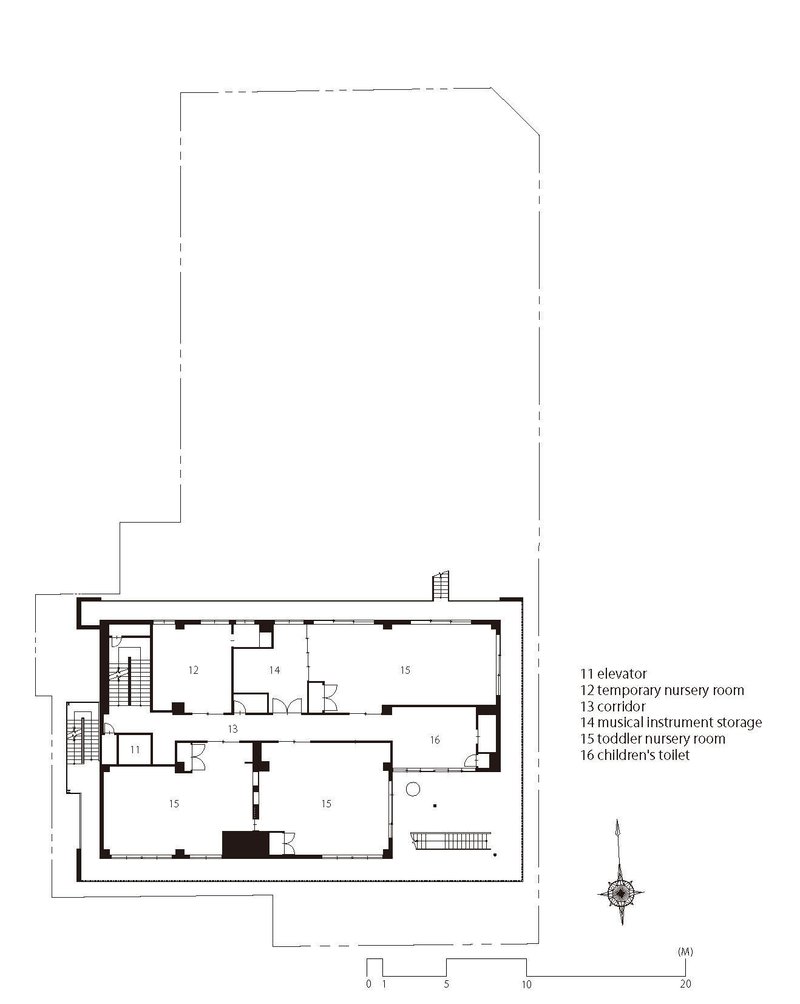
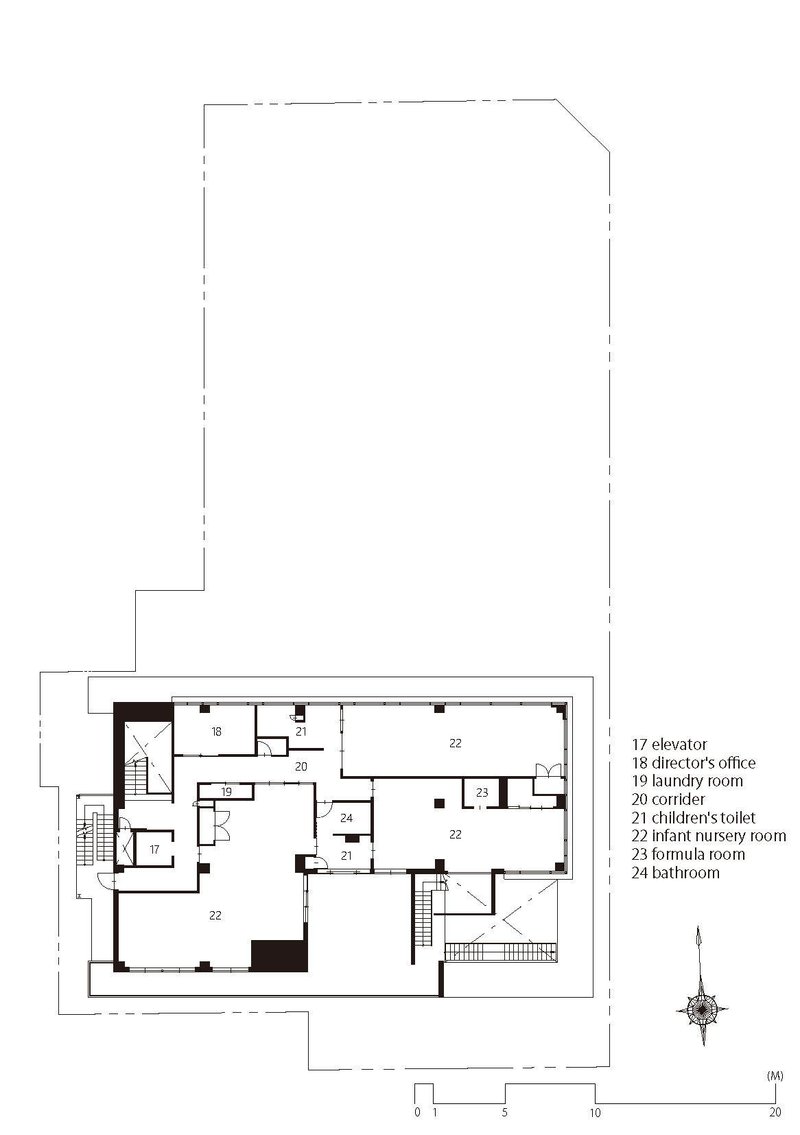
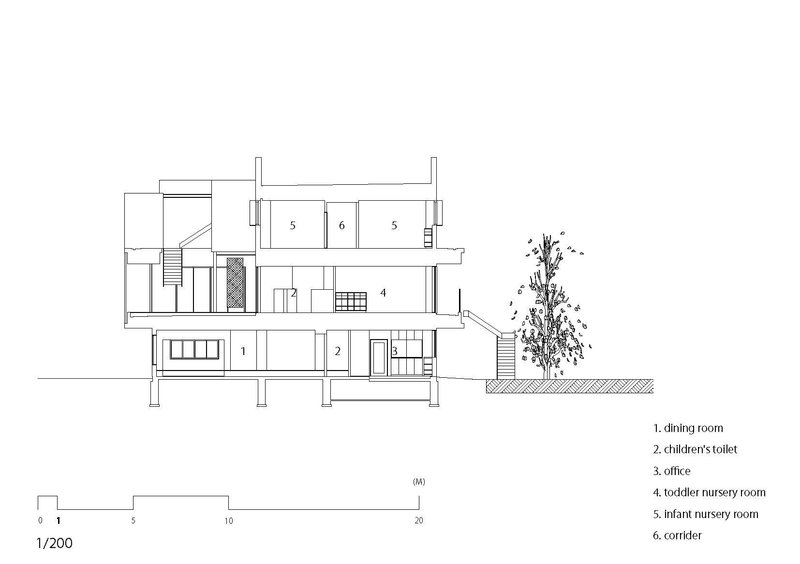
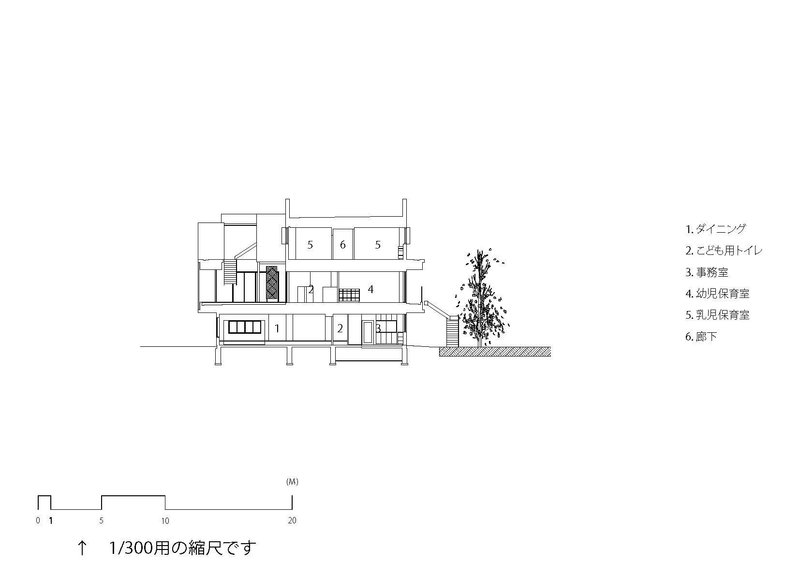
The plans reveal a compact footprint of 416 square meters stretched across three floors. The first floor organizes entrance hall, offices, and dining areas around an outdoor courtyard punctuated by trees. Nursery rooms cluster on the second floor around a central elevator core, while the third floor houses additional classrooms, office space, and nursery rooms. The sections are particularly instructive: staggered floor levels create spatial variety within a modest overall height, and the relationship between the building's interior organization and the adjacent tree canopy is drawn with care.
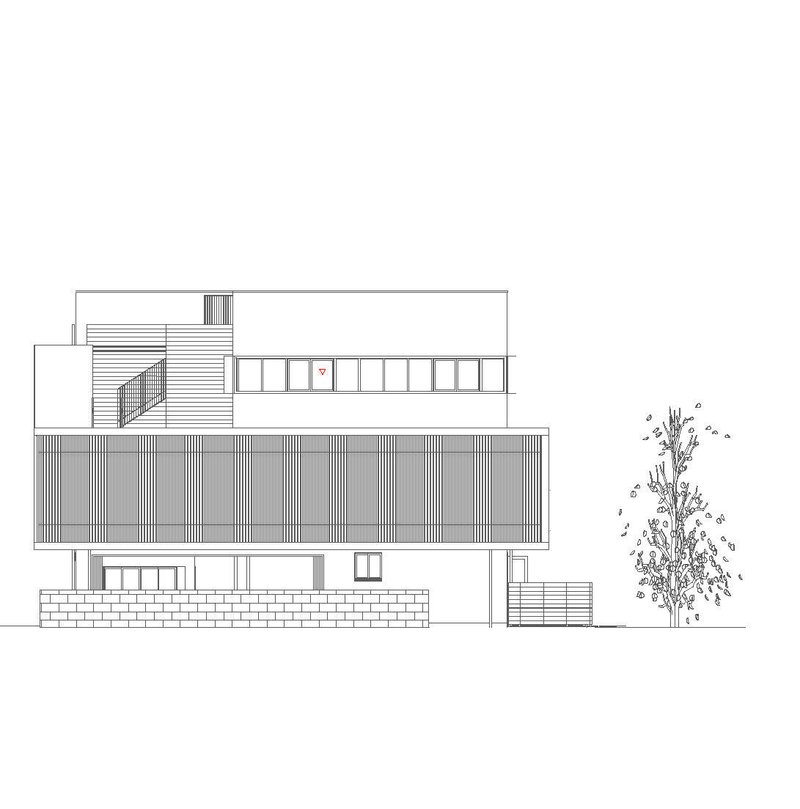
The elevation drawing confirms what the photographs suggest: the horizontal slatted cladding system is consistent across all three levels but varies in density and depth, creating a gradient of transparency that responds to the program behind it. More private rooms get denser screening; communal spaces open up. It is a simple logic, well executed.
Why This Project Matters
Nursery architecture has become one of the most productive testing grounds for ideas about how space shapes behavior. RJ Nursery succeeds because it does not treat children as a special category requiring themed environments or padded surfaces. Instead, it offers real materials, real weather, real community context, and real spatial complexity. The louver system is the project's headline, but its deeper achievement is the integration of a civic institution into the grain of a specific neighborhood, linking daily childhood routines to the rhythms of a temple, a street, and a local culture.
HIBINOSEKKEI, Youji no Shiro, and Kids Design Labo have built a substantial body of work in educational architecture, and RJ Nursery represents a refinement of their shared methodology. The concept of "hometown love" could easily tip into nostalgia, but here it is grounded in material specificity: copper that ages, louvers that register wind, sight lines that frame a particular temple on a particular street. The building does not sentimentalize childhood or community. It constructs the physical conditions for both.
RJ Nursery, designed by HIBINOSEKKEI, Youji no Shiro, and Kids Design Labo. Okayama, Japan. 1,052 m². Completed 2020. Photography by Studio Bauhaus.
About the Studio
Youji no Shiro
Official website of Youji no Shiro, one of the studios behind this project.
e-ensha.comShare Your Own Work on uni.xyz
If projects like this are the kind of work you want to make, uni.xyz is a place to publish your own, find collaborators, and enter design competitions.




Popular Articles
Popular articles from the community

Kerry Kounnapis Packs 800 Daily Coffees into a 43-Square-Metre Melbourne Laneway Bar
Palace Coffee channels Pellegrini's and European standing bars through oxide-red steel and spotted gum timber in a Ridgway Place sliver.

IKC de Geluksvogel: Sustainable School Architecture Designed for Free Movement and Digital Learning
IKC de Geluksvogel turns sustainable school architecture into a flexible Maastricht campus for digital learning, nature, and free movement.
Kaffeebühnen: Coffee Shop Architecture Designed as a Civic Stage Between Vienna’s City and Park
Kaffeebühnen turns coffee shop architecture into a civic stage, linking Vienna’s park edge, urban life, warm timber yards, and coffee craft.
PLATAFORMArq Folds a Concrete Roof Over the Portuguese Mountains in House #474
A 220-square-meter residence in Teixoso, Portugal, wraps board-formed concrete into an angular canopy that frames the Serra da Estrela foothills.


Similar Reads
You might also enjoy these articles
Freebird Residence by Alexis Dornier: A Tropical Modernist Sanctuary in Bali
Floating living pavilion above pool anchors H-shaped tropical villa, blending Japanese minimalism, sustainable strategies, lush landscape, and sculptural interiors.
127af Flips a Tiny Bagnolet Rowhouse Upside Down with a Handcrafted Roof Extension
A 55-square-meter terraced house on the edge of Paris gains a luminous upper living floor through lightweight timber and steel.
1.61 Design Workshop Wraps a 600-Square-Meter Café in Vietnam in Sculptural Burgundy Drama
Reden Café & Bistro pairs a helical staircase, mosaic floors, and deep red interiors to rethink Vietnamese hospitality space.

The Unbound Brain: A School Shaped by Cognitive Architecture
Cylindrical learning pods radiate like neurons from a central cortex, turning the floor plan into a spatial model of human thought.


Explore Educational Building Competitions
Discover active competitions in this discipline




The International Standard for Design Portfolios


The Global Benchmark for Architecture Dissertation Awards


The Global Benchmark for Graduation Excellence


Challenge to design public laboratory
Comments (0)
Please login or sign up to add comments
No comments yet. Be the first to comment!