

Marshland Punk: Where Steampunk Grandeur Meets Wetland Regeneration
A circular greenhouse complex in England's Tame Valley Wetlands fuses punk ideology, Victorian ironwork, and ecological science into a single resilient lan


What if punk's founding instinct, the refusal to accept decay as inevitable, could be channeled into architecture? That is the provocation at the core of Marshland Punk, a project that treats nature itself as a rebel: pushing through polluted soil, reclaiming industrial wetlands, regenerating what centuries of extraction tried to erase. The proposal plants a circular greenhouse complex in England's Tame Valley Wetlands, drawing structural inspiration from Steampunk's brass-and-glass retrofuturism while orienting its programme toward the ecological optimism of Solarpunk. The result is a building that tells a story of resistance and renewal at every scale, from its arched ironwork down to its in vitro propagation lab.
Designed by Jelisaveta Petric and submitted as an Institutional Excellence Award entry to the WIC competition, the project operates on the historically industrial terrain of the Tame Valley, a landscape scarred by neglect yet rich with ecological potential. Petric frames architectural design as a form of cultural rebellion, aligning punk values of radical freedom, mutual aid, and anti-corporatism with a programme dedicated to wetland restoration, plant propagation, and environmental education.
A Spiraling Amphitheater Carved into the Hillside


The aerial view reveals the project's primary gesture: a spiraling amphitheater of pathways that wrap around a cylindrical water tower, set against a densely planted hillside. The tower is more than a vertical landmark. Its dynamic roof opens to release water in cascading flows that cool the structure and offer visitors a tactile encounter with the hydrological cycle. Birds wheel overhead, and the landscape reads as a terrain that has been designed to invite occupation by more than just humans.
At ground level, an elevated pedestrian bridge stretches between planted beds on ornamental steel columns, its detailing drawn directly from Steampunk's affection for Victorian engineering. A lone figure walks beneath it, and the scale is immediately legible: this is infrastructure sized for ceremony, a colonnade that connects the site's poles both metaphorically and physically, reinforcing the tension between technological intervention and ecological restoration.
Glass, Iron, and the Greenhouse as Architectural Nucleus


Step inside the main glasshouse, and the triangulated steel and glass roof overhead transforms filtered daylight into something almost liturgical. Ornamental columns rise through planted beds, and the interior reads less like a conventional greenhouse and more like a Victorian exhibition hall repurposed for wetland species. The main glasshouse serves as the architectural nucleus: an artificial pond accommodates aquatic species, while a sloped amphitheater doubles as a lecture space and observatory. Visitors are invited to walk into the shallow water, making physical engagement with the ecosystem part of the spatial programme.
The axonometric drawing clarifies the full composition. A spiraling ramp structure interlocks with greenhouses and an elevated walkway, all threaded through a gridded field of trees that constitutes the arboretum, a living library organized by botanical gradient that transitions visitors from wetland to forest ecosystems. Distributed around this core are microambients: a lab for in vitro plant propagation, acclimatization zones for lab-grown species, and a hydroponic system showcasing modern cultivation techniques.
Multi-Level Interiors Where Science Becomes Spectacle

The section drawing cuts through the heart of the pavilion, exposing curving stairs, ornamental railings, and two figures occupying different floors. What it reveals is a deliberate strategy of vertical visibility. The in vitro propagation lab is tucked below ground, but its glass ceiling allows visitors above to witness regenerative science in action. The architecture refuses to hide its programme; instead, it turns research into public spectacle, bridging the gap between environmental science and popular awareness. Every level offers a different ecological reading, from submerged plant zones at the base to arboreal canopies above.
Punk as Design Framework: Twelve Visual Genealogies
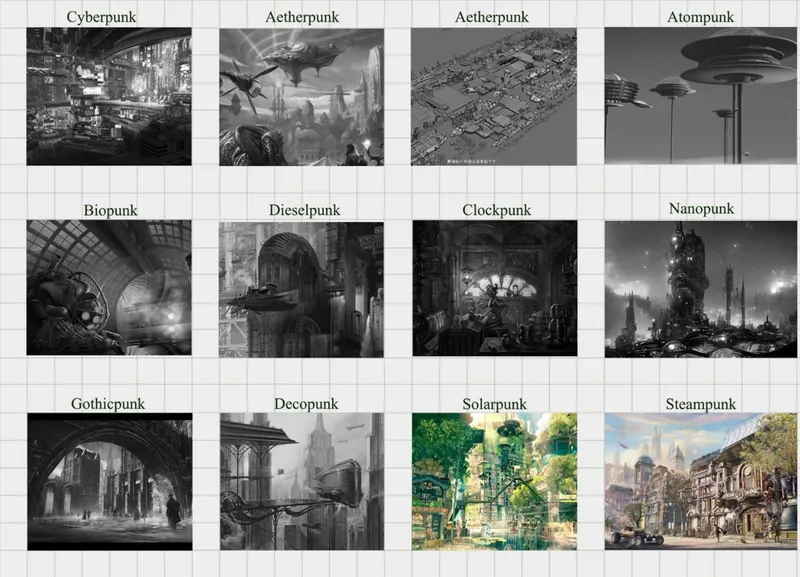
A grid of twelve visual style categories maps the ideological terrain that feeds the project's aesthetic. From Steampunk's retrofuturistic obsession with brass, steel, and glass to Solarpunk's embrace of renewable energy and decentralized systems, each panel presents a rendered architectural scene or urban landscape as evidence. Petric treats punk not as a singular style but as a family of subcultures, each defined by persistent opposition to the destructive status quo. The diagram functions as a design manifesto: by placing Marshland Punk within this constellation, the project claims legitimacy as both cultural statement and ecological instrument.
Arched Iron Vaults and the Memory of Industrial England

The final interior view places the visitor beneath soaring arched iron and glass vaults that span the multi-level pavilion. The structural language is unmistakably 19th-century: arches, ironwork, and the elaborate detailing of grand Victorian greenhouses. But the programme running through these bones is forward-looking. Renewable systems, plant science labs, and hydroponic installations occupy spaces that read like Kew Gardens crossed with a research institute. The tension is productive. Petric uses the weight of industrial history, the very history responsible for the Tame Valley's degradation, as the material vocabulary for its ecological redemption.
Why This Project Matters
Marshland Punk succeeds because it refuses the false choice between narrative and function. The punk framework is not applied as surface decoration; it structures the entire design logic, from the rebellious act of planting a regenerative greenhouse on degraded industrial land to the Steampunk detailing that repurposes the aesthetic of the era that caused the damage in the first place. Every programmatic element, the propagation lab, the hydroponic microambients, the amphitheater lecture space, serves both ecological and pedagogical ends.
More importantly, the project positions architecture as a medium for environmental justice at a moment when wetland ecosystems are under existential threat. By making science visible, by inviting visitors to step into shallow water and watch plant tissue cultures grow through a glass floor, Petric turns passive observation into physical complicity with regeneration. That is the punk move here: not smashing the system, but growing something resilient through its cracks.
View the Full Project
About the Designers
Designer: Jelisaveta Petric
Enter a Design Competition on uni.xyz
uni.xyz runs architecture and design competitions year-round that reward proposals with spatial conviction and real site intelligence.
Project credits: Marshland Punk: Science-Powered Greenhouse by Jelisaveta Petric WIC (uni.xyz).




Popular Articles
Popular articles from the community


Riyadh For All: Intergenerational Urban Design for Active Aging in Rabat
Riyadh For All reimagines urban design in Rabat with intergenerational co-living, adaptive courtyards, and Moroccan cultural exchange today.

Co-life: Sustainable Architecture for Age-Friendly Community Living
Co-life reimagines sustainable architecture for seniors through courtyards, rammed earth, shared gardens, and spaces designed for belonging.

Conexión: Biophilic Design Reimagines High-Rise Living in Hong Kong
Conexión reimagines high-rise living in Hong Kong through biophilic design, green facades, shared spaces, daylight, water and nature within.

Co-Life: Senior Housing Design That Reconnects Older Adults With the City
Co-Life reimagines senior housing design through healing gardens, shared streets, workshops, and a sustainable community across generations.


Similar Reads
You might also enjoy these articles

Day and Night Park: A Time-Based Urban Newsstand in Beijing
A temporary urban newsstand in Beijing blending travel, light, and reading through poetic colors, compact form, and community-focused design.

Modernist Patio Renovation in El Masnou, Barcelona by Oliver Segura Arquitectura + Cebrià Arquitectura
Modernist patio renovation blending tradition and innovation with a movable pool, leveled floors, and Catalan materials in El Masnou.

Alto Residencial Coop: Cooperative Housing Development in Santiago de Compostela by Carbajo Barrios Arquitectos
A linear cooperative housing complex blending white volumes and perforated metal façades, enhancing community living, natural light, privacy, and urban integration.

Vil Genis School by BPA ARCHITECTURE – Massy, France
Vil Genis School in Massy, France, features sustainable design, south-facing classrooms, community integration, accessible spaces, and modern educational architecture.





Comments (0)
Please login or sign up to add comments
No comments yet. Be the first to comment!