
OAM Oficina d'Arquitectura Settles a Rammed Earth House into a Mallorcan Hillside
Gallineta House in Manacor unfolds along the slope with earthen walls, bamboo vaults, and courtyards open to the landscape.


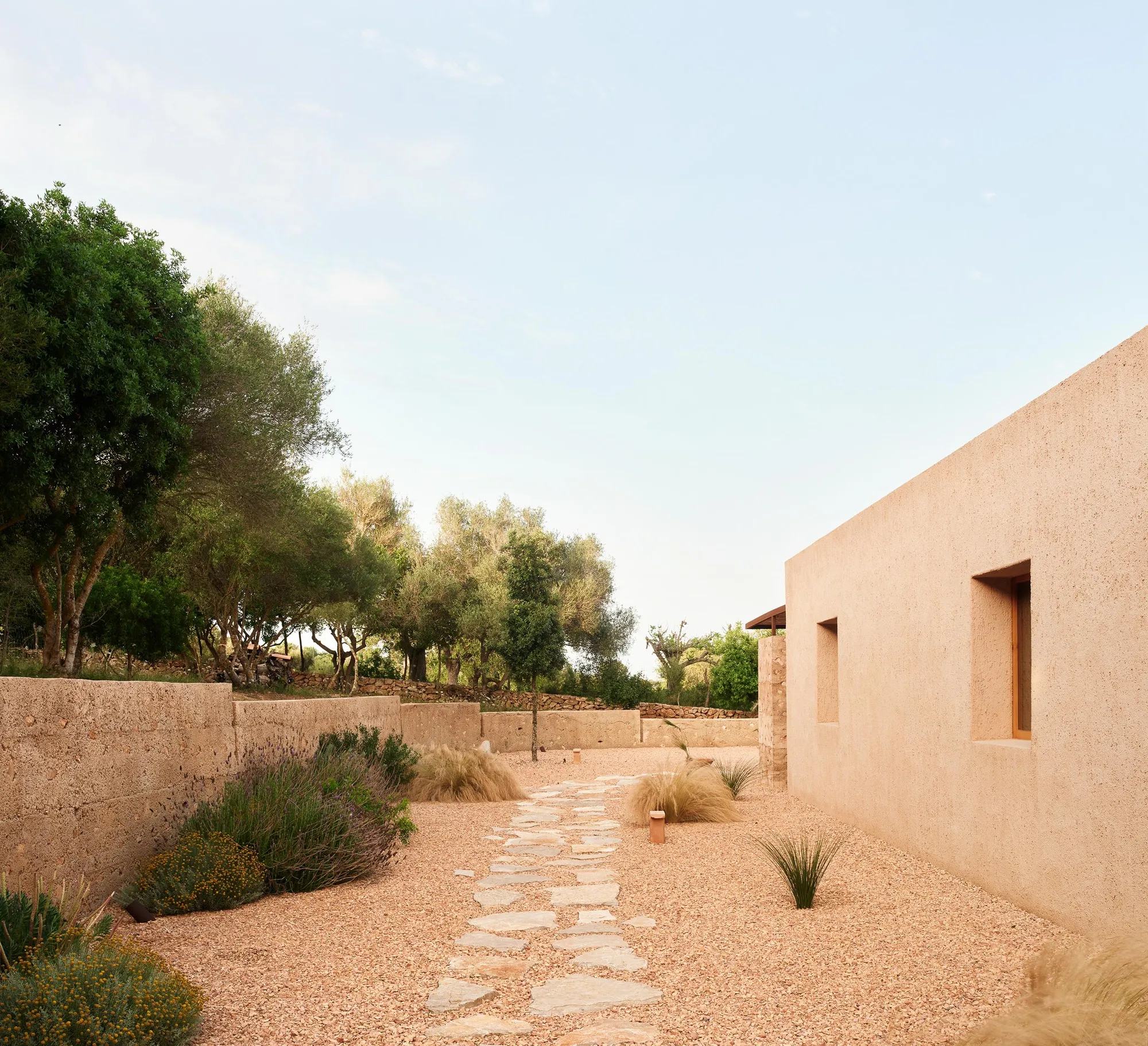
There is a particular restraint required to build on a hillside without announcing yourself to it. Gallineta House, designed by lead architect Toni Oliver of OAM Oficina d'Arquitectura a Mallorca, does exactly that: it sits on the highest point of a sloping site in Manacor and stretches along the terrain rather than cutting into it. The result is a 271 square meter residence that reads less as a building imposed on a landscape and more as a low wall that grew out of the ground, anchored by olive trees and gravel gardens that blur the line between cultivation and architecture.
What makes the project genuinely interesting is the commitment to a single material logic, rammed earth and aggregate block, paired with a bamboo vaulted ceiling system that runs through nearly every interior space. The house is organized as a long, linear sequence of rooms threaded together by corridors and punctuated by courtyards. It is a plan that privileges movement and framed views over any single grand gesture. Every room connects to the outside in at least two directions, and the effect is of living inside a covered garden rather than a sealed domestic box.
Earthen Walls and Arid Gardens
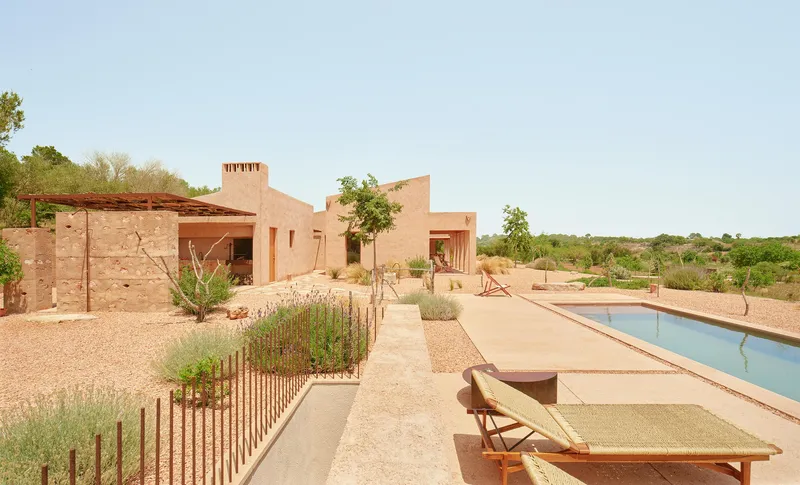
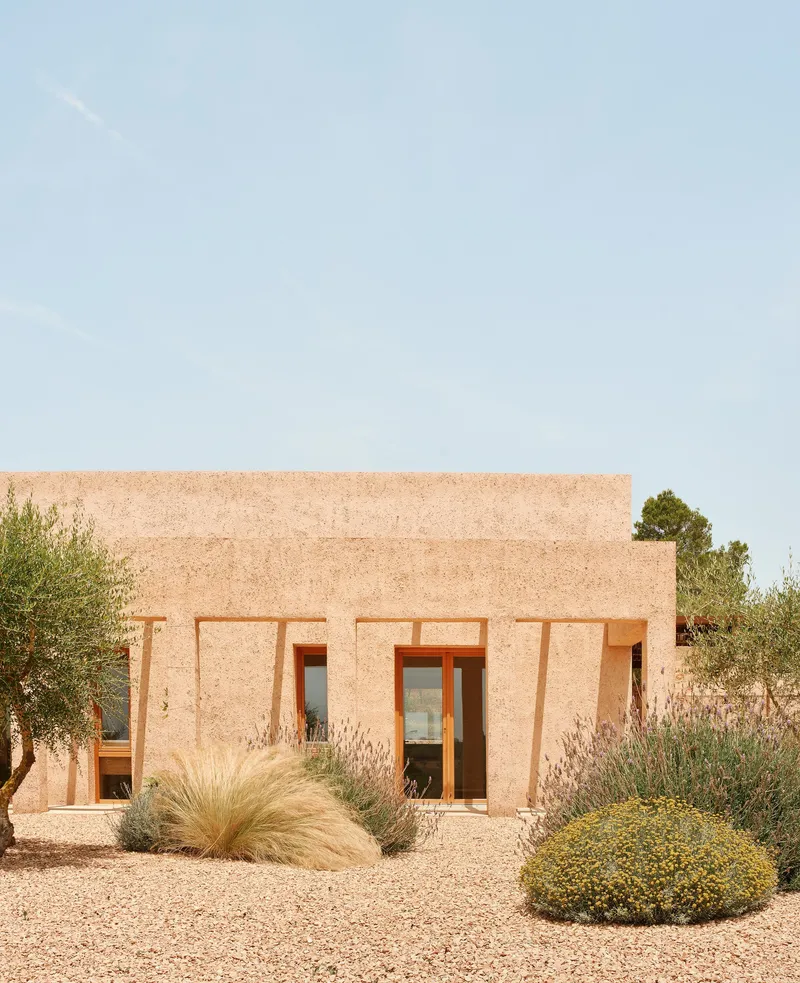
The exterior walls deploy a straw-textured aggregate finish that catches the Mallorcan sun at a low angle, producing a surface that shifts in tone through the day. The material choice is not cosmetic. These walls are load-bearing envelopes that reduce the need for conventional reinforced concrete frames, and their thermal mass keeps interiors cool through summer months without heavy mechanical intervention. Drought-tolerant grasses, olive trees, and gravel paths surround the volumes, reinforcing the sense that the building's footprint was negotiated with the existing planting rather than cleared for it.
Stepped facades along the slope allow the house to follow the natural grade, which minimizes earthworks. It is a practical decision that also gives the residence its particular silhouette: low and horizontal, with terracotta roof sections just barely visible above the wall line.
The Colonnade as Threshold
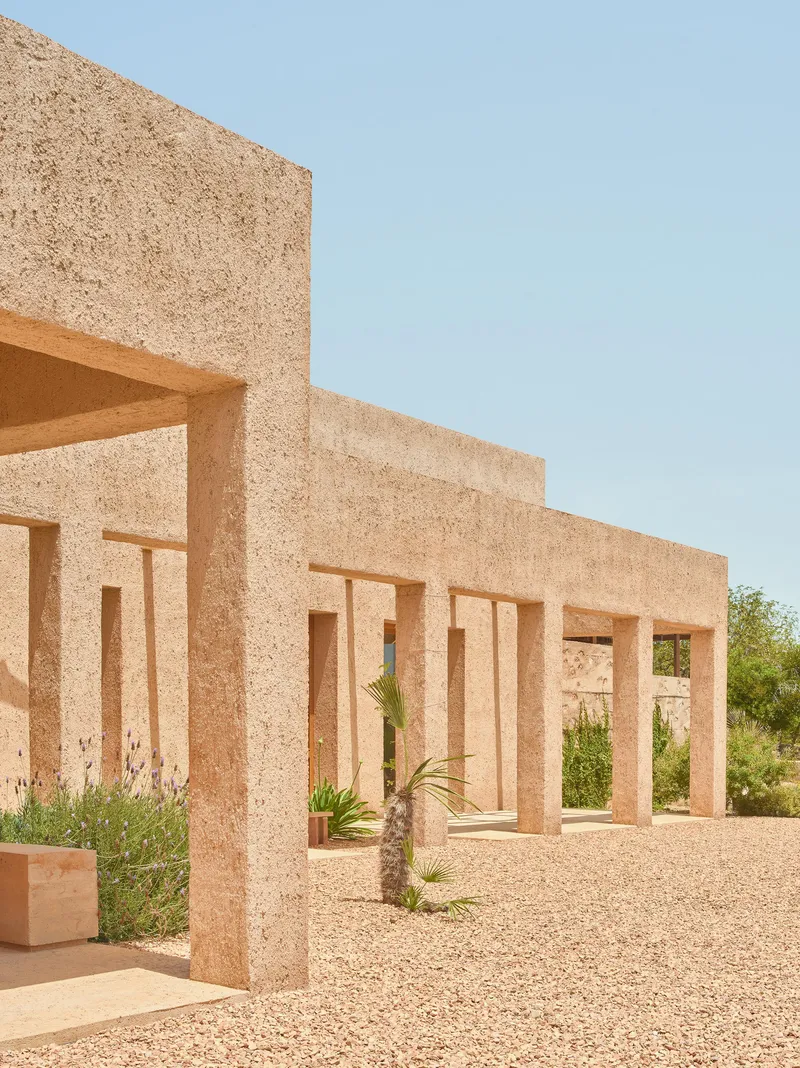
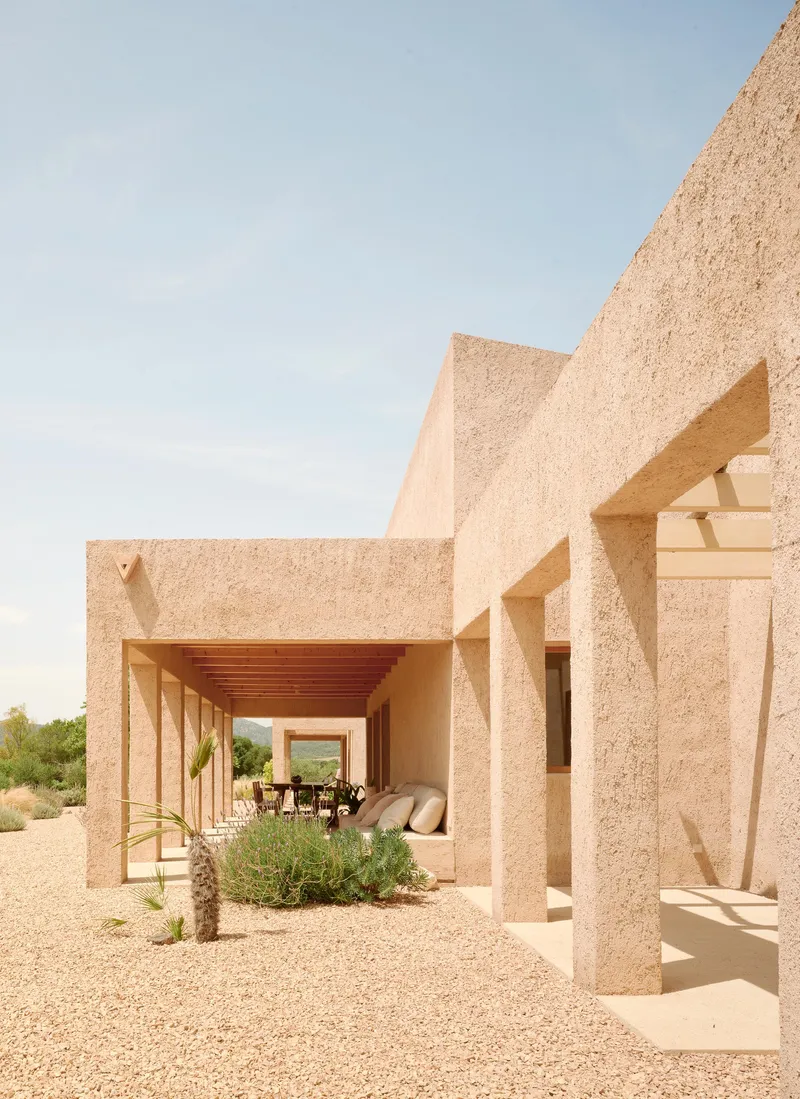
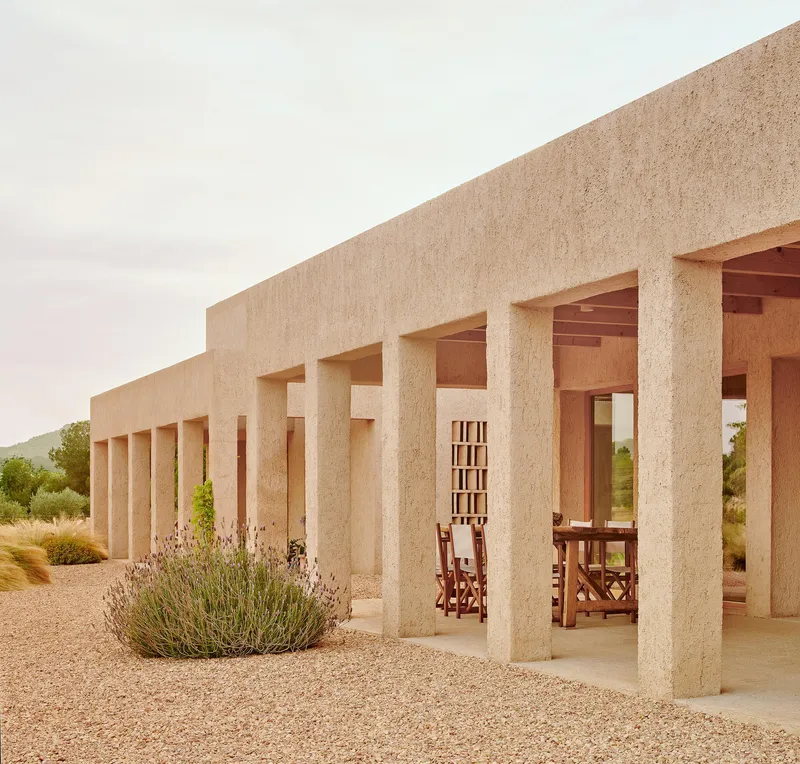
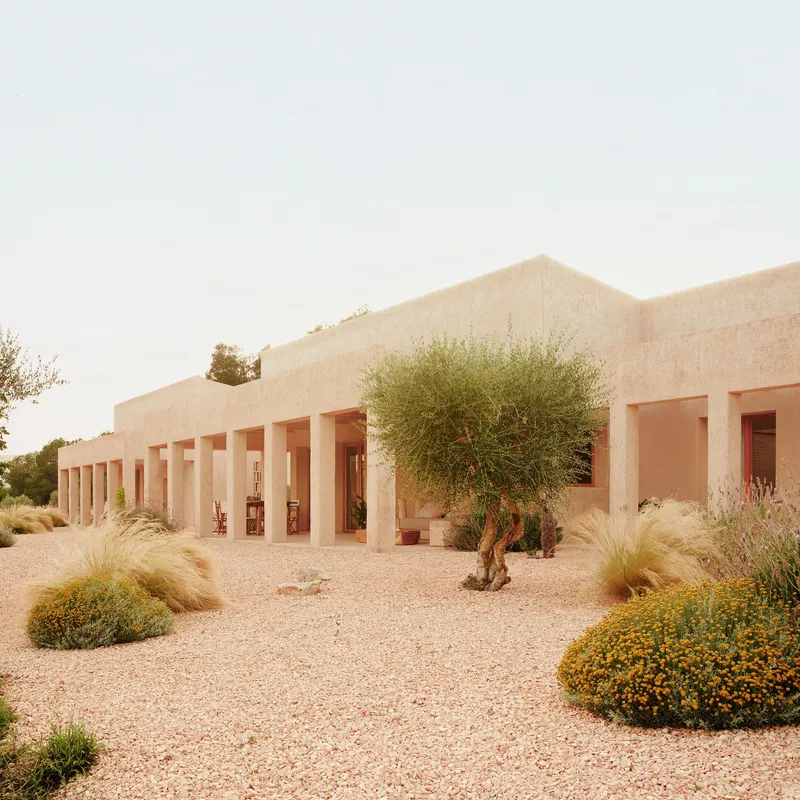
A colonnade of textured aggregate columns runs along one facade, framing a gravel courtyard planted with palms. This is not a decorative arcade. It is the primary threshold between the house's interior life and the open landscape beyond, functioning simultaneously as a shaded walkway, a dining loggia, and a wind buffer. The timber ceiling panels that span between columns soften what could otherwise feel monumental, bringing the scale down to something human and informal.
Through the columns, distant mountains appear as framed compositions. The loggia furniture, simple wooden pieces, signals that this is a room in constant use, not an architectural set piece waiting for a photographer. The interplay between the heavy masonry columns and the light timber overhead is one of the house's most resolved details.
Courtyards, Canopies, and Shadow Play
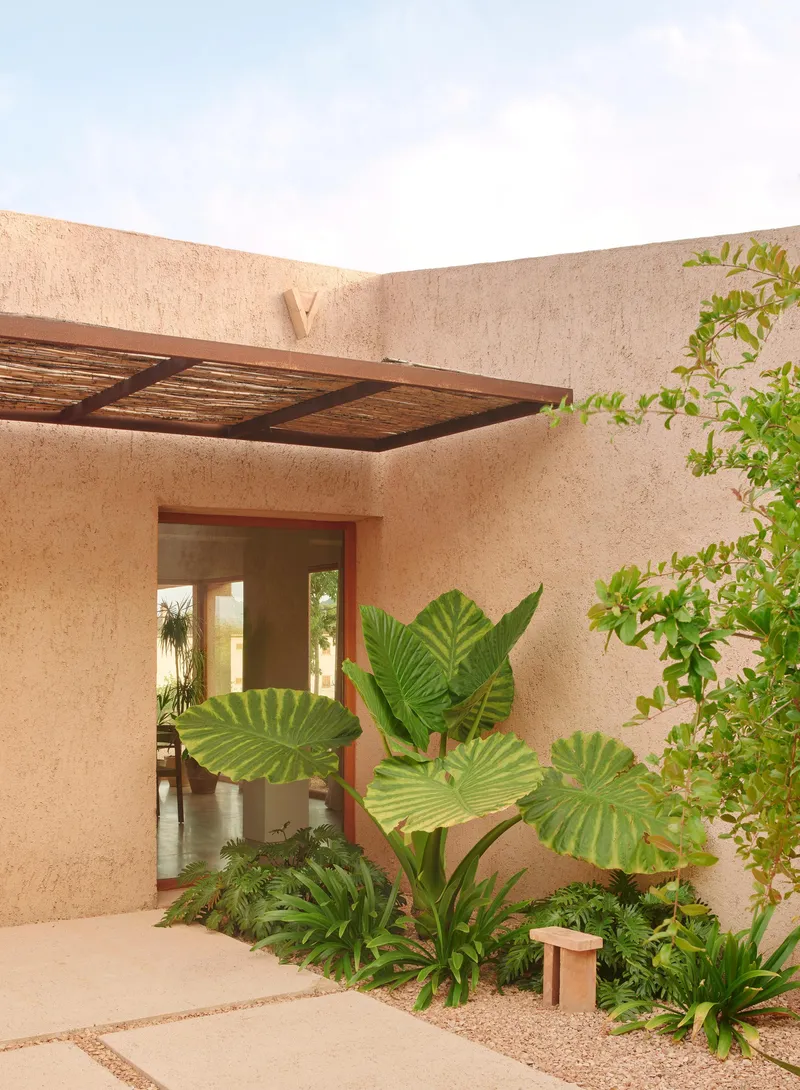
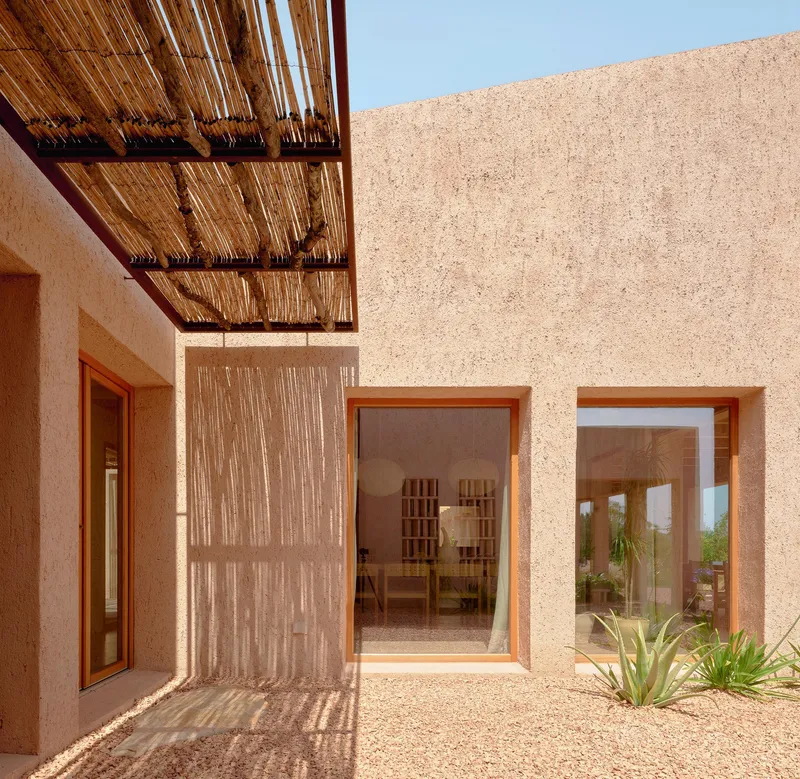
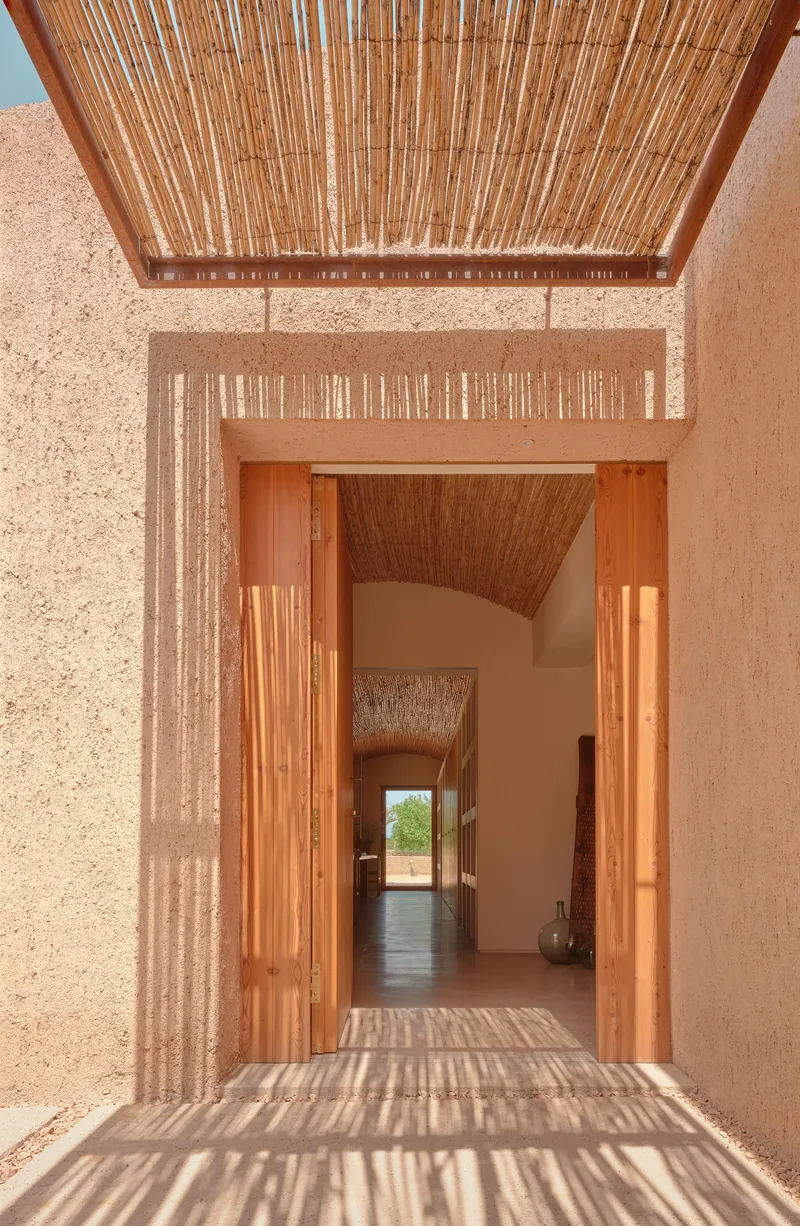
Entry into the house is mediated by courtyards rather than front doors. A timber shade canopy overhead, planted beds of large-leafed tropicals below, and the interplay of bamboo screens casting striped shadows across thresholds: arrival here is a slow compression of light and space. The courtyard with textured aggregate walls and bamboo overhead is particularly effective, producing dappled shadow patterns that shift through the day and make the transition from sun to interior gradual rather than abrupt.
These intermediate spaces do serious environmental work. They pre-cool air before it enters the house, they provide sheltered outdoor rooms for much of the year, and they break the building mass into smaller volumes that ventilate naturally. The bamboo screen at the entry door is a fine example of how a simple material, used structurally and ornamentally at once, can do the work that a mechanized facade system would struggle to replicate.
Bamboo Vaults and the Continuous Interior
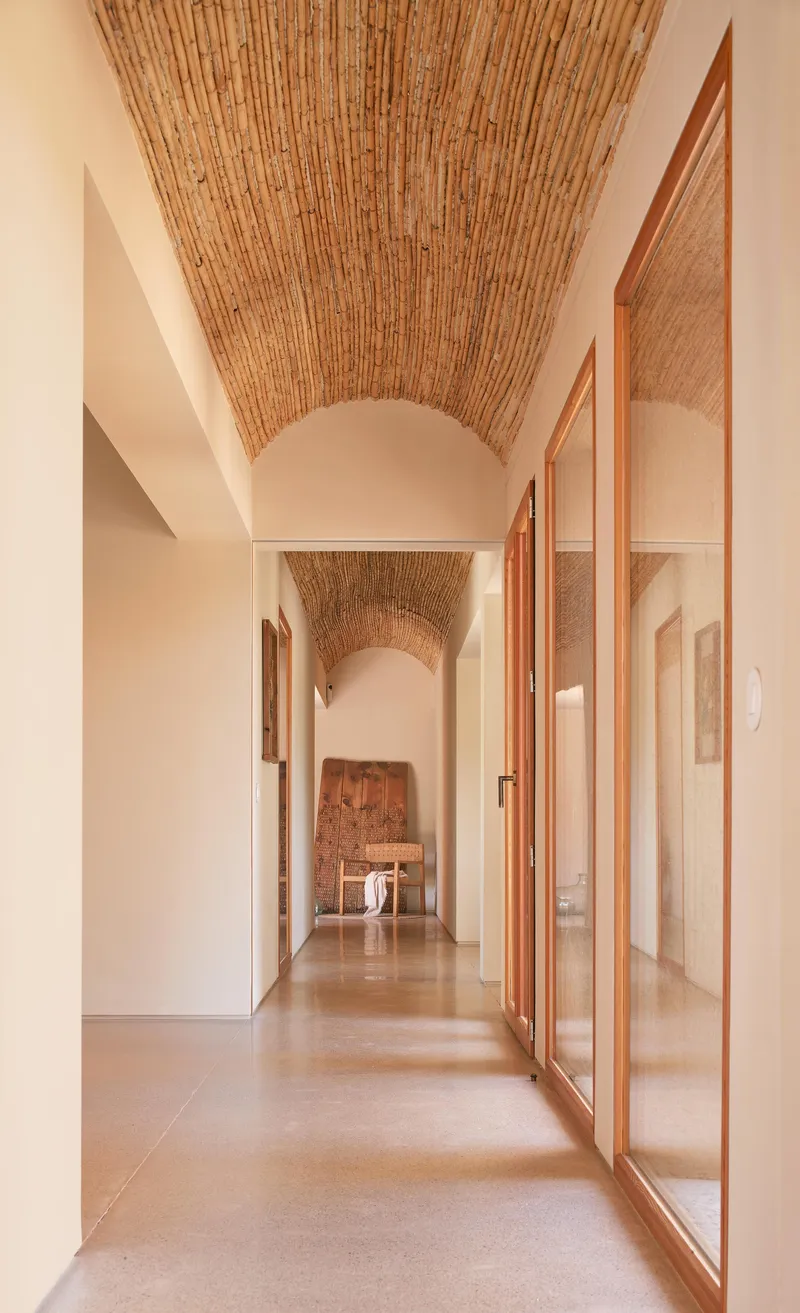
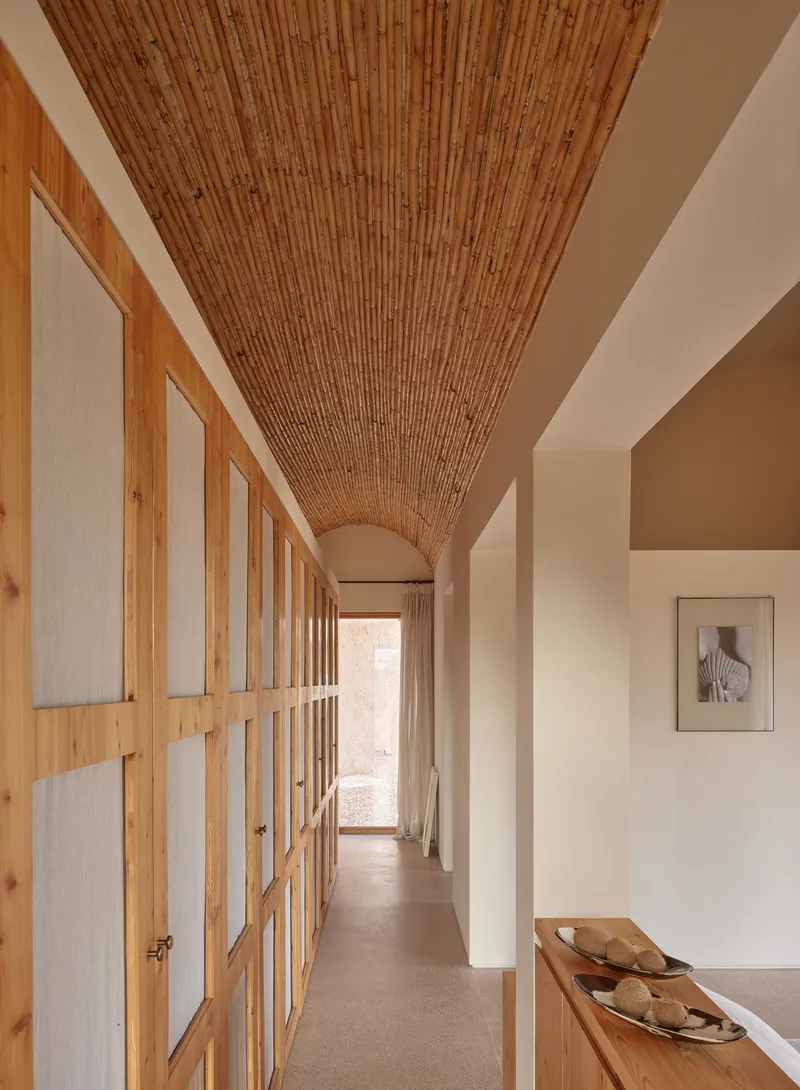
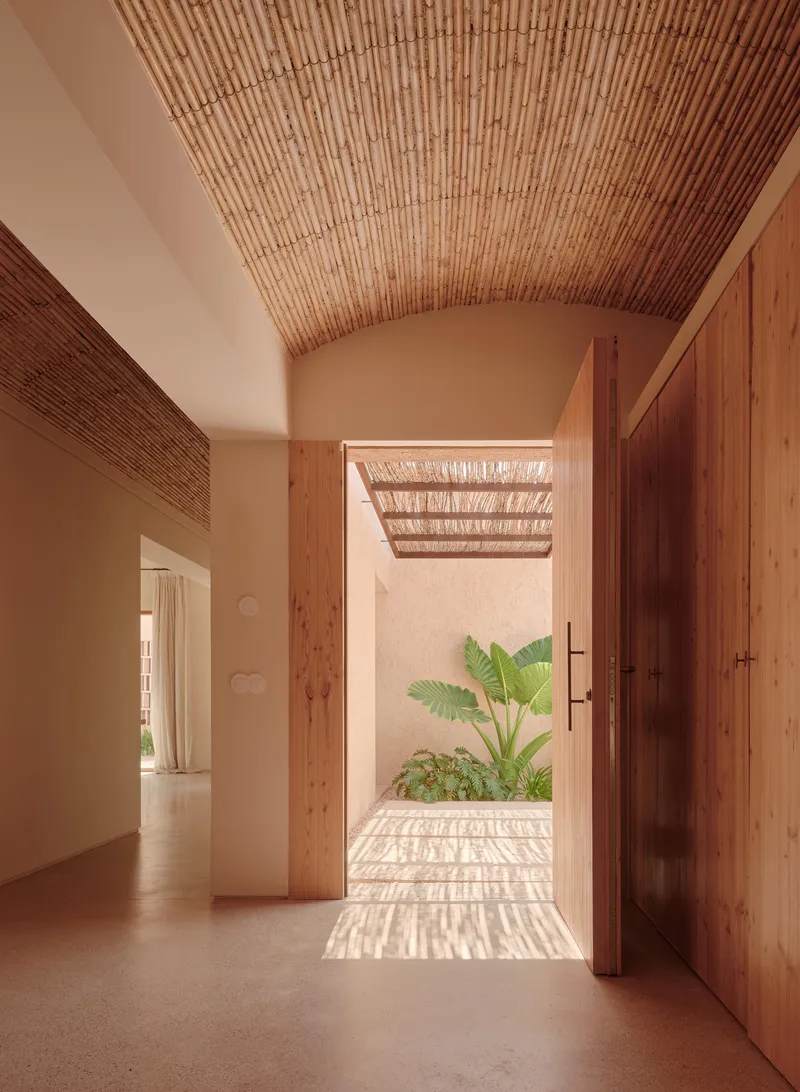
The defining interior move is a barrel vault ceiling constructed from bamboo slats that runs through corridors, bedrooms, and bathrooms without interruption. It unifies what could easily have become a fragmented sequence of rooms into a single continuous spatial experience. The vault reads as lightweight and warm overhead, a deliberate counterpoint to the thick, cool masonry walls below.
Along the corridors, timber-framed glass doors and frosted panels line one wall, creating a rhythm of transparency and opacity. You move through these passages with a constant sense of peripheral landscape: an olive tree here, a courtyard garden there, always visible through narrow openings. This is a house designed for walking through, not just sitting in.
Kitchen and Living Spaces Open to the Ground
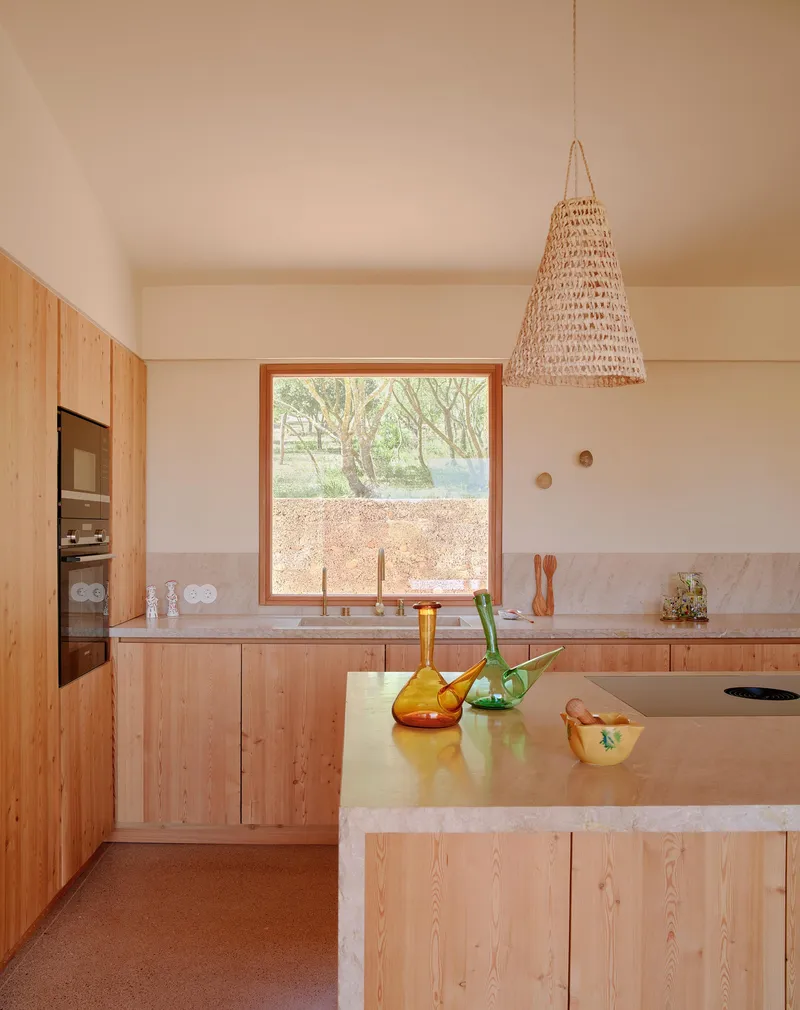
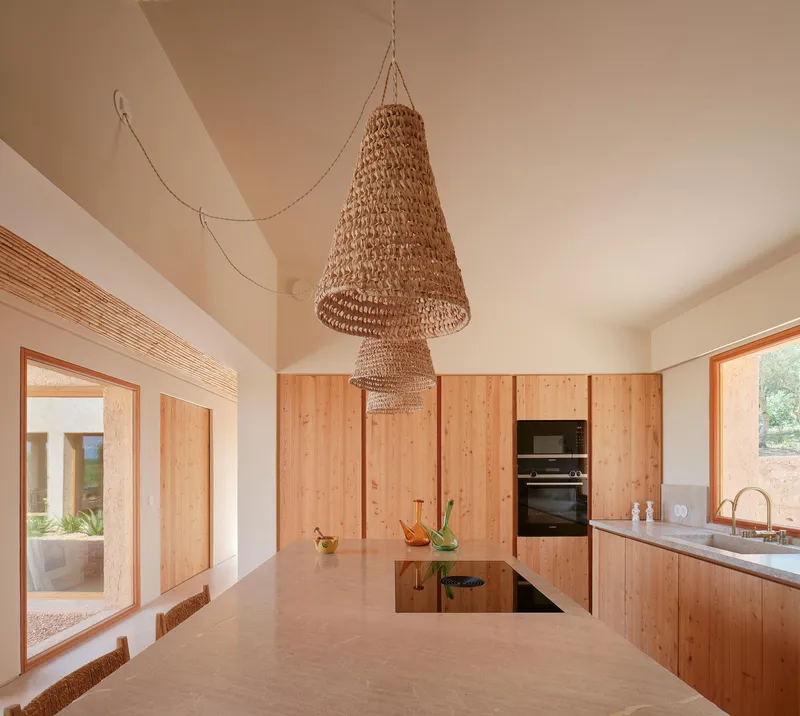
The kitchen sits at the social center of the plan, with timber cabinetry, marble countertops, and a central island beneath the vaulted bamboo ceiling. Two-tiered woven pendant fixtures hang from the apex of the vault, their craft quality reinforcing the handmade material palette. Glazed doors open directly onto the courtyard, so cooking and outdoor life overlap without ceremony.
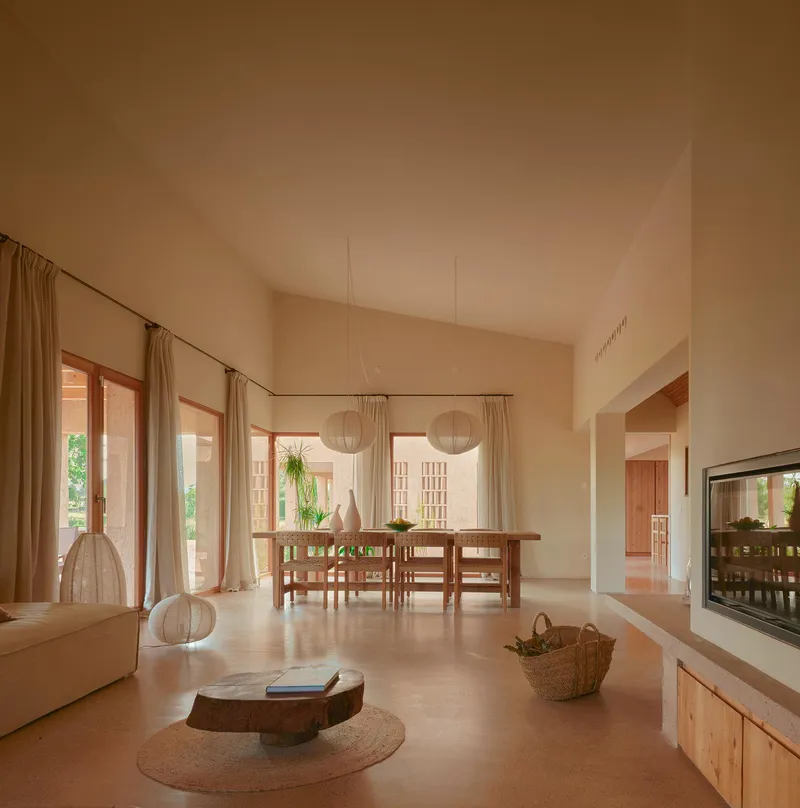
The open-plan living and dining space extends this logic, with timber-framed doors that fold away to connect the room fully to the sunlit courtyard. A spherical paper pendant light over the dining table and a row of circular wall vents along one wall add texture without competing with the vault above. The furniture is restrained, letting the architecture carry the atmosphere.
Private Rooms with Landscape Views
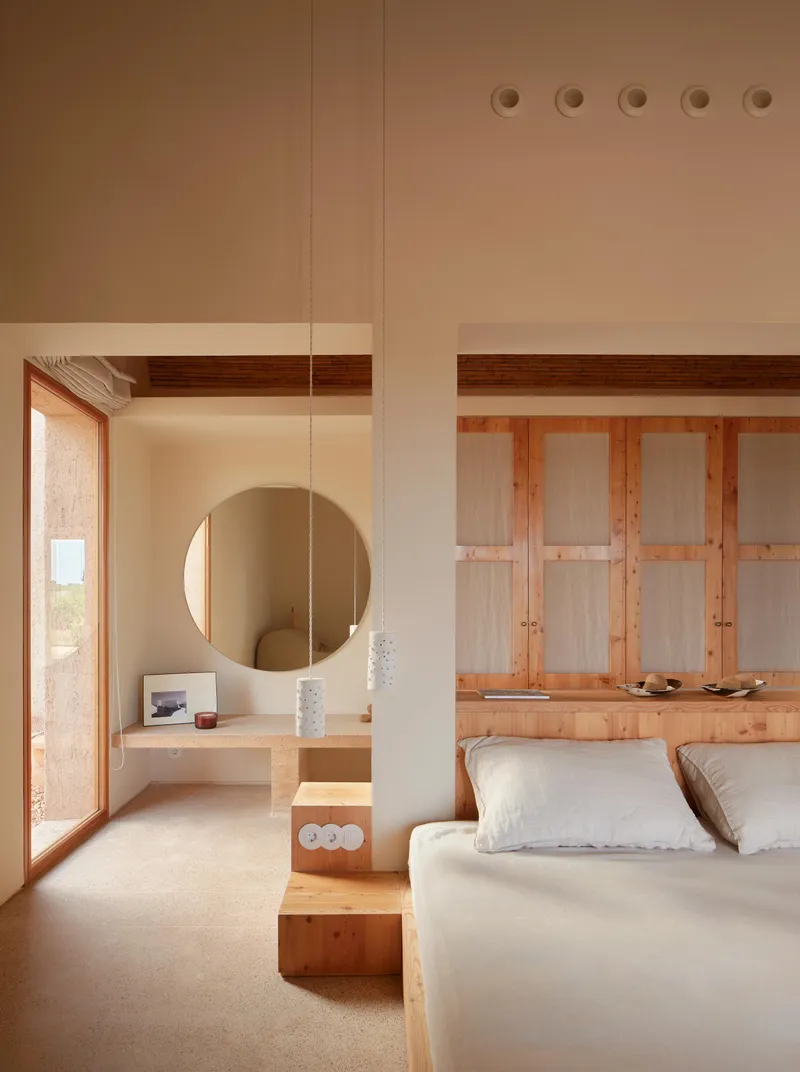
Bedrooms feature timber platform beds beneath exposed wooden ceiling beams, continuing the material vocabulary without variation. The effect is of sleeping inside a carefully constructed wooden shell, warm and enclosed but never claustrophobic, thanks to windows that frame specific landscape views. A study alcove with a woven chair and a desk oriented toward the horizon offers a compact workspace that borrows its sense of space from the terrain beyond.
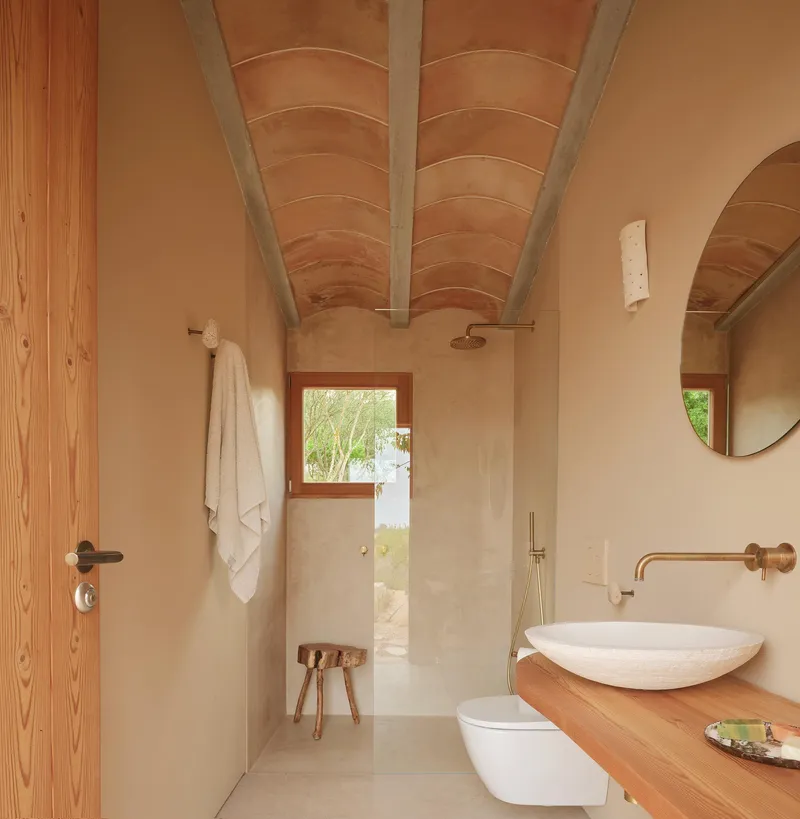
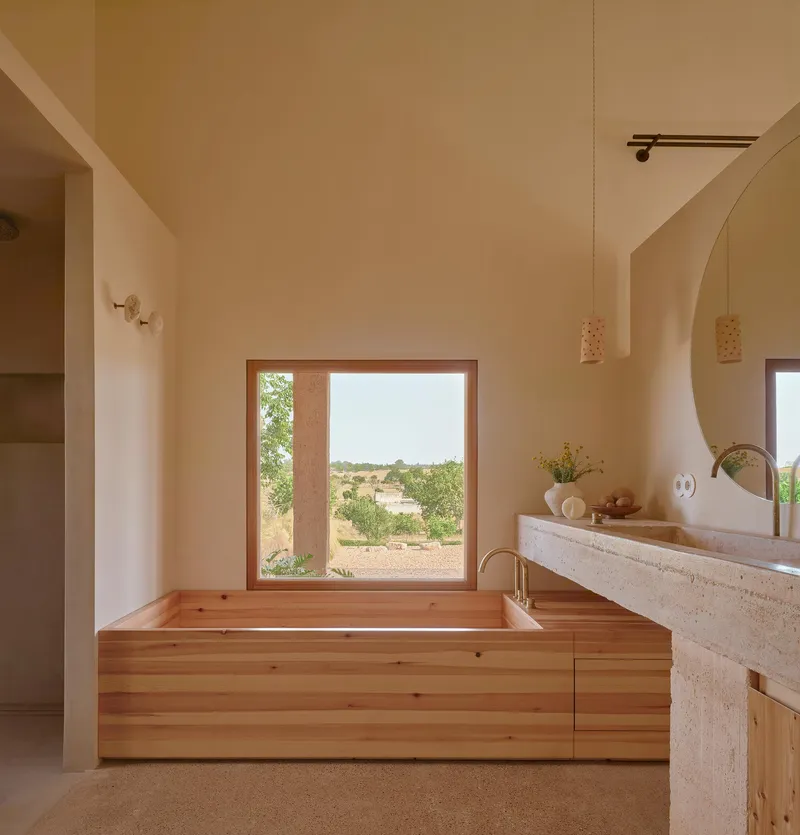
The bathrooms are where the bamboo vault reaches its most expressive moment: an arched opening leads from a vanity area into a walk-in shower with a full garden view. A timber-clad soaking tub sits beneath a wide window overlooking the arid landscape. These are not luxury gestures so much as spatial decisions that collapse the boundary between bathing and being outdoors.
Pool Terrace and the Planted Edge
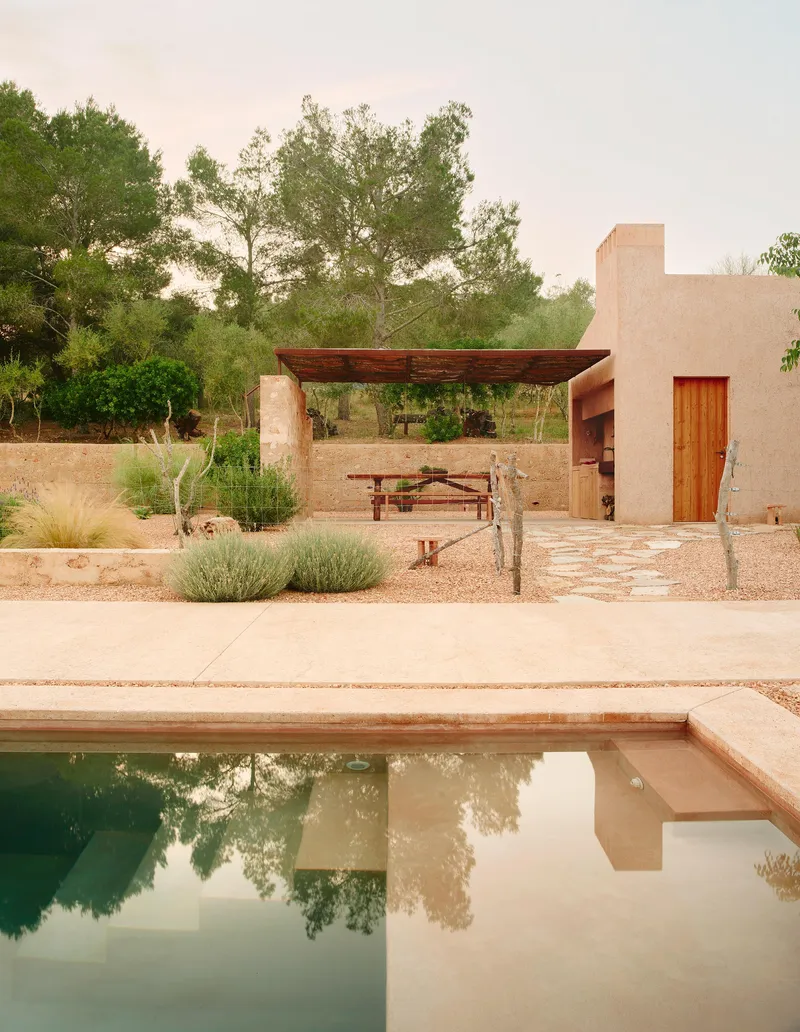
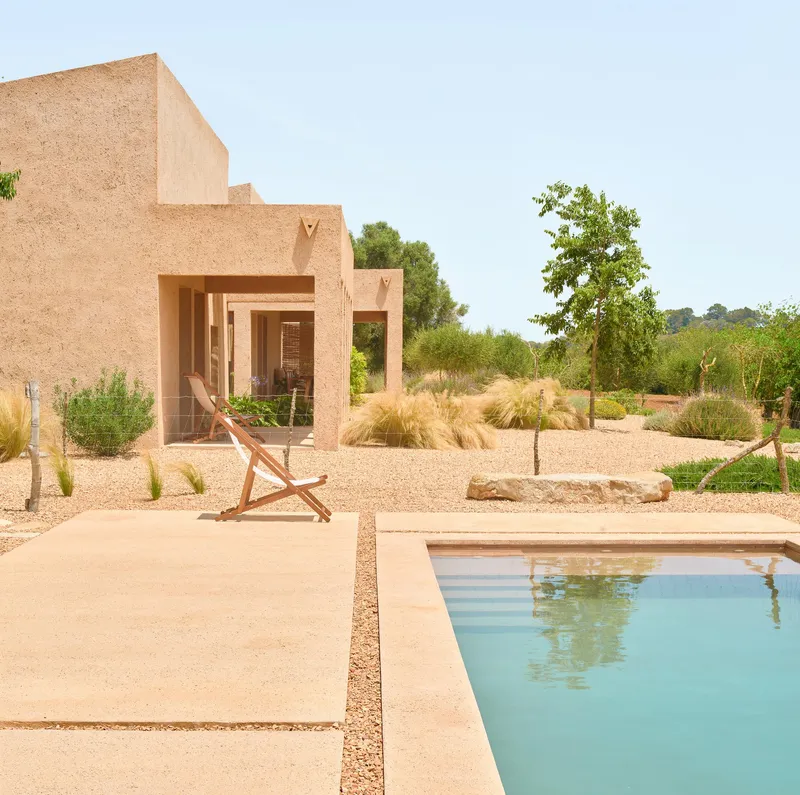
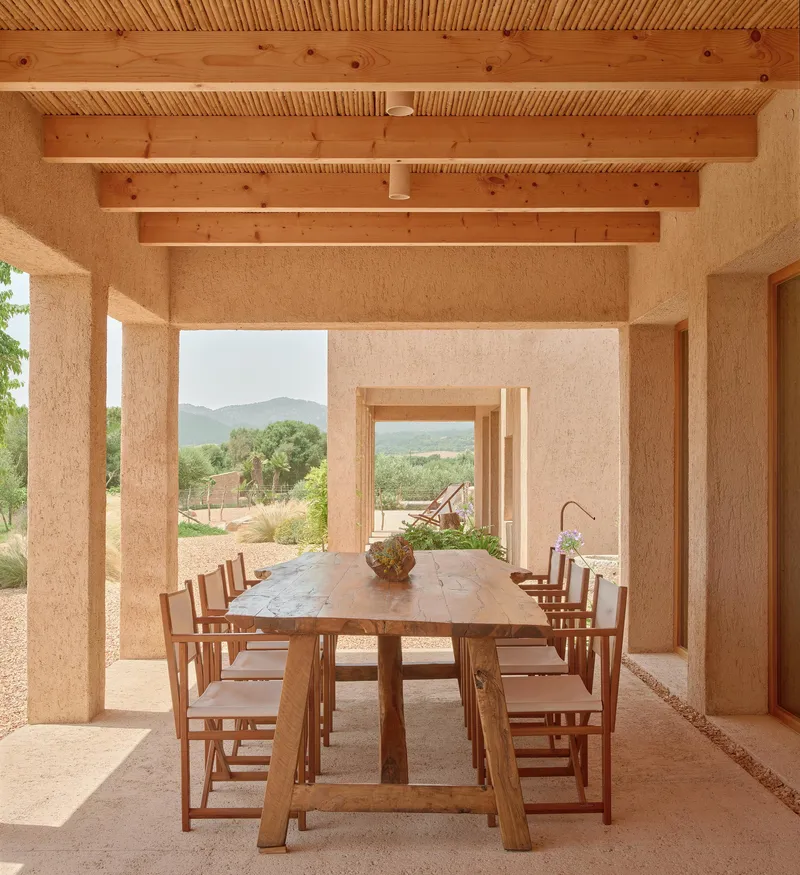
The swimming pool sits in a planted courtyard, its still water reflecting the straw-textured walls and timber pergola structure overhead. A single deck chair on the adjacent terrace looks out over a gravel garden toward the horizon. The covered dining terrace, with its exposed timber beams and open sides framing the mountains, extends the house's living space outward in a way that feels inevitable rather than aspirational.
The planting strategy deserves attention. Rather than importing a green lawn into an arid climate, the landscape relies on native grasses, shrubs, and mature olive trees. This is not just ecological responsibility; it gives the house its visual identity, rooting it in the specific dryness and color of interior Mallorca.
Plans and Drawings
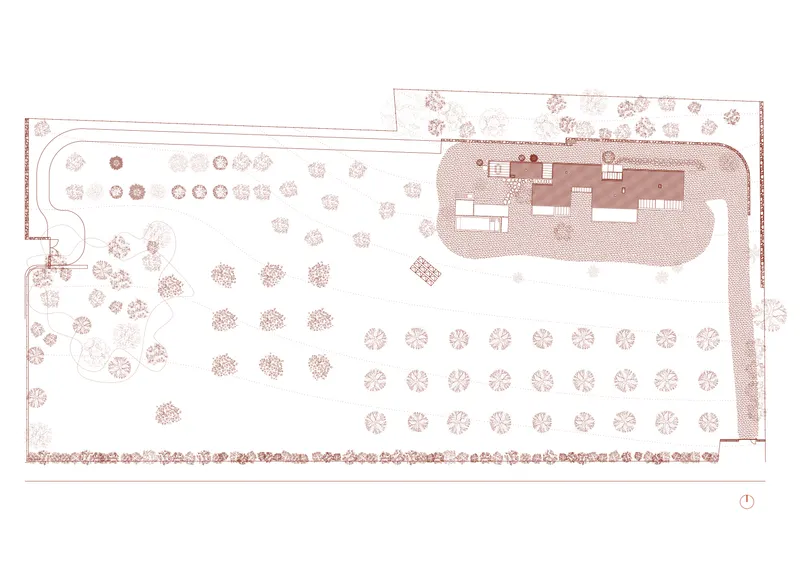
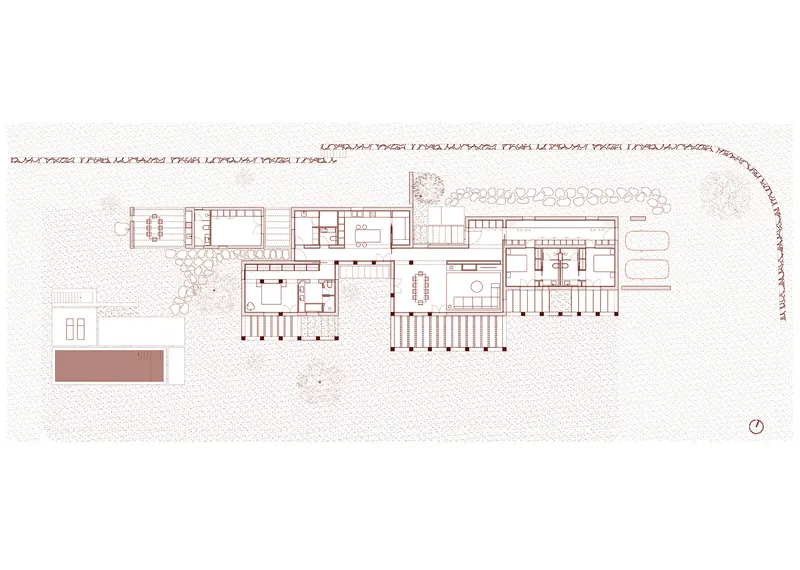
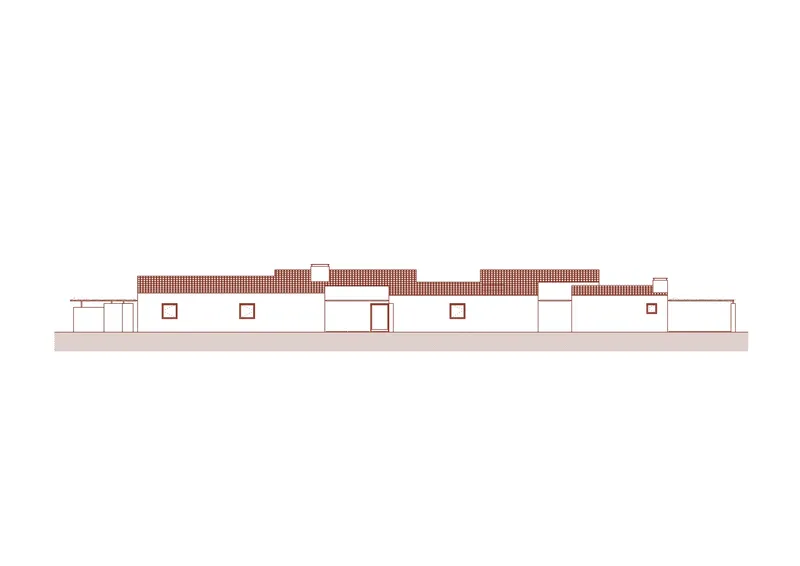
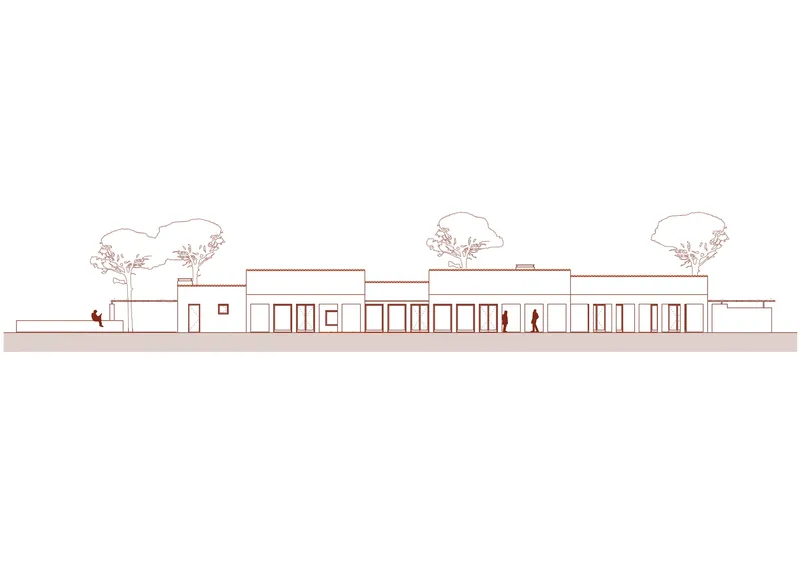
The site plan reveals the building's strategy clearly: a rectangular footprint set within an orchard, with scattered tree plantings filling the remaining site. The floor plan shows an elongated residence organized around courtyards, with a row of trees along a curved site boundary that provides a natural screen. Two elevations depict the long, low profile of the house: one emphasizing the white walls and terracotta roof sections, the other showing the colonnade facade with its rhythmic columns.
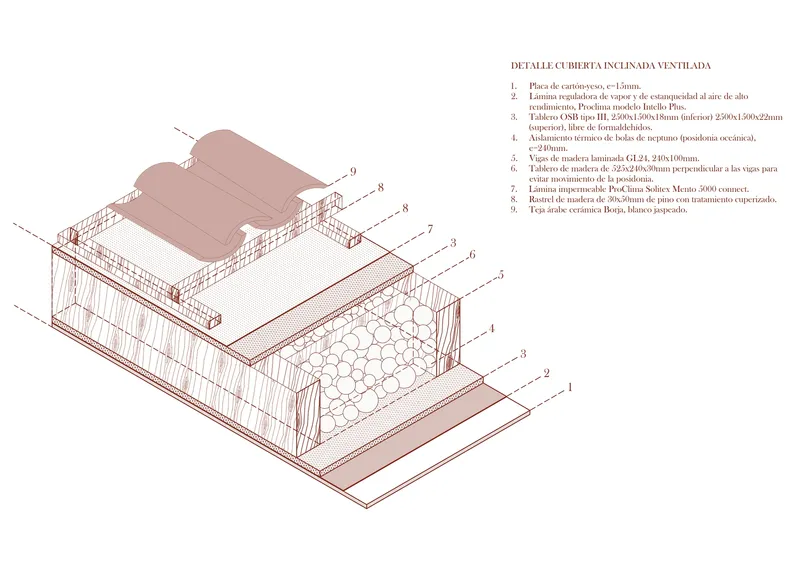
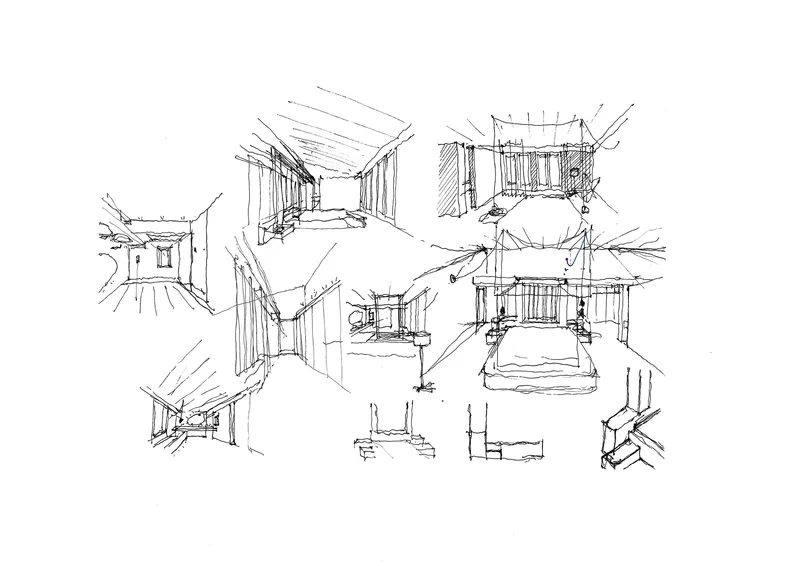
An isometric drawing of the roof assembly is particularly revealing, illustrating a layered system with a ventilated air cavity that explains how the house manages solar gain without relying on heavy insulation alone. Perspective sketch studies show the interior corridor views and spatial sequences that the design team used to develop the project's characteristic movement through vaulted passages and framed thresholds.
Why This Project Matters
Gallineta House is a quiet argument against two trends in contemporary residential architecture: the fetish for white minimalist boxes dropped onto Mediterranean landscapes, and the opposite impulse to clad everything in rustic stone and pretend the twenty-first century never happened. OAM's approach splits the difference with intelligence. The rammed earth and aggregate walls are genuinely local in material and technique, while the bamboo vaulted ceilings and timber detailing bring a craft sophistication that goes beyond nostalgia. The plan, long, linear, courtyard-punctuated, is a proven Mediterranean typology updated with modern environmental thinking.
What stays with you is the way the house refuses to separate inside from outside. Every corridor is a viewing gallery. Every bathroom opens to the landscape. Every threshold is a shadow screen. The building does not conquer its hillside; it negotiates with it, and the negotiation produces architecture that feels both ancient and precise. In a region where over-development is a genuine threat, this house offers a model for how to build generously without building loudly.
Gallineta House by OAM Oficina d'Arquitectura a Mallorca, lead architect Toni Oliver. Manacor, Spain. 271 m², completed 2023. Photography by OAM Oficina d'Arquitectura a Mallorca.
About the Studio
Share Your Own Work on uni.xyz
If projects like this are the kind of work you want to make, uni.xyz is a place to publish your own, find collaborators, and enter design competitions.




Popular Articles
Popular articles from the community


Co-Life: Senior Housing Design That Reconnects Older Adults With the City
Co-Life reimagines senior housing design through healing gardens, shared streets, workshops, and a sustainable community across generations.

Co-life: Sustainable Architecture for Age-Friendly Community Living
Co-life reimagines sustainable architecture for seniors through courtyards, rammed earth, shared gardens, and spaces designed for belonging.

Lunar Spiral: Space Architecture Shaped by the Mathematics of the Universe
Lunar Spiral reimagines space architecture through Fibonacci geometry, lunar regolith, levitating habitats, and self-sustaining Moon living.

Conexión: Biophilic Design Reimagines High-Rise Living in Hong Kong
Conexión reimagines high-rise living in Hong Kong through biophilic design, green facades, shared spaces, daylight, water and nature within.


Similar Reads
You might also enjoy these articles

Bao Huynh Watercolor Atelier: A Serene Art Retreat in Hội An
Bao Huynh Watercolor Atelier in Hội An blends multifunctional art spaces, sustainable design, local materials, and family-friendly living in a serene environment.

Atelier Macri Concept Store Interior Design by CASE-REAL
Atelier Macri store features a "ko" counter, walnut wood details, cork displays, blending retail, gallery, and seamless customer experiences.

Manuel Vargas Izquierdo Stadium and High-Performance Sports Center: Architectural Excellence in Jalpa de Méndez
The Manuel Vargas Izquierdo Stadium blends sustainable design, inclusive sports facilities, and cultural-inspired architecture, revitalizing Jalpa de Méndez’s public spaces.

KAKR Buluh Awar Hall: Revitalizing Community and Ecology Through Bamboo Architecture
Community built bamboo hall revitalizes Buluh Awar village, empowering youth, restoring ecology, celebrating vernacular craftsmanship through sustainable architecture and culture.


Explore Residential Building Competitions
Discover active competitions in this discipline


Challenge to design mud housing for contemporary communities


Design challenge to reuse E-waste
Comments (0)
Please login or sign up to add comments
No comments yet. Be the first to comment!