
Oasis Daycare: Where the Building Disappears and the Landscape Teaches
A runner-up entry in Form Follows Climate 2020 dissolves daycare architecture into a continuous inhabitable park for Miami's hot-humid context.


What happens when you refuse to put children inside a building? You get a topographic playground that swallows its own architecture, replacing walls with berms, corridors with ramps, and ceilings with rolling green roofs where kids grow vegetables. Oasis Daycare treats the entire site as a continuous inhabitable landscape, positioning early childhood education not within a structure but within an ecosystem. The result is a daycare that reads as a public park from the street and functions as a climate machine from within.
Designed by Alan Fan, Kathy Yuan, and Kirsten Feng, the project earned Runner-up recognition in the Form Follows Climate 2020 competition. Set within Miami's hot-humid climate and dense urban grid, the proposal uses the city's prevailing southern winds, intense solar exposure, and adjacent park infrastructure as generative inputs rather than obstacles. The designers position sustainability not as curriculum content but as spatial experience: children don't learn about water cycles from a textbook, they watch rainwater harvesting pools cool the air they breathe.
A Sand Playground Under Glass Curves
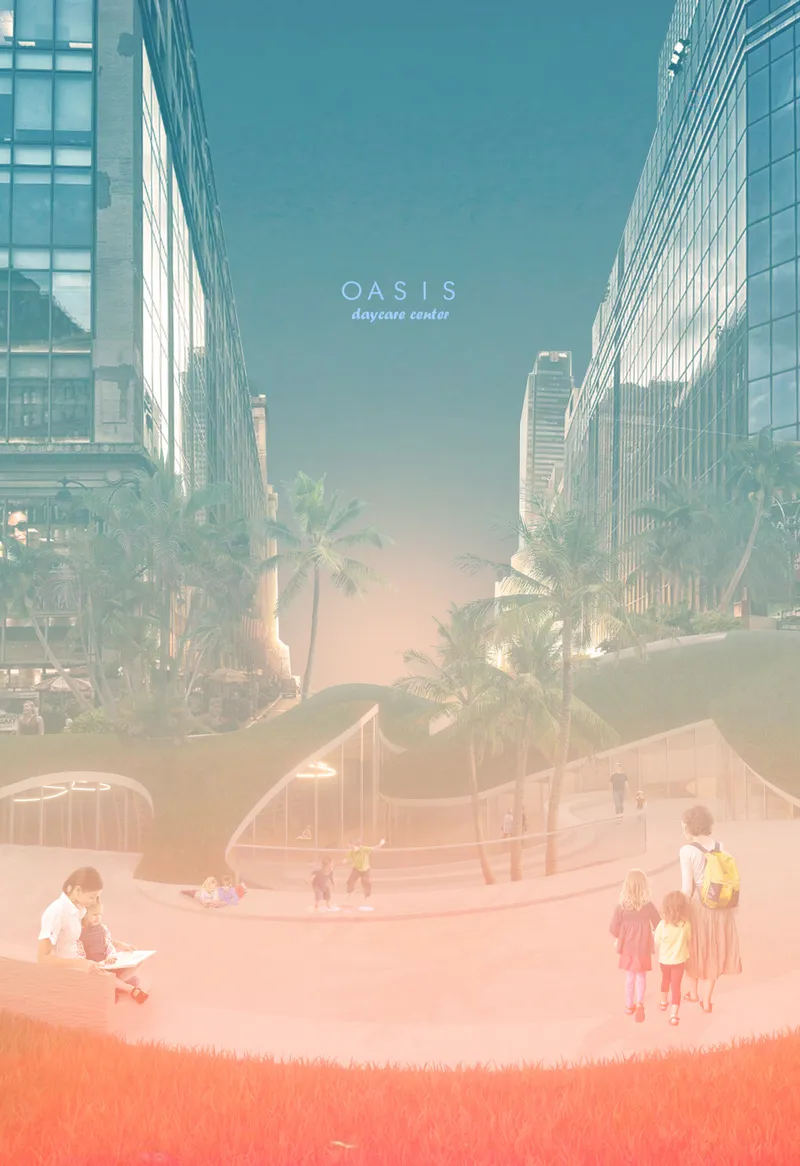
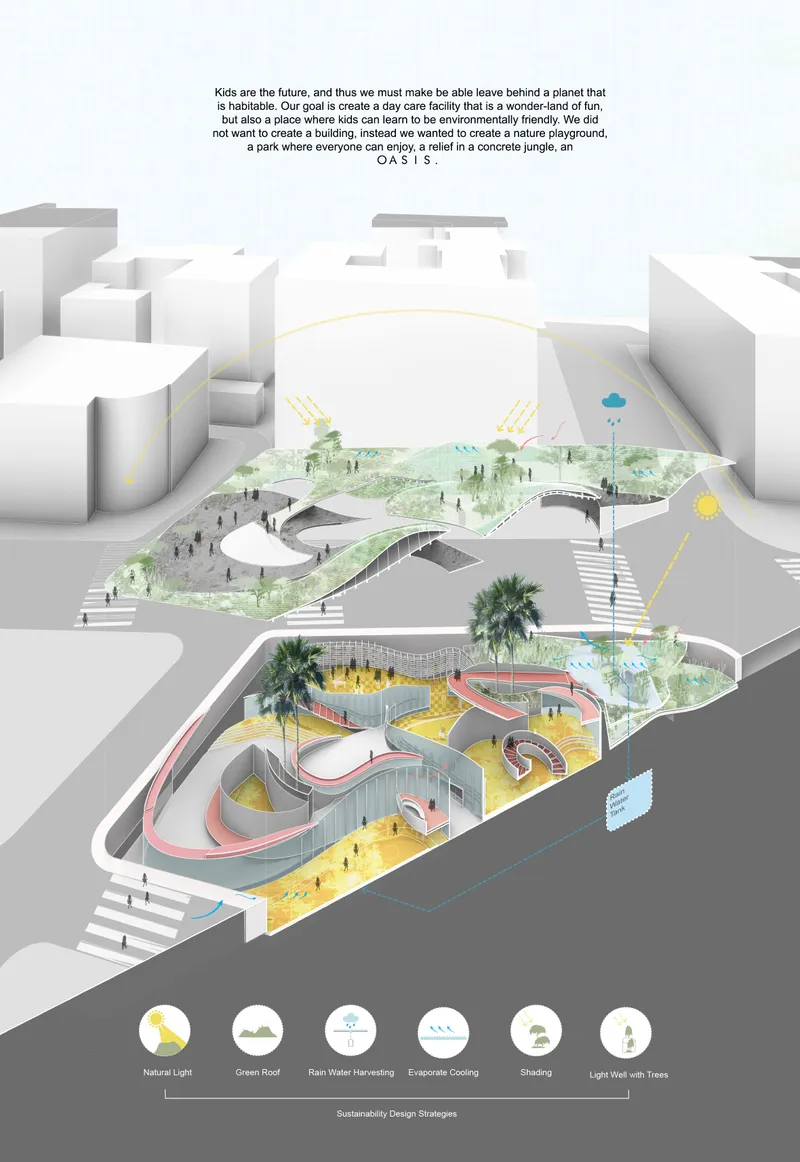
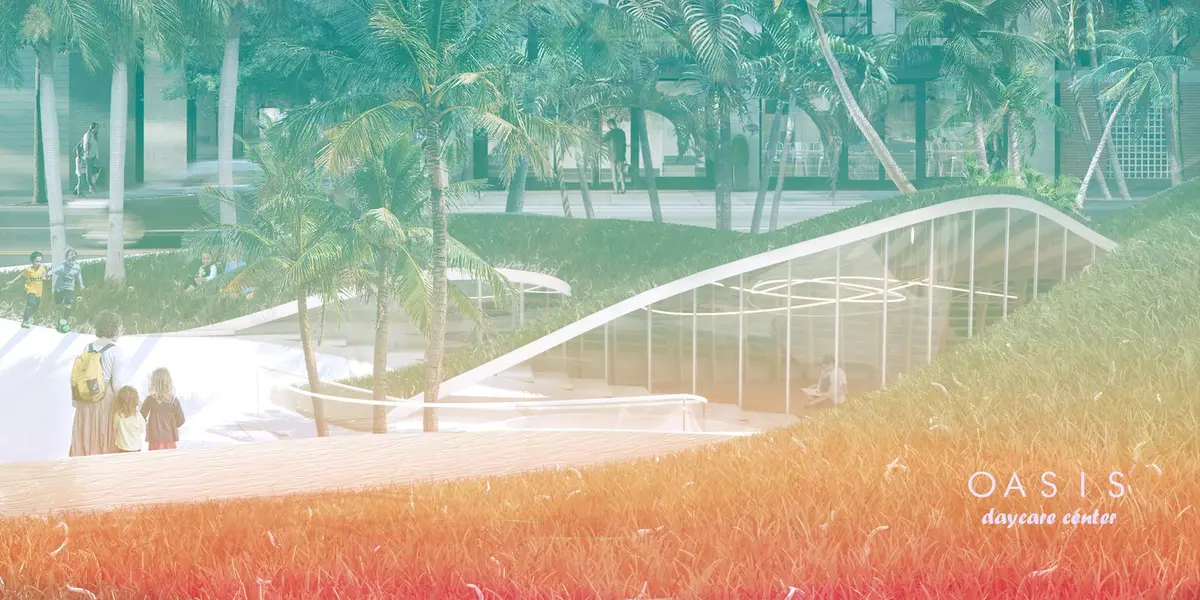
The opening render reveals the project's fundamental ambition: architecture that disappears into its own ground plane. Curved glass pavilions rise gently from sandy play surfaces, their arched profiles more suggestive of dune formations than institutional buildings. Palm trees punctuate the composition, and the surrounding glass towers of the city recede into a hazy background, reinforcing the daycare's role as a visual and climatic refuge. The axonometric cutaway drawing makes the spatial logic legible, exposing a network of underground play spaces carved beneath the park surface. Classrooms, libraries, and communal zones nestle below grade while the landscape above remains continuous and publicly accessible.
This sectional strategy is more than formal play. By lowering key program elements, the designers create sunken courtyard zones where planted mounds and trees generate a cooler microclimate without relying on mechanical systems. The rolling green roofs that cap these subterranean rooms reduce heat gain and mitigate the urban heat island effect, functioning simultaneously as insulation, stormwater management, and outdoor learning surfaces.
Pavilions That Breathe With the Wind
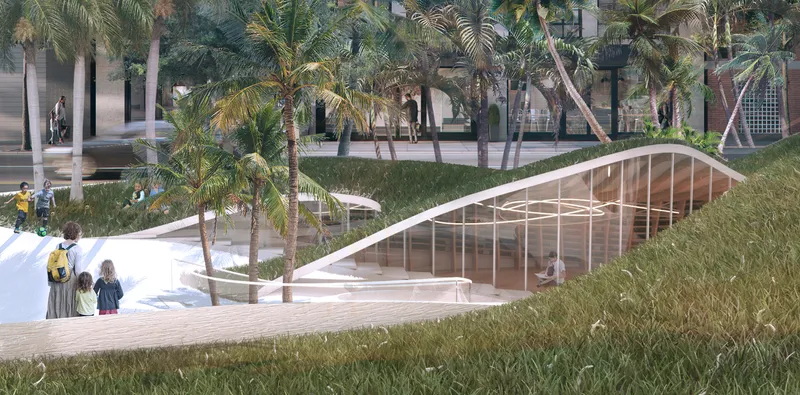
A closer view of the curved glass pavilion shows how the design harnesses Miami's climate rather than resisting it. The arched roof profile emerges from landscaped berms dense with grasses and palms, blurring the threshold between interior shelter and exterior garden. The glazing allows filtered daylight to reach interior zones while the form channels airflow: positioned between city blocks, the site exploits a wind tunnel effect that draws prevailing southern breezes across playground and interior spaces alike.
Water collection pools along the southern edge add another layer of passive cooling. As wind passes over these pools before entering interior zones, an evaporative cooling effect produces a localized sea-breeze condition. Combined with tree canopies, roof overhangs, and sculpted light openings, the pavilion creates a passive environmental control strategy that significantly reduces dependence on air conditioning. The architecture does not simply sit in its climate; it performs as a climate instrument.
Timber Shelves and Ring Light: The Underground Library
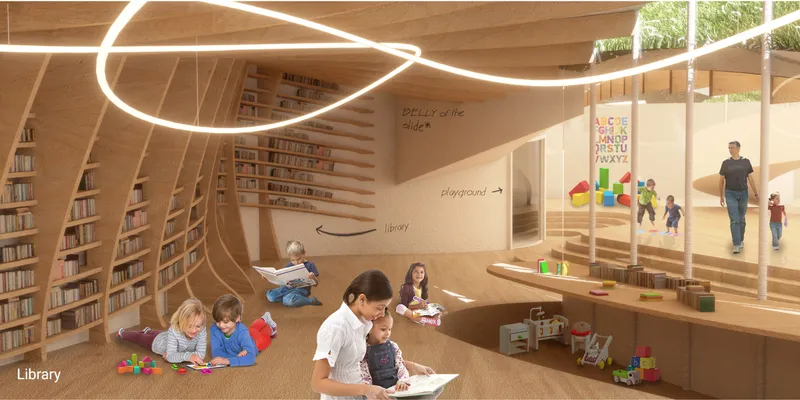
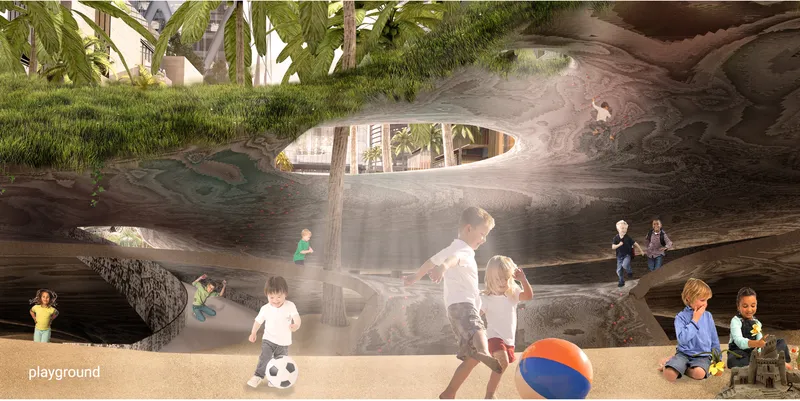
Two interior views reveal the warmth and tactile richness of the below-grade spaces. The library wraps children in curved timber shelving that follows the organic geometry of the landscape above. Pendant ring lights cast soft, even illumination across reading zones where kids sit directly on the floor, reinforcing a pedagogy rooted in comfort and spatial curiosity rather than rigid furniture arrangements. Every surface curves, and visual continuity with outdoor play areas is maintained through strategically placed openings.
The underground play cavern takes this spatial ambition further. Carved rock formations create a grotto-like environment, while oval skylights punch through the ceiling to draw daylight down from the park above. Children playing here remain in constant dialogue with the landscape overhead. These light wells are not decorative; they reinforce the project's central argument that architecture should make natural systems visible and tangible. Sliding levels, ramps, and gentle slopes replace traditional corridors throughout, turning circulation itself into a form of play.
Stitching Into the Urban Grid
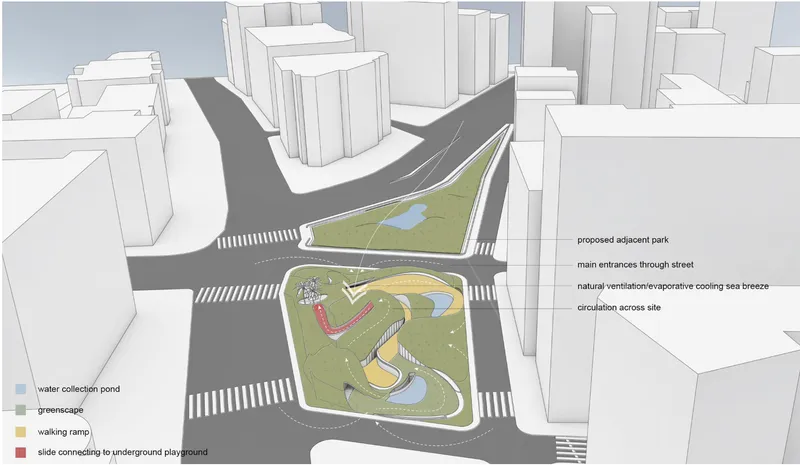
The site diagram reveals the project's urban strategy with clarity. The daycare's interconnected curved playground spaces occupy a street intersection, their organic geometries contrasting with the orthogonal city grid. An adjacent park is physically and visually linked to the daycare landscape, dissolving the property boundary between childcare facility and public green space. The site becomes a shared community asset: a green lung within dense urban fabric that serves families during operating hours and neighbors at all other times.
This dual reading as both institution and infrastructure is critical. By refusing to fence itself off, the daycare amplifies its ecological and social footprint far beyond its program. The vegetated roofs, water features, and tree canopies contribute to the neighborhood's microclimate. The playgrounds invite public engagement. The architecture, having absorbed itself into the ground, gives back its entire footprint as park.
Why This Project Matters
Oasis Daycare challenges a stubborn assumption in educational architecture: that children need to be contained in order to be cared for. By distributing program beneath a continuous landscape and using climate as a design driver rather than a problem to solve, the project demonstrates that institutional buildings can be generous to their cities. The passive cooling strategies, from wind tunnels to evaporative pools to green roofs, are not applied technologies but spatial consequences of the design's own geometry and orientation.
For Alan Fan, Kathy Yuan, and Kirsten Feng, the proposal represents a compelling argument that sustainability in architecture begins with spatial imagination, not technical specification. When a daycare teaches children about ecology simply by existing, when its walls are berms and its corridors are ramps through gardens, the building stops being a container for learning and becomes the lesson itself. That shift, from instruction to inhabitation, is what makes the project resonate beyond the competition brief.
View the Full Project
About the Designers
Designers: Alan Fan, Kathy Yuan, Kirsten Feng
Enter a Design Competition on uni.xyz
uni.xyz runs architecture and design competitions year-round that reward proposals with spatial conviction and real site intelligence.
Project credits: Oasis Daycare by Alan Fan, Kathy Yuan, Kirsten Feng Form Follows Climate 2020 (uni.xyz).


Popular Articles
Popular articles from the community


Co-life: Sustainable Architecture for Age-Friendly Community Living
Co-life reimagines sustainable architecture for seniors through courtyards, rammed earth, shared gardens, and spaces designed for belonging.

The Ocean Hive: Sustainable Architecture for a Self-Sufficient Civilization at Sea
The Ocean Hive imagines sustainable architecture at sea, where modular habitats, algae, wave power and ocean waste sustain a growing colony.

Co-Life: Senior Housing Design That Reconnects Older Adults With the City
Co-Life reimagines senior housing design through healing gardens, shared streets, workshops, and a sustainable community across generations.

The Musturak Paradise: Senior Living Architecture for a Connected Future in Temara, Morocco
The Musturak Paradise reimagines senior living architecture in Temara via private homes, social spaces, culture, community, and shared care.

Similar Reads
You might also enjoy these articles

ALGAL REALM: A Bio-Integrated Lunar Habitat Design for Life Beyond Earth
ALGAL REALM reimagines lunar habitat design with algae-powered life support, 3D-printed regolith, and vertical living for a lunar future.

Cinema Futurismo: Futuristic Architecture Reimagining the Future of Cinema
Cinema Futurismo merges futuristic architecture, holographic projection, intimate seating, and landscape into a new social cinema.

Little Red Riding Hood: Architectural Design as a Journey Through Fear, Light, and Storytelling
Little Red Riding Hood reimagines the fairy tale through architectural design shaped by fear, light, scale, memory, uncertainty, and choice.
Playducation: Modular Architecture That Turns Play Into a Space for Learning
Playducation transforms modular architecture into a flexible world of play, learning, and healing for children in refugee settlements.

Explore Green Oasis Competitions
Discover active competitions in this discipline

Challenge to design luxury tourism on rails

VR headsets Storefront design competition

Designing a staircase for a client
Comments (0)
Please login or sign up to add comments
No comments yet. Be the first to comment!