
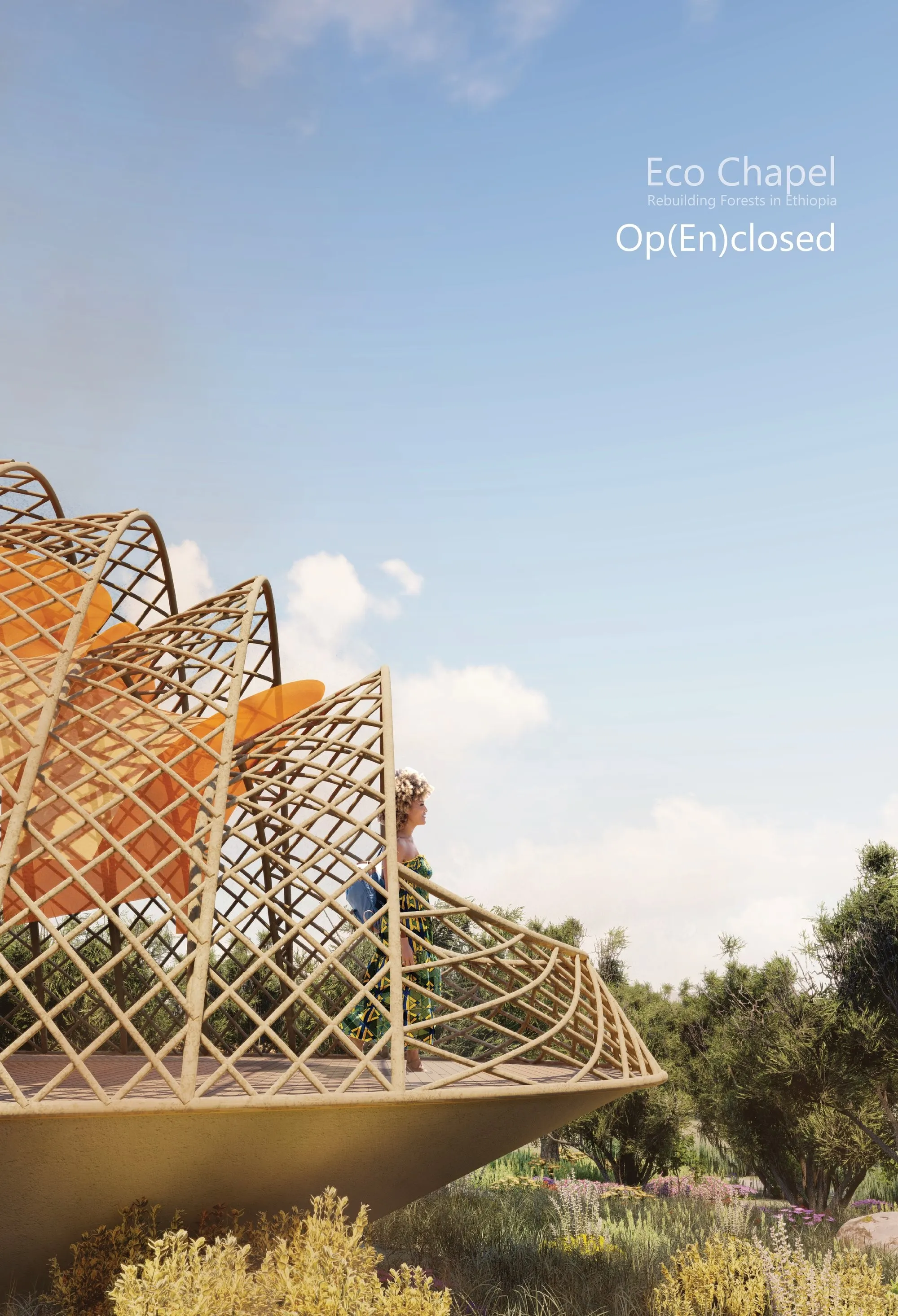
Op(En)closed: A Sustainable Architecture Vision Reimagining Ethiopia's Forest Church Tradition
A bamboo-built sustainable architecture vision for Ethiopia that restores forest ecosystems while creating a community-centered sacred landscape.


As environmental challenges continue to reshape the future of design, architects are increasingly seeking solutions that merge ecological responsibility with cultural identity. Op(En)closed, an Editor's Choice entry in the Eco-Chapel competition by Andrew Hadley, explores how sustainable architecture can become a catalyst for environmental restoration, community engagement, and spiritual reflection.
Set within the rapidly changing landscape of Ethiopia, the proposal responds to one of the nation's most pressing environmental concerns: deforestation. Rather than relying on conventional construction materials with high embodied energy, the project embraces bamboo, one of Africa's most abundant yet underutilized renewable resources. Through this strategy, Op(En)closed demonstrates how architecture can become part of a regenerative ecological system rather than an extractive one.
Addressing Ethiopia's Environmental Challenges Through Design
Ethiopia possesses vast bamboo resources, accounting for a significant proportion of Africa's bamboo forests. Despite this natural advantage, the material remains underused in large-scale architectural applications. At the same time, extensive deforestation continues to threaten biodiversity, ecosystems, and local communities.
Op(En)closed directly addresses these challenges by proposing a construction methodology centered around bamboo as the primary building material. The project reduces dependence on timber while promoting a renewable resource capable of supporting local industries and sustainable economic development.
Rather than viewing architecture as an isolated object, the proposal considers the broader environmental systems surrounding it. The design becomes a tool for ecological restoration, helping reconnect urban populations with the natural landscapes that sustain them.
Reinterpreting the Ethiopian Forest Church
The conceptual foundation of the project emerges from Ethiopia's historic forest churches. These sacred places traditionally exist as protected ecological sanctuaries where dense forests surround religious structures, creating islands of biodiversity within increasingly developed landscapes.
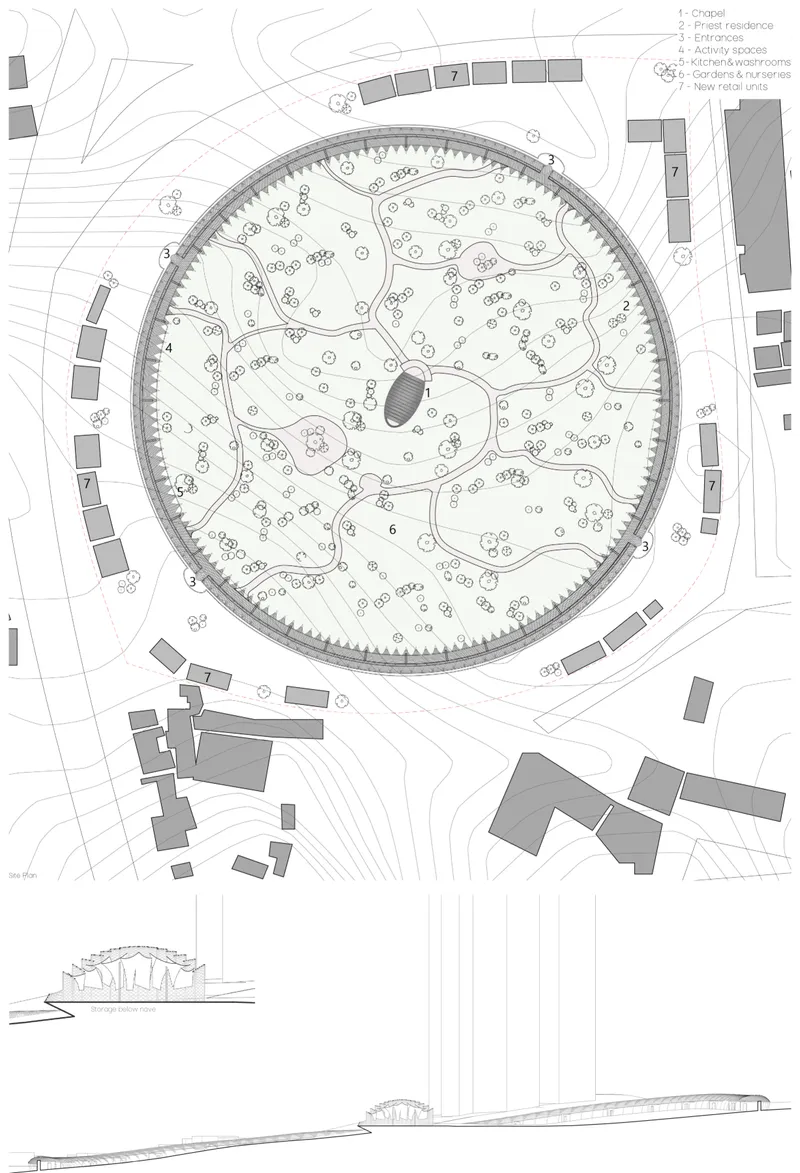
Op(En)closed reimagines this typology for contemporary Addis Ababa. Instead of preserving a forest around a church, the project creates an enclosed garden sanctuary that functions as both ecological infrastructure and community space. At its center stands the chapel, while a circular landscape framework protects and nurtures the surrounding ecosystem.
This reinterpretation transforms the traditional forest church into a modern environmental and social resource. The architecture actively contributes to conservation while maintaining the spiritual qualities that define the original typology.
A Circular Landscape for Community and Nature
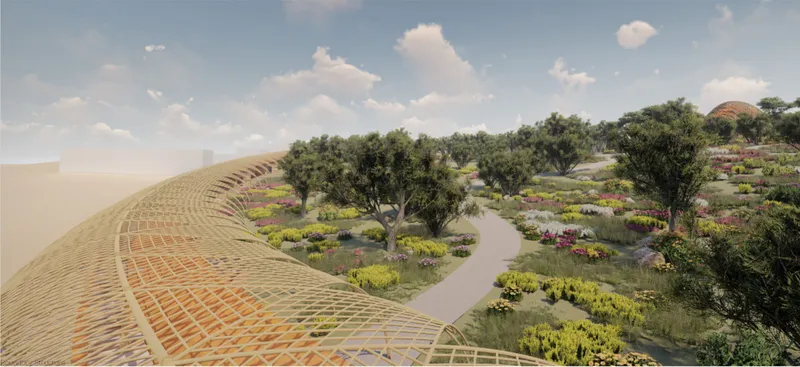
The masterplan is organized around a large circular enclosure that creates a distinct boundary between the city and the restored landscape within. This perimeter establishes a protected environment where vegetation, wildlife, and community activities can coexist.
Visitors enter through carefully positioned gateways and transition from the urban environment into a lush interior garden. Pathways weave throughout the landscape, encouraging exploration and interaction with nature. Rather than directing movement through rigid routes, the circulation network allows visitors to wander freely among trees, planting zones, and communal spaces.
The circular geometry reinforces ideas of protection, continuity, and collective stewardship. It establishes a powerful visual identity while creating a framework capable of supporting ecological regeneration over time.
Bamboo as Structure, Shelter, and Symbol
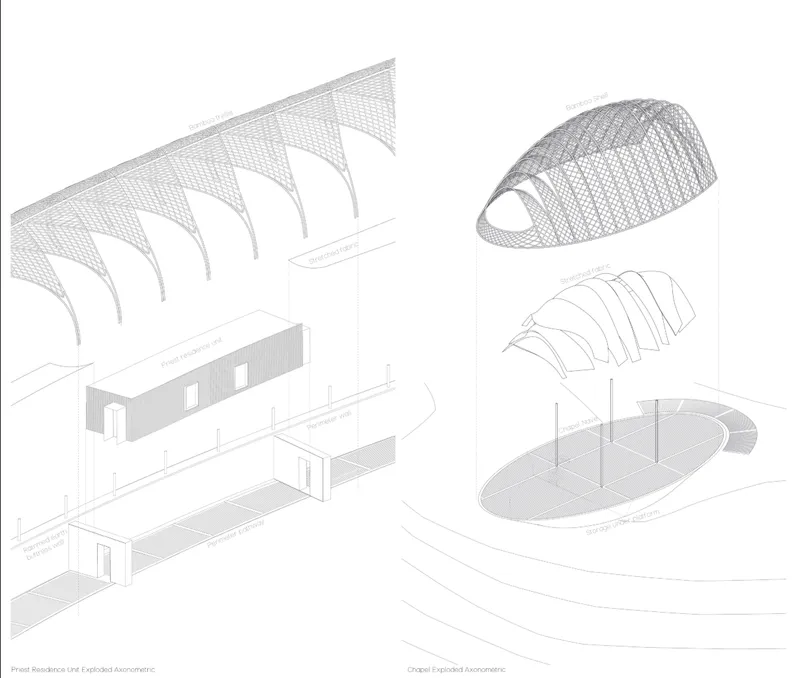
The architectural language of Op(En)closed is defined by bamboo. The material forms the structural framework, shading systems, enclosure elements, and expressive architectural features throughout the project.
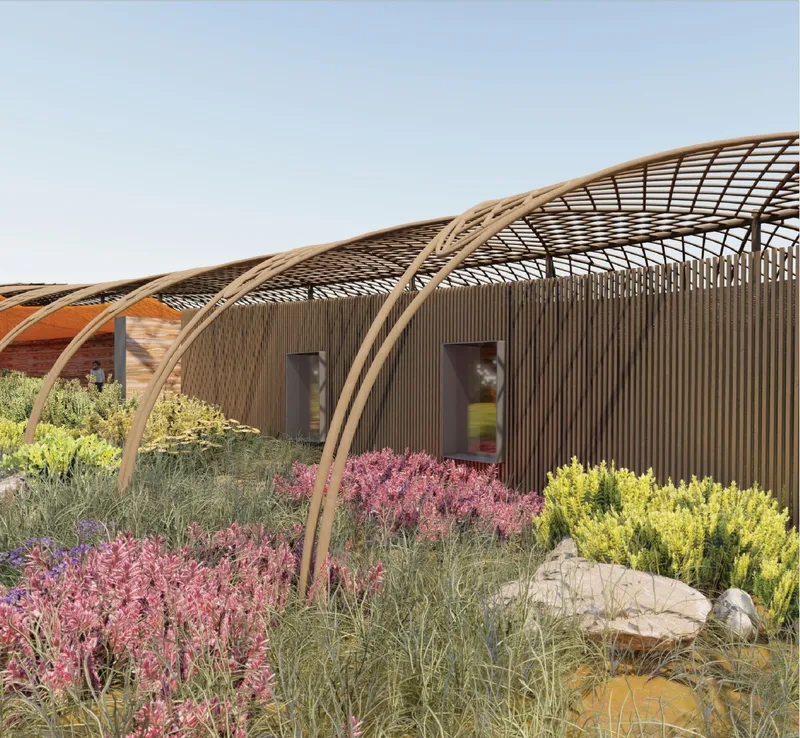
Around the perimeter, bamboo trellises extend above community facilities and residential units, creating shaded outdoor environments that soften the transition between built space and landscape. Stretched fabric elements suspended beneath the trellises provide additional protection from sunlight and rainfall while maintaining openness and ventilation.
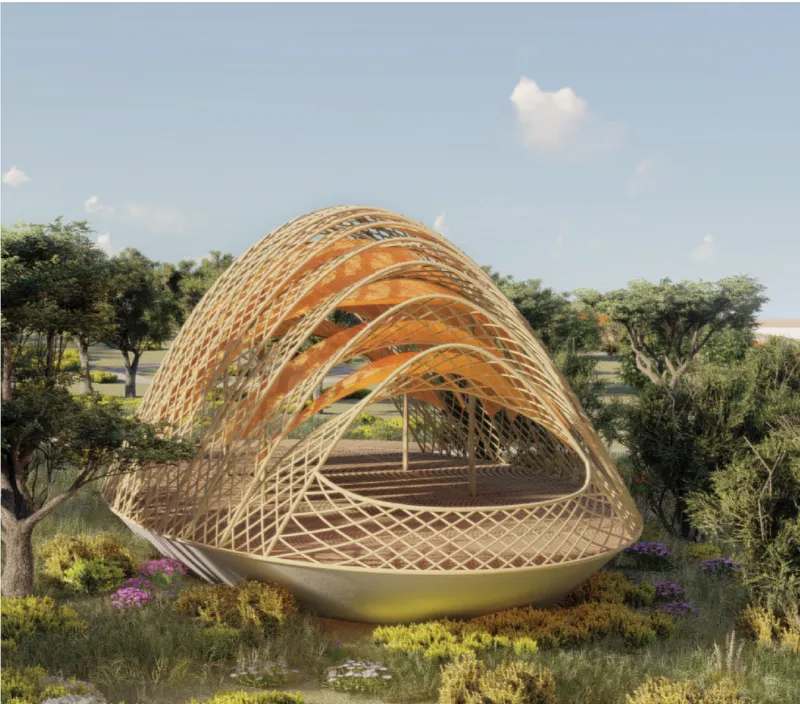
At the center of the site, the chapel emerges as a sculptural bamboo structure. Its woven shell rises gracefully above a circular platform, creating a lightweight and visually dynamic form that appears to grow from the landscape itself.
The bamboo lattice allows light, air, and vegetation to interact with the architecture, reinforcing the project's central theme of coexistence between nature and the built environment.
The Chapel as a Space of Reflection
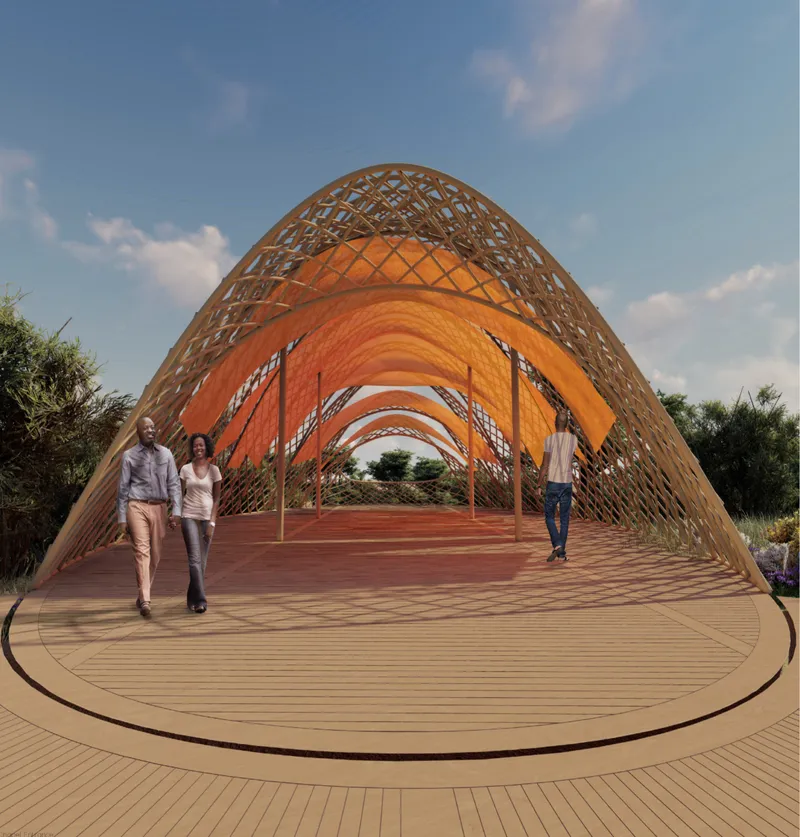
Unlike traditional enclosed religious buildings, the chapel embraces openness and transparency. The woven bamboo shell creates a semi-enclosed environment where visitors remain connected to the surrounding landscape.
Natural light filters through the lattice structure, producing constantly changing patterns of shadow and illumination. The experience is intentionally immersive, encouraging reflection on humanity's relationship with the environment.
The chapel's elevated position offers panoramic views across the gardens, reinforcing its role as both a spiritual destination and a place for environmental awareness. Rather than separating worship from nature, the design integrates the two into a single architectural experience.
Integrating Community Programs
Beyond its spiritual function, Op(En)closed serves as a community hub. The project incorporates residential spaces for clergy, communal facilities, activity zones, kitchens, washrooms, and retail spaces along the perimeter.
These programs are carefully integrated into the enclosing wall structure, minimizing their visual impact while maximizing accessibility. The arrangement allows the landscape to remain the dominant element of the project while ensuring that essential community services are readily available.
This combination of spiritual, ecological, and social functions transforms the development into a multifunctional destination that supports daily life while promoting environmental stewardship.
Architecture as Ecological Infrastructure
One of the most compelling aspects of Op(En)closed is its understanding of architecture as ecological infrastructure. The project does not simply occupy land; it actively contributes to landscape regeneration.
The enclosed gardens become living ecosystems capable of supporting biodiversity, improving environmental quality, and strengthening community engagement with nature. The architecture creates conditions that encourage ecological growth rather than limiting it.
By combining renewable materials, passive environmental strategies, and landscape restoration, the proposal demonstrates how sustainable architecture can produce positive environmental outcomes while creating meaningful human experiences.
A Model for Regenerative Design
Op(En)closed presents a powerful vision for the future of sustainable architecture. Through its innovative use of bamboo, reinterpretation of Ethiopian forest church traditions, and commitment to ecological restoration, the project offers a compelling alternative to conventional development models.
Andrew Hadley's proposal illustrates how architecture can move beyond minimizing environmental impact to actively improving environmental conditions. It creates a place where spirituality, community, and ecology are intertwined within a single regenerative framework.
In doing so, Op(En)closed becomes more than an architectural proposal. It serves as a model for how future cities can reconnect with nature while preserving cultural identity and supporting environmental resilience.



Popular Articles
Popular articles from the community


Hill & Cross Opera: Sculptural Opera House Architecture Shaped by Tallinn’s Landscape and Identity
Hill & Cross Opera reimagines opera house architecture in Tallinn through its sculptural hill, civic plaza, glass wave and a luminous cross.

Co-life: Sustainable Architecture for Age-Friendly Community Living
Co-life reimagines sustainable architecture for seniors through courtyards, rammed earth, shared gardens, and spaces designed for belonging.

Play: Fragments of Their World
Familiar architecture becomes modular playground design, creating safe spaces where displaced children can learn, connect, imagine and play.

The Earth Pod: 3D Printed Homes for Resilient Refugee Communities
The Earth Pod reimagines refugee housing through 3D printed homes made from clay, combining resilience, self-sufficiency, and rapid shelter.


Similar Reads
You might also enjoy these articles

Eco Chapel: A Green Architecture Pavilion Designed in Symbiosis with the Forest
Eco Chapel uses green architecture to weave prayer, learning and reuse into a forest pavilion shaped by modular hexagonal canopies for life.
Kaffeebühnen: Coffee Shop Architecture Designed as a Civic Stage Between Vienna’s City and Park
Kaffeebühnen turns coffee shop architecture into a civic stage, linking Vienna’s park edge, urban life, warm timber yards, and coffee craft.
Healing Façade: Sustainable Architecture for Reforestation, Community, and Sacred Ecology in Ethiopia
Healing Façade reimagines sustainable architecture as a living wall that restores soil, catches water and renews Ethiopia's forest churches.


Urban Forest: A Vertical Ecosystem for 5,000 Workers in Singapore's Changi Business Park
Radially stacked pods and layered green decks turn a 7-acre plot into 47 acres of ecological workspace projected for 2040.

Explore Architecture Competitions
Discover active competitions in this discipline



Challenge to reimagine the Iron Throne


Photograph architecture without architects


Illustrate the lost glory of Angkor Wat - Render Challenge


Design challenge to reuse E-waste
Comments (0)
Please login or sign up to add comments
No comments yet. Be the first to comment!