
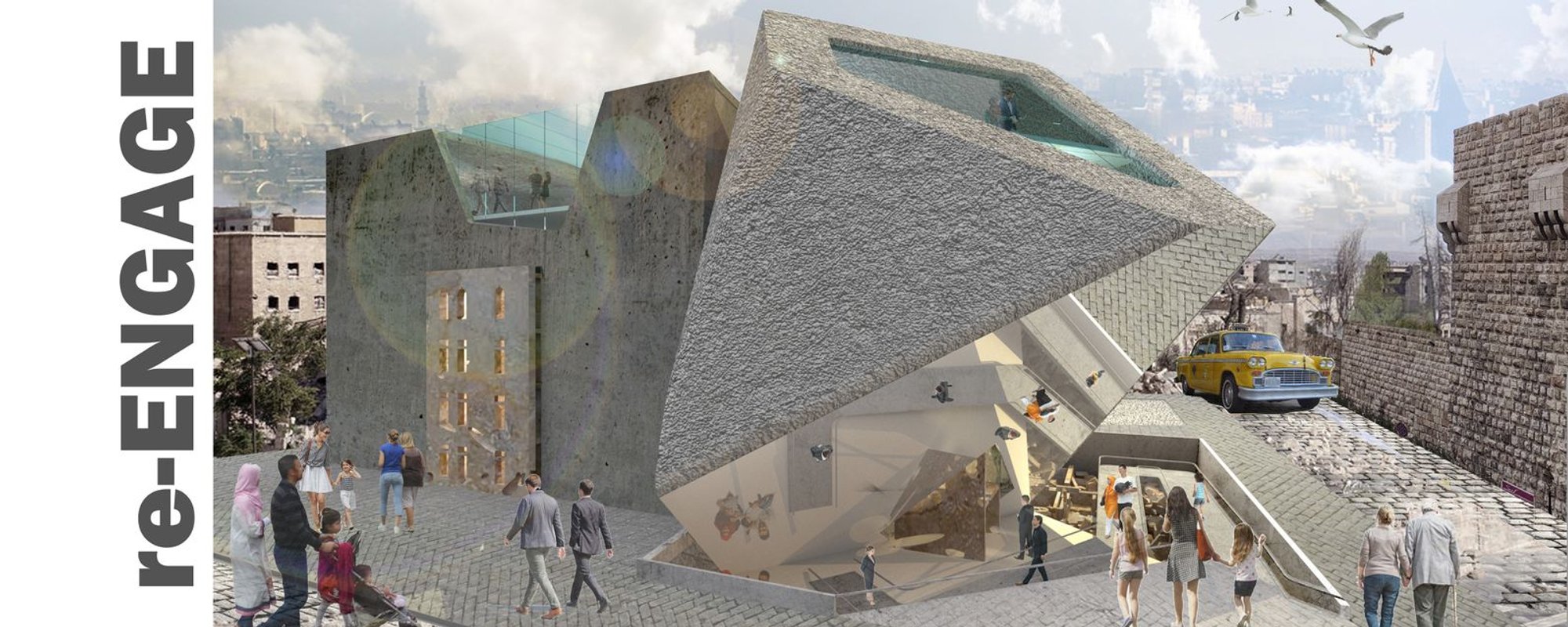
Re-ENGAGE: Rebuilding Aleppo's Grand Serail as a Museum of Collective Memory
A voronoi-inspired cultural museum rises from the ruins of Aleppo's Grand Serail, fusing archaeological preservation with contemporary gallery space.

What does it mean to build within a wound? In Aleppo, one of the oldest continuously inhabited cities on Earth, the question is not hypothetical. Years of conflict have stripped away layers of built heritage that took millennia to accumulate, leaving residents without the spatial anchors that once held collective identity in place. Re-ENGAGE proposes that architecture can serve as the medium through which that identity is reconstructed: not by erasing the damage, but by designing directly into it, treating ruins as active foundations rather than passive scars.
Designed by Diana Khalifeh, Re-ENGAGE is a conceptual cultural museum sited within the remnants of Aleppo's Grand Serail. The project integrates preserved archaeological fragments with a contemporary voronoi-inspired structure, creating a multi-functional programme that houses permanent and temporary exhibitions, a library, an art gallery and shop, and a rooftop restaurant overlooking the Citadel. It is a project grounded in phenomenology, concerned less with formal spectacle and more with how people see, touch, hear, and move through spaces shaped by memory and destruction alike.
Curving Ramps and Triangular Light: An Interior Built for Slow Encounter
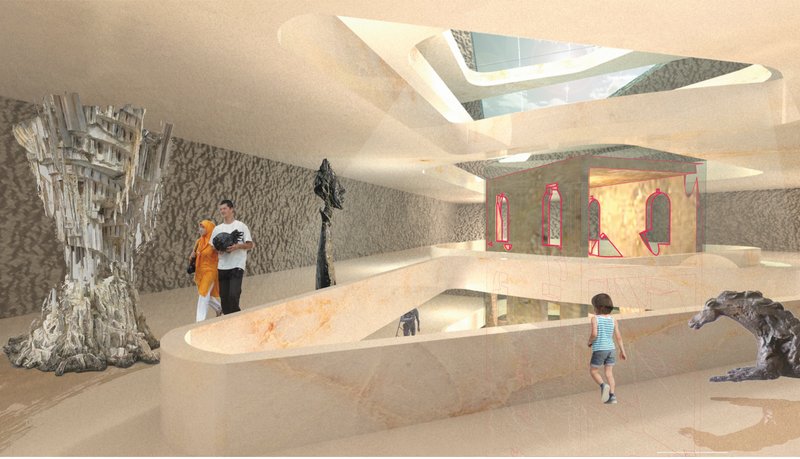
The interior gallery unfolds as a continuous spatial sequence rather than a series of discrete rooms. Curving ramps guide visitors between levels, establishing a rhythm of ascent and descent that mirrors the layered nature of Aleppo's own history. Triangular skylights punch through the ceiling, filtering natural light into shifting patterns that change with the time of day. Visitors encounter sculptural installations along the route, each framed by the interplay of shadow, concrete surface, and overhead geometry. The effect is one of deliberate slowness: the architecture asks you to linger, to let sensory perception accumulate before meaning arrives.
Khalifeh's approach here is rooted in the idea that human experience is shaped by the interaction between sensory perception and environment. Every texture, every fall of light, every acoustic quality of a ramp's curve contributes to a narrative larger than any single exhibit. The museum's programme spans permanent historical exhibitions and temporary halls dedicated to Syrian artists, so the spatial sequence must accommodate both reverence for the past and the unpredictable energy of contemporary creative practice. The flowing ramps do this well, offering a connective tissue that holds both functions without forcing hierarchy.
Stone, Folds, and the Citadel: A Voronoi Mass Rooted in Context
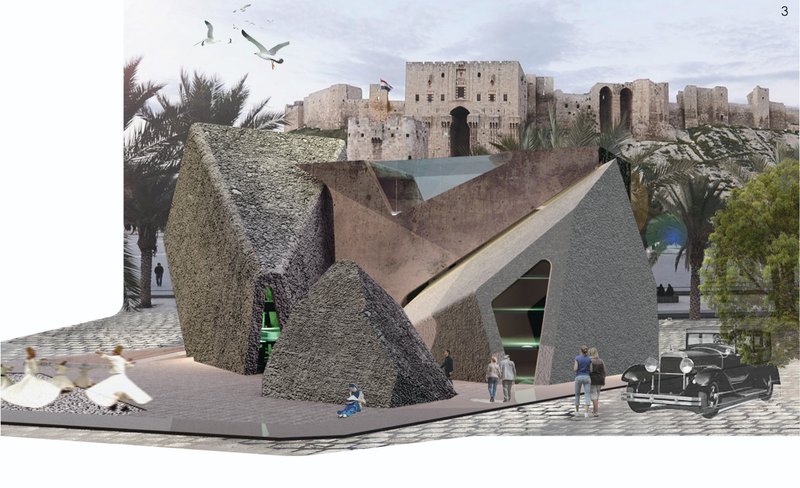
From the exterior, Re-ENGAGE reads as something between geological formation and deliberate architecture. An angular, stone-clad pavilion with folded roof planes sits against the backdrop of Aleppo's Citadel, its massing oriented to establish a visual dialogue with that iconic landmark. The voronoi-inspired geometry generates faceted surfaces that refuse to flatten into a single reading; depending on the angle of approach, the building appears massive or fractured, ancient or decisively modern. The material choice of stone cladding is critical. It grounds the new structure in the same tectonic vocabulary as the surrounding ruins, ensuring the addition does not read as an import but as something that grew from the same ground.
The directional gesture toward the Citadel is more than formal flourish. It reactivates a spatial relationship that the destruction of the Grand Serail had severed, stitching the new museum back into the city's network of significant landmarks. The contrast between the folded contemporary planes and the Citadel's monolithic silhouette embodies the project's central tension: past and future held in the same frame, neither dominating the other.
Glass Floor, Exposed Ruins: Archaeology as Living Programme
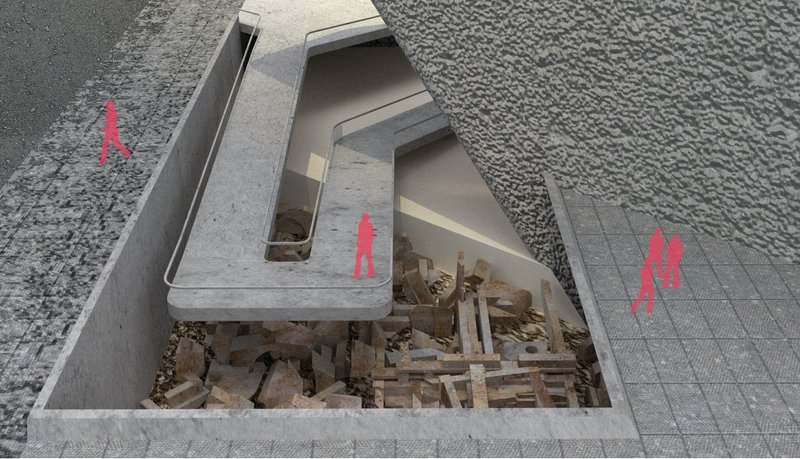
Perhaps the most striking move in Re-ENGAGE is the triangular glass floor opening that reveals excavated archaeological ruins below ground level. Seen from above, the transparent plane transforms the act of walking into the act of witnessing: visitors stand directly over fragments of the Grand Serail, separated only by a sheet of glass. The effect is simultaneously protective and confrontational. The transparent enclosure preserves the remains from weather and contact while refusing to hide them behind walls or beneath new construction. Destruction is not buried; it is placed on display as evidence of resilience.
This strategy of using a glass box over historical fragments creates the sharp contrast between exposed, irregular ruins and the precision of the contemporary enclosure. Khalifeh frames this as clarity emerging from destruction, and the material honesty of the detail supports that reading. The glass does not interpret the ruins. It simply makes them visible, inviting each visitor to construct their own relationship to what was lost and what remains. Combined with the aerial perspective the opening affords, the device collapses the vertical distance between present-day life and buried history into a single glance.
Why This Project Matters
Re-ENGAGE refuses the false binary that dominates post-conflict reconstruction debates: the choice between faithful restoration and clean-slate modernization. Khalifeh charts a third path, one in which the new structure is legible as contemporary but inseparable from the ruin it inhabits. The programme reinforces this position. A permanent historical exhibition, temporary galleries for living Syrian artists, a library, and a rooftop restaurant oriented toward the Citadel together form a cultural ecosystem that serves both commemoration and daily civic life. Architecture here is not a monument sealed off from the present; it is a working public space that happens to contain centuries of memory.
At a moment when cities across conflict zones face urgent questions about what to preserve, what to rebuild, and what to let go, Re-ENGAGE offers a compelling design thesis: ruins are not the absence of architecture but its most honest expression. By building within them rather than over them, Khalifeh demonstrates that resilience is not about returning to a prior state. It is about constructing new meaning from what remains, and giving a community the spatial framework to do so together.
View the Full Project
About the Designers
Designer: Diana Khalifeh
Enter a Design Competition on uni.xyz
uni.xyz runs architecture and design competitions year-round that reward proposals with spatial conviction and real site intelligence.
Project credits: Re-ENGAGE by Diana Khalifeh.



Popular Articles
Popular articles from the community

Kawasaki Olympic Sports Center: Sports Complex Architecture Rooted in Community, Tradition, and Movement
Kawasaki Olympic Sports Center reimagines sports complex architecture as a civic park where tradition, training, and community meet locally.

Eco Chapel: A Green Architecture Pavilion Designed in Symbiosis with the Forest
Eco Chapel uses green architecture to weave prayer, learning and reuse into a forest pavilion shaped by modular hexagonal canopies for life.
Reincarnation Weaves a Three-Story Retreat into the Green Landscape of Rural Bangladesh
Ara Manor in Narsingdi dissolves the line between domestic architecture and its lush surroundings through screens, courtyards, and planted rooftops.
The Faith: Modular Architecture for Play, Learning, and Hope in Kutupalong Refugee Camp
A modular playground architecture project in Bangladesh where play, learning, safety, and hope rebuild childhood inside a refugee camp anew.


Similar Reads
You might also enjoy these articles
Cinema Box: Modern Cinema Architecture Designed to Keep Up With the Times
Cinema Box reimagines modern cinema architecture as a flexible cultural platform where film, desert climate, and public life meet in motion.
CRACK: Winery Architecture Carved Into the Landscape
CRACK reimagines winery architecture as a buried path through vineyard terrain, linking production, tasting, lodging, landscape and culture.
Earthquake-Resistant Architecture in Iran: A Resilient City District for Shelter, Recovery, and Everyday Urban Life
Earthquake-resistant architecture shapes an Iranian city district as an urban oasis for shelter, care, recovery, and resilient daily living.
Kawasaki Olympic Sports Center: Sports Complex Architecture Rooted in Community, Tradition, and Movement
Kawasaki Olympic Sports Center reimagines sports complex architecture as a civic park where tradition, training, and community meet locally.


Explore Exhibition Design Competitions
Discover active competitions in this discipline




The International Standard for Design Portfolios


The Global Benchmark for Architecture Dissertation Awards


The Global Benchmark for Graduation Excellence


Challenge to reimagine the Iron Throne
Comments (0)
Please login or sign up to add comments
No comments yet. Be the first to comment!