
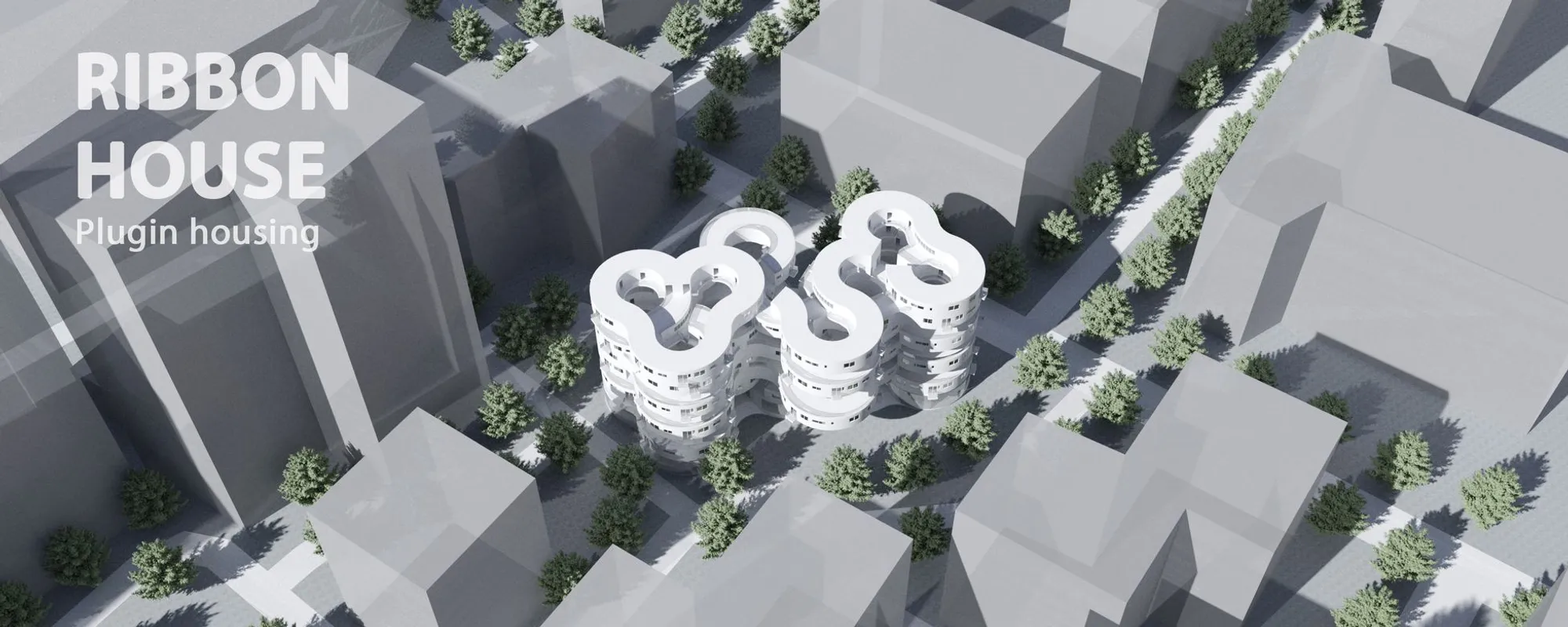
Ribbon House: Curvilinear Towers Redefine Dense Housing in Guangzhou
A shortlisted Plugin Housing entry wraps residential floor plates into continuous ribbon loops, creating shared terraces and sky gardens.


Most high-density housing treats floor plates as flat, repetitive trays stacked toward the sky. Ribbon House refuses that logic entirely. Instead of discrete slabs, the building's floors loop and fold like continuous strips of fabric, wrapping around vertical cores to produce staggered balconies, circular courtyards, and rooftop terraces that blur the line between private dwelling and shared urban space. Situated in the heart of Guangzhou, one of China's fastest-growing megacities, the project proposes that density and delight are not mutually exclusive.
Ribbon House was designed by 冰原, 赫祺李, XIAOLING WEI, and Yu Huang. It was shortlisted in the Plugin Housing Challenge 2020, recognized for its inventive approach to sustainable urban housing that integrates residential and commercial programming within a single curvilinear envelope.
Towers That Move Like Fabric
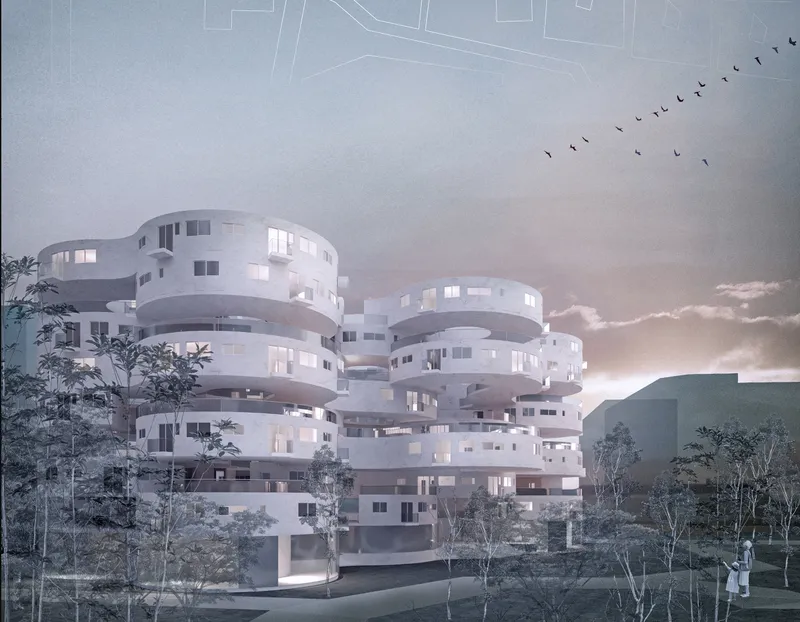
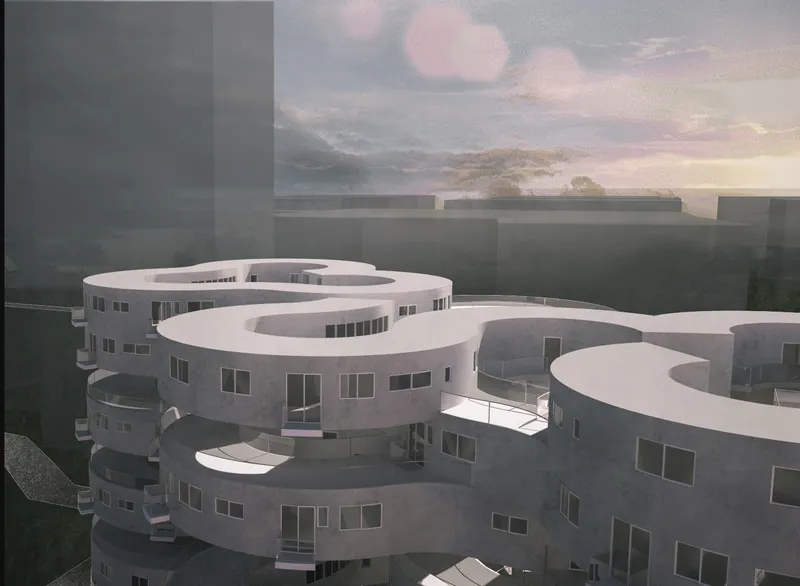
Seen at dusk, the interlocking white towers read less like buildings and more like ribbons frozen mid-flutter. The curvilinear balconies wrap each volume in continuous horizontal bands, softening what would otherwise be a blunt residential block into something almost kinetic. The rooftop view reveals the full scope of the strategy: floor plates loop back on themselves, creating circular courtyard openings that punch light and air deep into the building's core. These are not decorative gestures. Each curve responds to Guangzhou's seasonal sun paths and prevailing wind patterns, orienting openings to maximize cross-ventilation and minimize direct solar gain during the city's punishing summers.
Interior Courtyards as Social Infrastructure
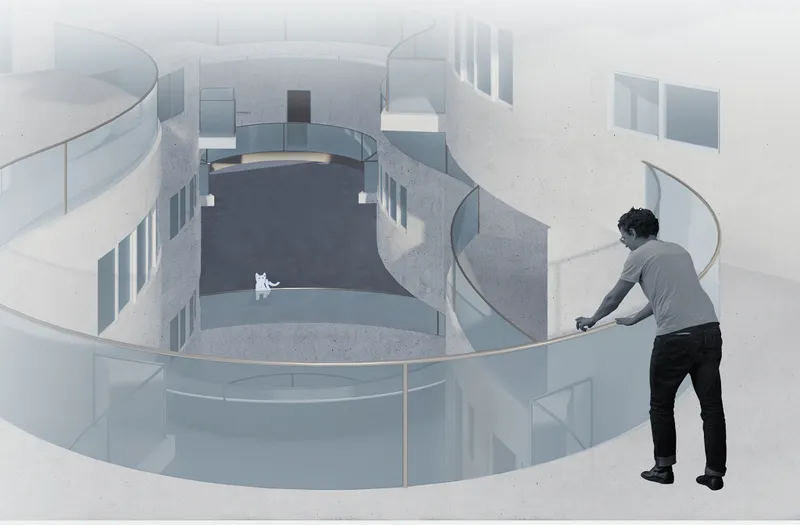
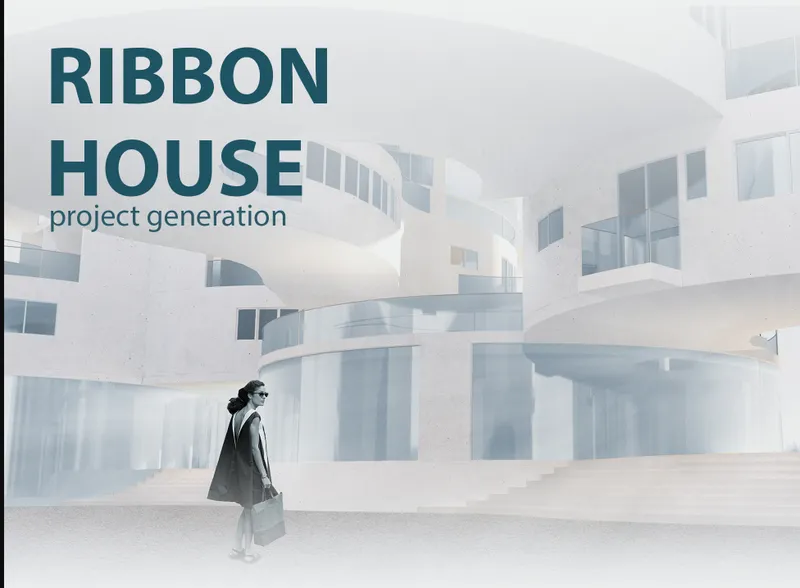
Step inside and the curvilinear logic continues. Curved glass balustrades line internal courtyards, turning circulation corridors into semi-public gathering zones where residents can lean over a railing and actually see their neighbors. The designers describe these shared balconies and sky gardens as tools for community interaction, and the renderings bear that out: figures pause, look outward, occupy the threshold between domestic privacy and collective life. At ground level, floor-to-ceiling glazing floods the mixed-use retail and communal zones with daylight, reinforcing the project's commitment to natural light and passive energy strategies.
The ground floor program is deliberately porous. Essential services, retail, and communal areas occupy the base of the towers, creating an activated street edge that serves both residents and the surrounding neighborhood. It is a straightforward but often neglected move in dense housing: make the bottom of the building belong to the city, not just to the people who live above it.
A Central Atrium That Breathes
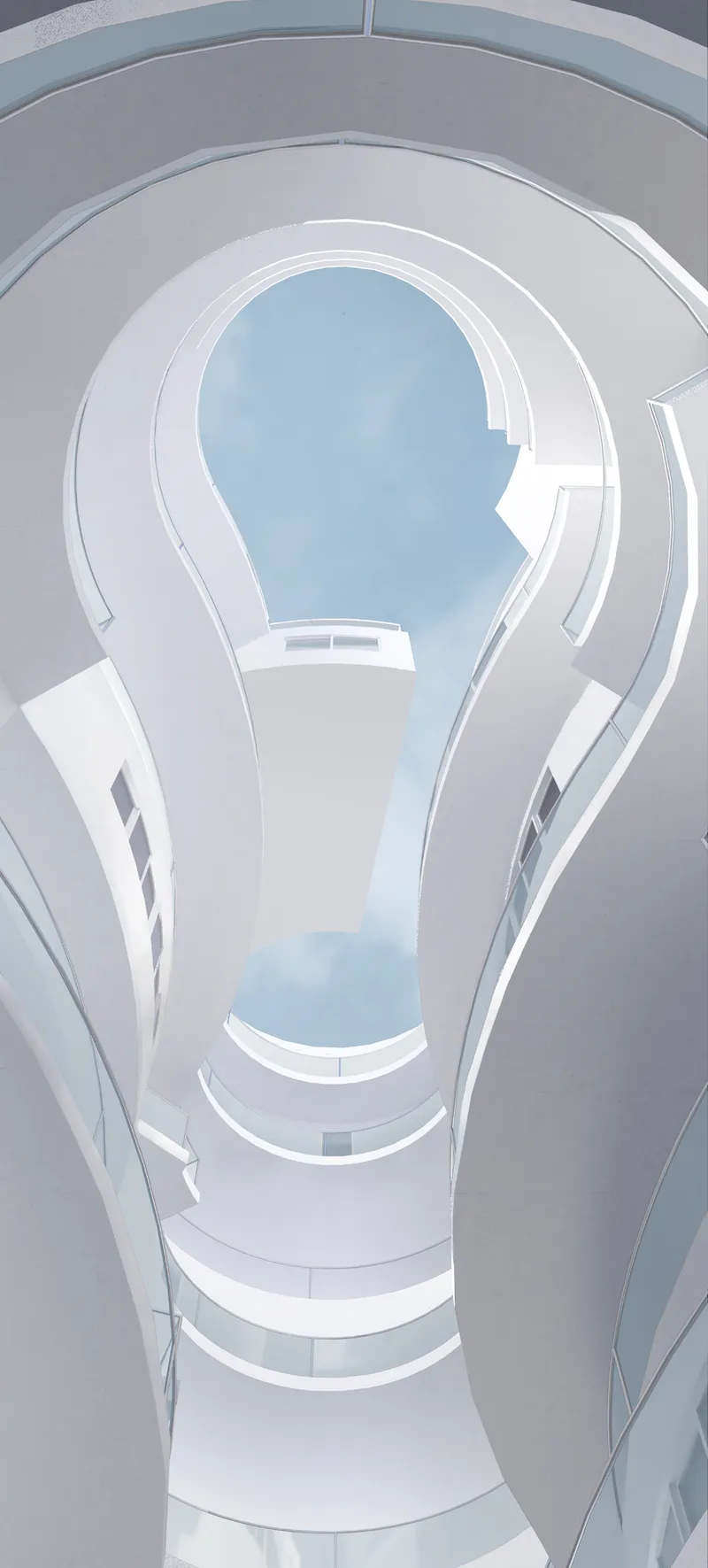
Looking straight up through the central atrium, the spiraling white floors tighten toward a circular skylight at the top. The effect is almost vertiginous, but the spatial purpose is clear: this void acts as the building's lung, channeling stack-effect ventilation upward while drawing diffuse daylight down through every level. The staggered floor plates ensure that no single apartment is boxed in by the one above it. Instead, each level steps back or forward, creating pockets of openness that give residents visual relief and access to sky views even deep within the building mass.
The Ribbon Unwrapped: Structural and Programmatic Logic
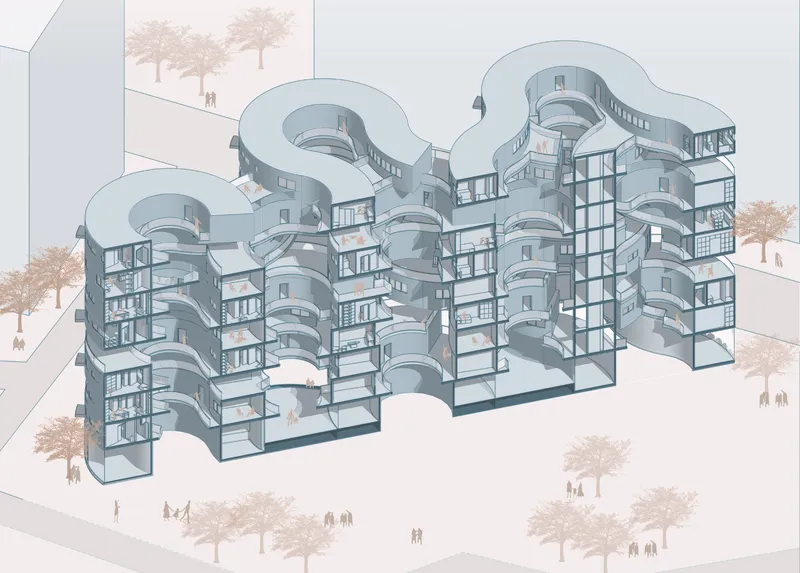
The axonometric drawing strips the project down to its organizational DNA. Ribbon-like floor plates wrap around multiple structural cores, with each loop accommodating a different mix of residential units, shared terraces, and service spaces. Trees and pedestrian paths at grade reveal the designers' attention to connectivity: carefully planned entrances feed into the surrounding transportation networks, while internal pathways guide residents from street to sky garden without dead ends or confusing wayfinding. The drawing makes one thing especially legible: the project's form is not arbitrary. Every curve follows a structural core, every opening corresponds to an environmental or social intention.
Why This Project Matters
Guangzhou adds millions of square meters of residential floor area every year, and most of it looks the same: flat slabs, narrow corridors, sealed facades. Ribbon House challenges that default with a proposal that treats density as an opportunity for spatial generosity rather than mere efficiency. The continuous floor plate, the punched courtyards, the activated ground floor: each decision addresses a real problem in high-density urbanism, from ventilation and daylighting to social isolation and street-level vitality.
For a student team working within a competition brief, the level of environmental and programmatic specificity here is notable. The project does not stop at a striking silhouette. It follows through with orientation strategies tied to local climate, mixed-use programming that engages the surrounding city, and vertical social spaces that give residents reasons to leave their front doors. As cities across southern China and Southeast Asia confront similar pressures of rapid densification, Ribbon House offers a compelling model: housing that wraps its inhabitants in light, air, and community rather than stacking them in silence.
View the Full Project
About the Designers
Designers: 冰原, 赫祺李, XIAOLING WEI, Yu Huang
Enter a Design Competition on uni.xyz
uni.xyz runs architecture and design competitions year-round that reward proposals with spatial conviction and real site intelligence.
Project credits: Ribbon House by 冰原, 赫祺李, XIAOLING WEI, Yu Huang Plugin Housing Challenge 2020 (uni.xyz).



Popular Articles
Popular articles from the community


Play: Fragments of Their World
Familiar architecture becomes modular playground design, creating safe spaces where displaced children can learn, connect, imagine and play.

Conexión: Biophilic Design Reimagines High-Rise Living in Hong Kong
Conexión reimagines high-rise living in Hong Kong through biophilic design, green facades, shared spaces, daylight, water and nature within.

Co-life: Sustainable Architecture for Age-Friendly Community Living
Co-life reimagines sustainable architecture for seniors through courtyards, rammed earth, shared gardens, and spaces designed for belonging.

Hill & Cross Opera: Sculptural Opera House Architecture Shaped by Tallinn’s Landscape and Identity
Hill & Cross Opera reimagines opera house architecture in Tallinn through its sculptural hill, civic plaza, glass wave and a luminous cross.
Similar Reads
You might also enjoy these articles

Day and Night Park: A Time-Based Urban Newsstand in Beijing
A temporary urban newsstand in Beijing blending travel, light, and reading through poetic colors, compact form, and community-focused design.

Modernist Patio Renovation in El Masnou, Barcelona by Oliver Segura Arquitectura + Cebrià Arquitectura
Modernist patio renovation blending tradition and innovation with a movable pool, leveled floors, and Catalan materials in El Masnou.

Alto Residencial Coop: Cooperative Housing Development in Santiago de Compostela by Carbajo Barrios Arquitectos
A linear cooperative housing complex blending white volumes and perforated metal façades, enhancing community living, natural light, privacy, and urban integration.
Vil Genis School by BPA ARCHITECTURE – Massy, France
Vil Genis School in Massy, France, features sustainable design, south-facing classrooms, community integration, accessible spaces, and modern educational architecture.


Comments (0)
Please login or sign up to add comments
No comments yet. Be the first to comment!