

Rodrigo Nuñez Arquitectos Terraces a 900 m² Brick House into a Forest Edge in León
A single clay brick and timber define a dwelling that mediates between suburbia and a protected pine forest on a steep Spanish slope.


The line between a suburban housing development and a protected forest is rarely a graceful one. In León, Spain, Rodrigo Nuñez Arquitectos found exactly that edge and decided to dissolve it. House in the Forest does not merely sit next to a stand of centenary pines; it borrows their logic, using excavation and terracing to pull the wild landscape into the building and push domestic life outward into the canopy. The result is a 900 m² residence completed in 2017 that reads less as a house placed on a slope and more as a topographic event that happens to contain rooms.
What makes this project worth studying is its material discipline. A single type of handmade clay brick, the ladrillo de tejar common to the region, does virtually everything: facade walls, retaining walls, exterior paving, interior floors, even gutters. Paired with wood in cladding, soffits, and carpentry, the palette stays deliberately narrow, letting the architecture's real complexity play out in section rather than surface. The steep natural slope is not graded flat but carved into a sequence of intertwined terraces where garden, courtyard, and interior space trade places at every half level.
A Facade That Reads Like Geology
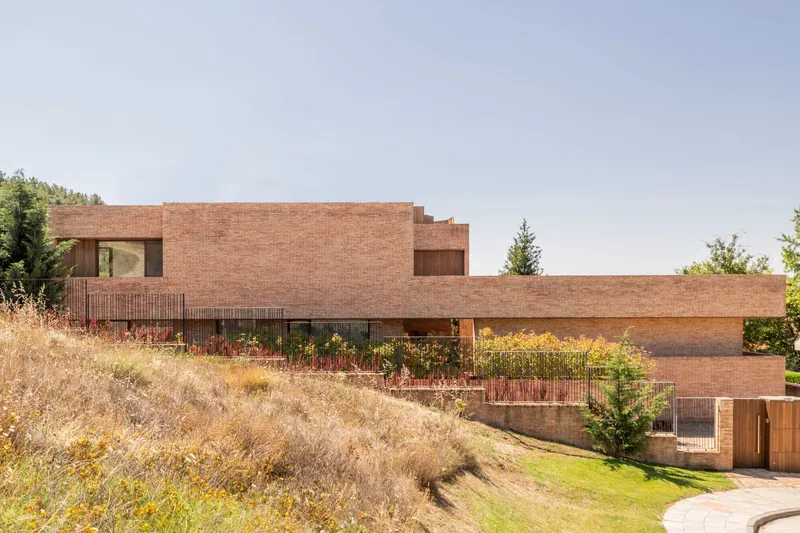
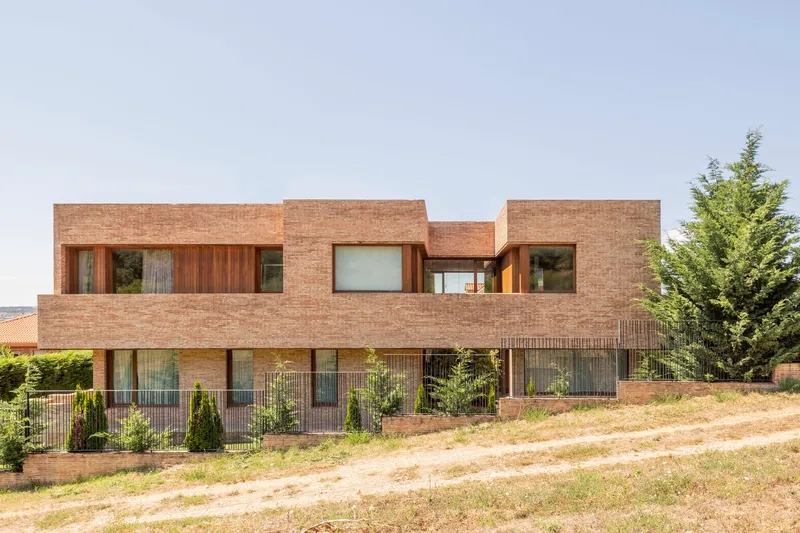
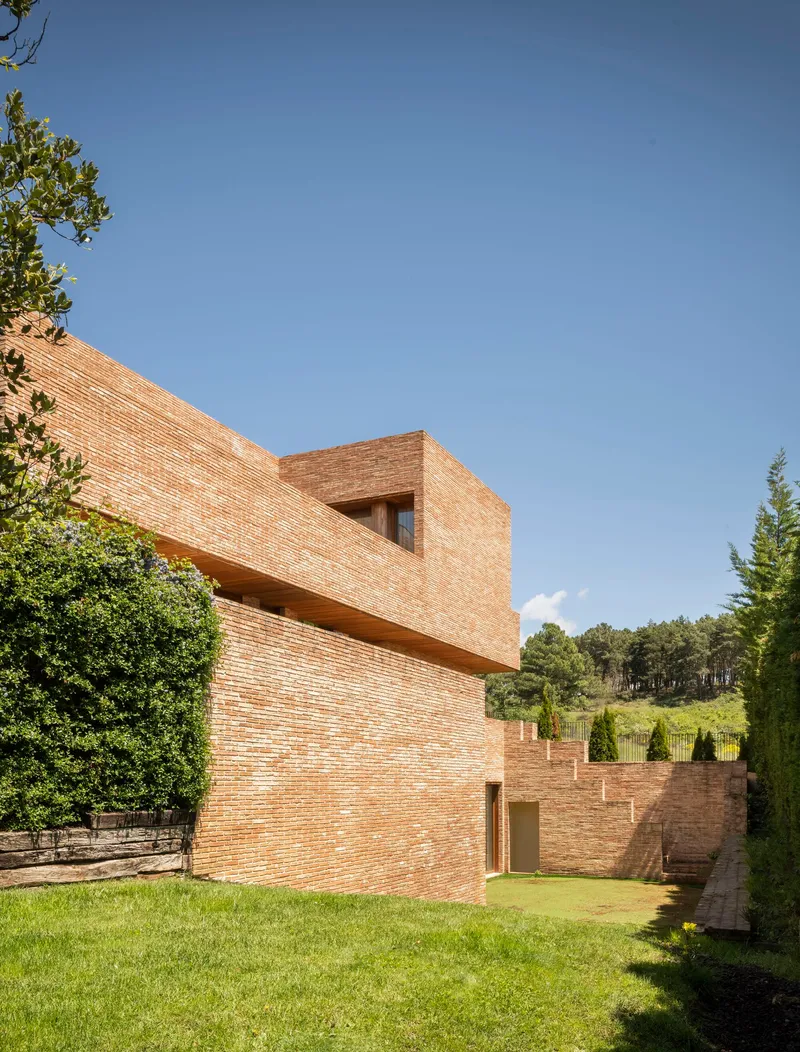
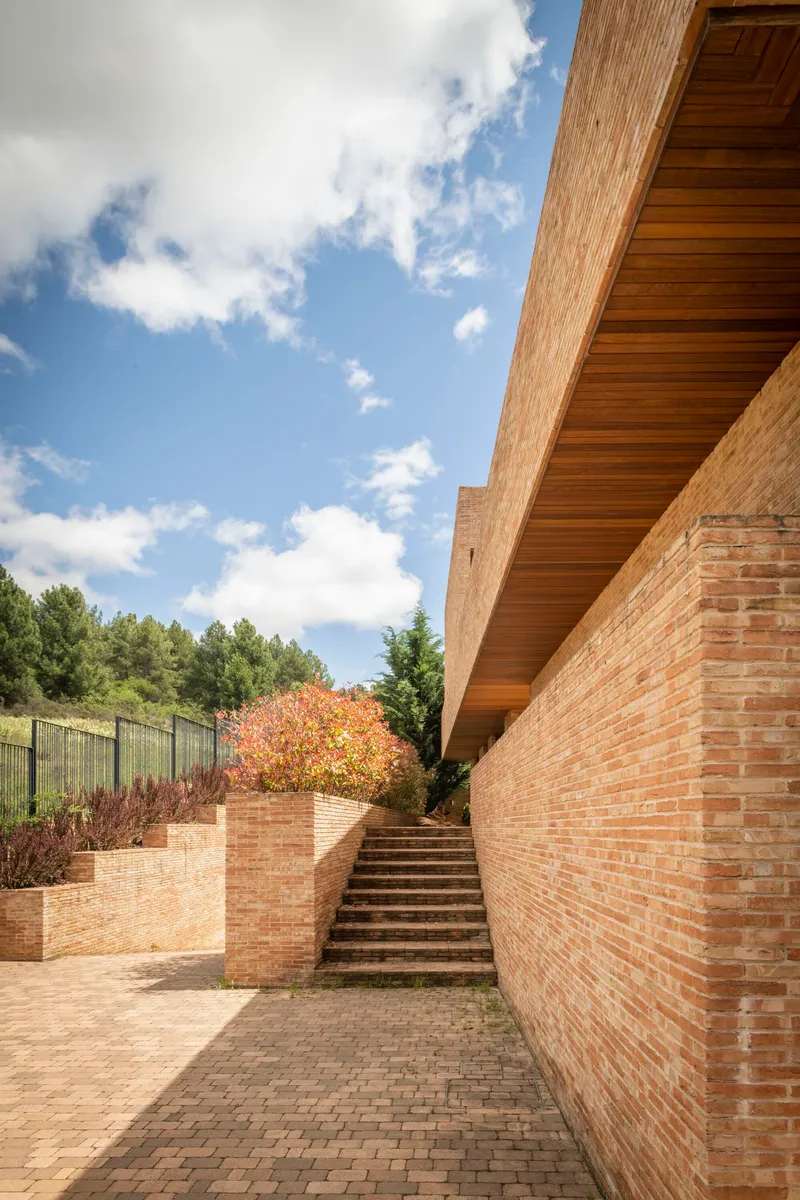
Seen from the meadow below, the house stacks its brick volumes like sedimentary strata exposed by erosion. Each terrace steps back from the one beneath it, so the building mass diminishes as it climbs. Dry grasses and planted beds colonize the horizontal ledges between volumes, reinforcing the geological metaphor. From the street side, a wire fence and a sloping lawn are all that separate the domestic facade from the open field, yet the massing conveys density and weight.
The vertical lines of the surrounding pine trunks find an echo in the timber window recesses punched into the brick planes, while the horizontal datum of the clay soil is carried through as continuous brick courses. It is a landscape translation, not a camouflage exercise. The house is obviously a building, but it borrows its proportional rhythm from what already stands around it.
Brick and Timber as a Dual Material System

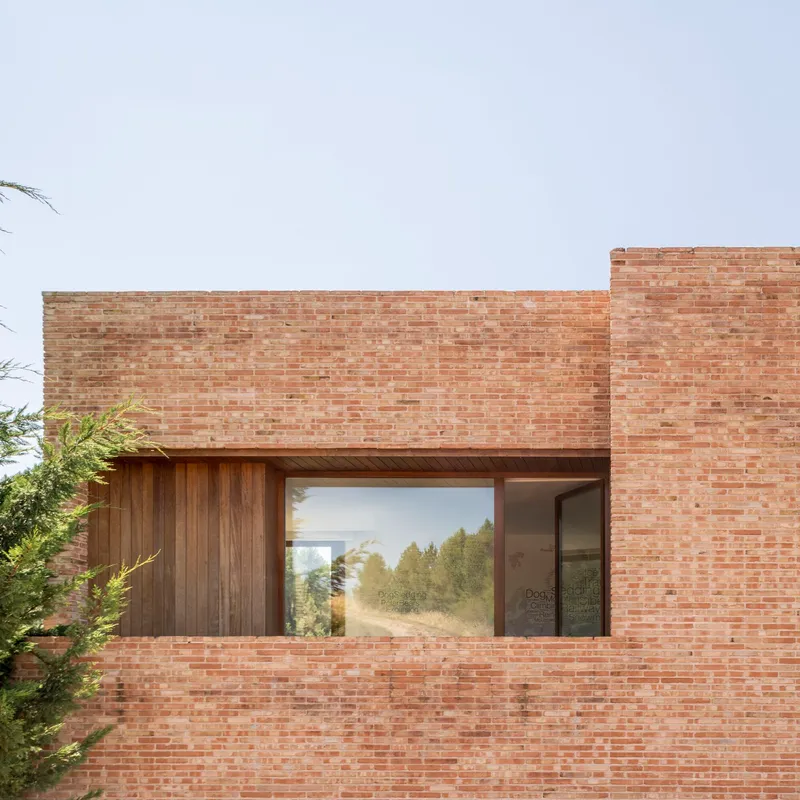

Using one type of brick for everything, from the structural facade to the courtyard paving to the drainage channels, is a move that sounds austere on paper but proves surprisingly rich in execution. The handmade clay units vary in tone from batch to batch, giving the walls a tonal warmth that a machined product could not achieve. Timber enters at every threshold: window frames, soffit linings, and slat screens that filter light along covered walkways.
The pairing is not decorative. Brick handles mass, ground contact, and thermal inertia. Wood handles the lighter, more articulated surfaces where the building meets the sky or frames a view. Where the two materials meet, the joint is clean and deliberate, a shadow line or a simple setback rather than a complicated detail. The shortlisting for Spain's XIII Brick Architecture Award seems well earned: the project treats brick not as a veneer but as the fundamental substance of the design.
Courtyards That Bring the Forest Inside


The house is organized around a series of courtyards placed at different levels, each open to the sky but sheltered on three or four sides by brick walls and timber soffits. Mature trees grow through these voids, their canopies rising above the roofline while their trunks occupy the paved ground plane. The effect is of the forest pushing through the building's mass, not of a potted tree placed for ornament.
Looking upward from the deepest courtyard, the timber-lined walls frame a vertical shaft of daylight filtered by evergreen branches. It is the kind of space that changes character with the seasons and the time of day, yet its proportions and materials keep it feeling composed rather than accidental. The brick paving flows without interruption from covered walkway to open air, erasing the usual threshold between inside and out.
Covered Passages and the Space Between Rooms


Circulation in this house is not a hallway; it is a landscape walk. Covered brick walkways with exposed concrete beams cast rhythmic shadows across the paving as you move from one level to the next. These are generous spaces, wide enough to linger in, where the boundary between terrace and corridor blurs. A person walking through midday light under a timber ceiling feels simultaneously inside the house and outside in the garden.
The architects clearly understood that on a site this steep, movement between levels is itself a significant spatial experience. Rather than burying stairs in a service core, they spread the vertical circulation across terraces and half levels, making the journey part of the architecture. Cypress trees and brick retaining walls frame the exterior passages, lending them a cloistered quality that rewards slow movement.
Interior Life Between Timber and Light
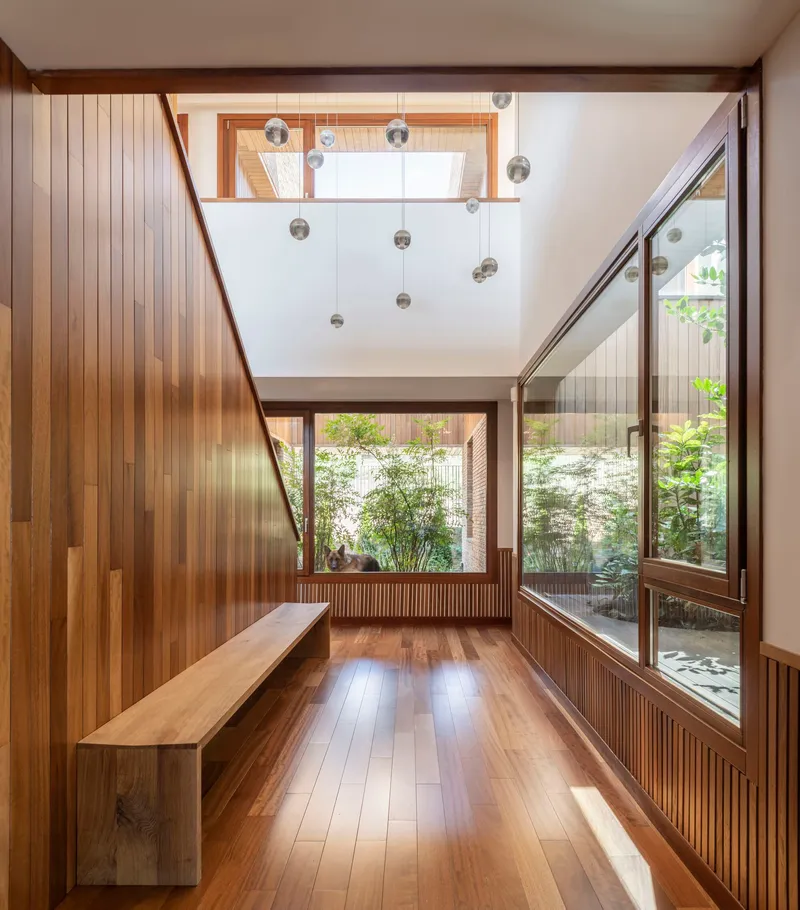


Inside, timber takes over from brick as the dominant surface. The double-height entryway is lined in vertical timber cladding lit by glass pendant fixtures, establishing a warm, compressed atmosphere that contrasts with the expansive courtyard views a few steps away. The living room features a mezzanine bridge and built-in shelving along one wall, treating the library not as a separate room but as a lining of the domestic space.
Corridors are treated with the same care as principal rooms. Timber slat paneling runs along hallway walls, filtering light from adjacent courtyards and creating shifting patterns of shadow throughout the day. The overall effect is of a house that privileges experience over spectacle: every surface is considered, but nothing screams for attention.
Domestic Rooms Open onto the Landscape
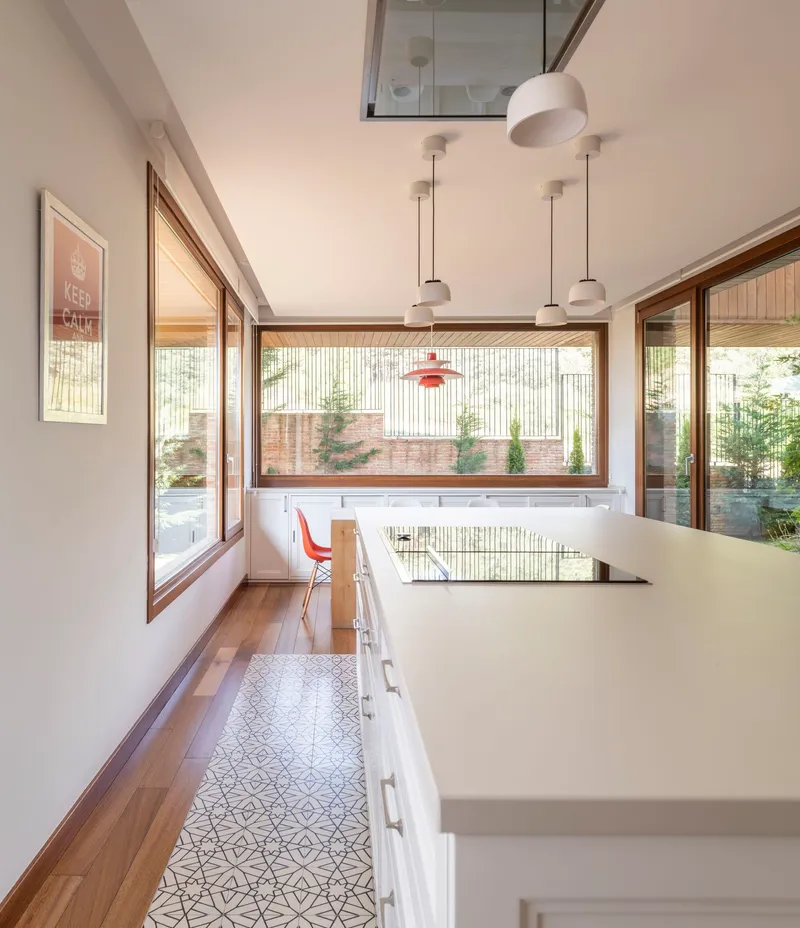


The kitchen looks out through timber-framed windows onto a planted courtyard, its patterned floor tiles the one moment of decorative exuberance in an otherwise restrained palette. A hallway seating nook doubles as a reading alcove with a bookshelf wall and a direct view into another garden void. These are not grand gestures; they are careful calibrations of how daily life meets daylight and greenery.
From the exterior, the cantilevered upper volume hovers above a glazed living space with planted beds at its feet. The section allows the public rooms on the lower level to open fully to the garden while the bedrooms above gain privacy from their elevated position and the depth of the brick reveals. The house manages to be both transparent and protected, a difficult balance on a site bordered by neighbors on one side and open forest on the other.
Garden as Architecture


The garden is not a leftover space; it is the organizing principle. Stepping stones thread through planted beds beneath the brick volumes, making the landscape feel continuous with the interior. A timber-framed window frames a courtyard garden at ground level where even the family dog occupies the paving with the ease of an inhabitant rather than a visitor. The gradient of spaces that the architects describe, some for people, some for nature, some for both, is most legible here, where planting and paving negotiate their borders at a fine grain.
Plans and Drawings

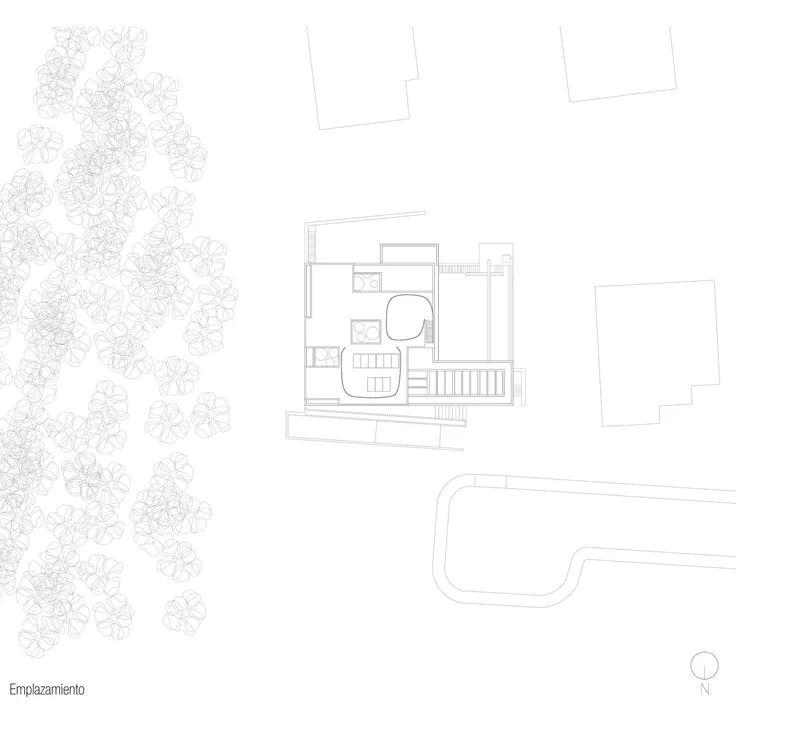

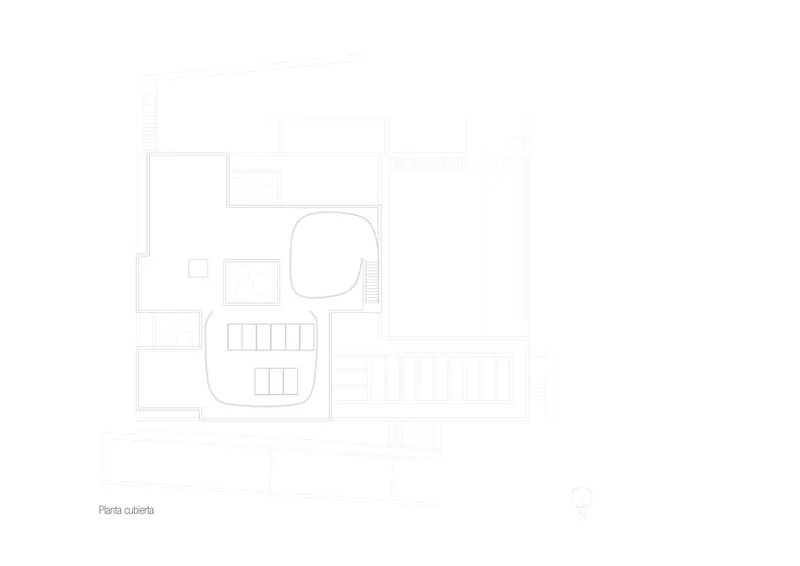
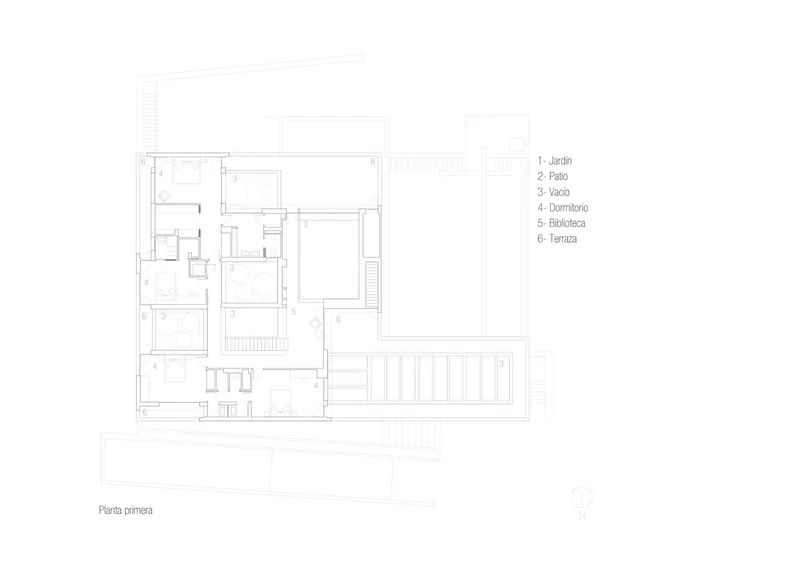


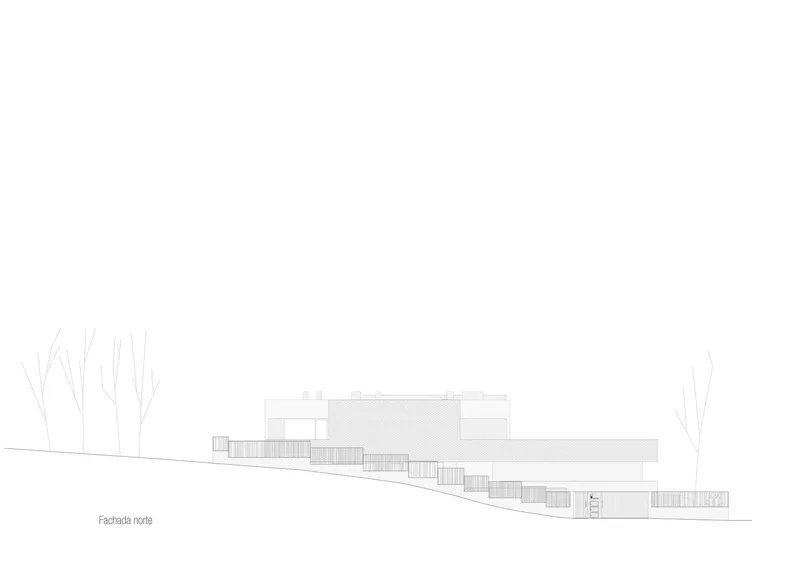


The site plans confirm what the photographs suggest: the building footprint occupies the transitional zone between a gridded residential neighborhood and an irregular mass of forest vegetation. The axonometric drawings reveal how the central stair stitches three levels together while courtyards puncture the floor plates at strategic points. In section, the split-level arrangement becomes fully legible, each half level responding to the natural slope so that excavation is minimized and every room finds its own relationship to grade.
The basement plan shows a practical program, a three-car garage and a pool with an adjacent courtyard, tucked into the deepest cut. The upper floor plan places living and dining rooms on the level with the best forest views, flanked by exterior porches. The construction details document the wall assemblies and floor buildups with the rigor you would expect from a project where a single brick type carries so much responsibility. Every joint, every flashing, every insulation layer is specified to ensure the handmade clay units can perform structurally, thermally, and aesthetically without a secondary cladding system.
Why This Project Matters
House in the Forest is a convincing argument that material economy and spatial richness are not opposed goals. By restricting the palette to one brick and one wood, Rodrigo Nuñez Arquitectos freed themselves to invest all their design energy in section, level changes, and the calibration of openings. The house rewards the body more than the camera: moving through its terraces and half levels, stepping from shade into sun and back again, is an experience no single photograph can capture.
It also offers a measured response to the question of how to build at the edge of a protected landscape. The house does not retreat from the forest or pretend to disappear into it. Instead, it uses excavation, terracing, and courtyard planting to create a genuine gradient between the domestic and the wild. In a period when suburban edge conditions are often treated as problems to be screened with hedges, this project demonstrates that the boundary itself can be the architecture.
House in the Forest by Rodrigo Nuñez Arquitectos (lead architect: Rodrigo Núñez). León, Spain. 900 m². Completed 2017. Photography by Amores Pictures.
About the Studio
Share Your Own Work on uni.xyz
If projects like this are the kind of work you want to make, uni.xyz is a place to publish your own, find collaborators, and enter design competitions.


Popular Articles
Popular articles from the community


Temporary Home for Dogs: A Reversed Zoo Rethinks Animal Shelter Architecture
In Bucharest, a sinuous corridor and freed landscape flip the logic of containment, designing a shelter that works to make itself unnecessary.

Opera on the Sea: Driftwood Logic Shapes a Timber Opera House on Estonia's Coast
Trevor Orgill's opera house translates the entangled drift of floating timber into a civic building where wood, water, and music converge.

Tsunami Convergenics: Turning Catastrophic Ocean Forces into Underwater Housing Infrastructure
A speculative underwater settlement off the coast of Onagawa, Japan, treats tsunamis and typhoons as energy sources rather than threats.

The Amber Palace Opera: A Geological Fiction Surfaces on Tallinn's Baltic Waterfront
Pierre Brillard reimagines a Baltic legend as a public landscape, opera house, and waterfront promenade rooted in Tallinn's coastal identity.

Similar Reads
You might also enjoy these articles

Pixel Gardens: One Repeated Module Stacked Into a Terraced Social Housing Tower for Famagusta
Salem Bader's shortlisted housing tower builds a vertical neighbourhood from one repeated module, offsetting units to carve terraces, light and air.

Bao Huynh Watercolor Atelier: A Serene Art Retreat in Hội An
Bao Huynh Watercolor Atelier in Hội An blends multifunctional art spaces, sustainable design, local materials, and family-friendly living in a serene environment.

Atelier Macri Concept Store Interior Design by CASE-REAL
Atelier Macri store features a "ko" counter, walnut wood details, cork displays, blending retail, gallery, and seamless customer experiences.

Manuel Vargas Izquierdo Stadium and High-Performance Sports Center: Architectural Excellence in Jalpa de Méndez
The Manuel Vargas Izquierdo Stadium blends sustainable design, inclusive sports facilities, and cultural-inspired architecture, revitalizing Jalpa de Méndez’s public spaces.

Explore Tree House Competitions
Discover active competitions in this discipline

Challenge to design mud housing for contemporary communities

Challenge to reimagine the Iron Throne

Photograph architecture without architects

Illustrate the lost glory of Angkor Wat - Render Challenge
Comments (0)
Please login or sign up to add comments
No comments yet. Be the first to comment!