

Sahara Communitas: A Desert Oasis Where the World's Festivals Never Stop
Jinming Li tunes an oasis venue to the global festival calendar, using liminal ritual theory to keep a desert communitas alive around the clock.


Somewhere on the planet, at any given hour, someone is celebrating. Sahara Communitas takes that observation literally and builds on it: a permanent festival ground in the Sahara where the world's rituals, from Holi to Passover to dragon parades, can unfold one after another without pause. The proposal treats celebration as an infrastructure that never switches off, and it places that infrastructure in one of the few desert conditions capable of sustaining it: an oasis.
Designed by Jinming Li, the project was shortlisted in the EHC Sahara competition, part of the Extreme Habitat Challenge series. Li sites the scheme at 21°11'01.10" N, 11°53'45.47" W and reads the oasis as a natural thermodynamic system, one that already organises itself. The architecture is positioned to work with that self-organising capacity rather than override it, and the cultural ambition rests on a specific theoretical source: Victor Turner's The Ritual Process: Structure and Anti-Structure.
A Pale Settlement Held Between Dunes and a Tree Belt
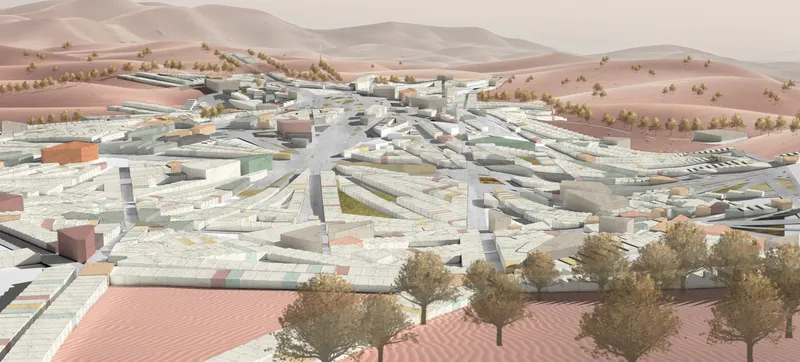
The aerial view establishes the scheme's footprint: a dense fabric of low, pale blocks pressed into pink dunes, with a line of trees running across the foreground. That line is not decoration. Li describes a tree belt as one of the project's core ecological strategies, a planted edge meant to hold the oasis microclimate in place and keep the settlement habitable. The compactness of the blocks reads as a deliberate desert response, with buildings clustered tightly rather than spread across open sand.
What makes the image persuasive is its restraint. The settlement does not compete with the dunes; it sits low and lets the terrain set the horizon. That matches the brief Li sets for the terrain itself, which is to leverage local geographical features in support of a self-sustaining environment rather than flatten them into a generic site.
Dune Sections Wired to the World's Rituals

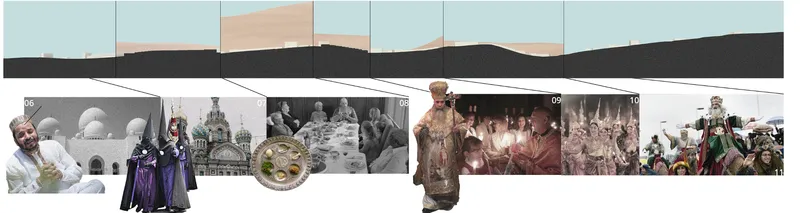
These sections are the conceptual heart of the entry. Each one draws a ground profile, a dune or a darker earth line, and tethers it with fine lines to collaged photographs: children, costumed dancers, a clergy procession, mosque domes, a Passover plate. The drawings make an argument that a plan alone could not, namely that specific terrain conditions can be paired with specific ceremonies, and that the desert section can host a calendar of very different faiths and traditions.
Turner's framework explains the logic. He described communitas as the bond that forms in liminal moments, when ordinary social structure is suspended during ritual. Li's move is to make that liminal state persistent: a place where rituals run 24/7, so the transition out of everyday norms never fully closes. The sections are how that idea touches the ground.
Reading the Global Festival Calendar as a Site Plan

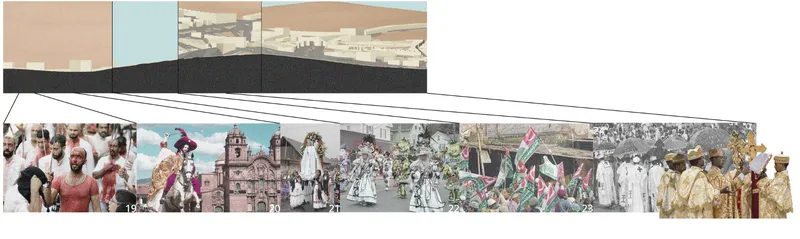
The next pair pushes the terrain into terraces and stepped white buildings, linked to Holi powder, street dancers, horseback riders, a baroque church and masked performers. Behind these drawings sits the project's most unusual generative method. Li mined data from tools such as Google Calendar to find patterns in when festivals occur worldwide, then interconnected the venues so that celebrations from different times and places can be synchronised on one site.
The placement of those venues came from particle simulations, which Li used to cluster festival spaces strategically. It is a computational approach applied to a cultural question, and it gives the scheme an internal rule set: venues are not placed by taste but by the overlapping rhythms of the calendar. The stepped buildings in image 4 suggest how that clustering translates into built form, with modular volumes climbing the dune rather than sitting on a levelled platform.
Multicultural Streets Under Desert Haze
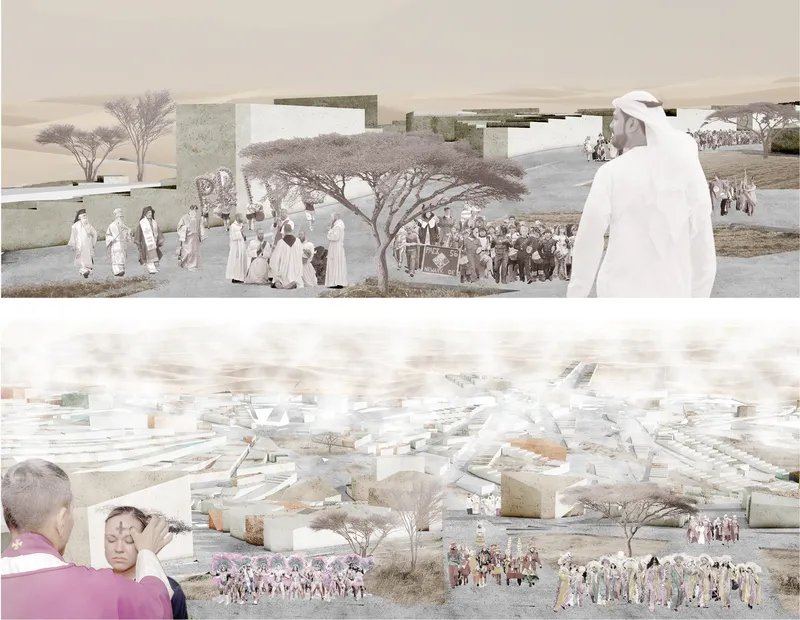
At street level the collages turn atmospheric: pale walled lanes dissolving into haze, processions moving through, acacia trees, a man in white robes, a priest marking ashes on a forehead. Li frames the infrastructure here as a cultural instrument, embedding multicultural streets and courtyards so that the public realm itself becomes the meeting ground between traditions.
The narrow, walled character of these streets is worth noting. It recalls the shaded alleys of desert settlements, and it makes the processions feel contained and intimate rather than staged on an open plaza. The proposal's programmatic flexibility shows up here too, with multi-functional buildings intended to support living, working and playing alongside the festival cycle, so that the streets have a life between ceremonies.
Terraced Ground as Stage, Seating and Microclimate


Two collage renderings bring the terraces into focus. In one, dragon dance performers move across a stepped landscape while onlookers gather on the levels around them, bare acacias standing in drifting mist. In the other, a procession carries a tall banner past concrete terrace walls. The terracing does double duty: it is the grandstand and the stage, and it is a way of working the dune into usable ground.
Li pairs this spatial strategy with a climatic one, citing thermodynamic principles and psychrometric charts to balance environmental comfort against energy use. The mist that recurs in these images reads as an atmospheric hint of that ambition, an oasis climate that the tree belt and site strategy aim to sustain. The entry stays at the level of principle rather than detailed performance figures, but the intent is clear: comfort is engineered from the oasis system, not imported.
A Main Building Lifted on Piles and Split Into Four Blocks
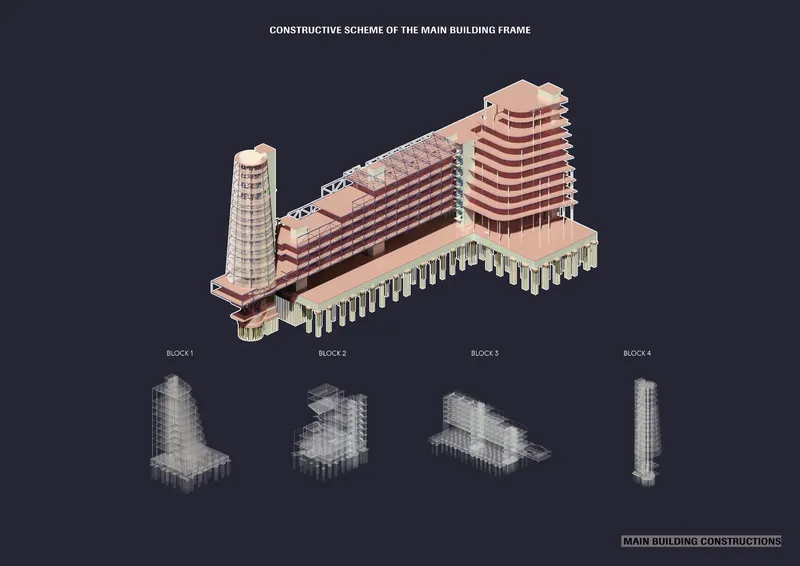
The closing axonometric shifts from atmosphere to construction. The main building's frame rises on piles, while four separate structural blocks, labelled Block 1 through Block 4, are drawn as wireframes below on a dark ground. Li presents these modular blocks as the means by which the building adapts to different functional needs, assembling and reassembling around the demands of whichever festival is underway.
Exploding the building this way exposes its logic plainly: a supporting frame and a kit of parts. It also connects back to the broader architectural strategy of modular, flexible units that encourage community engagement. The piles keep the structure's contact with the sand minimal, which suits a project so focused on respecting the ground it occupies.
Why This Project Matters
Most desert habitat proposals start from survival: shelter, water, shade. Sahara Communitas starts from a social question instead, asking what a settlement in an extreme landscape is for, and answering with ritual. By grounding that answer in Turner's theory of liminality and then operationalising it with calendar data and particle simulations, Li builds a bridge between anthropology and computation that few competition entries attempt.
The section drawings are the project's lasting contribution. They show, in a single readable diagram, how terrain and ceremony might be matched, and they make the abstract idea of a global, round-the-clock communitas feel spatially specific. Whether or not such a place could ever be built, the entry offers a useful provocation for designers working in harsh climates: an oasis can be read not only as a resource to protect but as a commons to share.
View the Full Project
About the Designers
Designer: Jinming Li
Enter a Design Competition on uni.xyz
uni.xyz runs architecture and design competitions year-round that reward proposals with spatial conviction and real site intelligence.
Project credits: Sahara Communitas by Jinming Li EHC Sahara (uni.xyz).


Popular Articles
Popular articles from the community


Manzana Morphosis: Stretching Barcelona's Grid into a Living Landscape for 2050
A radical reworking of the Eixample manzana turns density into a tool for generous public space, vertical ecology, and environmental performance.


Cube Design Draws an Ecological Corridor Between Two Shenzhen Hills with the Nankai Building
Beside Shenzhen's container docks, the Nankai Building pairs stacked balconies with a climbing green screen to connect two hillsides across its height.

The Amber Palace Opera: A Geological Fiction Surfaces on Tallinn's Baltic Waterfront
Pierre Brillard reimagines a Baltic legend as a public landscape, opera house, and waterfront promenade rooted in Tallinn's coastal identity.

Singing Woman: An Opera House That Performs Before the Curtain Rises
Ovidiu Cristian Pavel's conceptual opera house translates Estonia's choral identity into a sculpted waterfront landmark facing the Baltic Sea.

Similar Reads
You might also enjoy these articles
Healing Façade: A Modular Chapel System That Restores Ethiopia's Sacred Forests
Winner of the Eco-Chapel competition, this circular timber façade collects water from air to rebuild soil and reforest degraded Ethiopian landscapes.
Kaffeebühnen: Where Coffee Shop Architecture Becomes a Civic Stage in Vienna
A linear sequence of timber boxes, transparent shells, and open yards turns the Viennese café tradition into a public performance space.
Eco Chapel: A Modular Forest Pavilion That Grows Like the Landscape It Protects
Hexagonal timber modules weave through existing trees, turning a chapel into a living system for prayer, education, and reforestation.


Urban Forest: A Vertical Ecosystem for 5,000 Workers in Singapore's Changi Business Park
Radially stacked pods and layered green decks turn a 7-acre plot into 47 acres of ecological workspace projected for 2040.


Comments (0)
Please login or sign up to add comments
No comments yet. Be the first to comment!