
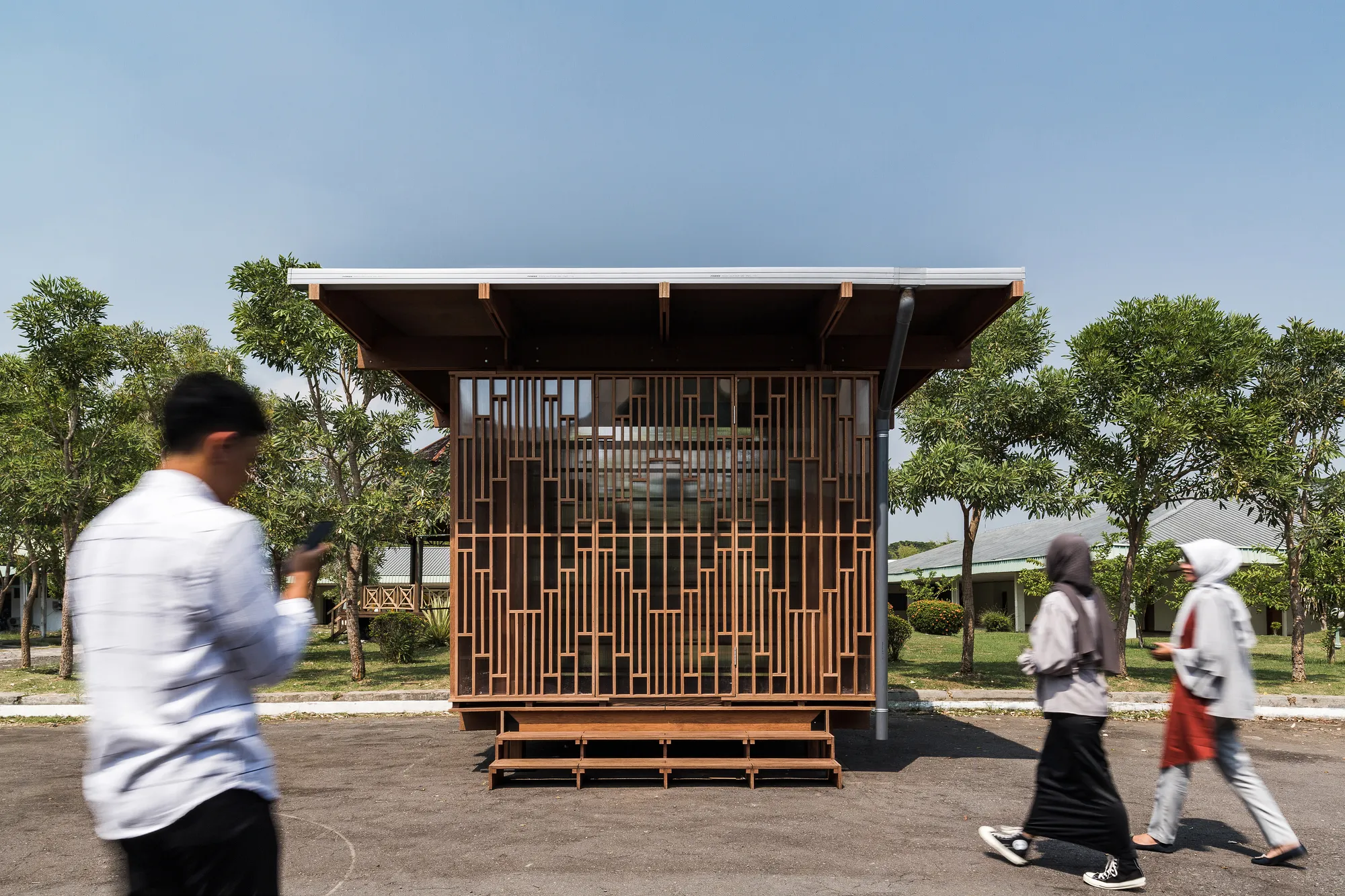
SHAU Indonesia Flat-Packs an Entire Library into 10 Square Meters of Plywood
Microlibrary MoKa in Bandung treats architecture as a product, using modular timber joinery to deliver reading rooms without waste.


A library that ships flat and assembles fast sounds like a pitch for furniture, not architecture. But SHAU Indonesia, led by Florian Heinzelmann and Daliana Suryawinata, has spent years proving that the line between the two can be productively blurred. Microlibrary MoKa, short for Modular Kayu (modular timber), is the latest in their series of microlibraries across Indonesia, and it represents a conceptual leap: the building is no longer a one-off design but a replicable system, dimensioned entirely around standard plywood boards so that almost nothing needs to be cut and almost nothing is wasted.
Sitting on a paved platform in Bandung, the 10 square meter pavilion reads as both delicate and robust, its layered timber screens filtering tropical light while its cantilevered roof throws shade well beyond the enclosed footprint. The real interest here, though, is not how the building looks but how it is made. Every measurement derives from the dimensions of a plywood sheet. Every joint, whether lap, cross lap, or layered bridle, is designed for prefabrication and rapid assembly. The ambition is not a single beautiful pavilion; it is a scalable template that can respond to different sites, orientations, and programs without requiring an architect to redesign from scratch.
Architecture as Product
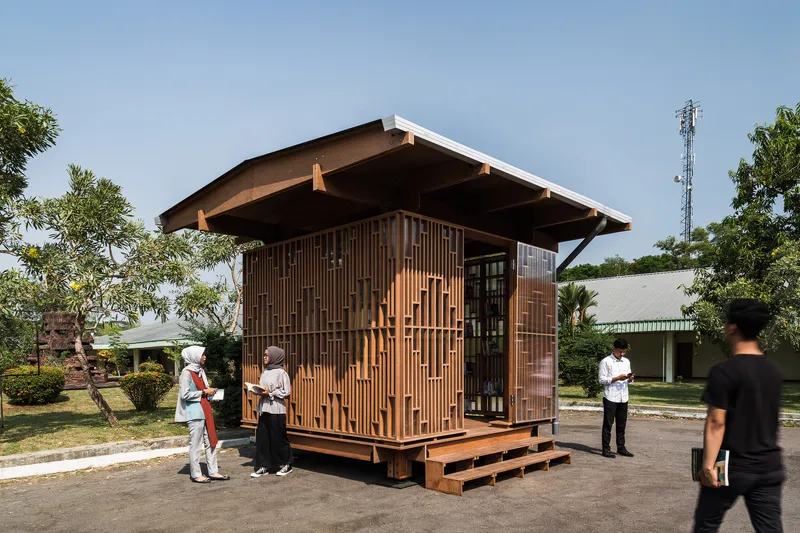


The phrase "architecture as a product" makes many designers uneasy, and for good reason: it can imply the erasure of context, craft, and site-specific thinking. SHAU's version of the idea is more nuanced. MoKa evolved over two years of conceptual development, building on lessons from three previous microlibraries, including the Hanging Gardens project with its staggered planter boxes, the Warak Kayu, and the Fibonacci. Each iteration refined the modular logic until the unit dimensions, joint typologies, and assembly sequence could be standardized.
The result is a post-and-beam system where bundled columns made from four finger-joint laminate elements meet plywood panels at precise, repeatable connections. Two structural modules placed side by side generate an in-between space equal to one module, thanks to the roof overhang. That emergent gap can become a veranda or remain open, which means spatial variety arises from combination rather than bespoke design. It is the kind of thinking that could, in principle, deliver reading rooms across the Indonesian archipelago with minimal on-site engineering.
Timber Screens and Tropical Light


The facade panels are where MoKa's modular discipline meets sensory richness. Alternating timber tones and translucent inserts create a lattice that shifts in density depending on the angle of view, filtering harsh equatorial sun into a warm, dappled interior. The screens are not fixed in a single configuration; they can be customized to respond to a building's specific orientation relative to solar heat gain, which is essential in a tropical climate where air conditioning is not part of the design brief.
Southeast Asian vernacular architecture has always understood this: timber, bamboo, and rattan structures with large overhanging roofs, cross-ventilation shutters, and houses on stilts are not nostalgic references but functional precedents. SHAU's contribution is to encode that climatic intelligence into a prefabricated system. The sliding screen panels visible in the front elevation allow the enclosure to open and close, turning the library from a sheltered reading room into a semi-outdoor pavilion. Passive design is not an add-on here; it is the structural and spatial logic itself.
The Interior at Nine Square Meters
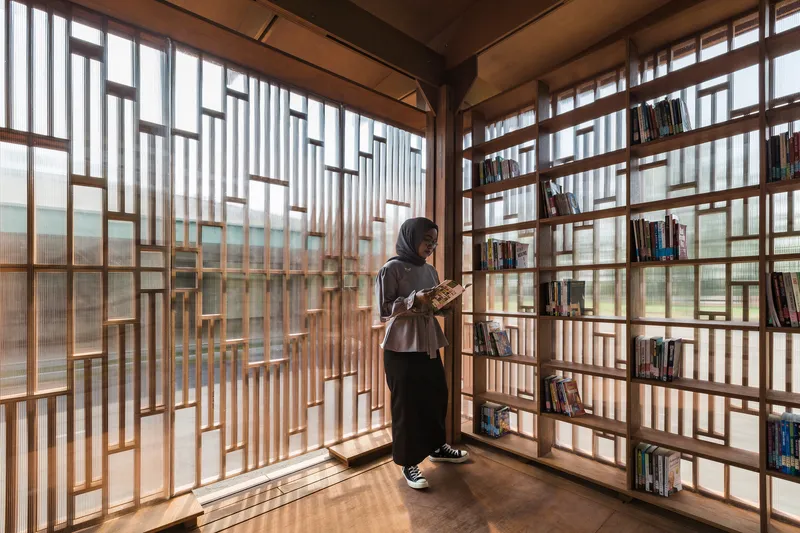
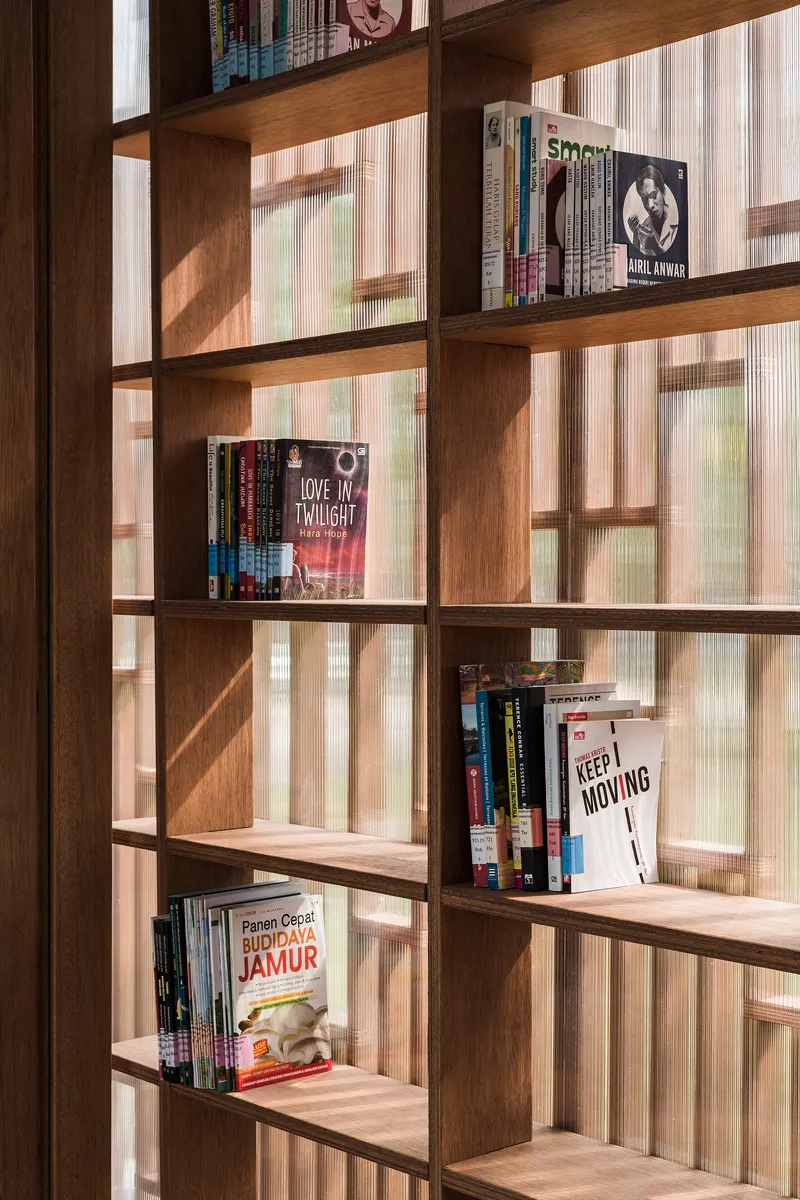
Nine square meters of interior space is roughly the area of a large bathroom in a middle-income apartment. That SHAU manages to make it feel generous, or at least sufficient, is a testament to careful sectional thinking. Bookshelves are integrated directly into the timber screen walls, so the structure that filters light also stores books. There is no redundancy: every surface works twice.
The reading corner, where a woman sits framed by the geometric screen and a low window, demonstrates the spatial quality that elevates MoKa beyond a mere kiosk. Translucent corrugated panels behind the shelving provide a soft backlight, and the wood tones vary enough to give the small room visual depth. It is compact, yes, but it is not cramped. The proportions are deliberate, derived from the plywood sheet, and they happen to produce a room that feels calibrated rather than constrained.
Joinery as Identity


Look closely at the column-to-beam intersection, with its visible bolted connections and exposed plywood ceiling, and you see the building's true character. MoKa does not hide its means of assembly. The bolts, the laminate layers, the finger joints are all legible, which is both an aesthetic choice and a practical one. A building designed to be assembled quickly by local labor needs connections that can be understood at a glance.
Indonesia exports vast quantities of timber while its own construction industry often defaults to concrete and steel. By specifying FSC-certified plywood from local manufacturers like PT. Kayu Lapis Indonesia and partnering with PT. Impak Pratama Industri Tbk, SHAU makes an argument for domestic timber as a legitimate, contemporary building material. The joinery is not a revival of traditional carpentry; it is a new system informed by industrial supply chains and fabrication capabilities that already exist in the country.
Landscape and Threshold


Seen from a distance through a grove of trees, MoKa reads as a modest object on a lawn, almost a garden folly. Up close, the raised platform and cantilevered roof create a threshold that is neither fully inside nor fully outside, a quality deeply rooted in the region's architectural traditions. Pedestrians pass by on the paved area, some glancing, some pausing. The pavilion invites without insisting, which is exactly the right posture for a public reading room in a tropical park setting.
Plans and Drawings

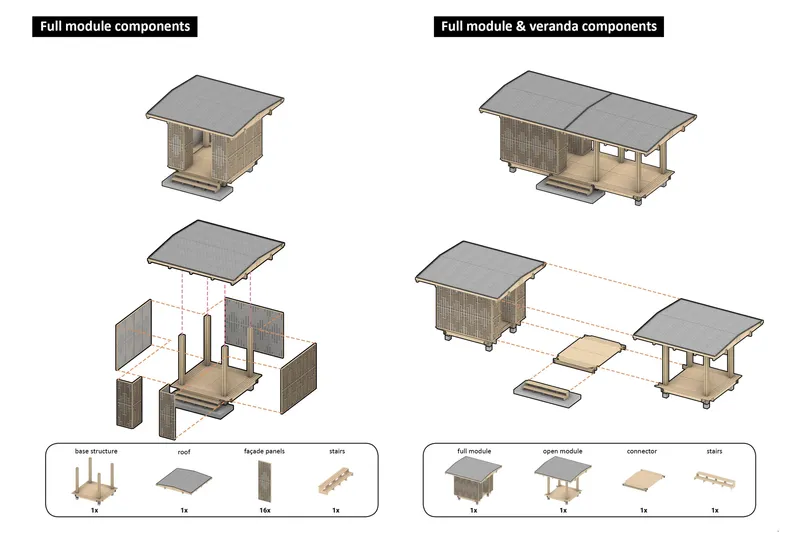
The axonometric diagrams reveal the system's scalability with striking clarity. A single module is the irreducible unit; two modules create a veranda condition; four, eight, or twelve modules can be arrayed into configurations that range from a small reading nook to a community center. The exploded view of the full module and veranda assembly shows every component, from base structure to roof panels, laid out like an instruction manual. This is architecture designed to be communicated, shipped, and built without the architect present on site.
What the drawings also make visible is the connector piece, the element that links modules and generates the interstitial space between them. It is a small detail with large consequences. The connector determines whether the gap becomes enclosed or open, whether the building breathes or seals. In a modular system, the joint is everything, and SHAU has clearly understood this.
Why This Project Matters
The microlibrary as a building type has gained traction in Indonesia and beyond, but most examples remain singular gestures: striking forms that generate press coverage but resist replication. MoKa pushes in the opposite direction. By anchoring every dimension to a standard plywood board and every joint to a repeatable typology, SHAU has created a system that could plausibly be deployed at scale. The flat-pack delivery model reduces on-site impact and construction time, while the passive climatic strategies eliminate the need for mechanical cooling. It is, in the best sense, appropriate technology applied to civic architecture.
Whether MoKa actually proliferates across Indonesia remains to be seen, and the gap between a promising prototype and a nationwide rollout is wide. But the thinking is sound, and the execution in Bandung demonstrates that modular discipline need not produce sterile results. At 10 square meters, this is one of the smallest projects we have covered, and one of the most carefully considered. Size, it turns out, has very little to do with ambition.
Microlibrary MoKa by SHAU Indonesia (Florian Heinzelmann, Daliana Suryawinata), Bandung, Indonesia. 10 m², completed 2021. Photography by Andreaswidi.
About the Studio
Share Your Own Work on uni.xyz
If projects like this are the kind of work you want to make, uni.xyz is a place to publish your own, find collaborators, and enter design competitions.




Popular Articles
Popular articles from the community


Hill & Cross Opera: Sculptural Opera House Architecture Shaped by Tallinn’s Landscape and Identity
Hill & Cross Opera reimagines opera house architecture in Tallinn through its sculptural hill, civic plaza, glass wave and a luminous cross.

Co-life: Sustainable Architecture for Age-Friendly Community Living
Co-life reimagines sustainable architecture for seniors through courtyards, rammed earth, shared gardens, and spaces designed for belonging.

Riyadh For All: Intergenerational Urban Design for Active Aging in Rabat
Riyadh For All reimagines urban design in Rabat with intergenerational co-living, adaptive courtyards, and Moroccan cultural exchange today.

The Earth Pod: 3D Printed Homes for Resilient Refugee Communities
The Earth Pod reimagines refugee housing through 3D printed homes made from clay, combining resilience, self-sufficiency, and rapid shelter.


Similar Reads
You might also enjoy these articles

Bao Huynh Watercolor Atelier: A Serene Art Retreat in Hội An
Bao Huynh Watercolor Atelier in Hội An blends multifunctional art spaces, sustainable design, local materials, and family-friendly living in a serene environment.

Atelier Macri Concept Store Interior Design by CASE-REAL
Atelier Macri store features a "ko" counter, walnut wood details, cork displays, blending retail, gallery, and seamless customer experiences.

Manuel Vargas Izquierdo Stadium and High-Performance Sports Center: Architectural Excellence in Jalpa de Méndez
The Manuel Vargas Izquierdo Stadium blends sustainable design, inclusive sports facilities, and cultural-inspired architecture, revitalizing Jalpa de Méndez’s public spaces.

KAKR Buluh Awar Hall: Revitalizing Community and Ecology Through Bamboo Architecture
Community built bamboo hall revitalizes Buluh Awar village, empowering youth, restoring ecology, celebrating vernacular craftsmanship through sustainable architecture and culture.


Explore Educational Building Competitions
Discover active competitions in this discipline



Challenge to design a portable theatre


Challenge to design a portable music platform


Challenge to design public laboratory


Challenge to design an open learning module for the elderly
Comments (0)
Please login or sign up to add comments
No comments yet. Be the first to comment!