

Social Core: One Room That Makes Co-Living Work
An L-shaped co-living building in Moscow with a double-height timber atrium at its centre, where one extraordinary shared room replaces a corridor.


Every co-living building has a corridor. Social Core replaces it with a room. The project, designed by Deniz Tutucu, Gorkem Semersatan, Yasemin Okumus, and Emre Seyran, places a double-height timber atrium at the centre of an L-shaped residential building in Moscow. The atrium is not circulation. It is the social programme: amphitheatre seating, suspended walkways, co-working, and communal space, all in a single visible volume that every resident passes through.
The project won the People's Choice Award in the Hustle Hub '19 competition on uni.xyz. It is the most architecturally grounded entry in the series: a real site near the Moscow River, a buildable L-shaped plan, and a central social space that works because of its position, not its programme list.
The L-Shape: Two Wings, One Core

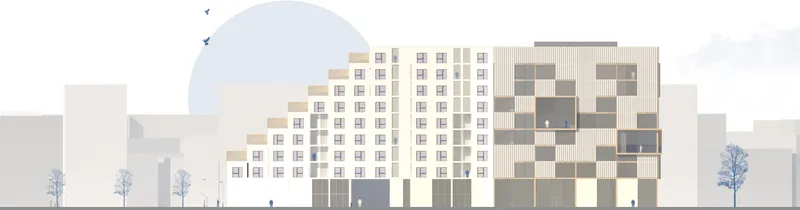
The building sits near the Moscow River in the Zilart district. Two residential wings form an L-shape, enclosing a courtyard on one side and opening to the city on the other. At the corner where the wings meet, the social core occupies a double-height glazed volume visible from the street. You can see the atrium before you enter the building. The social life is not hidden. It is advertised.
The elevation shows the two wings in context. The left wing has a regular white residential facade. The right wing introduces a checkerboard pattern that signals a different programme: more public, more varied. The change in facade marks the change in use without signage. The architecture communicates.
The Atrium: Timber, Blue, and Light

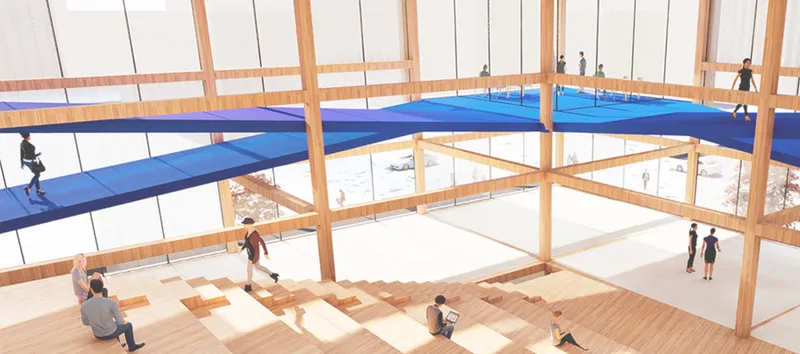
The two atrium renders are the project's best images. The first shows a double-height timber-framed void with blue walkway bridges spanning across it, stepped timber seating below, and natural light pouring from above. The second shows blue fabric canopies suspended as hammock bridges between timber columns, with an amphitheatre of stepped seating at ground level.
The colour strategy is precise. The structure is warm timber. The social elements (bridges, canopies, railings) are blue. The distinction is immediate: wood is permanent, blue is social. You always know where the building ends and where the community begins. This is not a generic co-working lounge. It is an architectural space designed to hold the largest possible number of informal encounters in the smallest possible volume.
The Apartments: Five Types, Blue Balconies

The apartment axonometrics show three of the five unit types. Each is compact, well-planned, and identifiable by the blue balcony railings that become the building's signature from the outside. Private kitchens, bathrooms, and balconies are standard. The smallest unit is a studio. The largest has separate bedrooms. All have direct sunlight.
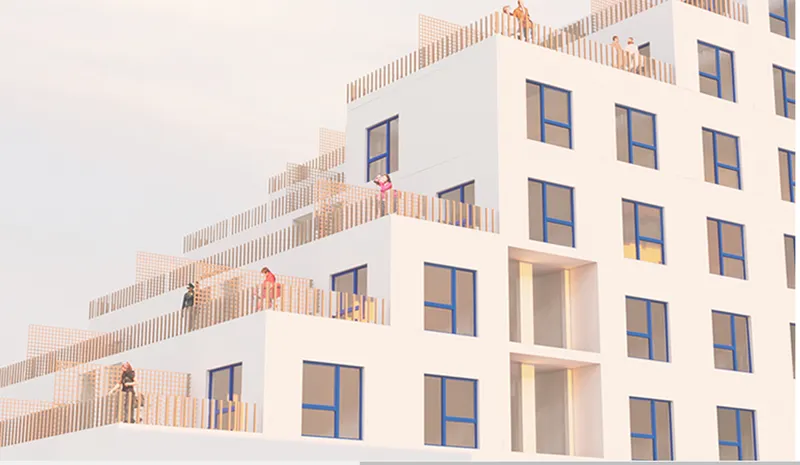
The exterior detail render shows the upper floors in close-up: stepped volumes with vertical timber balustrade screens and blue window frames. Residents stand on their terraces. The building reads as inhabited, warm, and specific. This is the visual quality that won the People's Choice: it looks like somewhere you would want to live, not just somewhere you would want to draw.
The Ground Floor: Glass, Bikes, and Winter
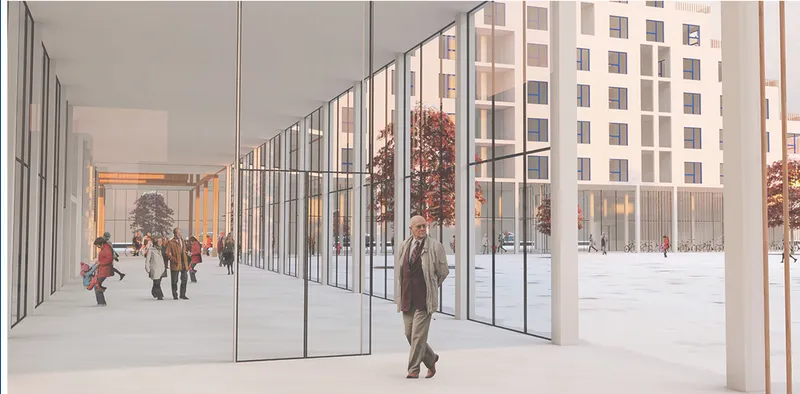

The ground-floor renders show two conditions. The glass-walled passage is a transparent lobby where you can see the courtyard on both sides: autumn trees, people walking, the city beyond. In Moscow's winter, this glazed corridor becomes the building's warmest social space at ground level: sheltered, bright, and public.
The bicycle parking is handled with the same care. A slatted timber screen conceals the racks while letting air through. Glass retail frontage opens onto the street. Residents arrive by bike or on foot and pass through the public programme before reaching their front doors. Every journey through the building is also a social encounter.
Why This Project Won the People's Choice
The Hustle Hub competition asked for co-living. Social Core answered by designing the one room that makes co-living work: the shared interior that is good enough to use. The atrium is not a gesture. It is a room with seating, bridges, light, and atmosphere. People voted for it because they could imagine themselves sitting there.
For anyone designing co-living, the lesson is spatial. You do not need a long list of shared amenities. You need one extraordinary shared room in the right position: at the building's centre, visible from the street, passed through every day. Social Core proves that one room, designed well and placed correctly, is more valuable than ten programmed spaces scattered through the plan.
View the Full Project
About the Designers
Designers: Deniz Tutucu, Gorkem Semersatan, Yasemin Okumus, Emre Seyran
Enter a Design Competition on uni.xyz
If co-living, shared atrium design, or community-centred housing is the kind of work you want to pursue, uni.xyz runs competitions year-round that reward projects where one well-designed room changes everything.
Project credits: Social Core by Deniz Tutucu, Gorkem Semersatan, Yasemin Okumus, Emre Seyran. People's Choice Award, Hustle Hub '19 (uni.xyz).


Popular Articles
Popular articles from the community


Singing Woman: Contemporary Architecture Inspired by Estonia’s Voice and the Sea
Singing Woman turns Estonia’s song culture into flowing opera house architecture, blending public life, landscape, sea, and national memory.

The Amber Palace Opera: A Geological Fiction Surfaces on Tallinn's Baltic Waterfront
Pierre Brillard reimagines a Baltic legend as a public landscape, opera house, and waterfront promenade rooted in Tallinn's coastal identity.
Opera by the Sea Estonia: Three Shells Dissolving Architecture into Tallinn's Coastline
A winning opera house proposal replaces monumental form with interconnected shells that blur the boundary between building, park and Baltic Sea.

Cloaked Colonization: A Mobile Underwater Habitat That Moves Like a Fish
Micah Abaya's shortlisted EHC Pacific entry reimagines ocean settlement as a dispersed network of self-sustaining architectural organisms.

Similar Reads
You might also enjoy these articles

Day and Night Park: A Time-Based Urban Newsstand in Beijing
A temporary urban newsstand in Beijing blending travel, light, and reading through poetic colors, compact form, and community-focused design.

Modernist Patio Renovation in El Masnou, Barcelona by Oliver Segura Arquitectura + Cebrià Arquitectura
Modernist patio renovation blending tradition and innovation with a movable pool, leveled floors, and Catalan materials in El Masnou.

Alto Residencial Coop: Cooperative Housing Development in Santiago de Compostela by Carbajo Barrios Arquitectos
A linear cooperative housing complex blending white volumes and perforated metal façades, enhancing community living, natural light, privacy, and urban integration.
Vil Genis School by BPA ARCHITECTURE – Massy, France
Vil Genis School in Massy, France, features sustainable design, south-facing classrooms, community integration, accessible spaces, and modern educational architecture.


Comments (0)
Please login or sign up to add comments
No comments yet. Be the first to comment!