

Modular Arctic Habitat: Stacking Life, Work, and Play Against the Ice
A four-stage modular system designed by Jakub Kubicki proposes scalable, oval-shaped units for off-grid Arctic living.


What does it take to build a home where the wind never stops and the ground never thaws? The Modular Arctic Habitat answers with a system, not a building. Conceived as a fully modular framework that scales from individual components to entire settlements, the project treats the Arctic not as a hostile backdrop but as a set of design constraints to be resolved through intelligent assembly. Four discrete stages of organization, modules, units, configurations, and habitats, allow construction to be rapid, expansion to be limitless, and environmental impact to remain low.
Designed by Jakub Kubicki, the project was a shortlisted entry in the EHC - Arctic competition. It proposes a vision that goes well beyond a single shelter: the system integrates living spaces, work hubs, greenhouses, and recreational areas into oval-shaped units engineered for wind resistance and energy self-sufficiency.
Vertical Assembly in a Frozen Landscape
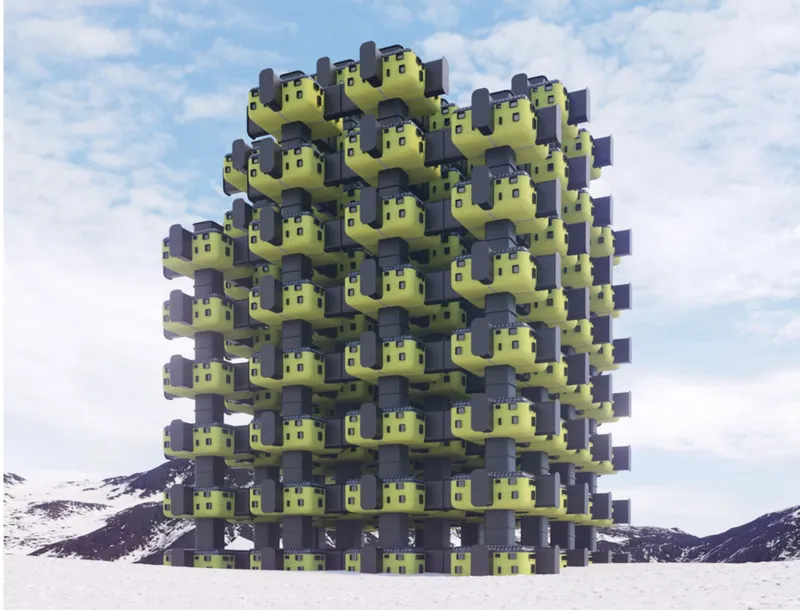
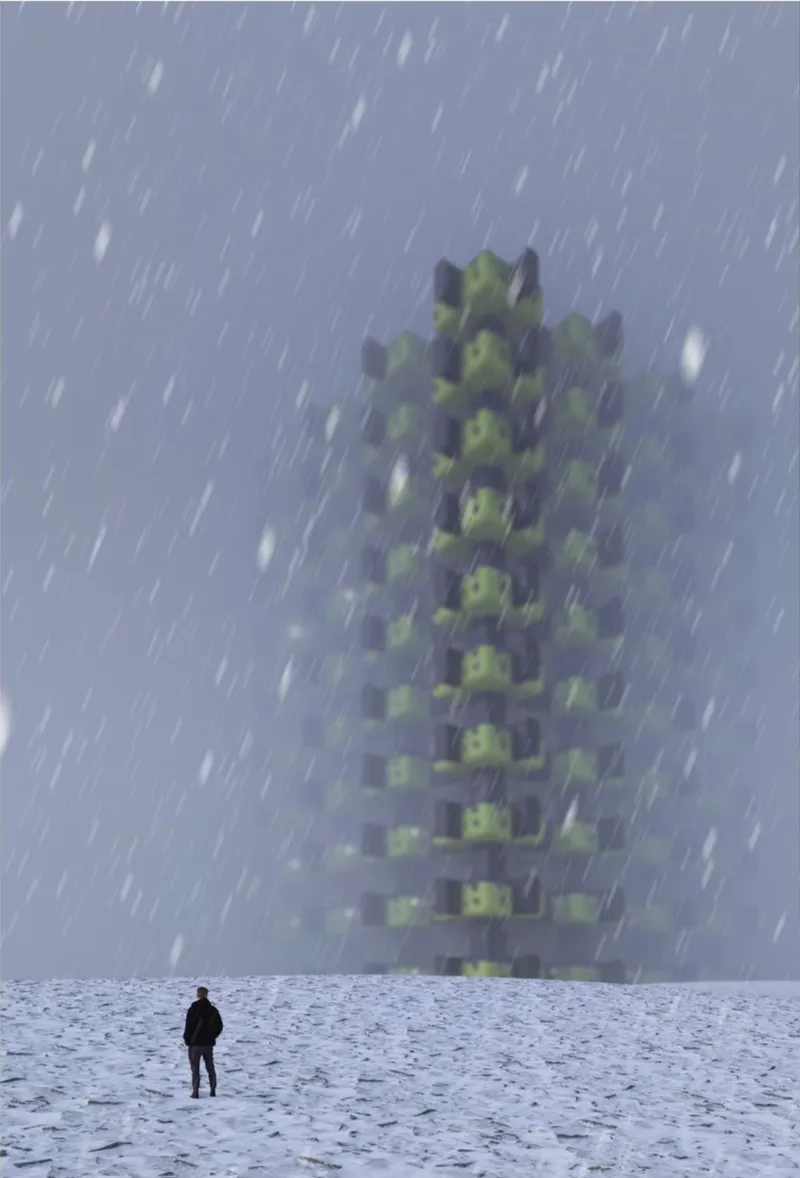
The primary render shows the habitat as a stacked tower of yellow and grey interlocking units rising from a snow-covered mountain landscape. The vertical orientation is deliberate: by building up rather than out, the system minimizes its footprint on fragile Arctic terrain while concentrating thermal mass. Each module slots into the next, suggesting a construction logic closer to industrial prefabrication than traditional site-built architecture. Solar panels visible on the module surfaces contribute to off-grid energy generation even at high latitudes.
The second image pulls the camera back into a whiteout of heavy snowfall, reducing the tower to a silhouette. A lone figure stands in the foreground, providing a stark sense of scale and isolation. The image is less a rendering than a test: can the structure hold its own against the visual erasure of an Arctic blizzard? The oval profile of the units, chosen specifically for improved wind resistance, becomes legible even through the storm, confirming that the form is shaped by force, not fashion.
Clustered Configurations at Night
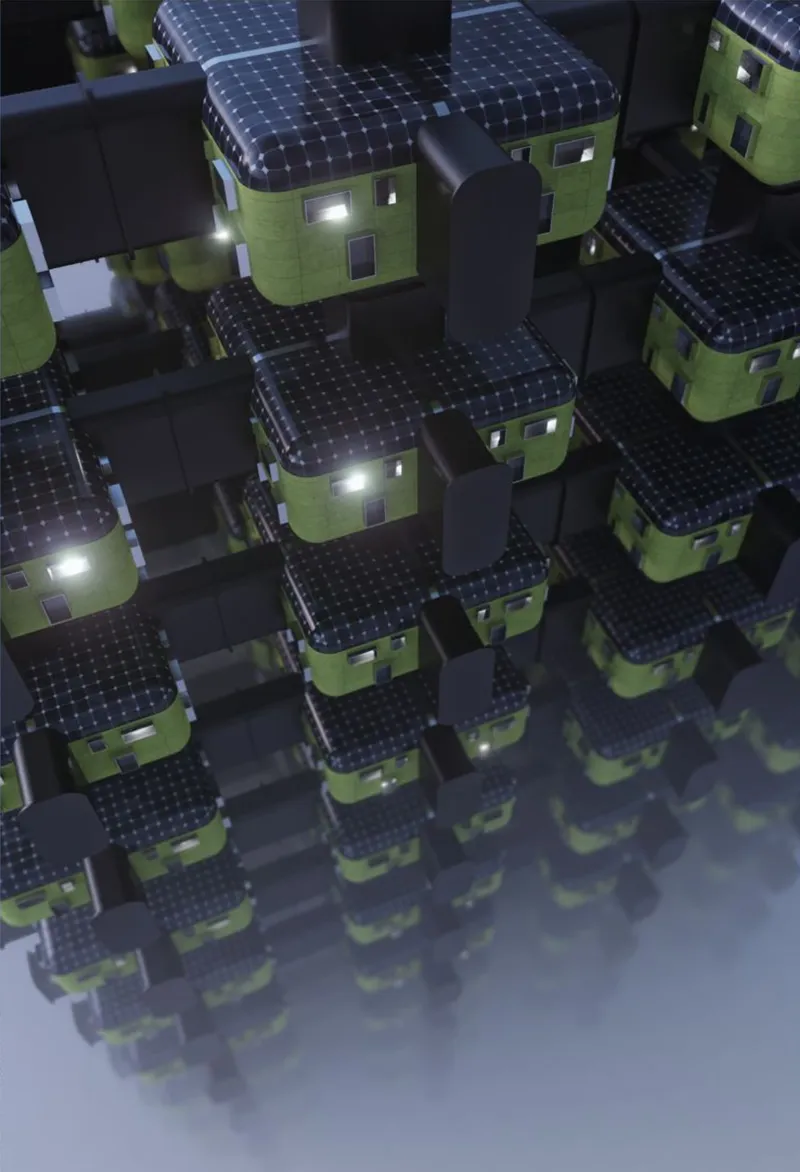
At the settlement scale, the project shifts from solitary tower to clustered neighborhood. The night view reveals a group of yellow housing units glowing warmly against the dark, their windows illuminated and solar panel roofs catching ambient light. The clustering strategy illustrates the "configurations" stage of the modular hierarchy: individual units combine into shared arrangements that can grow incrementally as communities require more space. The visual warmth of the scene is a pointed counterargument to the idea that Arctic architecture must look as cold as its context.
Color-Coded Program on Two Levels
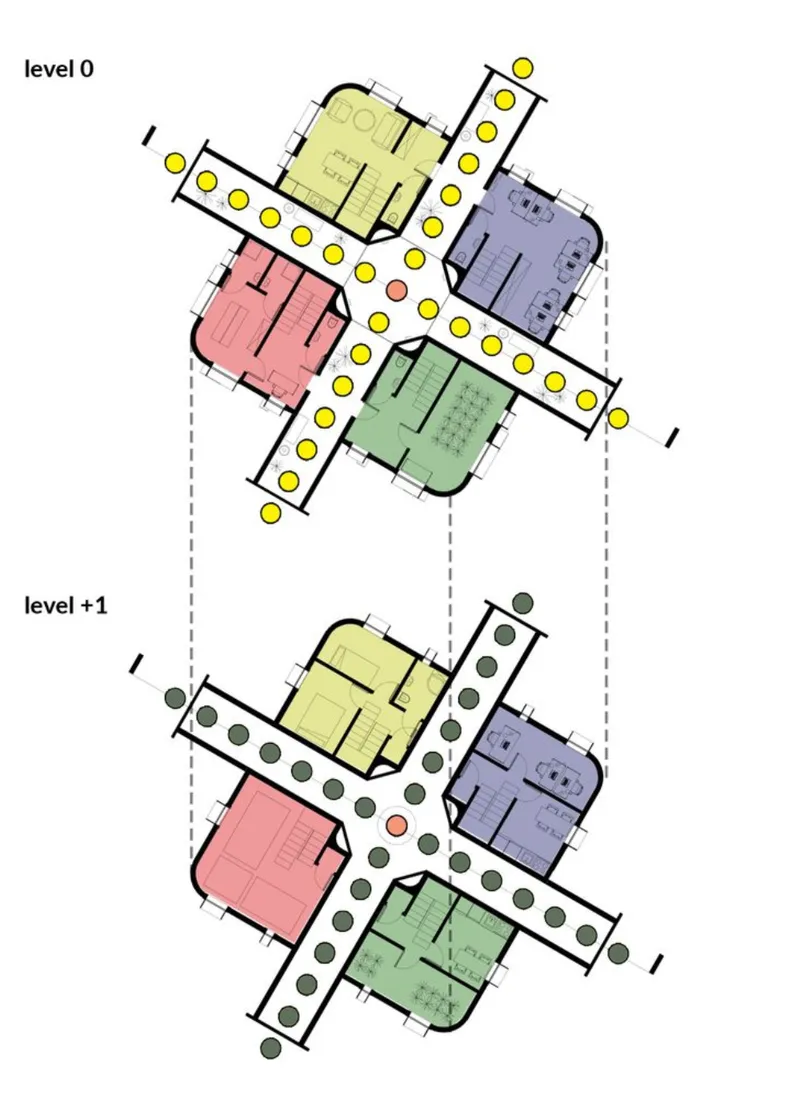
The floor plan drawing lays out the internal logic of a single unit across two levels. Four color-coded zones, likely corresponding to living, working, greenhouse, and recreational functions, are arranged around a central circulation corridor. The plan makes the adaptability claim concrete: by swapping zone types within the same structural envelope, residents or planners can reconfigure a unit's program without altering its shell. The central corridor acts as spine and social condenser, keeping movement efficient in a climate where every unnecessary step outdoors carries risk.
This organizational clarity is what separates the project from a generic prefab proposal. The modular system is not just about snapping boxes together; it is about encoding programmatic flexibility into the smallest repeatable element, so that the habitat can serve a research station, a small community, or a temporary work camp with equal effectiveness.
Why This Project Matters
Arctic architecture is gaining urgency as climate change opens new territories to habitation, resource extraction, and scientific research. The Modular Arctic Habitat responds to this reality with a system that is scalable, transportable, and programmatically flexible. By grounding its formal decisions in measurable performance criteria like wind resistance and energy self-sufficiency, it avoids the trap of speculative Arctic imagery that looks dramatic but solves nothing.
Kubicki's contribution is a clear-eyed proposal that treats modularity not as an aesthetic but as a strategy for survival. The four-stage hierarchy, from module to habitat, offers a framework that could inform real deployments in extreme environments. As a shortlisted entry in the EHC - Arctic competition, the project signals that the next generation of designers is thinking about polar construction with both rigor and ambition.
View the Full Project
About the Designers
Designer: Jakub Kubicki
Enter a Design Competition on uni.xyz
uni.xyz runs architecture and design competitions year-round that reward proposals with spatial conviction and real site intelligence.
Project credits: Modular Arctic Habitat by Jakub Kubicki EHC - Arctic (uni.xyz).


Popular Articles
Popular articles from the community


Cloaked Colonization: A Mobile Underwater Habitat That Moves Like a Fish
Micah Abaya's shortlisted EHC Pacific entry reimagines ocean settlement as a dispersed network of self-sustaining architectural organisms.
Extended Shell: Retrofitting Kolkata's Balconies as Living Urban Thresholds
A modular retrofit system recovers the social and environmental intelligence of Kolkata's historic verandas for contemporary Park Street residents.

Manzana Morphosis: Stretching Barcelona's Grid into a Living Landscape for 2050
A radical reworking of the Eixample manzana turns density into a tool for generous public space, vertical ecology, and environmental performance.

Opera on the Sea: Driftwood Logic Shapes a Timber Opera House on Estonia's Coast
Trevor Orgill's opera house translates the entangled drift of floating timber into a civic building where wood, water, and music converge.

Similar Reads
You might also enjoy these articles

Shakur's House: Exposed Brick as an Interior Organiser in a 168 m² Mashhad Residence
Brick moves indoors in this Mashhad residence, where masonry walls, glass partitions and teal planes sequence a compact home without closing it off.

Day and Night Park: A Time-Based Urban Newsstand in Beijing
A temporary urban newsstand in Beijing blending travel, light, and reading through poetic colors, compact form, and community-focused design.

Modernist Patio Renovation in El Masnou, Barcelona by Oliver Segura Arquitectura + Cebrià Arquitectura
Modernist patio renovation blending tradition and innovation with a movable pool, leveled floors, and Catalan materials in El Masnou.
Alto Residencial Coop: Cooperative Housing Development in Santiago de Compostela by Carbajo Barrios Arquitectos
A linear cooperative housing complex blending white volumes and perforated metal façades, enhancing community living, natural light, privacy, and urban integration.

Comments (0)
Please login or sign up to add comments
No comments yet. Be the first to comment!