
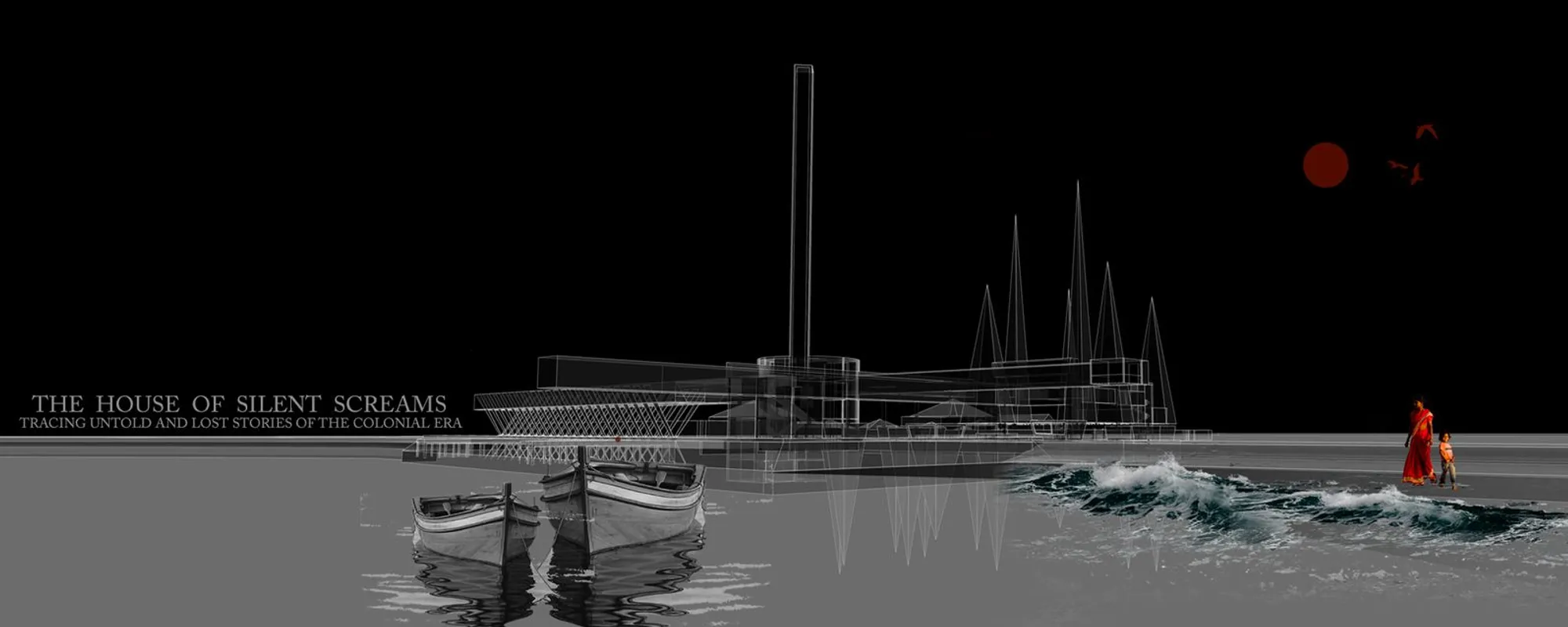
The House of Silent Screams: Tracing Untold and Lost Stories of the Colonial Era
A memorial architecture project in Fort Kochi that uncovers silenced colonial histories through space, memory, and experiential design.


Is a single story ever enough to understand a place?
Cities, landscapes, and monuments are layered with memories, some celebrated, others deliberately forgotten. While dominant historical narratives often glorify colonial power, trade, and conquest, they rarely acknowledge the violence, displacement, and erasure that accompanied them. The House of Silent Screams, a thesis project "The House of Silent Screams- Tracing Untold and Lost Stories of the Colonial Era" by Ganesh Katave, positions memorial architecture as a critical medium to confront these absences and question the ethics of historical remembrance.
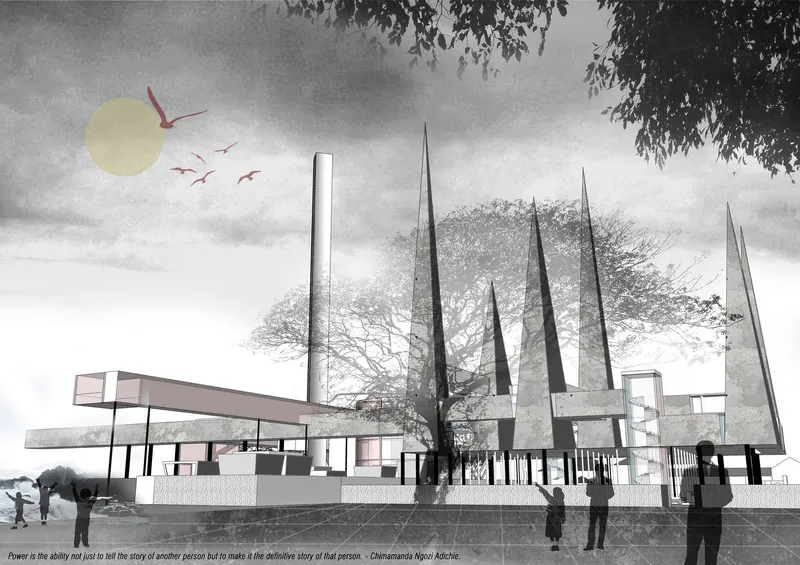
Located within the Dutch Cemetery at Fort Kochi, Kerala, the project explores how architecture can act as a vessel for suppressed narratives: particularly those of enslaved, subaltern, and marginalized communities whose stories were never recorded in stone or text.
Institutional Excellence Award entry of UnIATA '19
Memorial Architecture as a Tool for Counter-Narratives
Memorial architecture is often understood as static, monuments frozen in time. This project challenges that notion by proposing a dynamic, experiential memorial that unfolds through movement, light, depth, and disorientation. Rather than offering closure, the architecture provokes discomfort, reflection, and inquiry.
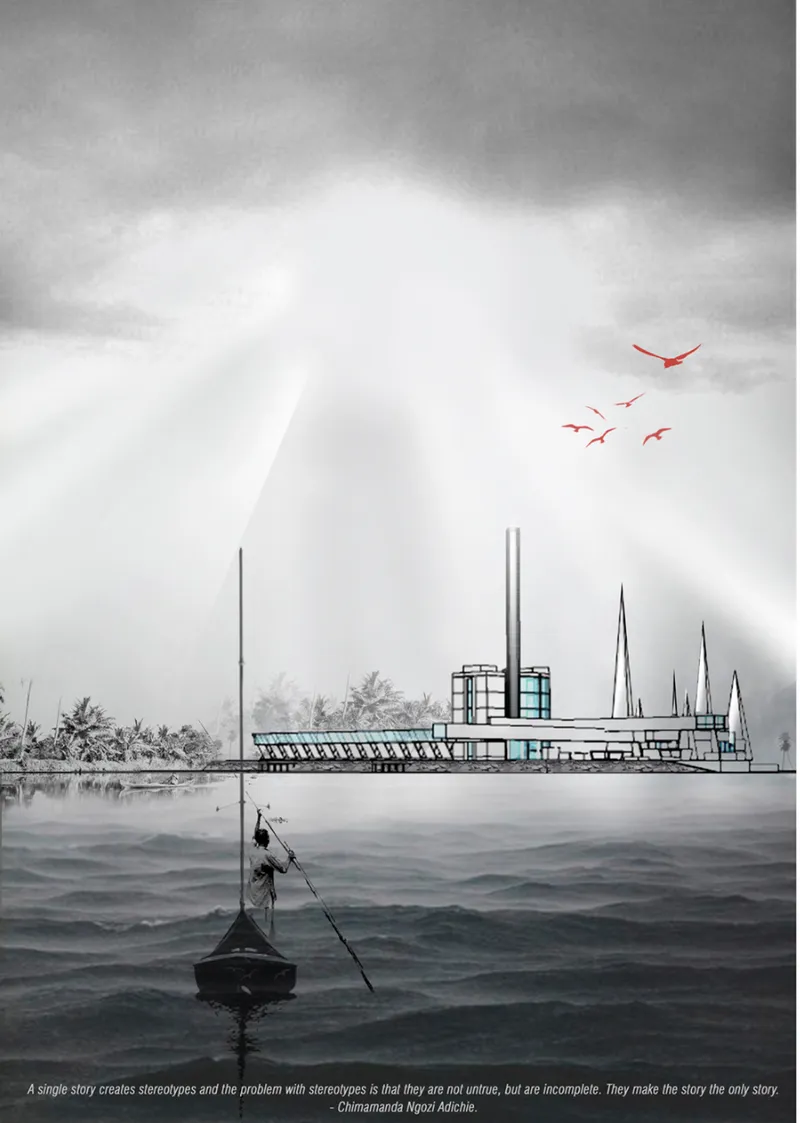
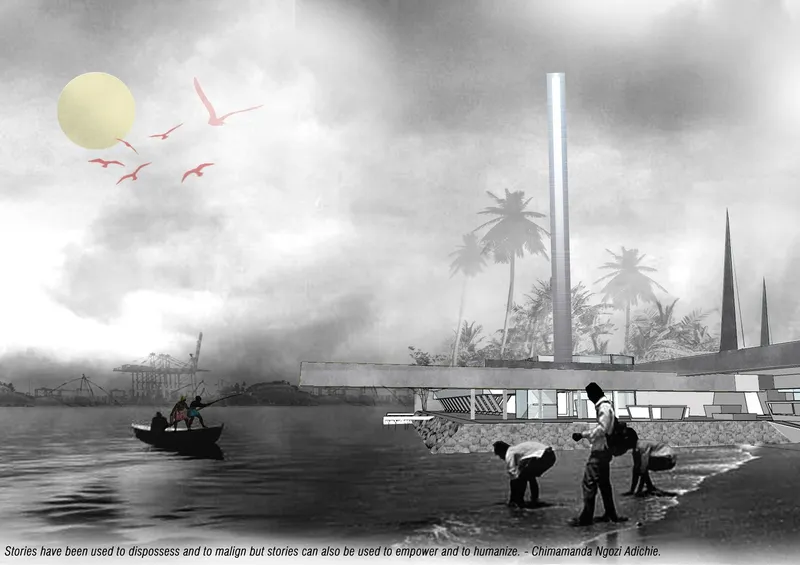
The thesis draws inspiration from Chimamanda Ngozi Adichie’s idea of the “single story,” questioning how colonial histories were constructed and whose voices were excluded. By embedding memory into spatial sequences rather than symbolic objects, the project transforms architecture into a narrative instrument, one that does not explain, but asks.
Site as Palimpsest: Dutch Cemetery, Fort Kochi
The Dutch Cemetery at Fort Kochi is a paradoxical site. Though physically present, it remains psychologically absent from the everyday consciousness of the city. Overshadowed by tourist-driven colonial nostalgia and the Kochi Muziris Biennale’s curated narratives, the cemetery silently bears witness to histories of trade, slavery, and cultural violence.
Positioned between the Arabian Sea and dense urban fabric, the site operates as a threshold: between land and water, memory and erasure, the spoken and the unspoken. The project treats the site as a palimpsest, layering new architectural interventions without erasing the existing terrain, graves, or ruins.
Spatial Strategy: From Surface to Subterranean Memory
The architectural journey is conceived as a gradual descent, from the visible, familiar realm into spaces of introspection and unease. Much of the program is pushed below ground, reinforcing the idea that these histories were buried, hidden, and denied.
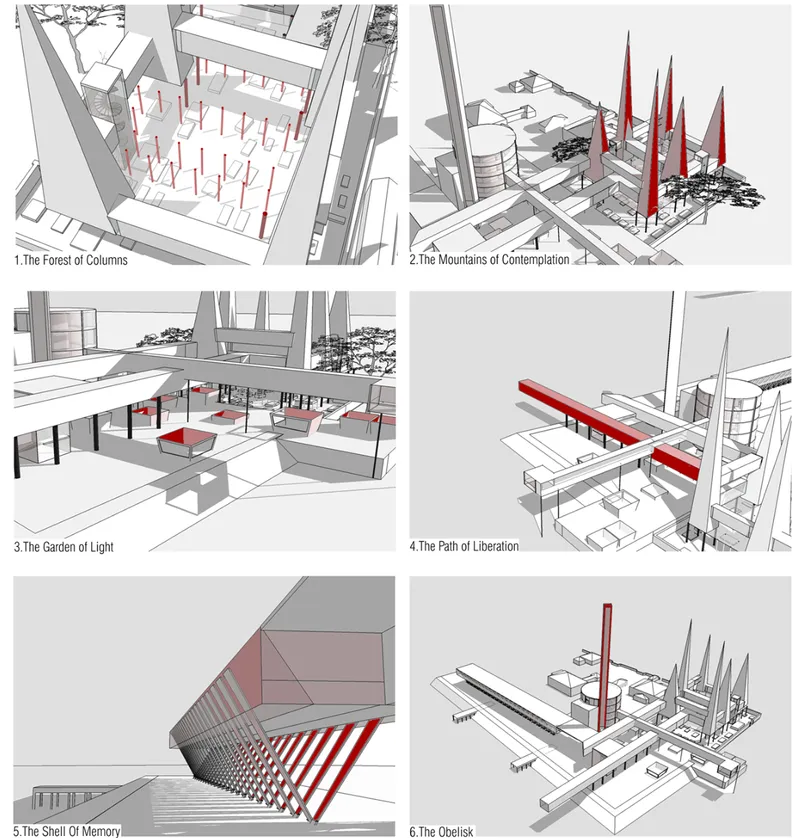
Key spatial sequences include:
- The Forest of Columns: A dense field of vertical elements symbolizing anonymity, loss, and the countless unnamed lives erased by colonial systems.
- Mountains of Contemplation: Sharp, distorted vertical forms emerging from the ground, representing trauma, fear, and psychological rupture.
- The Garden of Light: A momentary release where filtered light offers pause without resolution.
- The Path of Liberation: A linear spatial axis guiding visitors through confrontation toward awareness, not absolution.
- The Shell of Memory and The Obelisk: Archetypal forms reinterpreted to question purity, power, and permanence in memorial architecture.
Movement through these spaces is intentionally non-linear, evoking uncertainty and loss of orientation, mirroring the fragmented nature of historical truth.
Architecture of the Uncanny
The project employs the concept of the uncanny, spaces that feel familiar yet deeply unsettling. Sharp geometries, distorted scales, and fragmented volumes challenge conventional expectations of museums and memorials.
Materiality remains restrained: exposed concrete, stone, light wells, voids, and shadows dominate the palette. These choices emphasize absence over presence, silence over spectacle. Architecture here does not narrate history, it allows visitors to feel its weight.
Programmatic Intent
The House of Silent Screams functions as:
- A cenotaph commemorating enslaved and erased communities
- A museum of lost memories, focusing on colonial violence rather than colonial glory
- An exhibition and reflection space, conceived as an extension of the Kochi Muziris Biennale, yet critically positioned against its selective storytelling
Rather than celebrating colonial heritage, the project exposes its omissions.
Reclaiming Memory Through Architecture
This thesis asserts that memorial architecture must go beyond commemoration. It must challenge, disturb, and provoke ethical reflection. By embedding architecture within the psychological and historical layers of Fort Kochi, The House of Silent Screams becomes a space where memory is not consumed but confronted.
In doing so, the project reframes architecture as an act of resistance, one that refuses the comfort of a single story and instead amplifies the voices history tried to silence.



Popular Articles
Popular articles from the community


Lunar Spiral: Space Architecture Shaped by the Mathematics of the Universe
Lunar Spiral reimagines space architecture through Fibonacci geometry, lunar regolith, levitating habitats, and self-sustaining Moon living.

Co-Life: Senior Housing Design That Reconnects Older Adults With the City
Co-Life reimagines senior housing design through healing gardens, shared streets, workshops, and a sustainable community across generations.

Riyadh For All: Intergenerational Urban Design for Active Aging in Rabat
Riyadh For All reimagines urban design in Rabat with intergenerational co-living, adaptive courtyards, and Moroccan cultural exchange today.

The Ocean Hive: Sustainable Architecture for a Self-Sufficient Civilization at Sea
The Ocean Hive imagines sustainable architecture at sea, where modular habitats, algae, wave power and ocean waste sustain a growing colony.


Similar Reads
You might also enjoy these articles

Eco Chapel: A Green Architecture Pavilion Designed in Symbiosis with the Forest
Eco Chapel uses green architecture to weave prayer, learning and reuse into a forest pavilion shaped by modular hexagonal canopies for life.
Kaffeebühnen: Coffee Shop Architecture Designed as a Civic Stage Between Vienna’s City and Park
Kaffeebühnen turns coffee shop architecture into a civic stage, linking Vienna’s park edge, urban life, warm timber yards, and coffee craft.
Healing Façade: Sustainable Architecture for Reforestation, Community, and Sacred Ecology in Ethiopia
Healing Façade reimagines sustainable architecture as a living wall that restores soil, catches water and renews Ethiopia's forest churches.


Urban Forest: A Vertical Ecosystem for 5,000 Workers in Singapore's Changi Business Park
Radially stacked pods and layered green decks turn a 7-acre plot into 47 acres of ecological workspace projected for 2040.


Explore Architecture Competitions
Discover active competitions in this discipline



Challenge to reimagine the Iron Throne


Photograph architecture without architects


Illustrate the lost glory of Angkor Wat - Render Challenge


Design challenge to reuse E-waste
Comments (0)
Please login or sign up to add comments
No comments yet. Be the first to comment!