

The Rotating Structure: Tribunes That Spin a Stadium Into a Marketplace
A hydraulic rotation system transforms tiered seating around a fixed axis, turning one stadium into five distinct public programs.


What happens when you give a stadium's tribunes permission to rotate? You get a building that refuses to sit idle. The Rotating Structure proposes a hydraulic mechanism that pivots entire seating shells around a fixed axis, converting a 10,000 to 30,000 seat sports venue into a marketplace, fitness center, expo hall, music festival stage, or urban botanical garden. It is not a stadium with bolt-on flexibility; it is a kinetic organism whose spatial identity changes with each configuration.
Designed by Ivan Stern, this concept was shortlisted in the Staydium 2020 competition, which challenged entrants to rethink the stadium as a year-round urban asset rather than a single-event monument. Stern's answer is radical: instead of reprogramming the interior fit-out, rotate the architecture itself. The result is a proposal that treats structure as software, reconfigurable at the scale of an entire building envelope.
An Oval Canopy Set Among Agricultural Fields

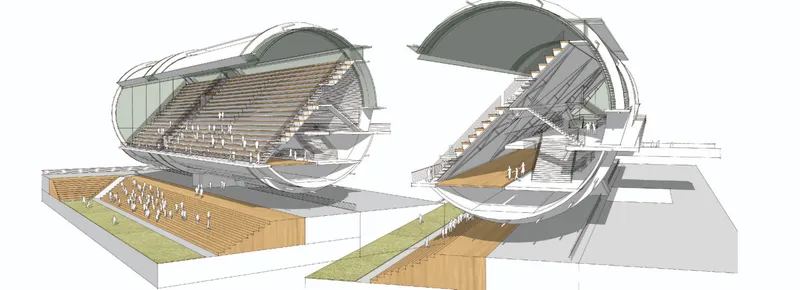
From the air, the stadium reads as a smooth oval canopy sitting at the intersection of roads and transit routes, its curved roof floating above agricultural plots that stretch to the horizon. The site strategy is deliberate: linking the venue to pedestrian pathways and public transport hubs encourages car-free access, turning what could be a parking-lot monoculture into a landscape that integrates food production and public infrastructure. The cutaway axonometric reveals the key move. Two rotating shell structures enclose tiered seating and the playing field below, their geometry hinged so the shells can pivot open or closed to expose or shelter the interior.
Rotating Frames That Rewrite the Program
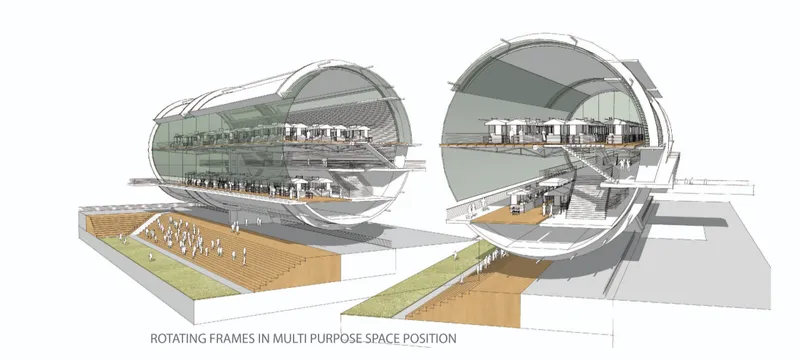
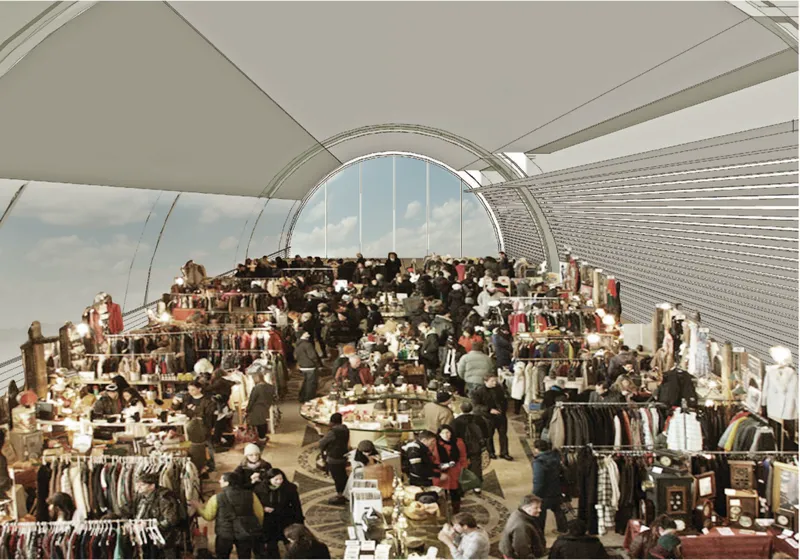
The axonometric section captures the multipurpose configuration mid-transformation: roof frames have swung into position over interior gathering spaces, and the tribune geometry has shifted to create broad, open floor plates rather than steep seating rakes. A hydraulic rotation system powers these transitions, and Stern claims minimal energy consumption for each reconfiguration cycle. The interior view of the marketplace mode proves the concept's ambition. Beneath the cable-stayed roof structure, vendors and shoppers populate a generously arched volume that feels closer to a 19th-century market hall than a sports arena. The structural ribs that support match-day spectators now define circulation corridors for commerce.
Athletics, Concerts, and Everything Between


The blue running track under the arched roof with its glazed end wall shows the venue in its most conventional athletic posture, yet even here the spatial quality is distinct. Daylight pours through the translucent enclosure, and the track surface benefits from a controlled microclimate that the rotating shells can modulate. Flip to night mode, and the same volume becomes a performance stage flanked by video screens, the crowd gathered beneath a starry sky made visible by the retracted roof panels. The design accommodates between 10,000 and 30,000 spectators depending on configuration, a range that reflects genuine operational flexibility rather than theoretical capacity.
Green Center and Lightweight Materiality
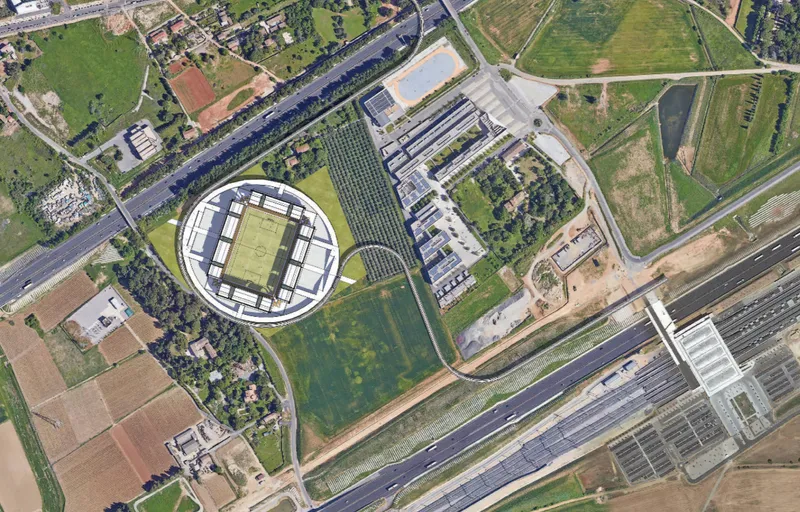
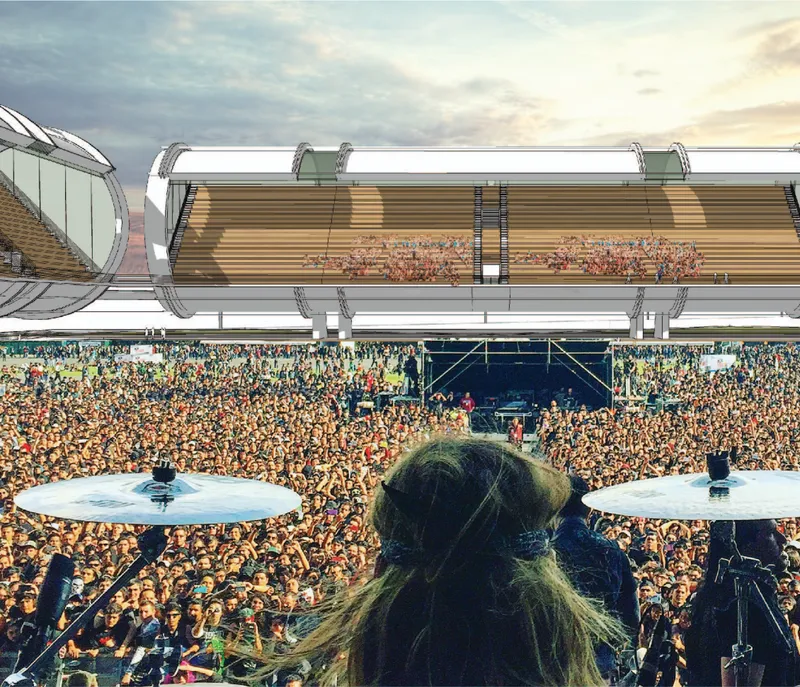
The second aerial reveals the stadium's relationship with surrounding green fields and agricultural plots, reinforcing the ecological premise. When no event is scheduled, the central pitch can transform into an urban botanical garden, a move that turns dead time into public amenity and promotes green architecture at the heart of the complex. Inside, the concert configuration exposes horizontal timber panels and louvered roof elements above a packed audience. These modular, lightweight materials serve double duty: they reduce the structure's environmental footprint while providing the acoustic diffusion that a live music venue demands. It is a material palette chosen for performance in every sense of the word.
Why This Project Matters
Stadiums are among the most expensive and least utilized building types on the planet. Most sit empty for the vast majority of the year, consuming land and maintenance budgets while contributing little to daily urban life. The Rotating Structure attacks this problem at the structural level, proposing that the building envelope itself should be the agent of transformation rather than temporary interior partitions or plug-in modules.
Ivan Stern's shortlisted entry for Staydium 2020 does not solve every engineering question such a mechanism would raise, but that is not the point at the competition stage. What it does accomplish is a convincing spatial argument: rotate the tribunes, and you rotate the entire economic and social logic of the stadium. The building stops being a venue and starts being infrastructure, as essential and as adaptable as the transit network it connects to.
View the Full Project
About the Designers
Designer: Ivan Stern
Enter a Design Competition on uni.xyz
uni.xyz runs architecture and design competitions year-round that reward proposals with spatial conviction and real site intelligence.
Project credits: The Rotating Structure by Ivan Stern Staydium 2020, (uni.xyz).


Popular Articles
Popular articles from the community


Opera on the Sea: Driftwood Logic Shapes a Timber Opera House on Estonia's Coast
Trevor Orgill's opera house translates the entangled drift of floating timber into a civic building where wood, water, and music converge.

Singing Woman: An Opera House That Performs Before the Curtain Rises
Ovidiu Cristian Pavel's conceptual opera house translates Estonia's choral identity into a sculpted waterfront landmark facing the Baltic Sea.


ETEH Reworks the Shared Spaces of São Domingos School in Brazil Around Timber, Color and Hanging Plants
At São Domingos School in Brazil, 436 m² of hall, refectory and library are recast with timber joinery, a yellow and blue code and trailing greenery.

Manzana Morphosis: Stretching Barcelona's Grid into a Living Landscape for 2050
A radical reworking of the Eixample manzana turns density into a tool for generous public space, vertical ecology, and environmental performance.

Similar Reads
You might also enjoy these articles

Vereda Arquitetos Renovates a 40-Square-Meter Apartment Inside Niemeyer's Copan Building
A compact unit in São Paulo's most iconic residential tower gets a material overhaul that pairs exposed concrete with bold blue Formica.

Shakur's House: Exposed Brick as an Interior Organiser in a 168 m² Mashhad Residence
Brick moves indoors in this Mashhad residence, where masonry walls, glass partitions and teal planes sequence a compact home without closing it off.

Day and Night Park: A Time-Based Urban Newsstand in Beijing
A temporary urban newsstand in Beijing blending travel, light, and reading through poetic colors, compact form, and community-focused design.

Modernist Patio Renovation in El Masnou, Barcelona by Oliver Segura Arquitectura + Cebrià Arquitectura
Modernist patio renovation blending tradition and innovation with a movable pool, leveled floors, and Catalan materials in El Masnou.

Explore Sports Architecture Competitions
Discover active competitions in this discipline

Challenge to design a barrier free sports center

Challenge to design an outdoor ice-rink and park
Comments (0)
Please login or sign up to add comments
No comments yet. Be the first to comment!