
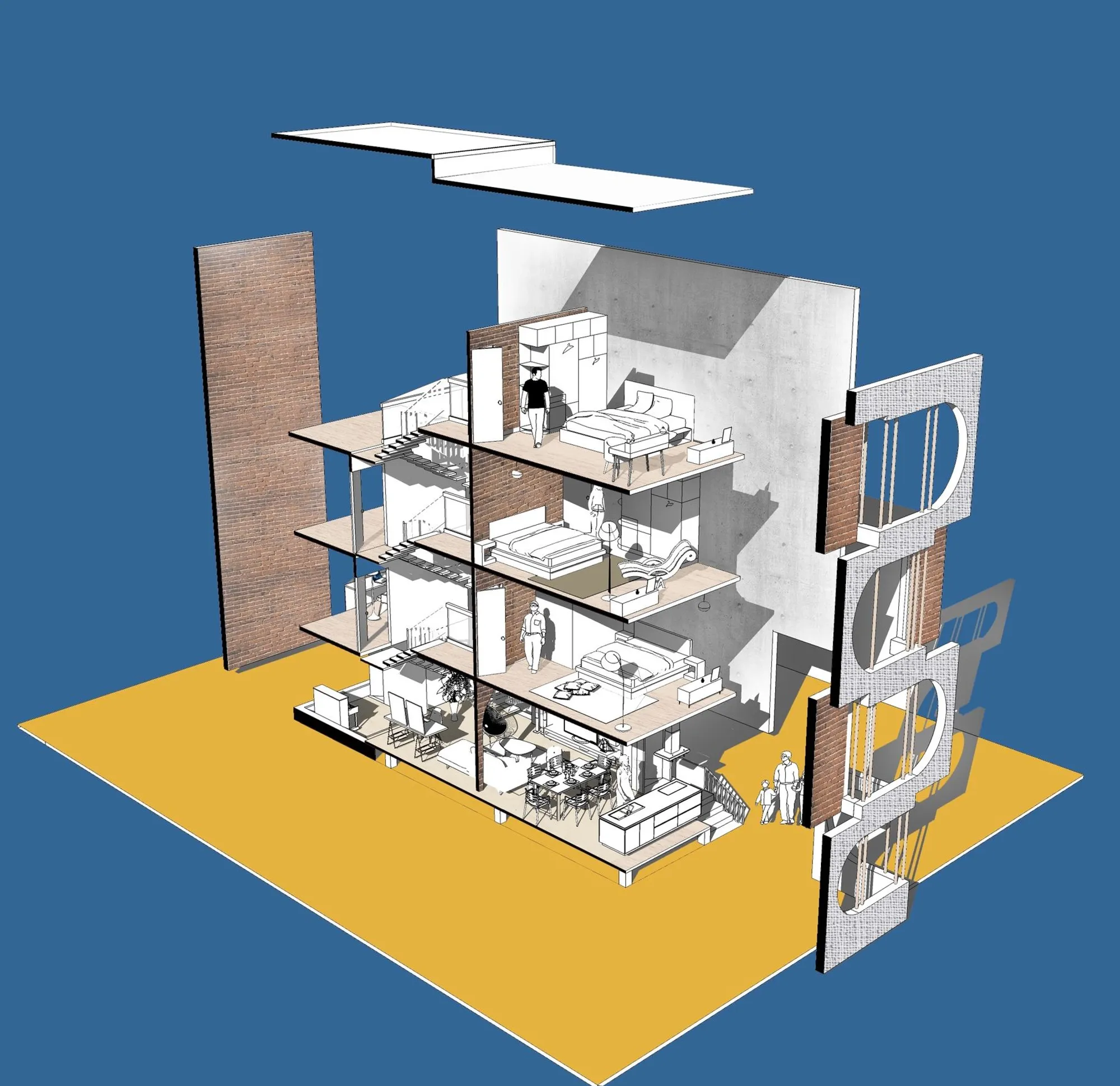
There is a Hole in the Market: A Courtyard Housing Prototype for Multigenerational Living
Rooted in Luoyang's historic core, this Siheyuan reinterpretation stacks six families around a central atrium of light and shared life.


What happens when you punch a void through the center of a dense urban dwelling and let it become the organizing principle for an entire family's life? In the historic core of Luoyang, China, a courtyard housing prototype for six families across three generations answers that question with a compact, light-filled structure that channels the spatial logic of the traditional Siheyuan into reinforced concrete and glass. The central atrium is not decorative; it is the building's circulatory system, pulling daylight and ventilation through every level while making family members visible to one another across floors.
Designed by 澳华 李, Mengyu Li, 志成 谭, and Can Yang, this shortlisted entry in the Nano Nest 2020 competition takes on the pressure points of rapid urbanization: rising land costs, shrinking household space, and the social fragmentation that comes with density. Rather than defaulting to stacked isolation, the team proposes a low-rise, high-density model where architecture becomes the connective tissue between generations.
A Street Facade That Stacks Openings Like Invitations
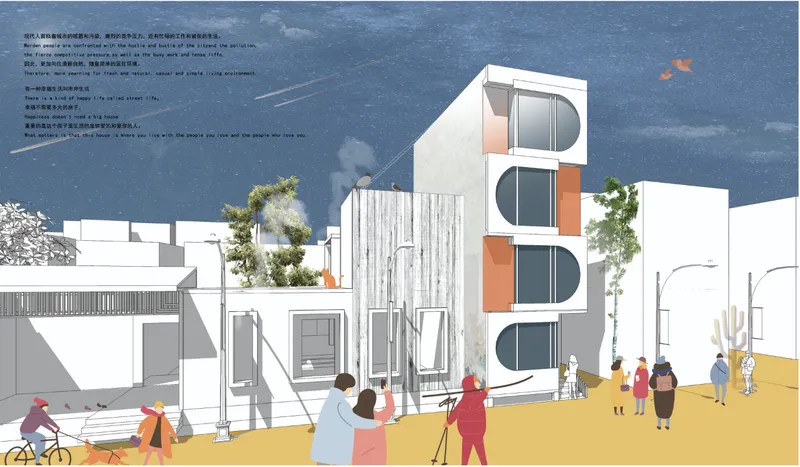
The street elevation reveals the project's formal boldness: stacked semicircular windows puncture a multi-story facade, creating a rhythmic pattern that reads as both playful and deliberate. Figures populate the sidewalk below, grounding the rendering in the scale of everyday pedestrian life. The facade avoids the blank concrete walls typical of dense residential infill; instead, each opening signals habitation, framing domestic life without exposing it entirely. This is architecture that acknowledges the street while protecting the interior world behind it.
Shared Interiors Where Generations Overlap
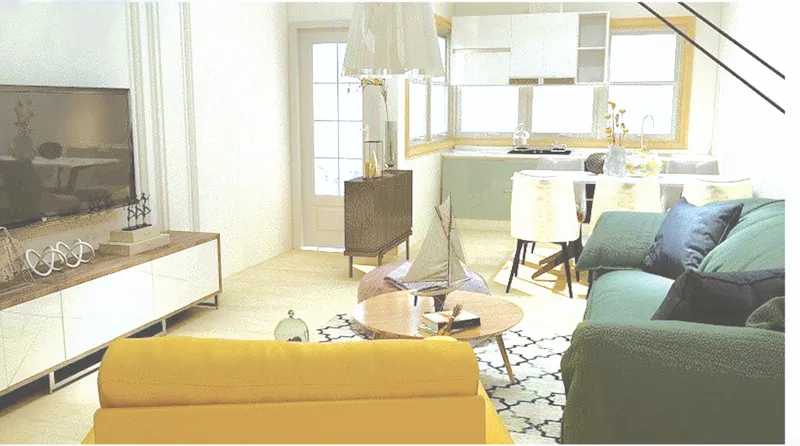

Inside, the open-plan living and dining area demonstrates how the team collapsed sprawling circulation corridors into a compact, centralized layout. A kitchen sits in direct visual connection with the living space, and a yellow ottoman anchors the room with casual warmth. Natural light floods in generously, a direct result of the central atrium and glazed rear facade working in concert. The atmosphere is not minimal for minimalism's sake; it supports fluid interaction between family members who might be cooking, eating, or simply sitting together.
The bedroom, by contrast, offers a quieter register. Floor-to-ceiling windows open onto the city, and a bamboo cradle beside the bed speaks directly to the multigenerational programme. Elderly family members receive accessible private rooms that honor the Confucian tradition of filial piety, while children benefit from safe, naturally lit zones. The design manages a careful negotiation: proximity without intrusion, togetherness without the erasure of individual identity. Adults get adaptable private and semi-private spaces; no one is forced into permanent exposure.
Passive Strategies Cut Through Every Floor
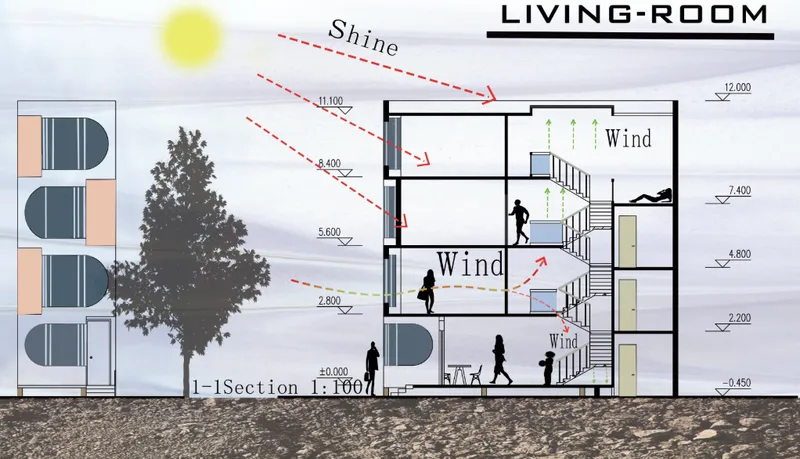
The section drawing lays bare the environmental logic driving the design. Sun angles are mapped across four levels, showing how the central atrium channels daylight deep into the plan. Cross-ventilation paths are traced through ground-level voids and upper openings, resolving indoor air quality and hygiene concerns without mechanical systems. A roof garden caps the section, adding thermal mass and greenery at the top of the stack. Strategic orientation ensures the building performs across seasons, maximizing passive gains in winter and shielding interiors from excessive heat in summer.
This is where the Siheyuan reference moves beyond nostalgia. The traditional courtyard house used its void to mediate climate, light, and social hierarchy. Here, that void is verticalized, compressed into an atrium that does the same work within a fraction of the footprint. The result is a building that reduces energy consumption not through technology alone but through spatial intelligence inherited from centuries of Chinese domestic architecture.
Why This Project Matters
In a housing market increasingly shaped by speculation and atomized living, this project makes a counter-argument through architecture itself. Six families, three generations, one building organized around a hole. That hole is not a deficit; it is the most valuable space in the structure, the place where daylight, air, and social life converge. The team's decision to prioritize intergenerational co-living over maximum unit count reflects a value system that treats family cohesion as a design parameter, not an afterthought.
What makes the proposal credible is its refusal to romanticize the past. The Siheyuan is referenced but fundamentally transformed: reinforced concrete replaces timber, glass replaces paper screens, and the horizontal courtyard becomes a vertical atrium suited to dense urban land. The designers have produced a prototype that is culturally grounded and environmentally responsible without being sentimental about either quality. For Luoyang's historic core, and for cities facing similar pressures worldwide, this is a blueprint worth studying.
View the Full Project
About the Designers
Designers: 澳华 李, Mengyu Li, 志成 谭, Can Yang
Enter a Design Competition on uni.xyz
uni.xyz runs architecture and design competitions year-round that reward proposals with spatial conviction and real site intelligence.
Project credits: There is a hole in the market by 澳华 李, Mengyu Li, 志成 谭, Can Yang Nano Nest 2020 (uni.xyz).




Popular Articles
Popular articles from the community


The Ocean Hive: Sustainable Architecture for a Self-Sufficient Civilization at Sea
The Ocean Hive imagines sustainable architecture at sea, where modular habitats, algae, wave power and ocean waste sustain a growing colony.

Riyadh For All: Intergenerational Urban Design for Active Aging in Rabat
Riyadh For All reimagines urban design in Rabat with intergenerational co-living, adaptive courtyards, and Moroccan cultural exchange today.

Conexión: Biophilic Design Reimagines High-Rise Living in Hong Kong
Conexión reimagines high-rise living in Hong Kong through biophilic design, green facades, shared spaces, daylight, water and nature within.

Hill & Cross Opera: Sculptural Opera House Architecture Shaped by Tallinn’s Landscape and Identity
Hill & Cross Opera reimagines opera house architecture in Tallinn through its sculptural hill, civic plaza, glass wave and a luminous cross.


Similar Reads
You might also enjoy these articles

Day and Night Park: A Time-Based Urban Newsstand in Beijing
A temporary urban newsstand in Beijing blending travel, light, and reading through poetic colors, compact form, and community-focused design.

Modernist Patio Renovation in El Masnou, Barcelona by Oliver Segura Arquitectura + Cebrià Arquitectura
Modernist patio renovation blending tradition and innovation with a movable pool, leveled floors, and Catalan materials in El Masnou.

Alto Residencial Coop: Cooperative Housing Development in Santiago de Compostela by Carbajo Barrios Arquitectos
A linear cooperative housing complex blending white volumes and perforated metal façades, enhancing community living, natural light, privacy, and urban integration.

Vil Genis School by BPA ARCHITECTURE – Massy, France
Vil Genis School in Massy, France, features sustainable design, south-facing classrooms, community integration, accessible spaces, and modern educational architecture.
Explore Residential Building Competitions
Discover active competitions in this discipline


Challenge to design mud housing for contemporary communities


Challenge to reimagine the Iron Throne


Photograph architecture without architects


Illustrate the lost glory of Angkor Wat - Render Challenge
Comments (0)
Please login or sign up to add comments
No comments yet. Be the first to comment!