
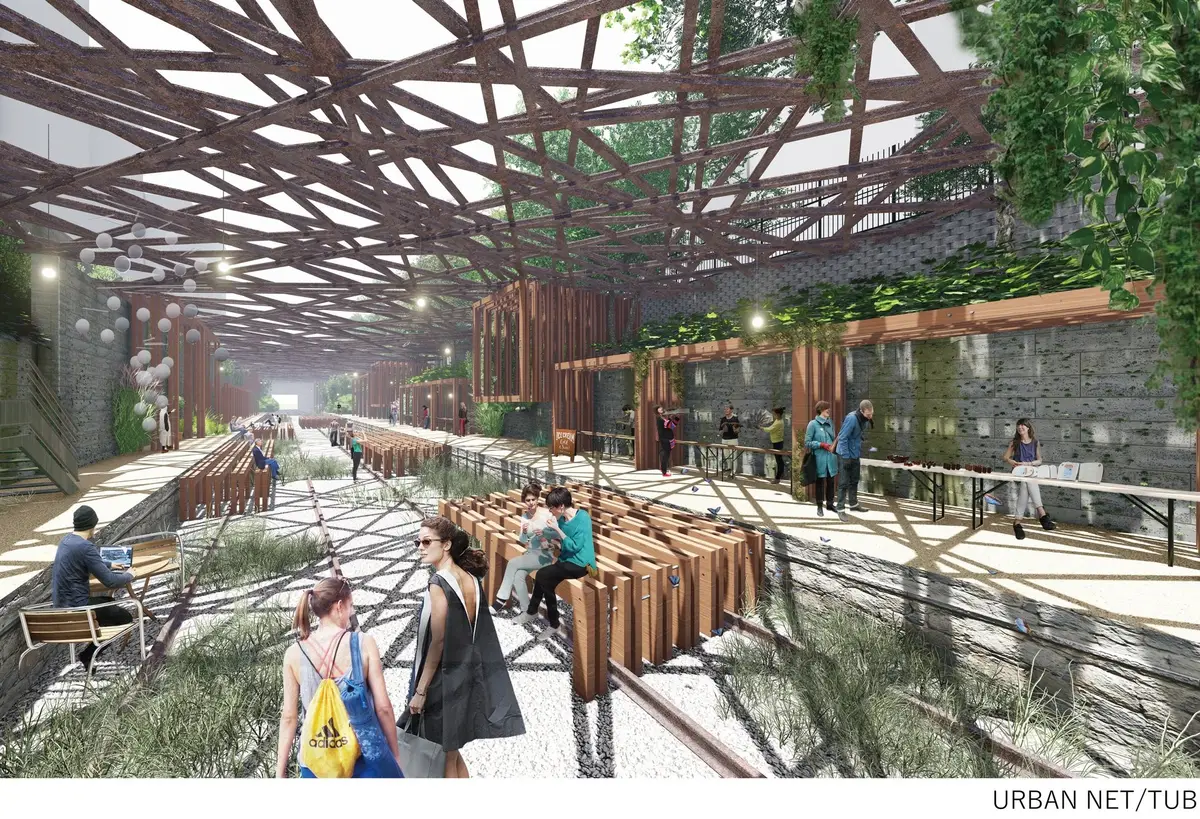
Urban Net / Tube by Takenaka Corporation
Adaptive architecture transforms abandoned rails into vibrant community spaces through modular nets and tubes that foster interaction and urban life.


Adaptive architecture has emerged as a critical strategy in contemporary urban regeneration, particularly in reclaiming neglected infrastructural corridors. Urban Net / Tube, a shortlisted entry in the Salut Paris competition by Takenaka Corporation and 三田村 聡, exemplifies this approach by transforming disused railway infrastructure into an active, multi-functional public realm.
This project reinterprets the linear rigidity of rail tracks into a dynamic spatial system that supports social interaction, flexibility, and ecological integration.
Concept: From Rail Lines to Spatial Networks
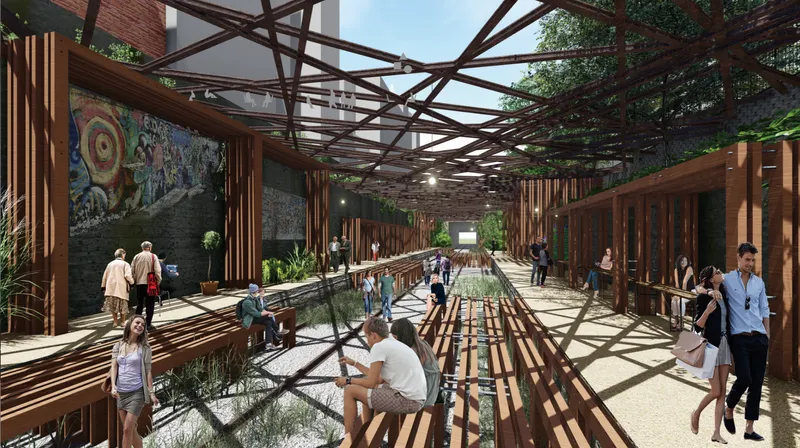
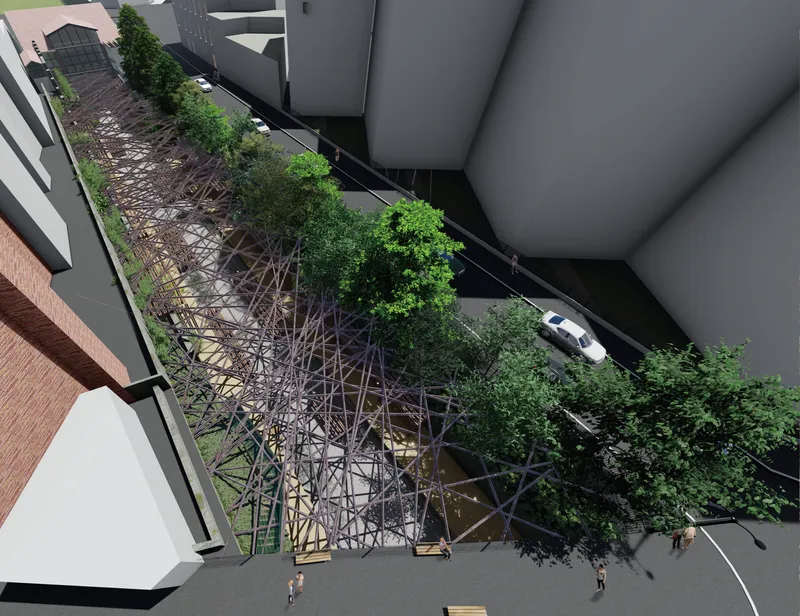
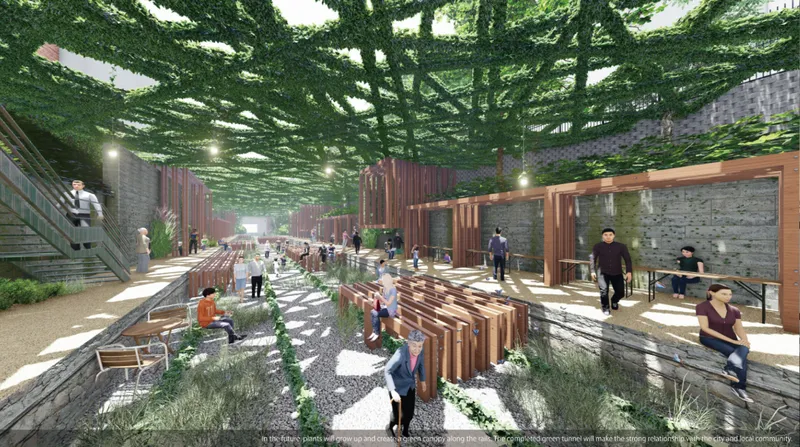
At the core of the proposal is the transformation of rail alignments into a three-dimensional “Net” structure. Steel rails are reconfigured at varying angles, creating a porous canopy that operates simultaneously as structure, shading device, and visual identity.
This elevated network introduces a layered spatial experience. While the infrastructure remains subtle from a distance, it reveals itself progressively as users engage with the space, establishing a nuanced relationship between visibility, discovery, and occupation.
Beneath this net, a sequence of modular “Tube” structures is introduced. These tubes are constructed from repetitive sleeper-based frames, generating adaptable enclosures that can host diverse activities.
Spatial Strategy: Modularity and User Agency
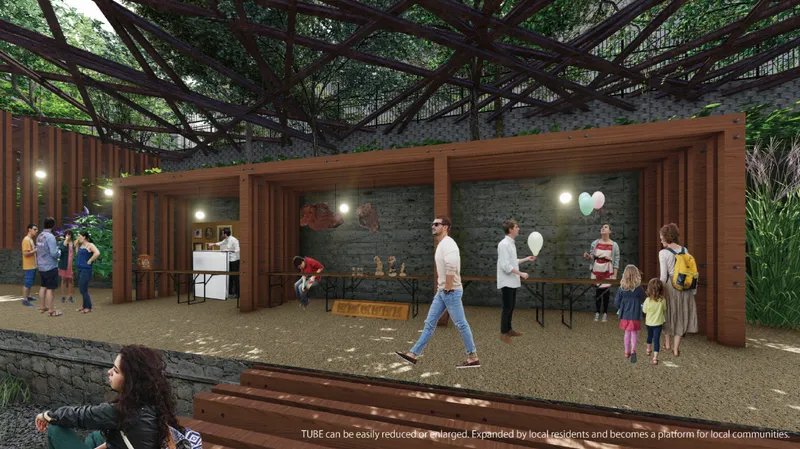
The project’s strength lies in its modular logic. The Tube system is not prescriptive; instead, it enables users to define their own spatial experiences.
- Small tubes function as intimate niches for resting, working, or informal gatherings
- Medium tubes support social interaction and community activities
- Larger tubes become collective platforms for events, exhibitions, or markets
This gradation of scale creates a flexible spatial ecosystem where architecture becomes a framework rather than a fixed program.
Users are not passive occupants but active participants, capable of appropriating spaces based on their needs. This aligns with broader trends in adaptive architecture, where responsiveness and user-driven programming are central.
Materiality and Atmosphere
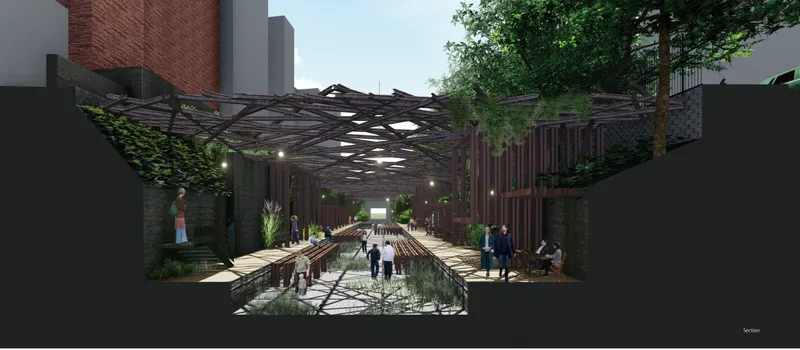
Material expression plays a significant role in shaping the project’s identity. The juxtaposition of:
- Industrial steel frameworks (net structure)
- Warm timber elements (tube frames and seating)
- Vegetation integrated into the canopy
creates a balanced dialogue between industrial heritage and ecological renewal.
The canopy evolves over time, with vegetation gradually enveloping the structure. This introduces seasonal variation, filtered light conditions, and microclimatic comfort, reinforcing the sensation of being under a natural canopy despite the artificial construct.
Lighting further enhances the spatial experience. During the day, the net filters sunlight, casting intricate shadow patterns. At night, integrated lighting transforms the space into a vibrant community corridor.
Urban Integration: Reconnecting the City
One of the project’s key achievements is its ability to reconnect fragmented urban fabric.
The intervention operates as:
- A pedestrian corridor
- A social condenser n- A cultural platform
Despite being embedded within dense urban surroundings, the design mitigates noise and visual clutter by partially concealing activities beneath the net. This creates a sense of retreat while maintaining connectivity to the city.
The project also activates previously underutilized land, converting it into a productive and inclusive public space that supports local economies through markets, events, and community-led initiatives.
Experience: A Layered Public Realm
The spatial experience is intentionally layered:
- Approach: The structure appears subtle and almost invisible
- Entry: The net becomes legible, revealing its complexity
- Occupation: Users engage with tubes, seating, and open areas
- Immersion: Vegetation and light create a sensory environment
This progression enhances user engagement and encourages repeated visits, making the space both functional and experiential.
Urban Net / Tube demonstrates how adaptive architecture can redefine obsolete infrastructure into meaningful public environments. By combining modular systems, user-driven programming, and ecological integration, the project proposes a scalable model for urban regeneration.
It is not merely an architectural intervention but a framework for community formation, where space evolves through use, time, and participation.
As cities continue to confront issues of underutilized infrastructure, this project offers a compelling vision of how design can transform constraints into opportunities for collective urban life.


Popular Articles
Popular articles from the community


The Ocean Hive: Sustainable Architecture for a Self-Sufficient Civilization at Sea
The Ocean Hive imagines sustainable architecture at sea, where modular habitats, algae, wave power and ocean waste sustain a growing colony.

Hill & Cross Opera: Sculptural Opera House Architecture Shaped by Tallinn’s Landscape and Identity
Hill & Cross Opera reimagines opera house architecture in Tallinn through its sculptural hill, civic plaza, glass wave and a luminous cross.

Conexión: Biophilic Design Reimagines High-Rise Living in Hong Kong
Conexión reimagines high-rise living in Hong Kong through biophilic design, green facades, shared spaces, daylight, water and nature within.

Lunar Spiral: Space Architecture Shaped by the Mathematics of the Universe
Lunar Spiral reimagines space architecture through Fibonacci geometry, lunar regolith, levitating habitats, and self-sustaining Moon living.

Similar Reads
You might also enjoy these articles

Eco Chapel: A Green Architecture Pavilion Designed in Symbiosis with the Forest
Eco Chapel uses green architecture to weave prayer, learning and reuse into a forest pavilion shaped by modular hexagonal canopies for life.
Kaffeebühnen: Coffee Shop Architecture Designed as a Civic Stage Between Vienna’s City and Park
Kaffeebühnen turns coffee shop architecture into a civic stage, linking Vienna’s park edge, urban life, warm timber yards, and coffee craft.
Healing Façade: Sustainable Architecture for Reforestation, Community, and Sacred Ecology in Ethiopia
Healing Façade reimagines sustainable architecture as a living wall that restores soil, catches water and renews Ethiopia's forest churches.


Urban Forest: A Vertical Ecosystem for 5,000 Workers in Singapore's Changi Business Park
Radially stacked pods and layered green decks turn a 7-acre plot into 47 acres of ecological workspace projected for 2040.

Explore Architecture Competitions
Discover active competitions in this discipline

Challenge to reimagine the Iron Throne

Photograph architecture without architects

Illustrate the lost glory of Angkor Wat - Render Challenge

Design challenge to reuse E-waste
Comments (0)
Please login or sign up to add comments
No comments yet. Be the first to comment!