

Urban Oasis: Baobab-Inspired Towers and Adinkra Unity Shape a Shaded Residential Commons in Accra
A clustered housing proposal where flared diagrid towers borrow the baobab's canopy and the Akoma Ntoaso's circle to give Accra shaded common ground.


Most housing schemes treat shade as an afterthought, something added with louvres once the massing is fixed. Urban Oasis starts from the opposite end. It asks what a residential cluster would look like if it were organised the way people already gather in West Africa: under the broad crown of a baobab, out of the sun, in each other's company. The answer is a set of cylindrical volumes that swell at the top into canopies, arranged in a ring and threaded by a public route. The project is as much a social diagram as a building.
Designed by Keerthigan Thavaseelan, Tyler Bakhtiari and Ben Millsom, the proposal received an Editor's Choice recognition in Earth Made 2020. It is set in Accra, and it tries to hold two conditions at once: a sense of seclusion for residents, and an open, engaging landscape for anyone passing through. It draws on Ghanaian cultural heritage, tropical climate analysis and a biomimetic reading of Africa's 'Tree of Life' to argue that density does not have to mean losing touch with ground, culture or climate.
A Hollow Trunk Becomes a Habitable Tower
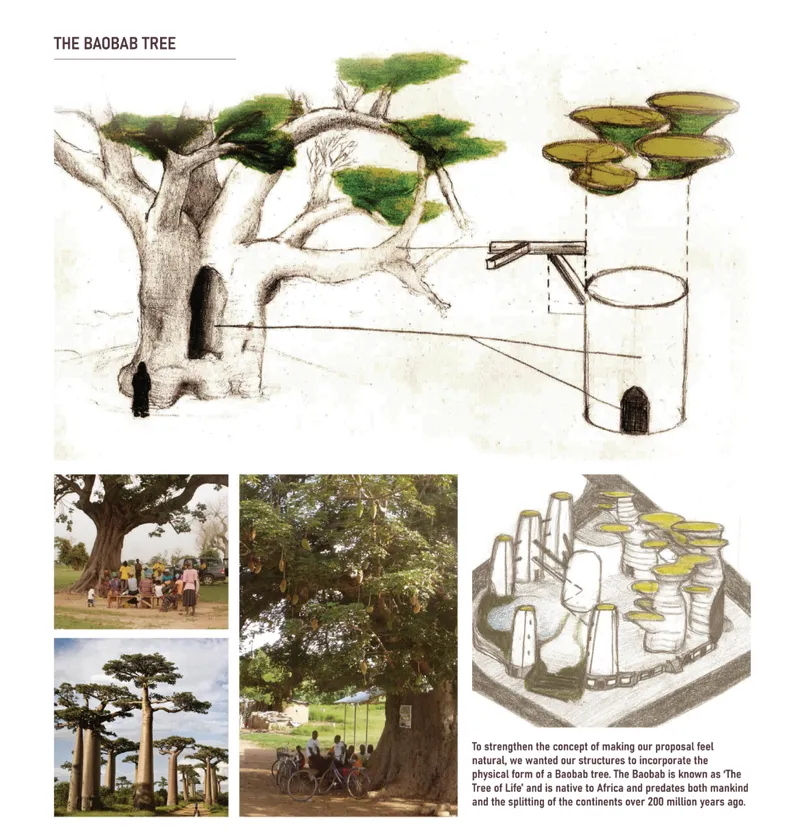
The concept board makes the core move plain. A hollow baobab trunk sits beside a cylindrical tower topped by dish-like canopies, and next to both are photographs of villagers resting in the tree's shadow. The designers take the baobab's form as both structural logic and spatial hierarchy: a solid, grounded base, and a crown that expands outward to shelter the people below. In the architecture this becomes a series of clustered cylinders that widen as they rise, producing shaded communal areas at height.
Pairing the trunk diagram with images of people under the canopy is the strongest part of the board. It shows that the team is not borrowing the baobab as a silhouette alone. They are borrowing the behaviour the tree produces, the gathering it invites, and treating the elevated canopies as social hubs rather than rooftop leftovers. Biomimicry here works on two levels: it governs how the building sheds sun, and it sets up the conditions for community.
Diagrid Crowns Around a Central Shaft
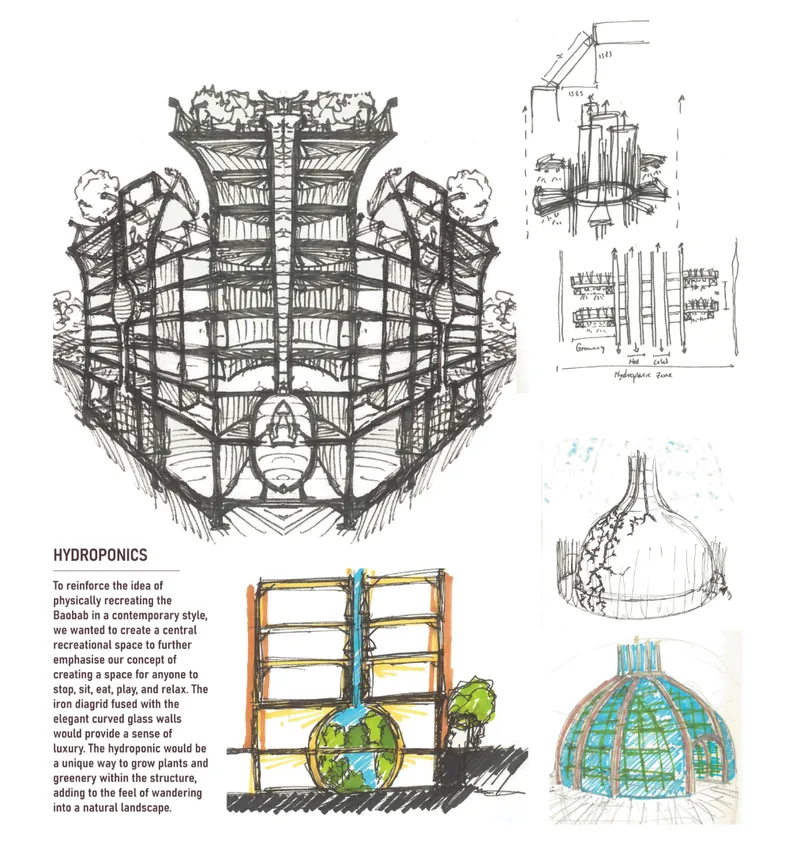
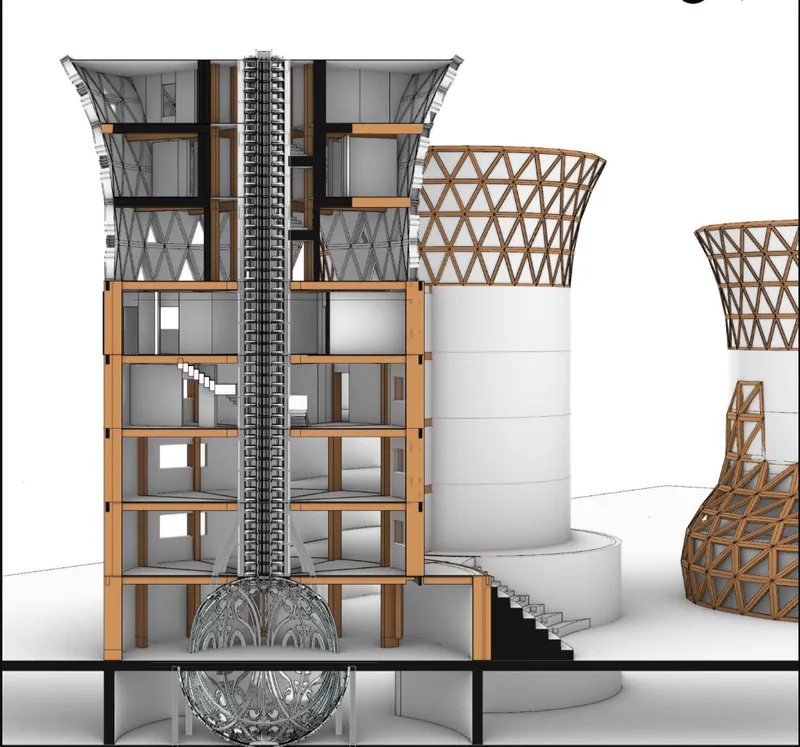
The sketch sheet and rendered section show how the idea gets built. Each tower is symmetrical, organised around a central shaft that carries a lift, with timber floors stacked around it and a diagrid lattice flaring out at the top. In the rendering, a lattice sphere sits below the tower, and the small dome studies in marker and pen on the sketch sheet point to the hydroponic systems the team folds into the environmental strategy.
The diagrid is a sensible choice for a form that gets wider as it climbs. A triangulated skin can follow the outward curve of the crown while staying light, and putting circulation in a single central core leaves the perimeter free for living space and openings. What reads as an organic canopy in the concept board turns out, in section, to be a disciplined and repeatable structure, and that matters if a scheme like this is ever going to scale beyond one tower.
Glulam Frames and Ring-Beam Floors
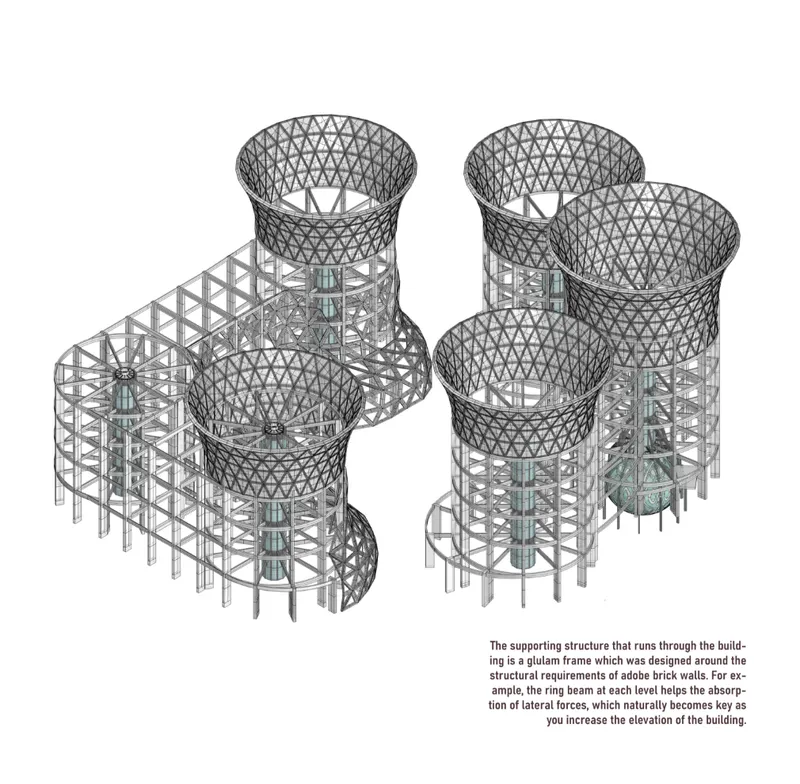
The axonometric shows the whole assembly. Glulam frames carry four flared diagrid towers that rise from ring-beam floors, and a linked rectangular block ties the cluster together. The ring beams pick up the circular geometry of each tower at every level, and the four-tower grouping makes the circular clustering legible in three dimensions.
That clustering comes from the Adinkra symbol 'Akoma Ntoaso,' which signifies unity and the joining of hearts. The designers use it as an organising principle rather than an ornament: units are grouped so that diverse residents share one environment, and that grouping shapes how circulation flows and how spaces relate to each other. In a city context where new developments tend to look the same everywhere, embedding a local symbol into the plan, rather than printing it on a façade, is a meaningful position to take.
A Public Spine Under Hanging Green
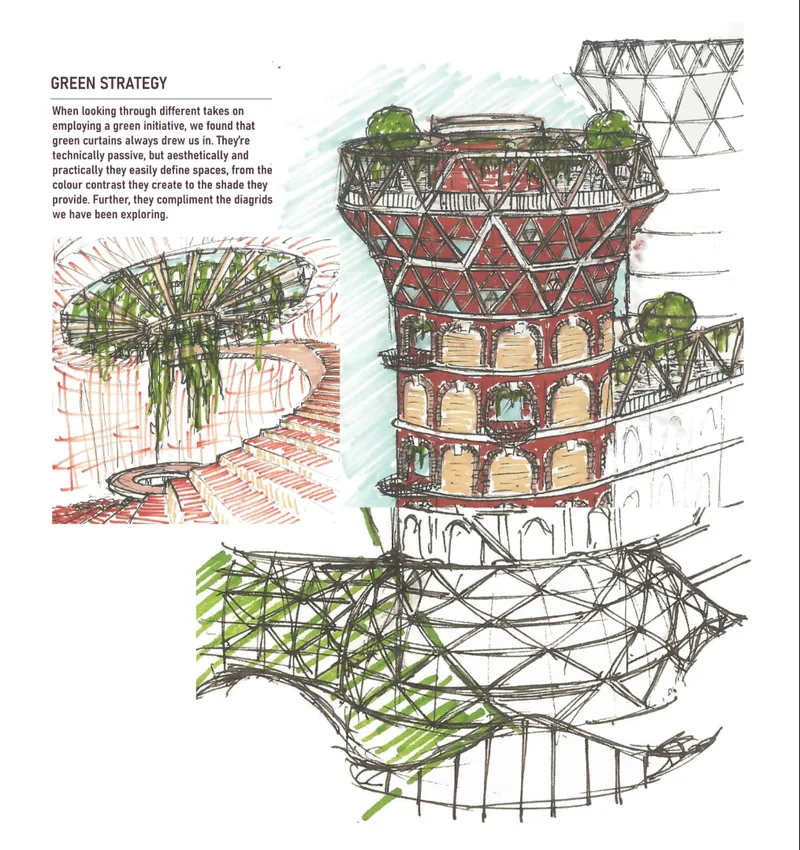
These marker sketches bring the scheme down to a human scale. A red arched tower with a diagrid crown carries trees on its roof, and alongside it a hanging green curtain falls over curved stairs. This is the experiential side of the project's circulation strategy: a central route that cuts across the site, working as a shortcut and as a social spine at the same time.
The route is open to everyone, and the designers place places to sit, play and relax along it. That is how the project resolves its own tension between seclusion and engagement. Residents get a protected cluster, while the city gets a shaded path through it that encourages people to slow down. The green curtain over the stair is a small gesture, but it captures the ambition well: movement through the site should feel like passing under foliage, not along a corridor.
Shading by Form, Domes for Growing
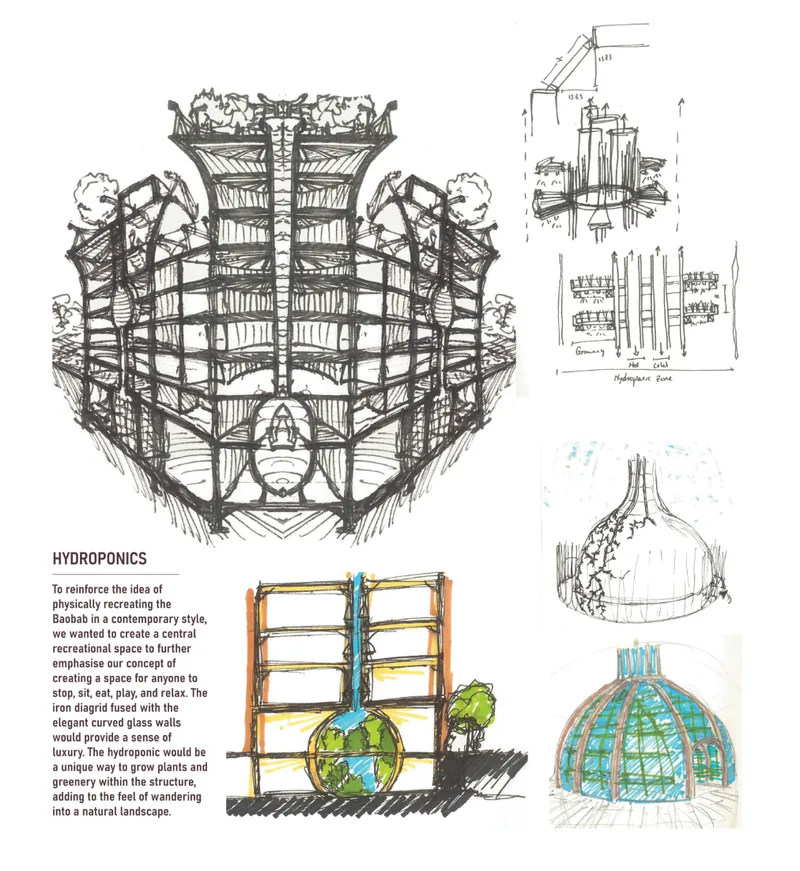
The final sketch sheet goes back to the tower section and adds glazed dome studies and a section with a green sphere, developing the hydroponic component further. These growing volumes sit inside a climate strategy grounded in analysis. Sun path studies and radiation analysis informed the orientation and massing, and the building form itself becomes the main shading device: the flared crowns shade the walls and spaces beneath them, while openings are placed to limit heat gain.
The clustered arrangement also does environmental work. Grouping the towers creates microclimates within the site, cutting exposure to harsh sun while promoting natural ventilation between volumes. In a tropical city like Accra, this passive approach, where geometry carries most of the load, is the right instinct. The baobab canopy that started as a cultural image ends up as a thermal one.
Why This Project Matters
Urban Oasis is persuasive because its three sources, the baobab, the Akoma Ntoaso and the climate data, all point toward the same form. The expanding crown provides shade, gives people a place to gather and expresses a local ecological symbol. The circular cluster represents unity, builds community and generates a cooler microclimate. When cultural meaning and environmental performance reinforce each other instead of competing, the design reads as coherent rather than collaged.
There is still work to be done. The relationship between the hydroponic domes and daily resident life, and how the public route manages privacy at its edges, both deserve sharper resolution. But as a competition proposal, it makes a clear and useful argument: housing in African cities can draw its structure from local ecology and symbolism, use timber and diagrid efficiently, and give the street a shaded commons in return. Few dense housing schemes offer that much back to the people who simply walk past.
View the Full Project
About the Designers
Designers: Keerthigan Thavaseelan, Tyler Bakhtiari, Ben Millsom
Enter a Design Competition on uni.xyz
uni.xyz runs architecture and design competitions year-round that reward proposals with spatial conviction and real site intelligence.
Project credits: Urban Oasis by Keerthigan Thavaseelan, Tyler Bakhtiari, Ben Millsom Earth Made 2020 (uni.xyz).


Popular Articles
Popular articles from the community


Cube Design Draws an Ecological Corridor Between Two Shenzhen Hills with the Nankai Building
Beside Shenzhen's container docks, the Nankai Building pairs stacked balconies with a climbing green screen to connect two hillsides across its height.

longwave studio Reorganizes a 112 m² Tainan Apartment Around the Daily Routines of a Family and Two Cats
In Tainan, Taiwan, birch plywood, rust-red furniture and a freestanding plaster wall link arrival, storage, work and family life in one apartment.

U.GA Architects Wraps an Oval Rooftop Pool in Curved Board-Formed Concrete on Busan's Jeollidan-gil
In Busan's Jeonpo-dong, a 454 m² mixed-use block stacks a neighborhood facility, guest rooms and an oval rooftop pool inside spiraling concrete walls.

Juan García Correa, John González and Claudia Rueda Sink a Circular Amphitheater into a Manizales Engineering Building
On the La Nubia campus in Manizales, Colombia, the S1 Building folds labs and offices into a hillside of ramped lawns that double as a campus route.

Similar Reads
You might also enjoy these articles
Healing Façade: A Modular Chapel System That Restores Ethiopia's Sacred Forests
Winner of the Eco-Chapel competition, this circular timber façade collects water from air to rebuild soil and reforest degraded Ethiopian landscapes.
Kaffeebühnen: Where Coffee Shop Architecture Becomes a Civic Stage in Vienna
A linear sequence of timber boxes, transparent shells, and open yards turns the Viennese café tradition into a public performance space.
Eco Chapel: A Modular Forest Pavilion That Grows Like the Landscape It Protects
Hexagonal timber modules weave through existing trees, turning a chapel into a living system for prayer, education, and reforestation.


Urban Forest: A Vertical Ecosystem for 5,000 Workers in Singapore's Changi Business Park
Radially stacked pods and layered green decks turn a 7-acre plot into 47 acres of ecological workspace projected for 2040.

Explore Architecture Competitions
Discover active competitions in this discipline

Design challenge to equip cities with modern furniture

Challenge to reimagine the Iron Throne

Photograph architecture without architects

Illustrate the lost glory of Angkor Wat - Render Challenge
Comments (0)
Please login or sign up to add comments
No comments yet. Be the first to comment!