
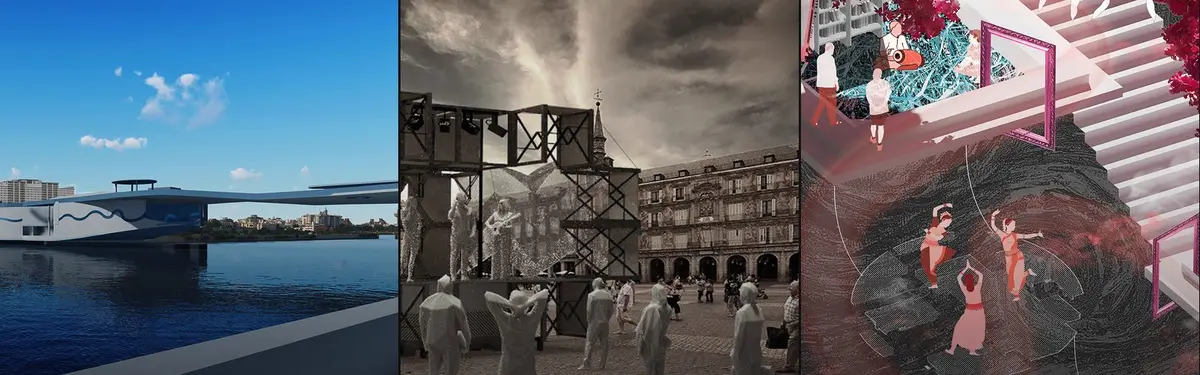


Public Art
Art installations, galleries, and cultural spaces designed for public engagement and community interaction.
Public art is art that is commissioned for, and sited in, spaces everyone can use: squares, parks, streets, stations, bridges and the walls and forecourts of public buildings. What sets it apart from art in a gallery is the public process behind it, from funding and selection to maintenance, and the expectation that it will answer to a particular place and the people who share it. Sculpture, murals, light works, temporary installations and participatory projects all belong to the field.
What is public art?
The simplest test is access. A public artwork can be seen and approached by anyone without a ticket, and it is usually paid for, selected and looked after through a public or civic process. The standard definition of public art stresses exactly this: works made for the general public through a public process, placed in the public realm and often tied to community involvement. That process is what separates a commissioned mural from an unsanctioned tag, even when the two sit on the same wall.
This makes public art a practice that lives between disciplines. An artist may lead, but the work is shaped by engineers, fabricators, planners, landscape designers and, very often, architects who decide where it sits and how people meet it. A sculpture on a plaza changes how the plaza is used; a mural changes how a street feels at night. For architects the question is rarely "what does the art look like" and more often "what does this place need, and who decides".
The field overlaps with several neighbours on uni.xyz. Street art covers the informal, often uncommissioned work that grows on city surfaces. Installations covers spatial artworks in any setting, indoors or out. Landscape art deals with works shaped from land and planting. Public art is the civic, commissioned strand that runs across all three, and it is inseparable from the design of public space itself.
"art's publicness rests in the quality and impact of its exchange with audiences."
Cher Krause Knight, Public Art: Theory, Practice and Populism (2008), as quoted in Wikipedia's entry on public art
A short history of public art
Cities have always placed art in shared space: triumphal columns, equestrian statues, fountains and war memorials told citizens who ruled them and what they were meant to remember. The modern idea of public art as a funded civic service is younger, and it took shape in the twentieth century through policy as much as through artists.
The key policy tool is the percent for art scheme, which reserves a share of a construction budget, usually around one percent, for commissioning art in or around the new building. According to the history of percent for art programmes, France has required one percent of the cost of public construction to go to art since 1951, Finland extended the principle to all public buildings in 1956, and Philadelphia adopted the first municipal ordinance in the United States in 1959. The Encyclopedia of Greater Philadelphia traces the city's programmes to the lawyer Michael von Moschzisker, who saw post-war urban renewal as aesthetically drab, and records works such as Claes Oldenburg's "Clothespin" opposite City Hall that came through the scheme.
"true functionalism in man-made edifices must include artistic expression."
Michael von Moschzisker, as quoted in the Encyclopedia of Greater Philadelphia
At federal level in the United States, the General Services Administration runs an Art in Architecture Program that commissions large, permanent artworks for federal buildings and also cares for the art made during the New Deal era. The collaboration between architect and artist became visible in 1967 with the Chicago Picasso, commissioned by the architects of the Civic Center (now the Richard J. Daley Center) and built in the same COR-TEN steel as the building it faces. In England, Gateshead Council commissioned Antony Gormley's Angel of the North, completed in 1998 on a former colliery site beside the A1. It met opposition during design and construction and is now a symbol of the region.

In recent decades the field has widened again. Temporary commissions, festival pavilions, light works and participatory projects now sit alongside permanent bronze and steel, and many cities treat public art as part of regeneration and placemaking rather than as decoration added at the end.
Key principles of public art
Every commission is different, but the strongest public art tends to share a handful of design principles. Member projects on uni.xyz show each of them clearly.
Site specificity
Good public art is made for one place. It reads the history, materials, light and daily routines of its site, and it would lose meaning if moved. FABRIC OF LIFE by Paul HUGUET, an Editor's Choice in the Canva competition, describes its terrace as "the artistic place of exchange" and draws its colours from the hues of the surrounding urban landscape, with a pattern meant to evolve like the city.

Access and everyday use
Public art works best when people meet it on their normal routes, not only on a special visit. Benches, steps, shade and paths around the work matter as much as the object. This is why so many entries on uni.xyz fold art into the furniture of the street rather than setting it on a pedestal.
Temporary and mobile formats
Not every commission needs to last a century. Temporary works let a city test ideas, reach new neighbourhoods and keep public space changing. OPERA TRUCK, Endless Possibilities by Yizhuo Chen, a winning entry in the Opera Truck competition, proposes a pop-up space that uses internet interaction to bring artists and the public closer.

Participation
Participatory public art invites people to shape or complete the work. Un Nouveau Soleil by Ahmad Kadry, Israa El-Maghraby, Muhammad Bargal and Hazem Youssef, an entry to the Salut Paris competition, uses placemaking to encourage Parisians to reclaim abandoned railway land and decide for themselves how to occupy it.
Collaboration between artist and architect
The best results come when the artwork is part of the project brief rather than a leftover corner, as with the Chicago Picasso, commissioned by the building's own architects. Under the Wings by Jannatun Nayeem Nowshin, Naorin Tabassum Chowdhury, asif elahirocky and Farzana Haque, made for the Sculpt[r] 2020 competition, treats the sculpture and the square as one design, inviting people back to the Place de la Concorde with an interactive LED floor.

Public art on uni.xyz
Members on uni.xyz approach public art mostly through competitions that ask how art can leave the gallery and enter the city. The projects below are among the most discussed on the platform.
KalaSetu by Ravi Thacker and Palash Trivedi received the People's Choice Award in the Bharat Bhavan 2020 competition. It places art on a foot-over bridge and its riverside promenade, so that people crossing the city meet artists and work along the way. The team's own statement puts the ambition plainly.
"A place where art persists for itself, dissolved in the dynamic public space of a foot-over bridge."
Ravi Thacker and Palash Trivedi, KalaSetu project statement

P.O.P Popular of Park by 蕭鈞豪 MArch-II-109 and 吳芷瑄 MArch-I-107 won the People's Choice Award at Art-ade. Our journal describes how thin, curving walls loop through a park and tighten into round rooms for galleries, a café and an artist's workspace, so visitors enter an exhibition without noticing a door.
Open Art Gallery by Hristo Stankushev, an Editor's Choice at Art-ade, frames art as part of everyday life and invites people to observe, understand and take part in its making. Its boards pair an outdoor gallery with ateliers and a public square.

Perspective: Ways of Seeing by Imagenary S, a winning entry in the Sculpt|r| competition, is an architectural sculpture whose 16 by 21 metre vertical plane and diagonal column cast shadows like a sundial, while the pedestal is reworked as landscape people can occupy.
The Parthenon at NGV's Garden, shared on uni.xyz by UNI, documents an installation by Newman and Tsang of NWMN: a third-scale version of the original building that acts as a community meeting place and venue for performances and music through the summer.

Two journals look at temporary work. Network Installation by Ricardo Salazar, shortlisted in Elevate 2019, stretches coloured fishing nets between trees and over plazas as moving canopies. Wonder Live Corridor by Sata Na Architect, built for the 2025 WOW Festival at Benjakitti Park in Bangkok, uses bubble wrap to make a breathing corridor about air pollution, with every panel set aside for reuse afterwards. Finally, M.A.U Museum of Urban Art by Caterina Di Giorgio sinks a museum into a slope in Rome's Serpentara district and hands its walls to street art, linking two parks along a former viaduct route.
Challenges and future directions
Public art carries all the tensions of public space. Commissions can be slow and political, and the history of percent schemes is full of disputes over cost and taste: the Philadelphia programmes faced developers who resisted the expense and a mayor who concluded that public art was a luxury the city could not afford. A work that pleases a committee may still feel imposed on the people who live with it, which is why consultation and participation are now central to most briefs.
Maintenance is the quiet problem. Outdoor works must survive weather, wear and vandalism, and someone must pay for upkeep decades after the opening. Temporary art avoids some of this but raises its own questions about waste, which is why projects like Wonder Live Corridor plan the afterlife of every material from the start.

Looking ahead, digital tools are changing both process and form. Apps can book artist modules, as in OPERA TRUCK, Endless Possibilities; projection and light let cities change a façade overnight; and climate concerns push artists toward reused materials, planting and water. The open question is governance: who chooses what goes into shared space, and how communities that are rarely consulted get a voice.
Public art for students and designers
Public art makes a strong thesis subject because it forces a designer to deal with site, budget, maintenance and politics at once. Promising angles include a percent for art strategy for a new transit line, a temporary pavilion programme for a neglected square, a participatory mural process for a housing estate, or a study of how a single sculpture changed the use of a plaza over decades. Start from the place and its users, not the object.
Live briefs are a good way to test ideas. Browse current design competitions on uni.xyz, many of which deal with pavilions, sculpture and public space, and read across related topics such as sculpture and placemaking to see how other members frame the same questions.
Frequently asked questions
What counts as public art?
Public art is artwork placed in spaces open to everyone, usually commissioned, funded and maintained through a public process. It includes permanent sculpture and murals as well as temporary installations, light works and participatory projects.
What is a percent for art scheme?
It is a policy that sets aside a share of a building or infrastructure budget, usually about one percent, for commissioning art in or around the project. France, Finland, Philadelphia and the US federal government all run versions of it.
How is public art different from street art?
Street art is usually made without commission or permission on surfaces in the city. Public art is sanctioned and commissioned, normally through a selection process, although some street artists now receive official commissions and the line has blurred.
How do architects work with artists on public art?
Architects often set the site, scale and sightlines, and the best results come when the artist joins early. The Chicago Picasso, commissioned by the architects of the Daley Center in the same steel as their building, is a well-known example.
References and further reading
- Public art, Wikipedia
- Percent for art, Wikipedia
- Percent for Art Programs, The Encyclopedia of Greater Philadelphia
- Fine arts and the Art in Architecture Program, U.S. General Services Administration
- Chicago Picasso, Wikipedia
- Angel of the North, Wikipedia


Open competitions in Public Art
See all Public Art competitions

Popular projects
View all 56 projects


Latest journals
View all 41 journals

P.O.P Popular of Park: Translucent Ribbon Walls That Turn a City Park into a Pop Art Gallery
Curving pale walls loop round gallery rooms, a café and a playground, so a public park becomes an exhibition you enter without noticing the door.

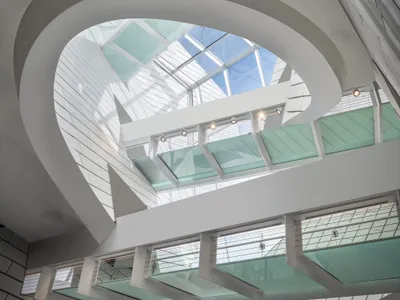
Morphosis Lifts a Landscaped Plaza Over 25,000 Square Feet of Gallery Space in Costa Mesa
The new Orange County Museum of Art rethinks the inward-facing institution with a 10,000-square-foot rooftop terrace and terracotta skin.
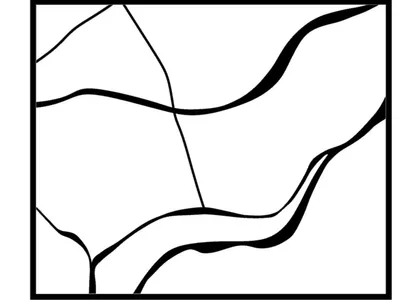
Opera Truck: A Modular Steel Chassis That Turns Madrid's Street Map into Stage, Seat and Playground
A shortlisted Opera Truck entry where interchangeable bentwood, net and light fillings slot into steel cubes, letting Madrid plazas host art every day.
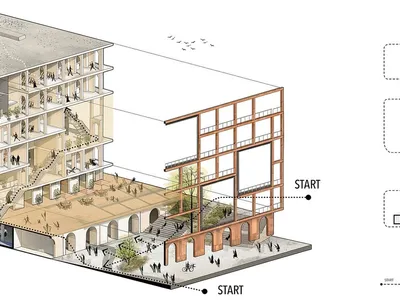
Floors of Culture: Stacking Public Terraces to Rebuild the City's Social Ground
Ela Szymańska's hybrid of building and public space lifts the urban ground into open terraces for working, learning, making and gathering together.


