School of Thought: A Shortlisted School Where Air, Ground and Underground Routes Teach Through Getting Lost
Nakisa Haeri treats circulation as curriculum, using three routes, terrazzo stairs and deliberate dead-ends to make finding your way a lesson in itself.


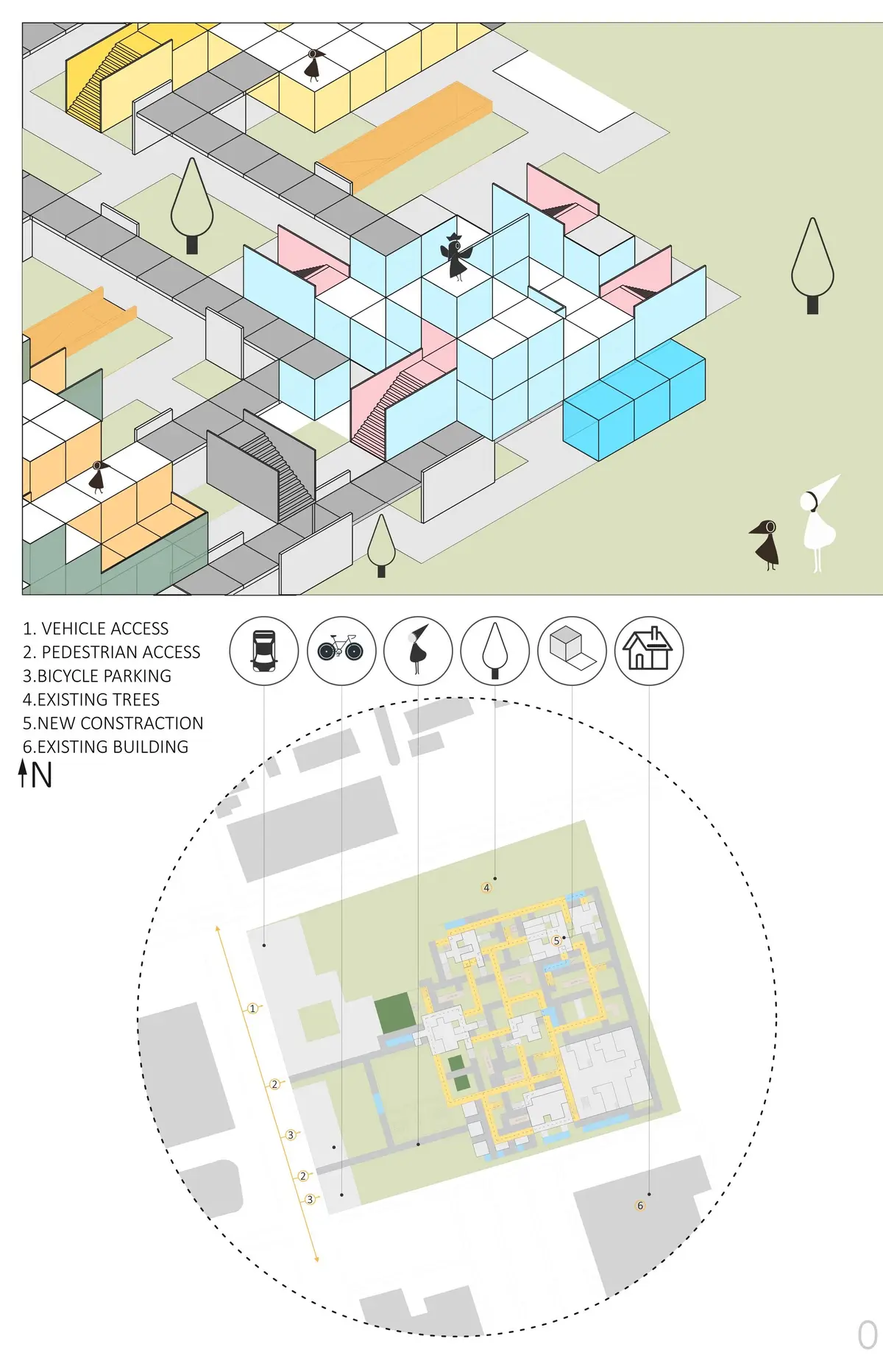
Most schools are designed so that nobody gets lost. Corridors run straight, classrooms repeat, and the building's main job is to deliver bodies to desks on time. School of Thought starts from the opposite premise: getting lost, hitting a dead-end, and working out how to climb past an obstacle are themselves forms of learning. The project argues that architecture should not quietly contain education. It should make demands on the people moving through it.
Designed by Nakisa Haeri, the scheme was a Shortlisted Entry in School Of Thought 2020. Haeri builds on the Reggio Emilia approach, which treats the environment as the "third teacher" alongside educators and peers. Instead of a grid of classrooms, the proposal is a landscape of connected experiences. Movement across it is non-linear, and students find their way by instinct, curiosity or mapping, not by following signs.
Terrazzo Stairs That Turn the Ground Route Into a Playground
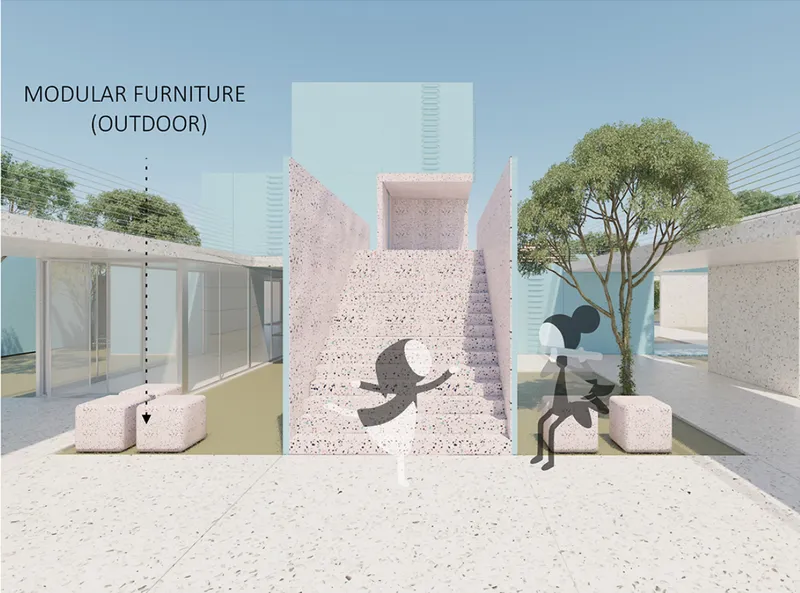
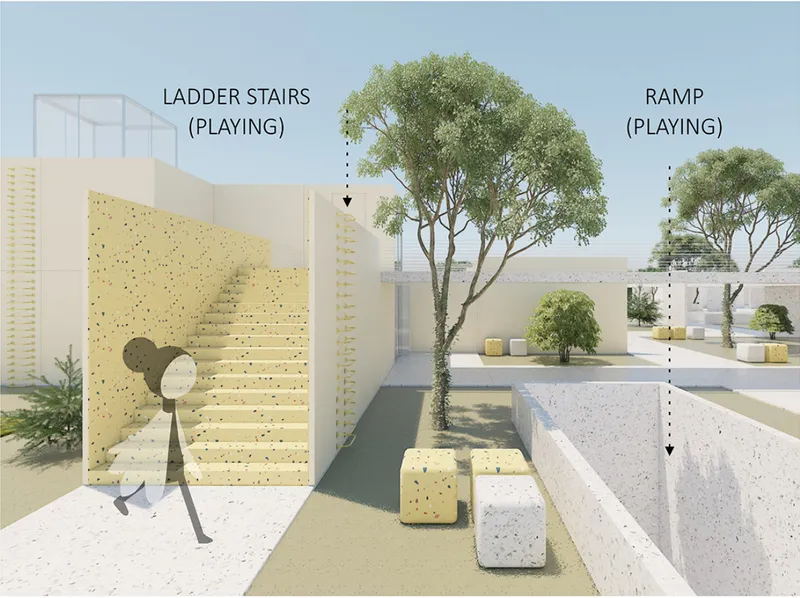
The first two views show the ground plane, which the project frames as the most stable of its three circulation systems. A pink terrazzo staircase rises between two angled walls. Nearby, yellow terrazzo ladder stairs sit beside a sunken white ramp. Cube seats are scattered beneath slender trees, so the space reads less like a path between rooms and more like an outdoor room you can occupy. Each stair is a different colour and a different kind of climb, and that variation tells you where you are without relying on wayfinding graphics.
This route matters because the rest of the scheme is designed to unsettle. Haeri treats the ground route as an anchor, a place where orientation is possible and students can catch their breath. It still connects to the harder sequences above and below. The sunken ramp beside the yellow stair suggests a way down, so even the calm route hints at the unpredictability under it.
An Air Route That Puts Learning Between Buildings
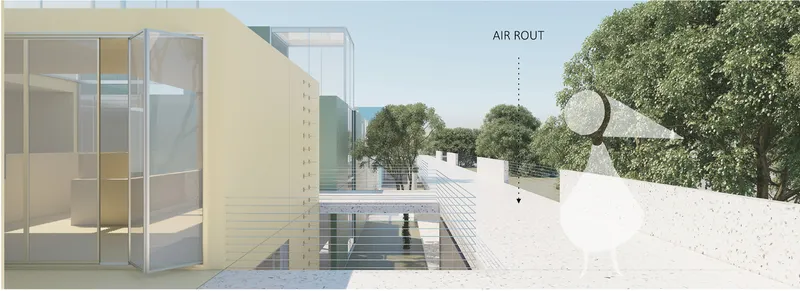
The air route is made of elevated pathways, balconies and transitional spaces strung between buildings. The rooftop walkway in this image, edged by a cable railing and running alongside a glazed pavilion beneath a tall tree canopy, captures that idea well. A silhouetted figure is caught between indoors and outdoors, which is exactly the condition the route sets out to create.
The point here is a shift in where learning happens. On the air route, views, light and exposure change as you move, so the walk to a learning space becomes part of the experience rather than dead time. Haeri describes learning on this route as a fluid transition, not a fixed destination. It is a strong idea, and the light cable railing makes the walkway feel open to the air rather than sealed off from it.
Rope Nets, Hanging Poles and a Stair Tower in a Green Room
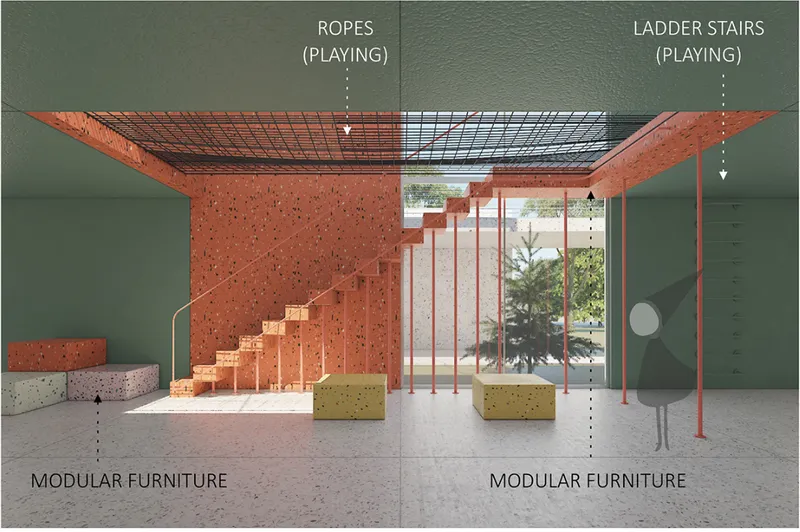
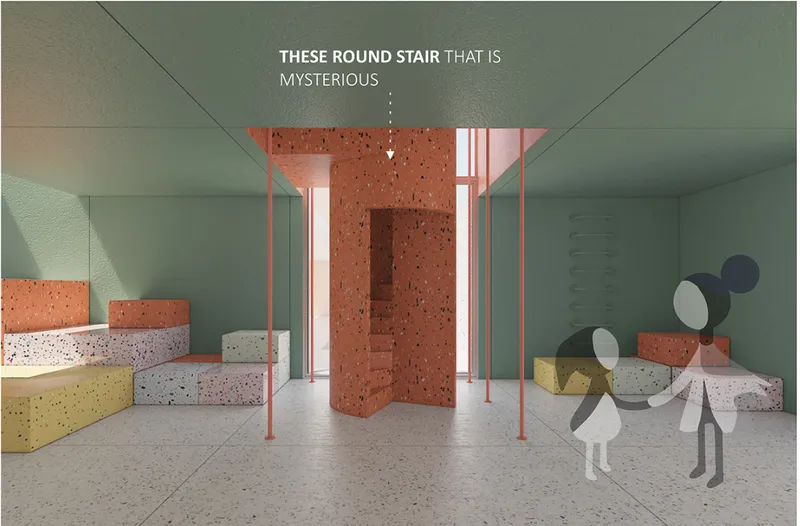
Inside, the building turns into equipment. A terracotta terrazzo stair climbs beneath an overhead rope net, with red poles hanging from above and a pine tree visible through the glazing. In the next space, a round terracotta stair tower stands in a green room beside stepped terrazzo seating, and two silhouetted figures hold hands at its base. These elements are not decoration added to a classroom. They are the interactive pieces through which the project expects learning to emerge, through movement, experimentation and play.
The palette supports this. Soft-toned surfaces are paired with playful geometric forms, and terracotta against green gives each room a clear identity. The stepped seating works as both an auditorium and a climbing slope, which fits the project's broader move away from fixed classrooms toward adaptable settings. Students can choose a perch, a net or a step according to how they want to learn that day.
A Hanging Platform That Makes Students Earn the Next Level
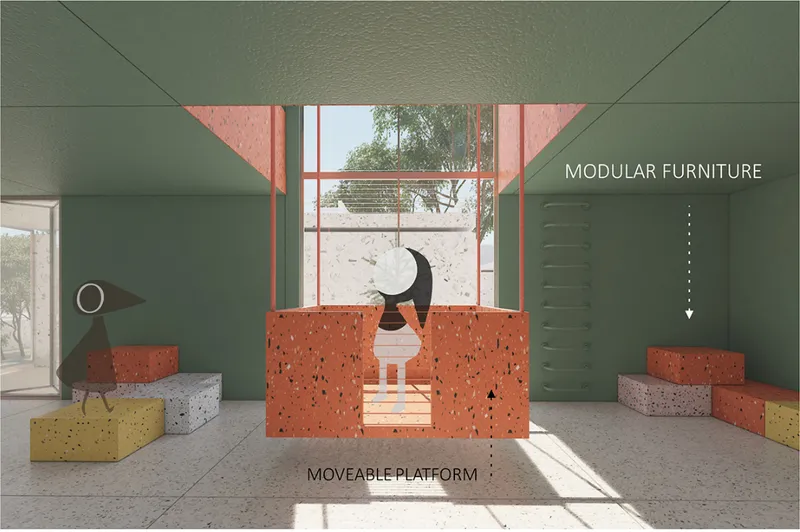
The final image is the clearest expression of the project's most provocative idea. A terracotta box platform hangs from red poles, reached by a rung ladder, with stacked terrazzo seating below in daylight. It recalls the mechanical interventions Haeri places along the underground route, such as lifting platforms that require users to solve a problem before they can move on. Along with dead-ends and hidden passages, these devices make circulation feel like a game, and a puzzle you have to work through together.
Haeri is explicit that confusion is intentional. The underground route is built to be unpredictable, and uncertainty is treated as a catalyst rather than a design flaw. This is the riskiest part of the proposal, since a school also has to function during a fire drill or a rushed morning. As a statement about pedagogy, though, it is consistent: a building that never asks anything of its students cannot teach them to adapt.
Why This Project Matters
School of Thought takes a familiar slogan, the environment as third teacher, and pushes it further than most entries would. Rather than adding a few colourful breakout spaces to a standard plan, Haeri reorganises the whole school around three modes of movement, each with its own emotional register: steady on the ground, exposed in the air, uncertain underground. Circulation, usually the least considered part of a school, becomes its curriculum.
The project's lasting value is its willingness to design for friction. Contemporary education spaces often aim to remove every obstacle, yet curiosity tends to begin when something does not quite work as expected. By making terrazzo stairs, rope nets and hanging platforms part of the daily route, the proposal suggests that the physical effort of finding your way can build the same skills a lesson tries to teach: judgement, collaboration and confidence in the face of the unknown.
View the Full Project
About the Designers
Designer: Nakisa Haeri
Enter a Design Competition on uni.xyz
uni.xyz runs architecture and design competitions year-round that reward proposals with spatial conviction and real site intelligence.
Project credits: School of Thought by Nakisa Haeri School Of Thought 2020 (uni.xyz).


Popular Articles
Popular articles from the community


Manzana Morphosis: Stretching Barcelona's Grid into a Living Landscape for 2050
A radical reworking of the Eixample manzana turns density into a tool for generous public space, vertical ecology, and environmental performance.


ETEH Reworks the Shared Spaces of São Domingos School in Brazil Around Timber, Color and Hanging Plants
At São Domingos School in Brazil, 436 m² of hall, refectory and library are recast with timber joinery, a yellow and blue code and trailing greenery.

Cube Design Draws an Ecological Corridor Between Two Shenzhen Hills with the Nankai Building
Beside Shenzhen's container docks, the Nankai Building pairs stacked balconies with a climbing green screen to connect two hillsides across its height.

David Ortega Stacks a Two-Story Mexico City Penthouse Around a Steel Stair and a Pergola-Shaded Roof Terrace
In Colonia Roma, a 300 m² penthouse uses oak joinery, a planted steel stair and a slatted roof pergola to make a new-build apartment feel like a house.

Similar Reads
You might also enjoy these articles
Healing Façade: A Modular Chapel System That Restores Ethiopia's Sacred Forests
Winner of the Eco-Chapel competition, this circular timber façade collects water from air to rebuild soil and reforest degraded Ethiopian landscapes.
Kaffeebühnen: Where Coffee Shop Architecture Becomes a Civic Stage in Vienna
A linear sequence of timber boxes, transparent shells, and open yards turns the Viennese café tradition into a public performance space.
Eco Chapel: A Modular Forest Pavilion That Grows Like the Landscape It Protects
Hexagonal timber modules weave through existing trees, turning a chapel into a living system for prayer, education, and reforestation.


Urban Forest: A Vertical Ecosystem for 5,000 Workers in Singapore's Changi Business Park
Radially stacked pods and layered green decks turn a 7-acre plot into 47 acres of ecological workspace projected for 2040.

Explore Experiential Architecture Competitions
Discover active competitions in this discipline

Challenge to design public laboratory

Challenge to reimagine the Iron Throne

Photograph architecture without architects

Illustrate the lost glory of Angkor Wat - Render Challenge
Comments (0)
Please login or sign up to add comments
No comments yet. Be the first to comment!