
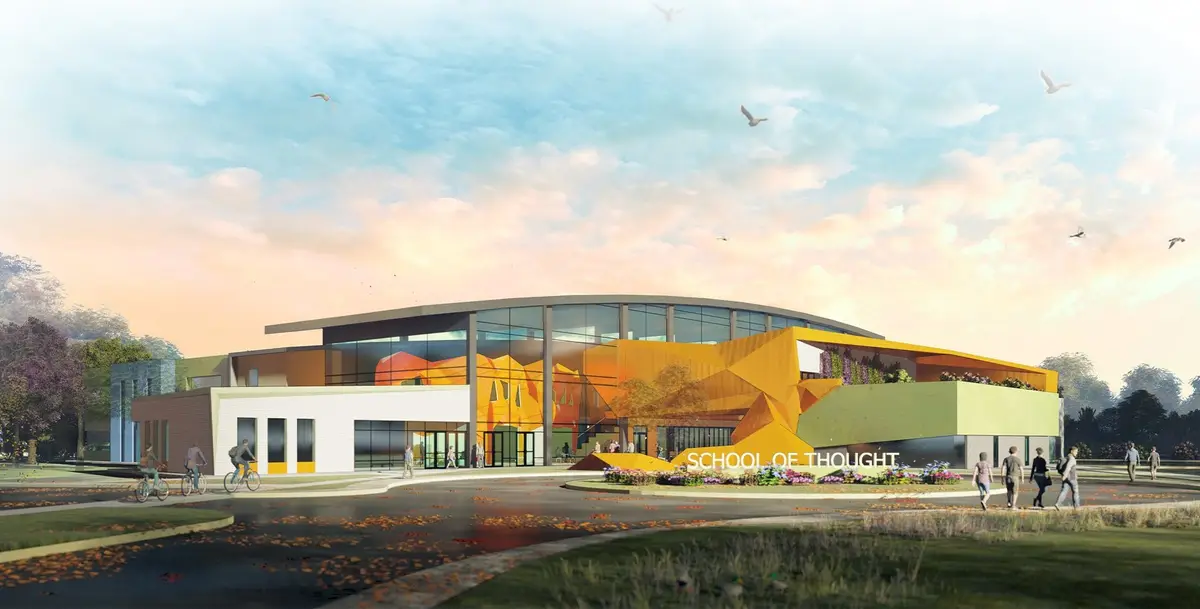
GRADE-IENT: A School Organised as a Gradient Students Navigate Between Modes of Learning
A gradient of learning zones, floating Iceberg studios and a central Collaboratorium let students choose how, where and with whom they learn.


Most schools still sort students into identical boxes and hope one teaching method fits everyone. GRADE-IENT starts from the opposite premise: learners are shaped by cultural, environmental and behavioural influences, so the building should offer a spectrum of spaces rather than a single answer. The result is a school conceived as a gradient, a continuous learning landscape where a student can drift from a quiet niche to a crowded stage without ever passing through a classroom door.
Designed by Dusty Lake and recognised with an Editor's Choice award in School of Thought 2020, the project pairs its architecture with a pedagogical model called Curriculum 2.0. This hybrid curriculum draws on Traditional, Montessori, Reggio Emilia, Maker Movement and Swiss VET systems, shifting the emphasis from rigid instruction to mentorship. The architecture is asked to carry that shift, and it does so by treating space as an adaptive system rather than a static container.
Faceted Orange Volumes Pull Teaching onto the Floor
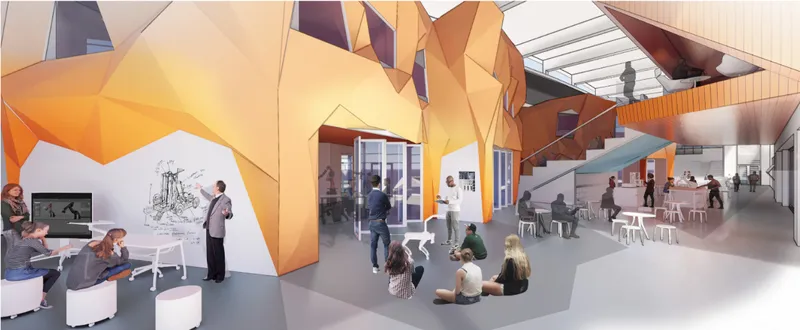
The opening rendering sets the tone: a faceted orange volume rises through the atrium while a teacher works at a sketch-covered whiteboard and students sit directly on the floor. There is no lectern and no row of desks. The scene reads less like a lesson than a working session, which is exactly the mentorship-driven relationship Curriculum 2.0 describes.
These volumes are the project's Icebergs, multi-level studios and labs floating within the central Collaboratorium. The metaphor is apt. Like an iceberg's visible and hidden mass, each structure layers open collaborative zones against tucked-away niches for individual study, so a single object serves both the extrovert and the student who needs to withdraw.
The Collaboratorium Treats Performance, Making and Dining as One Programme
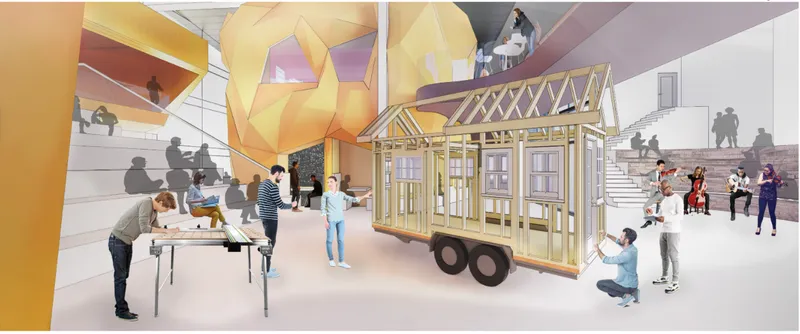
A timber-framed tiny house on a trailer parked inside an atrium, with musicians playing on tiered seating nearby, is an unexpected image, and a telling one. It shows the Collaboratorium doing what the brief claims: dissolving the boundaries between dining, media, performance and learning so that a build project, a concert and an audience can occupy the same room. The tiny house reads as a Maker Movement artefact given a civic stage.
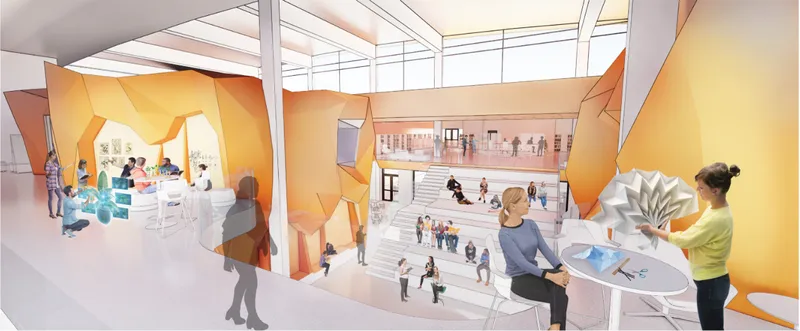
The second view tightens the focus. Stair seating steps up beside the orange pods while a student folds a paper model at a standing table. The tiers double as circulation, auditorium and casual perch, and the standing table turns the edge of the stair into a workbench. This is where the project's interest in spontaneous learning becomes tangible; the infrastructure for an unplanned lesson is always within reach.
Shifting Colour Fields Map the Move from Collective to Reflective
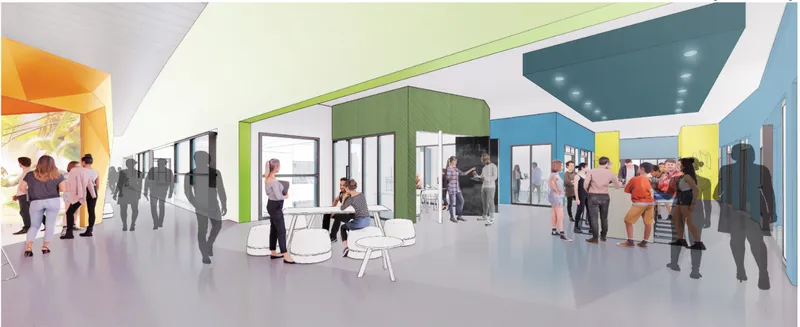
Away from the orange core, the palette cools. A corridor lined with green and blue wall panels sits under a teal ceiling canopy, with students gathered at a counter. Colour here does spatial work, signalling a change in register as one moves along the gradient. The project ties this variation to student temperament, from introverted to extroverted, and to cognitive approaches such as sensing, intuition, thinking and feeling.
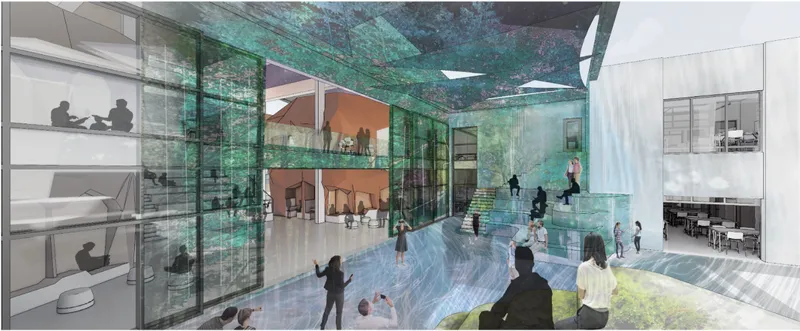
The double-height space with its green-blue patterned glass wall and ceiling pushes the idea further, wrapping a stepped seating area in a filtered, almost aquatic light while visitors stop to photograph it. Combined with the flexible furniture, writable surfaces and modular configurations the project specifies, these rooms are meant to be reconfigured in real time, accommodating the immersive, simulation-based learning that GRADE-IENT positions alongside hands-on making.
Bridges, Two Levels and The Shelf Stitch the Gradient Together
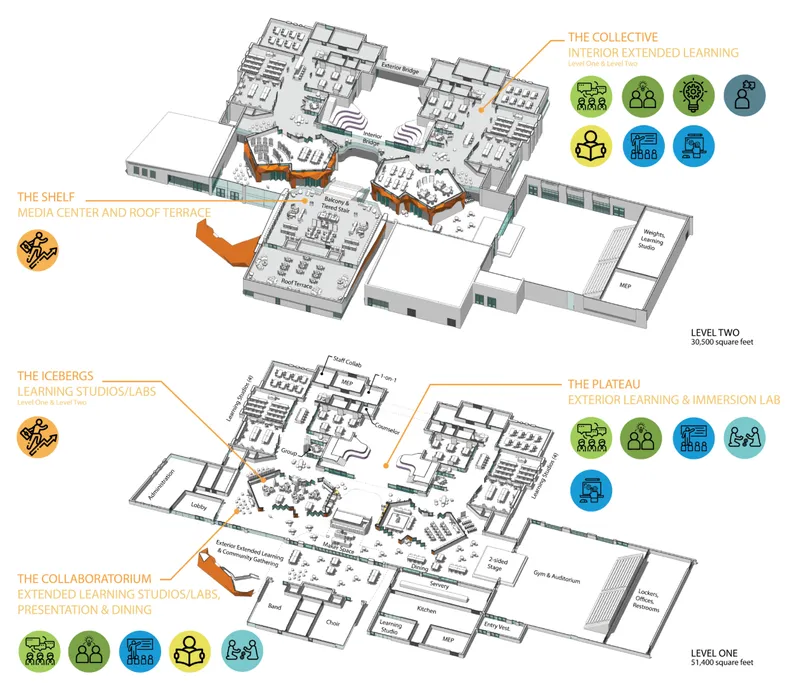
The axonometric drawings reveal the organisation behind the renderings. Two floor levels are mapped with labelled learning zones, circulation routes and bridges, and coloured programme icons make the gradient legible as a plan rather than a mood. The bridges matter: they let students cross the Collaboratorium at height, keeping the vertical connection between Icebergs as continuous as the horizontal one.
At the top sits The Shelf, a media centre and roof terrace that extends learning upward and outward. It completes a sequence that runs from the communal ground through the layered studios to the open sky, linking interior to exterior. Around it, The Collective works as a neighbourhood of open and enclosed spaces that mixes age groups and learning levels, while the site itself is framed as the "third teacher", a Reggio Emilia idea given architectural form.
Why This Project Matters
GRADE-IENT is persuasive because its architecture and curriculum argue the same point. Blending five educational models could easily have produced a diagram with no spatial consequence; instead, each methodology finds a home somewhere on the gradient, from the Maker tiers to the reflective glass rooms. The Icebergs in particular offer a clever answer to an old problem in open-plan schools: how to give students both visibility and refuge within a single, shared volume.
There are questions a built version would need to settle, notably acoustics in a hall where concerts, dining and study overlap. But as a competition proposition, the project makes a clear case that a school can be organised around student choice rather than timetables. It asks designers to stop drawing classrooms and start drawing ranges of experience, and that is a brief worth taking seriously.
View the Full Project
About the Designers
Designer: Dusty Lake
Enter a Design Competition on uni.xyz
uni.xyz runs architecture and design competitions year-round that reward proposals with spatial conviction and real site intelligence.
Project credits: GRADE-IENT by Dusty Lake School of Thought 2020 (uni.xyz).


Popular Articles
Popular articles from the community


Manzana Morphosis: Stretching Barcelona's Grid into a Living Landscape for 2050
A radical reworking of the Eixample manzana turns density into a tool for generous public space, vertical ecology, and environmental performance.


David Ortega Stacks a Two-Story Mexico City Penthouse Around a Steel Stair and a Pergola-Shaded Roof Terrace
In Colonia Roma, a 300 m² penthouse uses oak joinery, a planted steel stair and a slatted roof pergola to make a new-build apartment feel like a house.

Opera on the Sea: Driftwood Logic Shapes a Timber Opera House on Estonia's Coast
Trevor Orgill's opera house translates the entangled drift of floating timber into a civic building where wood, water, and music converge.

Aquadapt: An Underwater Habitat That Rewrites Its Rooms by the Hour
Curved modules ring the seabed while one shell shifts from breakfast room to cinema, farm and football pitch as residents' needs change.

Similar Reads
You might also enjoy these articles
Healing Façade: A Modular Chapel System That Restores Ethiopia's Sacred Forests
Winner of the Eco-Chapel competition, this circular timber façade collects water from air to rebuild soil and reforest degraded Ethiopian landscapes.
Kaffeebühnen: Where Coffee Shop Architecture Becomes a Civic Stage in Vienna
A linear sequence of timber boxes, transparent shells, and open yards turns the Viennese café tradition into a public performance space.
Eco Chapel: A Modular Forest Pavilion That Grows Like the Landscape It Protects
Hexagonal timber modules weave through existing trees, turning a chapel into a living system for prayer, education, and reforestation.


Urban Forest: A Vertical Ecosystem for 5,000 Workers in Singapore's Changi Business Park
Radially stacked pods and layered green decks turn a 7-acre plot into 47 acres of ecological workspace projected for 2040.

Explore Learning Spaces Competitions
Discover active competitions in this discipline

Challenge to design public laboratory

Challenge to reimagine the Iron Throne

Photograph architecture without architects

Illustrate the lost glory of Angkor Wat - Render Challenge
Comments (0)
Please login or sign up to add comments
No comments yet. Be the first to comment!