

Living Space: Vertical Housing That Breathes in Tropical Density
A compact four-story dwelling in Vietnam turns staircases into gardens, voids into cinemas, and walls into frames for family life.


What if every surface in a house did more than one thing? What if the staircase was also a garden, the wall also a cinema screen, and the roof also a farm? In dense tropical cities where land is scarce and humidity is relentless, these questions stop being theoretical and become urgent. "Living Space" takes a narrow vertical footprint and fills it with overlapping programmes, biophilic layers, and passive cooling strategies that challenge the assumption that compact living must feel cramped.
Designed by Fatma Akkaya, this shortlisted entry for Nano Nest 2020 addresses Vietnam's surging urban population and the spatial pressures that come with it. The brief called for innovative nano-scale dwellings, and Akkaya responded with a four-story family home that treats every architectural element, from staircase to building envelope, as an opportunity for greenery, social connection, and thermal performance.
Four Open Floors and a Rooftop Farm
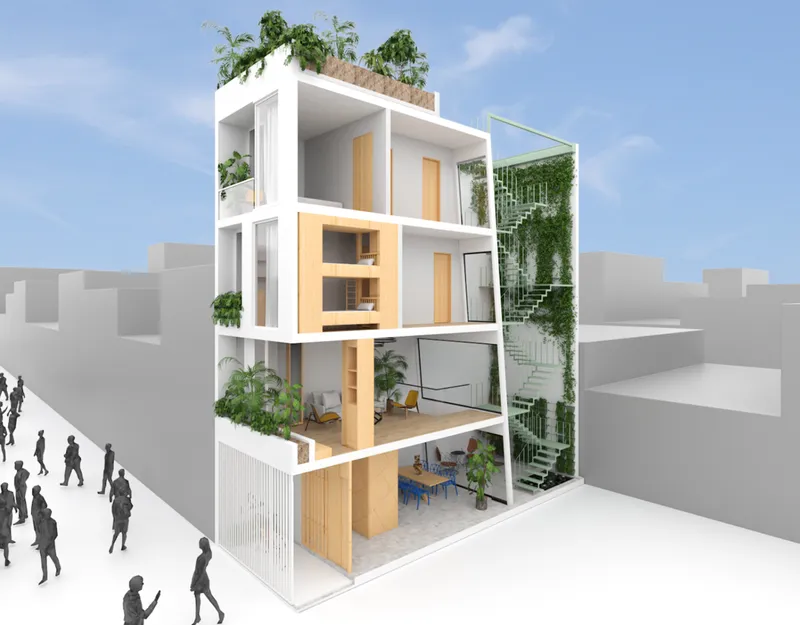
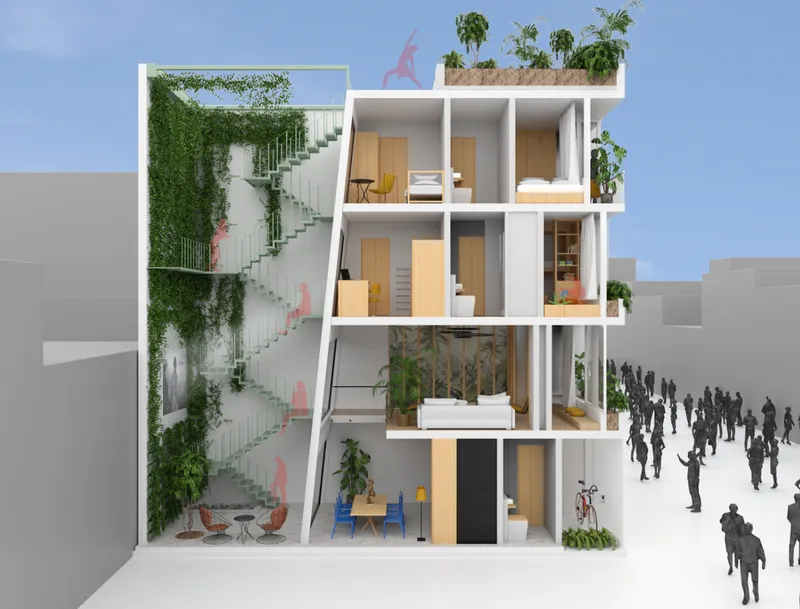
The sectional perspectives reveal how the building operates as a stack of open volumes rather than a series of enclosed boxes. Each floor peels apart from the next through strategic voids and cut-outs that allow daylight and wind to circulate freely through the section. The ground floor extends into a shaded terrace with a wall pond and green zone, blurring the line between interior and street. Above, a family living hub occupies the first floor, while upper levels hold private sleeping and hobby spaces. At the top, a rooftop garden insulates against tropical heat while doubling as space for food cultivation, a lounge, or even an open-air cinema.
The vertical green wall flanking the staircase is the building's spine. It appears in both perspectives as a thick planted surface that residents move through daily, transforming a utilitarian circulation route into a biophilic experience. Akkaya frames the staircase not as a conduit between floors but as a communal zone: a yoga platform in the morning, a reading retreat in the afternoon, an evening gathering space. The green wall even serves as a projection surface for a children's cinema room, collapsing infrastructure and programme into a single element.
Climate-Responsive Materiality: Concrete, Wood, and Perforated Partitions
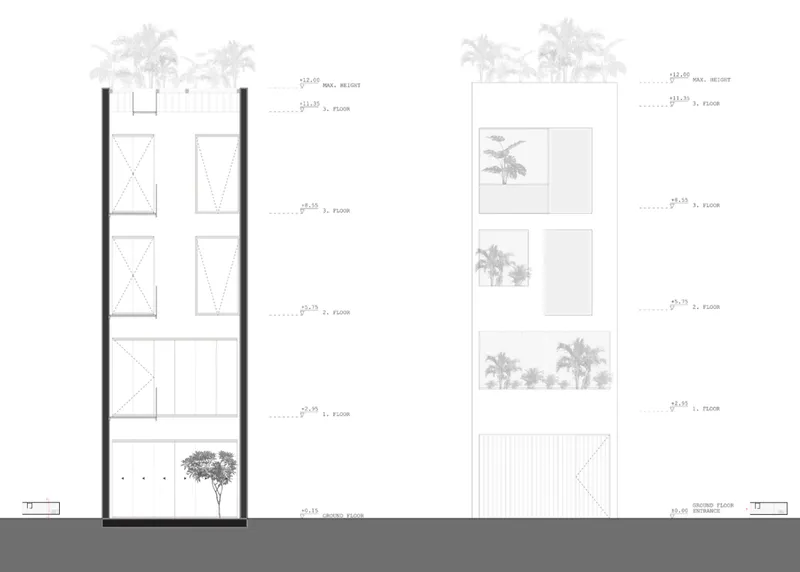
The front and rear elevations show a four-story volume punctuated by planted openings at varying scales. The material logic is straightforward and site-appropriate: public concrete provides structural durability against high humidity and soil salinity, while wooden joinery and perforated partitions maintain airflow without sacrificing privacy. Fewer solid walls and more folding surfaces maximize usable area while enabling the passive cross-ventilation that is essential in Vietnam's tropical climate. The elevations make clear that the building envelope is not a sealed boundary but a porous interface, with vegetation spilling out of every gap.
Section Logic: Maintaining Family Connection Across Vertical Planes
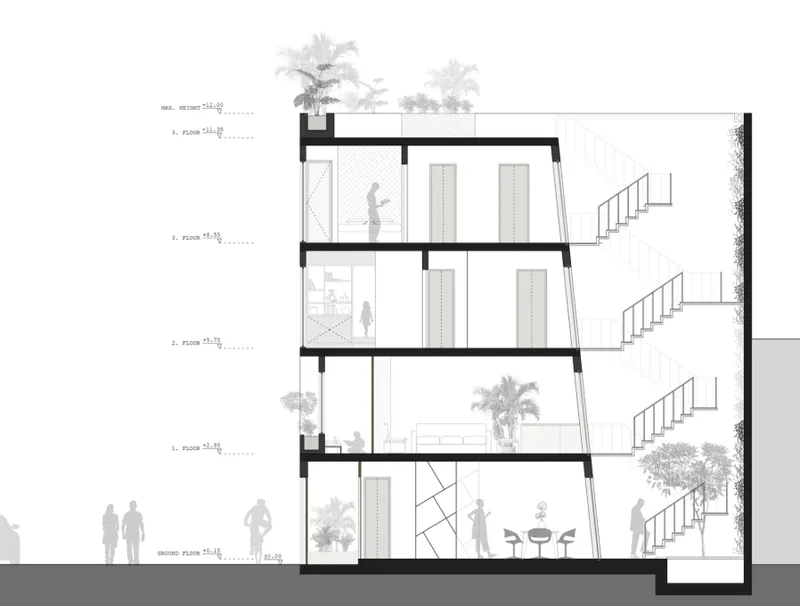
The section drawing is the most revealing document. It exposes how floor levels, the external staircase, and planted terraces interlock to create visual and spatial links between zones. Even when family members occupy separate floors for sleep, work, or solitude, they remain connected through sightlines threaded across the open voids. The children's room, with its indoor play area and cinema projection onto the green wall, sits in direct visual contact with the family hub below. The logic is clear: vertical distance should not mean emotional distance.
Mass separation between floor plates also performs a climatic function. By pulling volumes apart, the design creates open channels for light and wind to penetrate deep into the plan. The staircase and terraces act as thermal buffer zones, shaded by planting and open to breezes. It is a simple strategy, but executed with enough precision that it avoids the monotony of generic tropical housing while keeping construction feasible with local, accessible materials.
Why This Project Matters
"Living Space" succeeds because it refuses to treat the nano-dwelling as a problem of mere reduction. Instead of shrinking rooms and stacking them, Akkaya multiplies the roles of each element. A staircase is a garden, a gathering space, and a circulation route. A wall is a planting surface, a cinema screen, and a privacy barrier. A roof is insulation, a farm, and a lounge. This layering of function onto form is the project's real contribution: it demonstrates that compact vertical housing can be spatially generous without demanding more land.
For tropical cities facing rapid densification, the proposal offers a persuasive argument that passive design and social connectivity are not luxuries reserved for larger buildings. By grounding its strategies in Vietnam's specific climate, materials, and family structures, the project avoids the trap of abstract universalism. It is specific enough to be buildable and propositional enough to provoke new thinking about what the smallest possible home can actually feel like.
View the Full Project
About the Designers
Designer: Fatma Akkaya
Enter a Design Competition on uni.xyz
uni.xyz runs architecture and design competitions year-round that reward proposals with spatial conviction and real site intelligence.
Project credits: Living Space by Fatma Akkaya Nano Nest 2020 (uni.xyz).


Popular Articles
Popular articles from the community


Opera on the Sea: Driftwood Logic Shapes a Timber Opera House on Estonia's Coast
Trevor Orgill's opera house translates the entangled drift of floating timber into a civic building where wood, water, and music converge.

Tsunami Convergenics: Turning Catastrophic Ocean Forces into Underwater Housing Infrastructure
A speculative underwater settlement off the coast of Onagawa, Japan, treats tsunamis and typhoons as energy sources rather than threats.
Faces of the Soviet Avant-Garde: Turning Moscow's Street Names into an Open-Air Museum
A network of sculptural installations across a Moscow residential district transforms forgotten architect names into spatial encounters with cultural memor

Temporary Home for Dogs: A Reversed Zoo Rethinks Animal Shelter Architecture
In Bucharest, a sinuous corridor and freed landscape flip the logic of containment, designing a shelter that works to make itself unnecessary.

Similar Reads
You might also enjoy these articles

Day and Night Park: A Time-Based Urban Newsstand in Beijing
A temporary urban newsstand in Beijing blending travel, light, and reading through poetic colors, compact form, and community-focused design.

Modernist Patio Renovation in El Masnou, Barcelona by Oliver Segura Arquitectura + Cebrià Arquitectura
Modernist patio renovation blending tradition and innovation with a movable pool, leveled floors, and Catalan materials in El Masnou.

Alto Residencial Coop: Cooperative Housing Development in Santiago de Compostela by Carbajo Barrios Arquitectos
A linear cooperative housing complex blending white volumes and perforated metal façades, enhancing community living, natural light, privacy, and urban integration.

Vil Genis School by BPA ARCHITECTURE – Massy, France
Vil Genis School in Massy, France, features sustainable design, south-facing classrooms, community integration, accessible spaces, and modern educational architecture.


Comments (0)
Please login or sign up to add comments
No comments yet. Be the first to comment!