
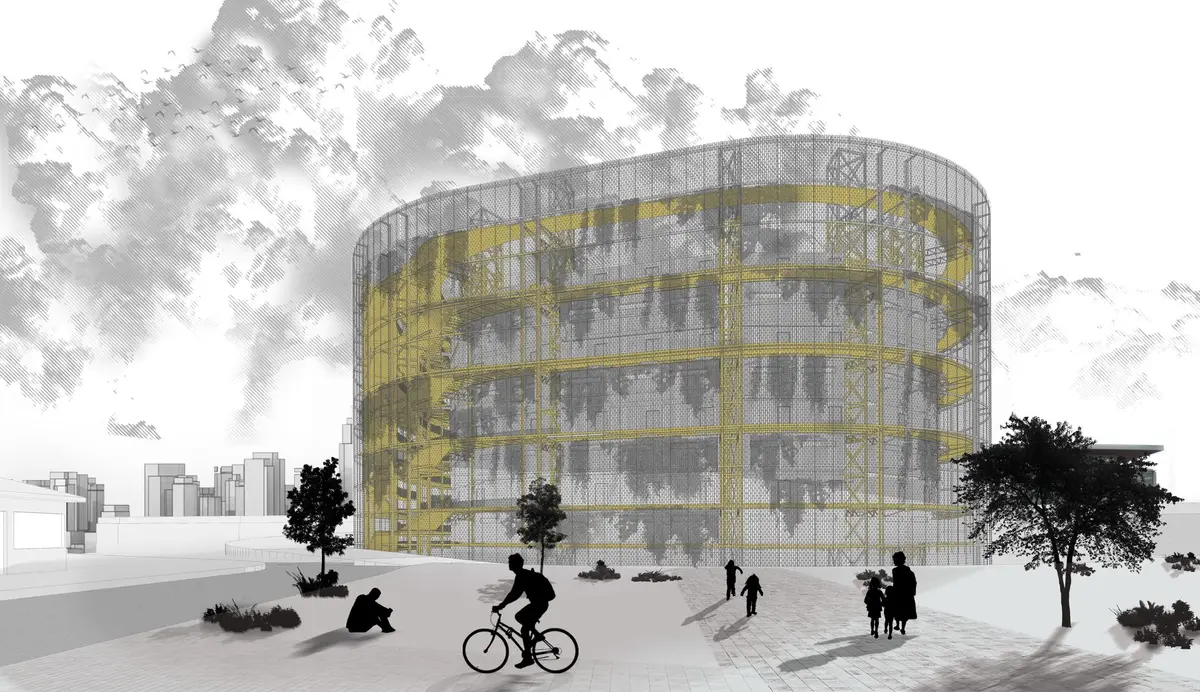
Residual Spaces: Modular Housing That Reclaims the Leftover Geometry of Cities
A flexible housing system designed to occupy the overlooked voids created by road infrastructure in high-density urban environments.


Every city has them: the triangular slivers, the awkward wedges, the too-narrow strips of land left behind where avenues intersect at odd angles. These residual spaces are the geometric waste products of road infrastructure, and they remain mostly invisible to urban planning. Residual Spaces treats them as an untapped resource, proposing modular and removable housing units that conform to irregular terrain and bring vertical density to sites that conventional development ignores entirely.
Designed by Javier Burgos and Amadis Sanchez, the project received an Honorable Mention in the Plugin Housing Challenge 2020. The competition invited participants to rethink housing as a pluggable, adaptable system for dense urban contexts. Burgos and Sanchez responded with a geometrically adaptive structure that flexes to fit the irregular footprints that major avenue crossings leave behind, turning neglected land into livable vertical communities.
A Courtyard Carved from Urban Residue
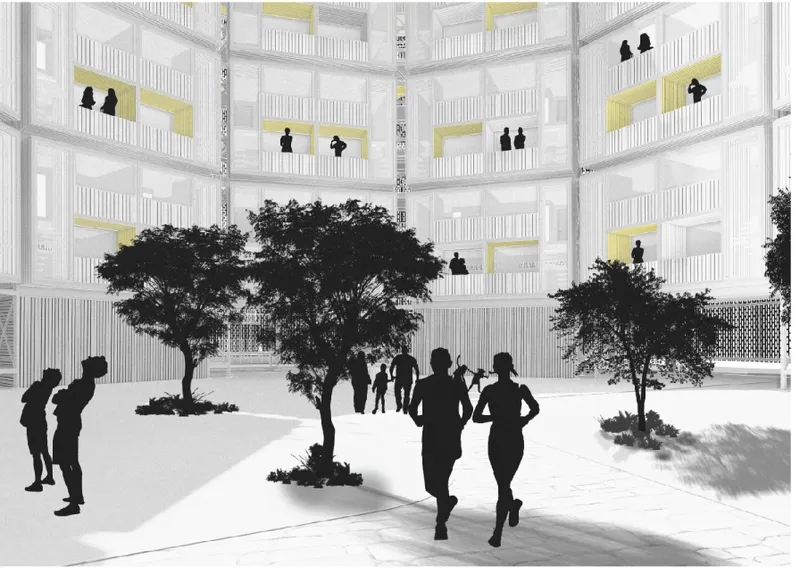
The project's interior atrium reveals how the designers organize communal life within a tight, irregular footprint. White corrugated facade panels define the enclosure while yellow accents punctuate balcony edges and thresholds, creating a consistent material language that reads as both industrial and deliberately warm. Mature trees rise through the section, suggesting that the atrium functions not just as a light well but as a genuine shared landscape, one that softens the hard geometry of stacked modular units.
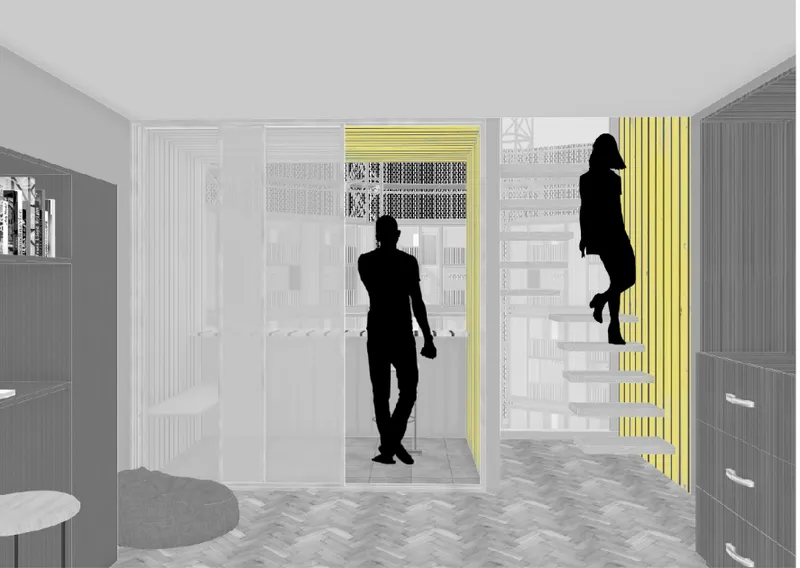
At the threshold level, yellow vertical louvers mediate between interior and exterior zones, while herringbone flooring signals a shift from circulation to dwelling. The split-level arrangement visible here points to the project's core spatial strategy: rather than stacking identical floor plates, the design accommodates the uneven terrain beneath it by stepping and shifting, producing varied spatial conditions that feel specific to each unit rather than mass-produced.
Facade as Frame: Looking Out from Within the Module
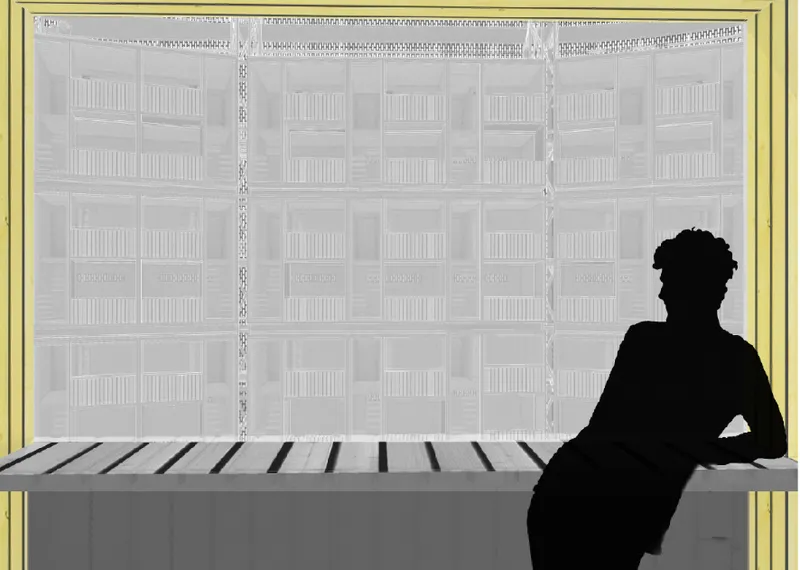
From a balcony vantage point, the repetitive white facade panels form a rhythm that gives the building its collective identity without suppressing individual expression. The yellow-framed window operates as a deliberate punctuation mark, drawing the eye and establishing a sense of address for each unit. What matters here is the relationship between the inhabitant and the building's own surface: looking outward, you see not the city but the community itself, layered and stacked in the corrugated panels that enclose the atrium. It is a housing system that makes neighbors visible to one another.
Sectional Choreography: Circulation as Architecture
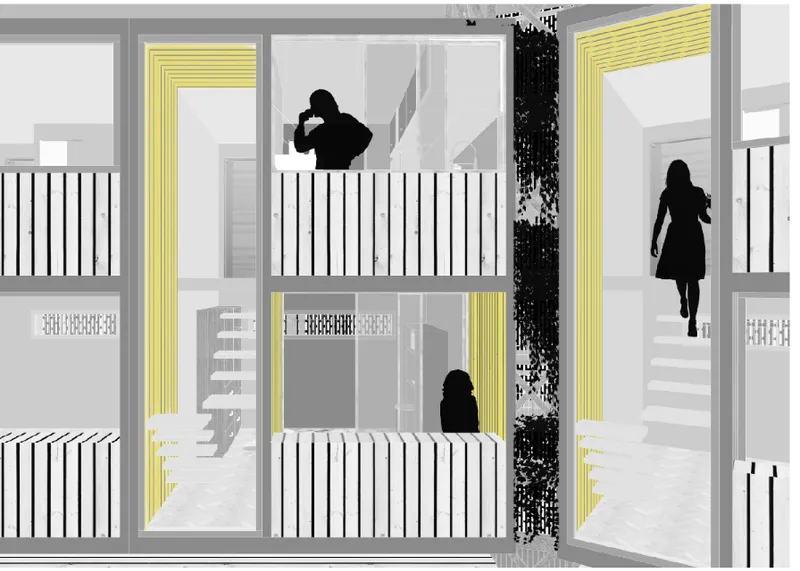
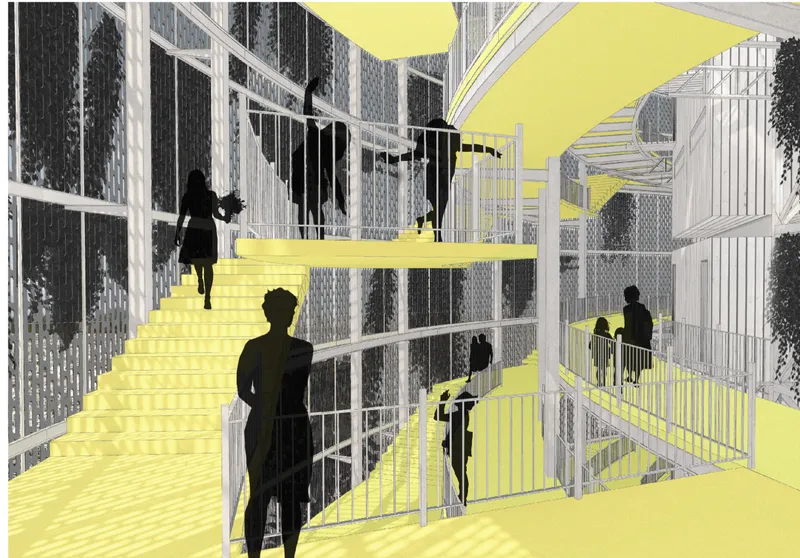
The section drawing makes the project's vertical ambition legible. Multilevel interior spaces cascade downward, connected by yellow-accented staircases and vertical railings that double as structural and visual markers. Figures appear at every level, reinforcing the idea that this is not a dormant stack of units but an actively inhabited section where movement between floors generates social overlap. The cascading arrangement suggests that the designers used the terrain's irregularity as a design driver rather than an obstacle to be leveled.
The interior perspective of the circulation spaces confirms this reading. Yellow staircases and transparent railings create a legible path through the section, guiding residents through what amounts to a continuous vertical neighborhood. The transparency is critical: it means that moving through the building is never a closed corridor experience but an open one, where sightlines to other levels reinforce a sense of shared occupation. For a modular, removable housing system, this degree of spatial generosity is notable.
Contextual Presence: A Textured Facade in the Streetscape
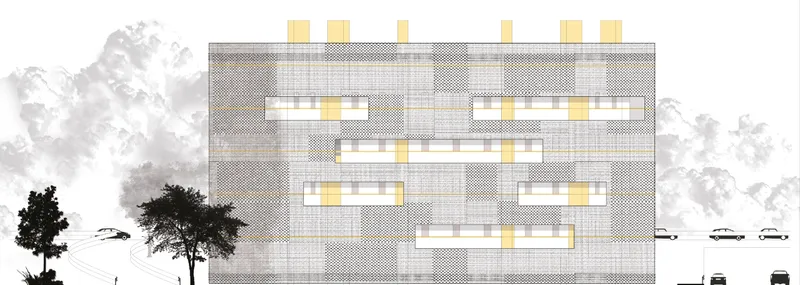
The elevation drawing situates the project within its urban context using a watercolor rendering that softens the boundary between building and surroundings. The textured facade, punctuated by yellow window accents, holds its own against the street without overwhelming it. Trees at the base suggest a ground-level landscape strategy that ties the building back to the pedestrian realm. What the elevation makes clear is that this is not a temporary-looking structure: despite being conceived as modular and removable, the building presents itself as a committed piece of urban architecture with material weight and civic presence.
Why This Project Matters
Residual Spaces succeeds because it reframes a problem of urban waste as an opportunity for architectural invention. Rather than seeking out pristine sites, Burgos and Sanchez direct attention to the scraps, the geometric leftovers that every city produces and almost no one addresses. The geometric adaptability of their modular system means these awkward parcels do not require reshaping; the architecture shapes itself to them. In cities where available land is scarce and expensive, this is a genuinely pragmatic contribution.
Beyond the site strategy, the project demonstrates that modular and removable housing need not default to utilitarian blandness. The atrium, the split-level thresholds, the transparent circulation zones, and the considered facade rhythm all point to a design team that refused to let the "plugin" premise excuse spatial poverty. The result is a housing prototype that could densify without dehumanizing, occupying the forgotten geometries of the city with architecture that takes both its residents and its context seriously.
View the Full Project
About the Designers
Designers: Javier Burgos, Amadis Sanchez
Enter a Design Competition on uni.xyz
uni.xyz runs architecture and design competitions year-round that reward proposals with spatial conviction and real site intelligence.
Project credits: Residual spaces" by Javier Burgos, Amadis Sanchez Plugin Housing Challenge 2020 (uni.xyz).


Popular Articles
Popular articles from the community


Manzana Morphosis: Stretching Barcelona's Grid into a Living Landscape for 2050
A radical reworking of the Eixample manzana turns density into a tool for generous public space, vertical ecology, and environmental performance.

Opera on the Sea: Driftwood Logic Shapes a Timber Opera House on Estonia's Coast
Trevor Orgill's opera house translates the entangled drift of floating timber into a civic building where wood, water, and music converge.


FCC Arquitectura Expands a Portuguese Granite House with a Board-Marked Concrete Wing
In Portugal, JV House pairs a cleaned-up whitewashed and granite dwelling with a timber-shuttered concrete extension, courtyards and a garden pool.

Singing Woman: An Opera House That Performs Before the Curtain Rises
Ovidiu Cristian Pavel's conceptual opera house translates Estonia's choral identity into a sculpted waterfront landmark facing the Baltic Sea.

Similar Reads
You might also enjoy these articles

Cube Design Draws an Ecological Corridor Between Two Shenzhen Hills with the Nankai Building
Beside Shenzhen's container docks, the Nankai Building pairs stacked balconies with a climbing green screen to connect two hillsides across its height.

Praksis A and Studio Sted Bend a Red Timber Cabin Across the Granite of Norway's Southern Coast
On the southern Norwegian coast, a 105 m² cabin follows the rock on slender posts, pairing red cladding outside with pine, brick and plywood within.

David Ortega Stacks a Two-Story Mexico City Penthouse Around a Steel Stair and a Pergola-Shaded Roof Terrace
In Colonia Roma, a 300 m² penthouse uses oak joinery, a planted steel stair and a slatted roof pergola to make a new-build apartment feel like a house.

PARALELA and LB2 Thread a Public Walkway Through the Base of a Las Condes Residential Tower
In Las Condes, Santiago, the Hamlet Building gives its fenceless ground floor to a 70-metre wooded passage linking two streets and the metro.

Comments (0)
Please login or sign up to add comments
No comments yet. Be the first to comment!