
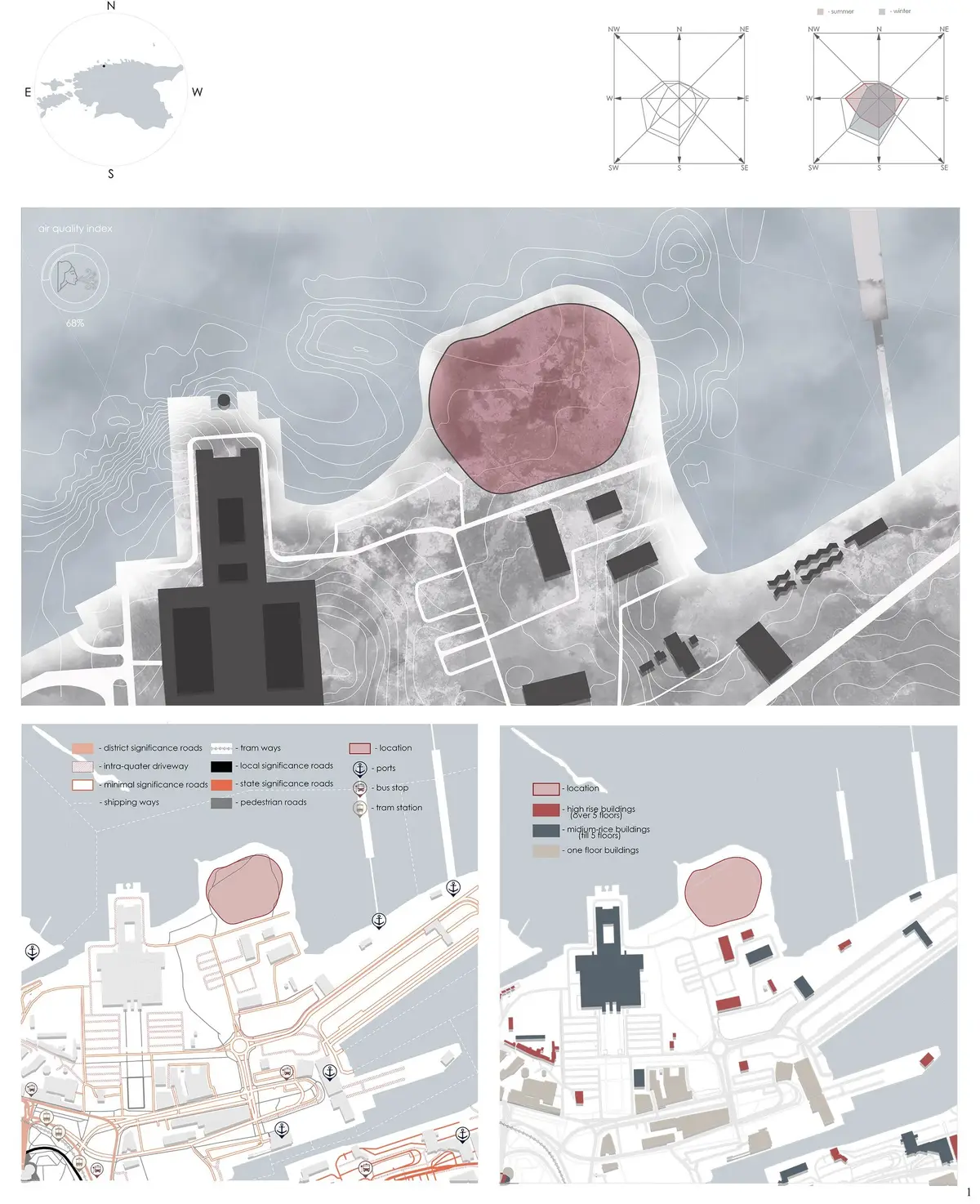
Opera by the Sea: A Shortlisted Opera House Whose Angular Volumes Rise Out of the Coastal Terrain
Dmitriy Gureev uses rule-based geometry and a circular landscape route to turn an opera house into civic terrain along the coastline.


Opera houses have long announced themselves through symmetry: a grand axis, a central stair, a facade built to be seen from a distance. Opera by the Sea sets that habit aside. Its mass breaks into angular volumes that seem to push up out of the ground, and its geometry follows a set of rules drawn from the site rather than a fixed image of monumentality. The building behaves less like an object on the shore and more like a piece of the shoreline that has been folded upward.
Designed by Dmitriy Gureev, the project was shortlisted in the Opera by the Sea competition on uni.xyz. The site sits on a coastal edge, and Gureev treats that condition as the main brief. The proposal sets land, water and cultural programme against one another, and it derives its form from site forces, movement patterns and visual axes. The usual inheritance of the type, from Italian Baroque theatres to the civic opera houses of Vienna and Germany, serves as a counterpoint rather than a template.
Angular Volumes That Grow Out of the Ground

The first impression is fragmentation held in check. Instead of one enclosing shell, the opera house reads as a cluster of faceted volumes, each tilted and cut so that the roofline climbs and drops across the composition. Because the masses appear to rise from the terrain rather than sit on a podium, the building's edge with the landscape stays blurred. The coast is a horizontal setting, and a sculptural silhouette that steps up from it feels more grounded than a freestanding monument would.
That restraint is what holds the composition together. The angles are not decorative gestures added one after another; they share a single faceted language, so the building stays recognisable as one institution even as it splits into parts. The opera house gets its civic presence without turning its back on the ground it stands on.
Geometry Generated by Rules, Not Imposed by Will

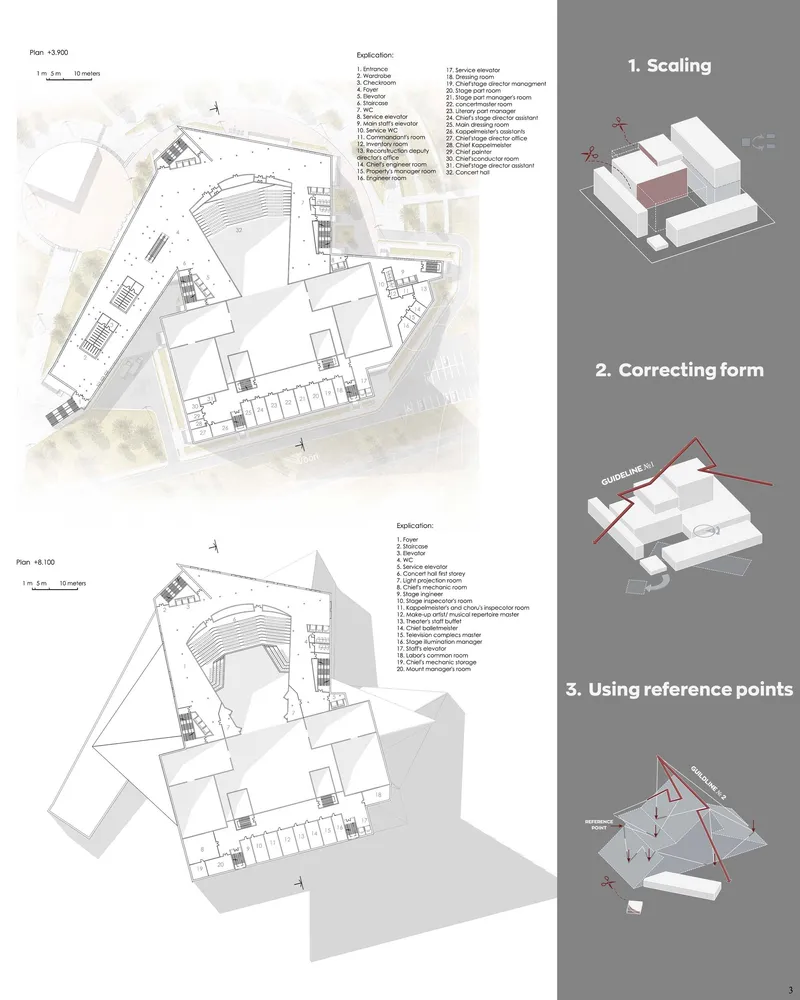
Gureev's development diagrams lay out the parametric logic step by step. The process starts with a simple volumetric configuration, scales it, then refines it against site-specific guidelines and reference points. Each move answers to a relationship, whether a sightline, a path of movement or an orientation toward the water. As a result the final form can be traced back through its decisions instead of standing as a one-off sculptural act.
This is the honest version of parametric design: the tool sets up a dialogue with context rather than producing complexity for its own sake. The diagrams show a building that adapts to its site rather than dominating it, and they make the case that an expressive form can still be accounted for, step by step.
A Stepped Hall Embedded Beneath the Faceted Roof


Behind the irregular exterior, the plan stays legible. The zoning separates public and private layers so that audience routes and performer and back-of-house routes keep clear boundaries, which matters a great deal in a building type where the order of spaces shapes the performance itself. At the centre sits the concert hall. In section its stepped seating wraps around the stage, shortening the distance between performer and listener and keeping sightlines open from the upper rows.
The hall is set deep within the mass, sheltered by the angular roof that defines the building's identity. That roof does two jobs: it gives the opera house its outline against the sky and acts as a protective envelope that supports acoustic performance. Placing the most demanding room at the protected core, with the expressive geometry working around it, is a sound strategy that keeps formal ambition from compromising the hall.
A Circular Route from Coastline to Courtyard

The site plan carries the argument beyond the building's footprint. A circular movement system ties the opera house to the coastline through a series of pathways, plazas and green pockets. Visitors do not simply arrive at a door; they move through a sequence that opens onto wide sea views, then narrows into more intimate courtyards before the entrance. The approach becomes a prelude, setting the rhythm before the performance begins.
This is where the project is strongest. By stretching the public realm into the landscape, Gureev makes the opera house usable on days without a performance, a place to walk, pause and look at the water. The building works as a civic landscape and a cultural anchor for the region, not a destination that comes alive only after dark.
Why This Project Matters
Opera by the Sea makes a case that the opera house can earn its civic weight without the familiar tools of symmetry and enclosed grandeur. Its rule-based geometry, traced through clear development diagrams, shows how parametric methods can serve a site instead of overriding it, and its legible interior proves that an expressive envelope and practical theatre planning can work together.
More importantly, the project reframes who the building is for. The circular landscape route, the plazas and the courtyards turn a ticketed institution into a public ground along the coast. For a type often criticised as exclusive, that shift from monument to terrain may be the entry's most lasting contribution.
View the Full Project
About the Designers
Designer: Dmitriy Gureev
Enter a Design Competition on uni.xyz
uni.xyz runs architecture and design competitions year-round that reward proposals with spatial conviction and real site intelligence.
Project credits: Opera by the Sea by Dmitriy Gureev Opera by the sea (uni.xyz).


Popular Articles
Popular articles from the community


Jaramillo Van Sluys Arquitectura and Urbanismo Turn a Demolished Registry Lot in Quito into an Orchard Plaza
In Quito's Centro Histórico, a 2,800 m² plaza exposes the San Agustín convent wall and redraws its lost Augustinian orchard in volcanic stone.

LT2A and OPEN Architectes Thread a Brick and Glass High School Through a Wooded Belgian Campus
In Braine-l'Alleud, a 3,000 m² wing for Collège Cardinal Mercier pairs pale brick with a glazed colonnade, deferring to a small chapel and a dense wood.

Cube Design Draws an Ecological Corridor Between Two Shenzhen Hills with the Nankai Building
Beside Shenzhen's container docks, the Nankai Building pairs stacked balconies with a climbing green screen to connect two hillsides across its height.

Juan García Correa, John González and Claudia Rueda Sink a Circular Amphitheater into a Manizales Engineering Building
On the La Nubia campus in Manizales, Colombia, the S1 Building folds labs and offices into a hillside of ramped lawns that double as a campus route.

Similar Reads
You might also enjoy these articles
Healing Façade: A Modular Chapel System That Restores Ethiopia's Sacred Forests
Winner of the Eco-Chapel competition, this circular timber façade collects water from air to rebuild soil and reforest degraded Ethiopian landscapes.
Kaffeebühnen: Where Coffee Shop Architecture Becomes a Civic Stage in Vienna
A linear sequence of timber boxes, transparent shells, and open yards turns the Viennese café tradition into a public performance space.
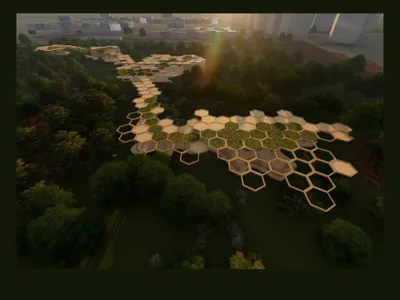
Eco Chapel: A Modular Forest Pavilion That Grows Like the Landscape It Protects
Hexagonal timber modules weave through existing trees, turning a chapel into a living system for prayer, education, and reforestation.


Urban Forest: A Vertical Ecosystem for 5,000 Workers in Singapore's Changi Business Park
Radially stacked pods and layered green decks turn a 7-acre plot into 47 acres of ecological workspace projected for 2040.

Explore Opera House Competitions
Discover active competitions in this discipline

Challenge to design locus for the upliftment of human rights

Challenge to design public laboratory

Challenge to design mud housing for contemporary communities

Design challenge to equip cities with modern furniture
Comments (0)
Please login or sign up to add comments
No comments yet. Be the first to comment!