
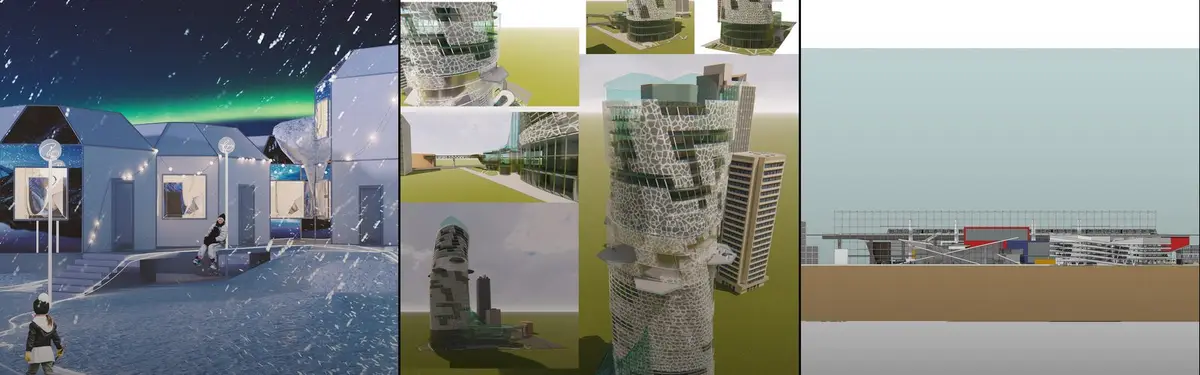


Smart City
FLDDesign approaches to creating responsive, sustainable urban environments through technology, modularity, and adaptive infrastructure.
A smart city is a city that uses sensors, data and connected infrastructure to run its services, from traffic signals and street lighting to water, waste and public transport, and to give residents new ways to take part in decisions. For architects and urban designers, the interesting question is not which gadgets a city buys but what kind of streets, buildings and public spaces that technology produces, and who controls the information it gathers.
What is a smart city?
Definitions vary, but most start from the same idea. The Wikipedia overview of the smart city describes an urban model that combines technology, human capital and governance to improve sustainability, efficiency and social inclusion. In practice that means networks of sensors, cameras and meters feeding information into control rooms and apps, so that a city can adjust bus frequencies, detect a burst water main or switch off empty streetlights. The same overview notes that the three largest areas of smart city spending in 2022 were visual surveillance, public transit and outdoor lighting, which says a lot about where the money really goes.
For designers the term is wider than software. A smart city project usually has a physical side: a transit interchange planned around real time passenger data, a lake that doubles as flood infrastructure, a street pole that carries lighting, Wi-Fi and seating at once. That overlaps with sustainable cities, which focus on energy, water and carbon, and it stands in deliberate contrast to the walkable city, whose tools are short blocks, wide pavements and shade rather than networks. Many of the best projects combine the two, using data to support a city that is already good to walk in.
"smart urbanism rooted in people, not just systems."
UNI Editorial, describing the position of Gangoly & Kristiner Architekten in Smart City Graz Square
That phrase sums up the design position this article takes. A smart city is judged by the quality of life it supports on the ground, not by the number of devices on its lampposts.
A short history of the smart city
Cities used computers long before the phrase existed. The smart city overview points to computational statistical analysis by the Community Analysis Bureau in Los Angeles in the late 1960s, and to Singapore's creation of a National Computer Board in 1981. Through the 1990s and 2000s the spread of the web produced "digital cities", local networks for civic information and participation that are now seen as forerunners of the smart city.
The term itself was pushed into the mainstream by technology companies. IBM launched its Smarter Planet marketing initiative in 2008, including a Smarter Cities Challenge, and in 2010 Cisco set up a Connected Urban Development programme with San Francisco, Amsterdam and Seoul. By 2011 the Smart City Expo World Congress in Barcelona was drawing 6,000 people from 50 countries. This was the era of whole districts planned around networks, such as the Songdo International Business District in South Korea, and of the criticism that followed: that smart city initiatives were driven by corporations and poorly adapted to residents' needs.

The 2010s moved the idea from companies to national governments. Singapore's Prime Minister Lee Hsien Loong launched the Smart Nation initiative on 24 November 2014, and the government presents the programme on its Smart Nation Singapore website. In India, Prime Minister Narendra Modi launched the Smart Cities Mission on 25 June 2015. It was planned to cover 100 cities, each delivering projects through a special purpose vehicle, and it formally closed on 31 March 2025. Its record is mixed: by 2025 only 18 of the 100 cities had declared every planned project complete.

Some of the mission's most visible results were landscapes rather than gadgets. Rajkot's Atal Sarovar, covered below, is one of them.
Key principles of smart city design
Technology changes every few years; streets and buildings last for generations. The principles below are the ones that survive that mismatch.
Start from a problem, not a product
Good smart city projects begin with a specific urban failure: a flooded district, an overloaded station, a street with nowhere to sit. The Locals with Locality proposal for Mumbai's suburban rail starts from crowding and then layers multiple levels of network, pedestrianisation, transit oriented development and intelligent transport systems around it. The sensors serve the plan, not the other way round.
Make infrastructure do more than one job
Digital systems are cheapest when they ride on objects the city already maintains. Archis turns the ordinary streetlamp into a modular node that can host seating, hawker stalls, bicycle racks, Wi-Fi, EV charging and real time traffic monitoring, designed for Indian streets that already serve as markets, rest stops and corridors at once.

Design for people first
The most convincing built example in the topic is Smart City Graz Square by Gangoly & Kristiner Architekten, completed in 2023 across 28,000 m². It takes the proportions of Graz's historic Gründerzeit blocks and rebuilds them as a flexible, mixed district, arguing that a smart city has to be judged on livability, accessibility and shared space rather than on technology alone.

Treat water, energy and mobility as one system
Smart infrastructure is at its best when it links networks that are usually planned separately. A City Knit & Fit by Aangi Shah, Jay Mehta and Mansi Mehta reimagines more than 100 hectares of Mumbai's railway land as three interlocking spines for ecology, water and utilities, each still moving people but also cleaning water and adding green space.
Keep data public and accountable
Whoever owns the data owns much of the city's future. Barcelona is a useful model here: its Decidim participation platform, which its developers describe as "Free/Libre Open Source infrastructure", was set up with the City Council of Barcelona in 2016 and has since been used by other municipalities, including in Zurich and Lucerne. Open standards and public ownership make it far easier to change suppliers, audit what is collected and let residents see how decisions are made.
Plan for adaptation
Because technology ages quickly, buildings and districts should be able to absorb change. Several members propose exactly that, from modular streets to whole layers of the city that can be reconfigured, as the projects below show.
Smart city projects on uni.xyz
uni.xyz members have explored the smart city in design competitions, theses and editorial features, often with a sceptical eye on technology for its own sake.
Locals with Locality by Nidhi Piludaria, Reema Prajapati, Krutik Patel, Parag Mistry and Aalisha Sorathiya is the most liked project in this topic and received a People's Choice Award in the Hyperlocal competition. It proposes regenerating Mumbai's local train system by 2030 through layered networks, pedestrianised streets and intelligent transport systems, so that a crowded system can "breathe".
SUPER CP! by Anjali Singh, Anas Ahmed, Kiran Bhamidipati and Abdul Bari was a winning entry in the Neo Delhi competition. It reimagines Connaught Place as a model business district built around meaningful interaction, casual or formal, planned or serendipitous. In the same competition, Resilient CP 2.0 by Inderpreet Kaur, Bharat Kumar Rolaniya and Prajwal Kumar focuses on open space and street life as the basis of a resilient centre.
Atal Sarovar, the 75-acre urban lake in Rajkot by INI Design Studio, was inaugurated on 1 May 2024 as the centrepiece of the city's Smart City initiative. The journal shows how water-sensitive urban design lets the lake recharge groundwater and handle 100-year flood scenarios, fed partly by treated water from a nearby sewage plant, while working as a public park.
Customized Instant City Module Operating System by Wanzhu Jiang and jiaqi wang, which received an Organizer's Choice Award in the Hyperblock competition, treats Barcelona's Eixample like software that can be patched and updated. Modules occupy the air above streets, rooftops, courtyards and underground zones, while the Cerdà grid below stays intact.

Opposign by Ashish Sanwal turns a signage pole into a civic interface: pedestrians scan a fingerprint and press a button to answer a public question shown on a screen. It is a bold idea for bringing participation to the street, and a useful prompt for debating where biometric data should and should not be collected.
Hexagon City by Piet Scholten, a People's Choice Award winner in the EHC - Sahara competition, takes the opposite line to most smart city proposals, relying on local materials and low-tech systems for energy, water, shade and cooling.
"Although it can be added we do not prefer high-tech solutions for their need of scarce raw materials."
Piet Scholten, project statement for Hexagon City
Two further projects push the idea toward the building scale. Vi2 Engagement Center by Katalin Banlaki, Angelica Polanco and Mario Romero imagines a building near Singapore's Changi Business Park that uses AI to adapt fittings, ambient conditions and learning modules to each occupant, while SMART CITY by Tanya Prevezentseva, from the New Dencities competition, organises the city into autonomous cells that could be isolated as a whole during a pandemic.

Challenges and future directions
The sharpest lesson of the last decade came from Toronto. In 2017 Sidewalk Labs, a subsidiary of Google's parent Alphabet, won Waterfront Toronto's call for a partner to develop Quayside on the city's eastern waterfront. Sidewalk Labs promoted Quayside as a neighbourhood built "from the internet up", and its 2019 master plan drew sustained criticism over how much data would be collected and who would control it. Sidewalk Labs proposed a civic data trust in response, but Alphabet announced on 7 May 2020 that the project was cancelled. Waterfront Toronto's Quayside page now describes a 4.9-hectare mixed-use community being developed by local developers Dream Unlimited and Great Gulf Group, selected through a competitive process.

Privacy was the breaking point. Ann Cavoukian, Ontario's former Information and Privacy Commissioner, whose privacy by design framework the project had adopted, resigned from it over how data would be handled.
"I imagined us creating a smart city of privacy, as opposed to a smart city of surveillance."
Ann Cavoukian, resignation letter, as quoted in her Wikipedia biography
Vendor lock-in is the quieter risk. When a single company supplies the sensors, the platform and the analytics, a city can find itself unable to switch providers or even read its own data. Critics also note that the same mobility that brings technology firms to a city lets them leave for a better offer. The future direction most designers now argue for is modest: open standards, public data governance, technology attached to good streets and parks rather than replacing them, and honest evaluation of what was actually delivered.
Smart city design for students and designers
For a thesis, the strongest smart city projects pick one system and follow it through at every scale. You could map how a transit interchange is really used and redesign it around transit oriented development, rethink a piece of street furniture as shared infrastructure, or study how a smart city mission project changed a neighbourhood's public space. Always ask who owns the data and what happens when the technology fails. Compare your proposal with a low-tech walkable city alternative and with urban mobility precedents, and test it in uni.xyz competitions, where juries often reward clear thinking over technological spectacle.
Frequently asked questions
What is a smart city in simple words?
It is a city that uses sensors, data and connected systems to run services such as transport, lighting, water and waste more efficiently, and to let residents interact with the city online. Good smart city design uses that information to improve everyday places rather than to collect data for its own sake.
When was India's Smart Cities Mission launched?
Prime Minister Narendra Modi launched the Smart Cities Mission on 25 June 2015. It was planned to cover 100 cities and formally closed on 31 March 2025.
What are examples of smart cities?
Singapore, with its Smart Nation initiative launched in 2014, and Barcelona, host of the Smart City Expo World Congress and home of the Decidim participation platform, are two well-known examples. Songdo International Business District in South Korea is an example of a smart district planned from scratch.
Why did the Sidewalk Labs Toronto project fail?
The Quayside plan faced strong criticism over privacy, data collection and who would govern the information gathered in public space. Alphabet announced the cancellation on 7 May 2020, and Waterfront Toronto has since chosen local developers for the site.
What is the difference between a smart city and a walkable city?
A smart city relies on digital infrastructure to manage services. A walkable city relies on low-tech physical design: density, mixed uses, short blocks and safe crossings. The two can work together, but walkability does not need any technology at all.
References and further reading
- Smart city, Wikipedia
- Smart Cities Mission, Wikipedia
- Smart Nation, Wikipedia
- Smart Nation Singapore, Government of Singapore
- Sidewalk Toronto, Wikipedia
- Ann Cavoukian, Wikipedia
- Quayside, Waterfront Toronto
- Decidim, Wikipedia
- Decidim: a digital platform for participation, Decidim


Popular projects
View all 42 projects


Latest journals
View all 55 journals

Customized Instant City Module Operating System: A Second, Movable City Above Barcelona's Eixample
A post-metabolist plan for Barcelona's Eixample inserts a mobile lattice of modules into the air, rooftops and courtyards rather than razing the grid.

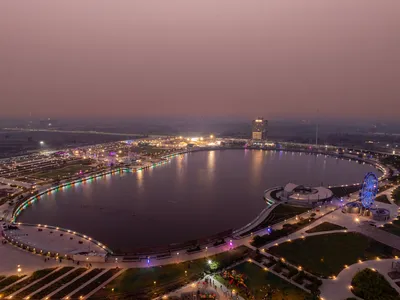
INI Design Studio Transforms a Neglected Depression into a 75-Acre Urban Lake for Rajkot
Atal Sarovar applies water-sensitive urbanism to turn a low-lying wasteland in Gujarat into a civic anchor for a smart city.
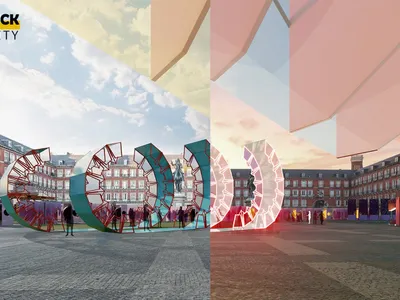
Instant City: Archigram's Roaming Metropolis Rebuilt as a Fleet of Unfolding Cultural Modules
A fleet of autonomous modules unfolds from compact transport forms into stages, markets and cinemas, turning plazas into temporary cultural venues.
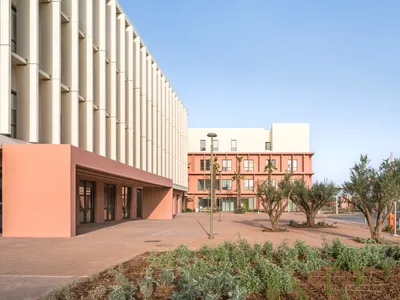
Michel Rémon, Associés, and ARCHIMATH Reinvent the Courtyard Hospital in Morocco's Desert
A 58,000 m² medical campus near Marrakech channels the ancient Bîmâristân through fiber-concrete moucharabieh and sun-driven planning.


