


Urban Renewal
Projects that revitalize urban spaces through architectural intervention, adaptive reuse, and community-centered design.
Urban renewal is the planned rebuilding or improvement of existing parts of a city, from a single derelict block to a whole district, usually to fix housing, infrastructure and economic decline. The term carries a heavy history: in the twentieth century it often meant clearing neighbourhoods wholesale, which is why designers today tend to speak of urban regeneration and favour approaches that repair a place without removing the people who live there.
What is urban renewal?
In its narrow, historical sense, urban renewal names a policy: a government identifies an area as "blighted", acquires and clears the land, and hands it over for new housing, offices or public space. The Wikipedia overview of urban renewal describes exactly this pattern, and notes that such projects are controversial because they have so often displaced low-income and minority communities.
In its broader, everyday sense, the phrase covers any deliberate effort to bring an underused part of a city back to life. UN-Habitat's urban regeneration programme defines regeneration as bringing back underutilised assets and redistributing opportunities, and lists the tools it can use: brownfield redevelopment, densification, heritage preservation and reuse, public space reactivation and better services. The same page is frank that regeneration risks gentrifying private space or privatising public space.
So the two words now point in slightly different directions. "Renewal" still suggests replacement, led from above. "Regeneration" suggests a longer process that keeps the existing fabric and community and adds to them. Neither is a separate discipline. Both sit across urban design, planning, housing and architecture, and they overlap closely with adaptive reuse, where the unit of change is a single building, and with conservation architecture, where the priority is to protect what is historically significant. What marks a project as renewal is its ambition to change the condition of a whole area, not just one site.
A short history of urban renewal
The model most people picture began in Paris. Between 1853 and 1870, Georges-Eugène Haussmann, prefect of the Seine under Napoleon III, cut wide boulevards through the dense medieval centre, added parks, and rebuilt the sewers and water supply. The history of Haussmann's renovation of Paris records both its achievements and the criticism that whole quarters lost their old character. It set a template: renewal as large-scale demolition followed by a new, more orderly city.

The United States turned that template into national policy. The Housing Act of 1949 authorised federal loans so that cities could acquire and clear slums and blighted land for public or private redevelopment. Its declaration of policy, still part of the United States Code at 42 U.S.C. 1441, tied slum clearance to a broad promise.
"the goal of a decent home and a suitable living environment for every American family"
United States Housing Act of 1949, Declaration of National Housing Policy
In practice, post-war clearance often targeted predominantly Black or immigrant neighbourhoods that were labelled as blighted, and the people who lived there were moved out. The record of the Act's Title I slum clearance programme and the wider literature on displacement show how the promise of better housing turned, for many families, into the loss of a home and a neighbourhood.

The sharpest response came in 1961, when Jane Jacobs published The Death and Life of Great American Cities, one of the first and strongest critiques of large-scale renewal. Jacobs argued from close observation of streets that mixed uses, short blocks, old buildings and dense, everyday activity were what kept neighbourhoods safe and alive, and that clearance destroyed them. By the 1970s criticism had widened to include the loss of historic urban fabric and the alienating effect of modernist architecture, alongside social displacement.
Key principles of urban renewal today
Contemporary practice has learned from that history. The principles below recur in good regeneration work, and in the projects members share on uni.xyz.
Start from what is already there
Heritage-led regeneration treats existing buildings and spaces as assets rather than obstacles. A new roof for CP by Rossignol Gregoire, an Honorable Mention in the Neo Delhi competition, sums up the idea in a single line: use the heritage as a solid basis for today's improvement. The same logic applies to former industrial land, which links this field to industrial heritage.

Reuse before you rebuild
Adapting an existing structure keeps its embodied energy and often keeps rents within reach. Community Beyond Ground: A Vertical Neighborhood by Hudaibiya Irfan, entered in UnIATA '26, takes an unfinished six-storey concrete structure in Kharadar, Karachi, and turns it into a vertical neighbourhood, linking spaces for learning, play, prayer and gathering with a continuous ramp.
"Old ideas can sometimes use new buildings. New ideas must use old buildings."
Jane Jacobs, The Death and Life of Great American Cities (1961), as quoted by Strong Towns

Let the community lead
Plans drawn from above tend to miss how a neighbourhood actually works. The journal on Centro Habana Urban Regeneration, Desde Adentro describes a proposal by Sara Venturini and Carolina Solis Bonini for Havana's Dragones area that works "from within", using vacant lots, facades and existing street life as the raw material for a fine-grain strategy built on community engagement.
Change things incrementally
Small, phased moves let a place adjust and let residents shape the result. The journal on Urban Retrofit covers a Retro - Fit 2020 proposal by jgfrontado that bolts a structural frame onto standardised public housing blocks in Caraballeda, Venezuela, so households can build balconies, gardens and workrooms one unit at a time instead of the blocks being replaced.
Keep people in place
The test of renewal is who still lives there afterwards. Projects that retain existing residents, add homes they can afford and improve shared space directly answer the displacement critique. Temporary and low-cost moves, the territory of tactical urbanism, can also test change before anything permanent is built.
Urban renewal on uni.xyz
Members' renewal projects cluster around a few recurring sites: disused railways, the spaces under flyovers, ageing housing estates and waterfronts that have lost their industry. Here are several worth studying.
Bend It by Rogerio Carvalheiro, Neil Maass and Matthew Cavender is a winning entry in the Salut Paris competition. It starts from how a neighbouring community had already taken over an abandoned train route informally, to meet nature and neighbours, and builds on that use rather than replacing it.
"The more dense our urban environments become, the more valuable open and natural settings become."
Bend It team, project statement (Salut Paris)

The Salut Paris brief drew other railway proposals too. Un Nouveau Soleil by Ahmad Kadry, Israa El-Maghraby, Muhammad Bargal and Hazem Youssef treats the abandoned lines as a placemaking project that invites Parisians to occupy and shape them, while Misak Terzibasiyan's entry adds urban farming, fish farming, workshops, reading rooms and cafés to a sunken railway space.
The journal Harlem Ustopia: Synthetic Regrowth on the Ruins of Public Housing presents a project by Miguelangel Murillo and Kevin Negrete, winner of the Peak competition. It confronts renewal's history head-on: the site is the void left where public housing in East Harlem was demolished, and the design frames its story in three stages, from Targeted Community to Erased Community to Community Regrowth.

Transition In Need, Reconnecting Fragmented Urban Ecology by Syed Shah Adnan, a thesis entered in UnIATA '26, studies the informal life beneath the Malir 15 flyover in Karachi. It proposes a connective intervention that ties together pedestrians, vendors and public life, turning neglected infrastructure into active public space.

The journal Forging a New Dawn for Darukhana covers a thesis by Rishu Jaiswal, a winner in UnIATA 25, for Mumbai's shipbreaking district. Instead of erasing the industry, it proposes a community and training centre, a waterfront promenade, a Shipyard Museum and safer, reorganised shipbreaking yards.
Housing estates are another recurring ground. Threaded City by Tobias Maiden, a People's Choice Award entry in the Peak competition, reimagines Harlem as ribbons of culture, housing, mobility and wellness. Ground Up by Oliver Brown, an Editor's Choice in the Sanctoreum competition, uses incremental housing scenarios for the community of Ikemeleng so that homes can become productive economically, socially and environmentally. And Farm/House by Amelia Aussie and daniel -, the most liked project in this topic, pairs a small rentable housing unit that can be extended later with urban farming in the space residents do not yet rent.
Challenges and future directions
The central question in renewal is still who benefits. Displacement can be direct, when residents are moved out to clear a site, or indirect, when improvements raise rents beyond what existing households can pay. UN-Habitat's call for regeneration that ensures affordability, access to services and involvement of local residents is a useful checklist precisely because so many projects fail one of those tests.
De-commodifying People by Vardhan Arora, which received a Special Mention and a Runner-up placing, argues for treating housing in Mumbai as a right rather than a commodity. It is a useful reminder that the economics of renewal shape the architecture as much as the other way round.

Other pressures are newer. Retrofitting existing buildings is increasingly argued for on carbon grounds, since demolition throws away the energy already spent on construction. Climate adaptation is adding parks and water to renewal briefs, which can itself raise land values and push residents out. And community participation, now expected almost everywhere, is easy to perform badly: a consultation held after the design is fixed is not the same as residents shaping it. The most convincing future for renewal is slower and smaller grained, built on tools that keep homes affordable, such as social housing, alongside the physical improvements.
Urban renewal for students and designers
Renewal makes a strong thesis subject because every site comes with a history, a community and a policy context you can research. Good angles include an infrastructure leftover in your own city, such as a flyover, a railway cutting or a vacant lot; a post-war housing estate facing demolition, which you could instead retrofit; or a former industrial waterfront where heritage and jobs both matter. Start with who lives and works there now, then test how your proposal changes their position. Mapping who stays, who leaves and who arrives is as important as the masterplan. Live briefs on themes like these appear regularly in uni.xyz competitions, and the adaptive reuse, industrial heritage and tactical urbanism topics linked above are good places to look for precedents.
Frequently asked questions
What is the difference between urban renewal and urban regeneration?
Urban renewal historically meant clearing areas judged to be blighted and rebuilding them, often with large-scale demolition. Urban regeneration usually describes a broader, longer process that improves an area's economy, housing and public space while keeping much of its existing fabric and community. In everyday use the terms overlap.
What was urban renewal in the United States?
It was a federal programme, launched under the Housing Act of 1949, that lent cities money to acquire and clear slums and blighted land for redevelopment. It rebuilt many downtowns but displaced large numbers of low-income, Black and immigrant residents, which is why the term is still contested.
Why did Jane Jacobs oppose urban renewal?
In The Death and Life of Great American Cities (1961), Jacobs argued that the qualities that keep cities safe and lively, such as mixed uses, short blocks, old buildings and constant street activity, were exactly what clearance projects destroyed. She based her case on observing how real neighbourhoods worked.
Does urban regeneration always cause gentrification?
No, but the risk is real. Improvements can raise rents and push out existing residents. Regeneration that protects affordable housing, involves residents from the start and keeps local jobs and services can improve a place without replacing its people.
What is heritage-led regeneration?
It is regeneration that uses an area's historic buildings, streets and industrial remains as the basis for its revival, reusing them for new purposes instead of demolishing them. It connects renewal with conservation and adaptive reuse.
References and further reading
- Urban renewal, Wikipedia
- Urban Regeneration, UN-Habitat
- Haussmann's renovation of Paris, Wikipedia
- 42 U.S. Code 1441, Declaration of national housing policy, Legal Information Institute, Cornell Law School
- Housing Act of 1949, Wikipedia
- Jane Jacobs, an urban ecologist, Strong Towns


Popular projects
View all 36 projects


Latest journals
View all 76 journals
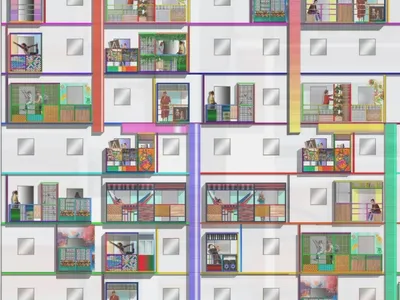
Urban Retrofit: Turning Mass Housing Facades into Fields of Individual Expression
A modular balcony framework grafted onto Venezuelan public housing lets residents reshape their own domestic edge, unit by unit.


Common Practice and Studio AAAN Carve a Hidden Courtyard World into Amsterdam's Narrowest Plot
Sixty-four mid-rent apartments on Oostenburgereiland turn a sliver beside a parking garage into a layered urban interior.
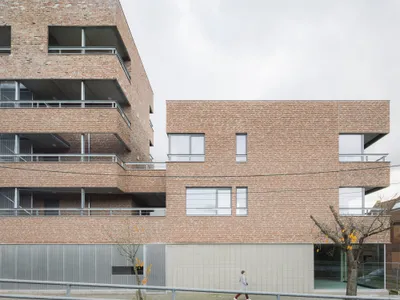
MAKER Architecten Weaves Social Housing into Kortrijk's Dense Urban Fabric with Brick and Restraint
A social housing infill in Kortrijk, Belgium, negotiates between existing rooftops, rail corridors, and neighborhood memory with quiet force.
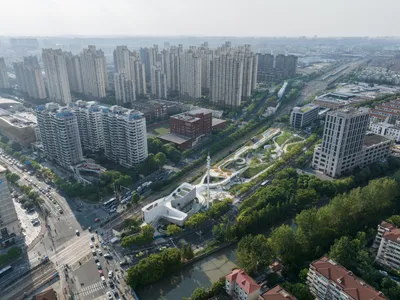
Shanghai New Horizon High Land Park and Civic Center: Urban Renewal Meets Public Engagement
Shanghai’s New Horizon High Land Park transforms an abandoned railway site into a vibrant civic center with rooftop park, public paths, and cultural integration.


