20 Most Popular Sustainable Design Projects of 2025
The 20 most-read sustainable architecture projects on uni.xyz in 2025, from flood-resilient shelters to biophilic wellness campuses.
Across every climate zone and program type, 2025 produced an extraordinary body of sustainable design work. The twenty projects gathered here represent the most-read architectural stories on uni.xyz this year — selected not by editorial committee but by the curiosity of our global community. From flood-resilient modular shelters in Kerala to a biophilic wellness campus in Gujarat, from regenerative reed-built research centres in Birmingham to student housing in Delft designed around a shared 'Heart', these projects chart the full spectrum of what ecological architecture can be in practice.
We have grouped them into four thematic threads: Climate Resilience, Net-Zero & Passive, Materials & Construction, and Biophilic & Green Infrastructure. Within each thread, conceptual visions and realised buildings sit side by side — because the best ideas on a drawing board today are the buildings that change cities tomorrow.
Climate Resilience
1. HEAL+ Modular Flood Shelter — A New Vision for Post-Disaster Architecture

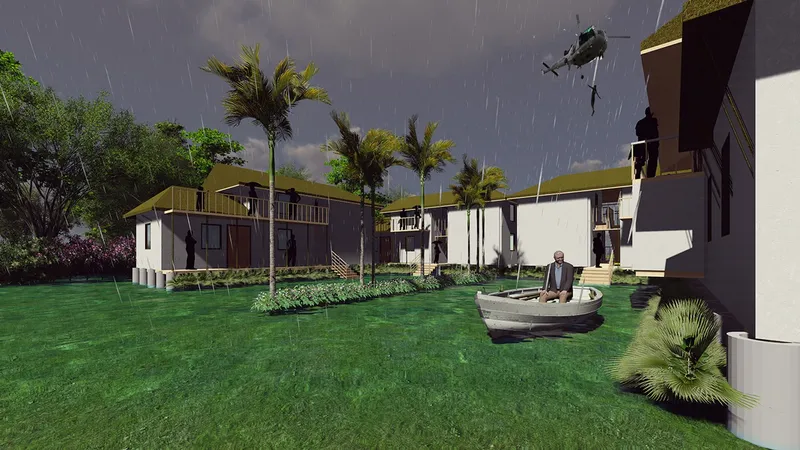
Kerala's recurring flood crises demanded an architectural answer that could be built before the next monsoon, not after. H.S. responded with PREF_SHELTER — a precast modular construction system designed to be both flood-resistant and rapidly deployable. The proposal rests on three pillars: shared community infrastructure scaled for flexible occupancy, stackable modules that grow with a family's needs, and a structural logic derived from precast concrete that reduces on-site labour to a minimum.
What makes this project stand out is its refusal to treat disaster housing as temporary. The modular units are calibrated for permanence, with elevated plinths, natural cross-ventilation, and material choices that acknowledge Kerala's humidity. This was a shortlisted entry in the HEAL+ Competition on uni.xyz.
2. Plug & Spread Housing — Flood-Resilient Architecture for Kerala's Future

The UNISDR statistic that over 600,000 people have lost their lives to disasters in the 21st century alone is the uncomfortable starting point for Isha and Prachi's Plug & Spread proposal. The concept centres on the 'Plug House' — an elevated, modular unit that can be dropped into flood-prone terrain and connected horizontally as communities grow. The 'Spread' dimension addresses settlement-level planning: units cluster around shared amenities, forming micro-neighbourhoods with collective resilience.
This shortlisted HEAL+ entry treats the act of building as a social contract. Each Plug House is designed to accommodate future additions without structural compromise, acknowledging that households in disaster-affected regions often expand as extended family returns after displacement.
3. Life Line of a City — Reviving Urban Design Architecture in Bucharest

Razvan Neagu's Life Line of a City begins with a deceptively simple premise: every city has an invisible pulse that shapes its streets and its people. The project visualises this rhythm through a series of urban acupuncture interventions along Bucharest's Magheru Boulevard, transforming an arterial road into a climate-responsive corridor. Layered green canopies reduce urban heat island effects; permeable surfaces manage stormwater; programmed pause-points interrupt the relentless forward motion of city life.
The project's conceptual ambition is matched by its specificity. Each intervention responds to an existing condition on Magheru — a dead facade, an overcrowded pavement, a polluted intersection — turning liabilities into urban assets. As a design proposal, it argues that climate resilience is not an infrastructure problem. It is a design literacy problem.
4. Pazhou South Waterfront Park — A Green Oasis in Guangzhou's Vibrant CBD

Not all climate resilience is built against disaster. Sometimes it is built into the everyday fabric of a city — as green buffer, flood sponge, and social gathering ground simultaneously. The Pazhou South Waterfront Park, designed by SWA Group in Guangzhou, China, does exactly this. Spanning 4 hectares and 300 metres of waterfront, the park dismantles rigid concrete embankments and replaces them with sculptural landforms calibrated to the Pearl River's tidal range — from +3.50 at low tide to +7.12 during a 20-year flood event.
Fourteen mature trees were preserved and integrated into the design, their canopies now anchoring an elevated meadow that brings seasonal biodiversity to the CBD. The result is a park that functions as ecological infrastructure first and public amenity second — though in practice it is impossible to separate the two.
5. REED MAZE — A Model for Regenerative Architecture

Ana Markovic's REED MAZE won the WIC Competition for its unflinching confrontation with industrial legacy. The River Tame near Birmingham was heavily industrialised from the 19th century onward, stripping the waterway of its ecological function and cultural memory. The proposal responds by placing a workshop and research centre directly in the river's corridor, using locally harvested reed as both structural material and ecological agent. The building grows from the landscape rather than being placed upon it.
The concept, framed as 'from exploitation to regeneration', treats architecture as the catalyst for ecological recovery. Reed beds purify water, provide habitat, and supply material for construction — closing a loop that industrial development had violently opened. The maze-like spatial organisation is not decorative; it mirrors the non-linear ecology of a wetland in recovery.
Net-Zero & Passive Design
6. Huimanguillo Market — A Modern Architectural Transformation

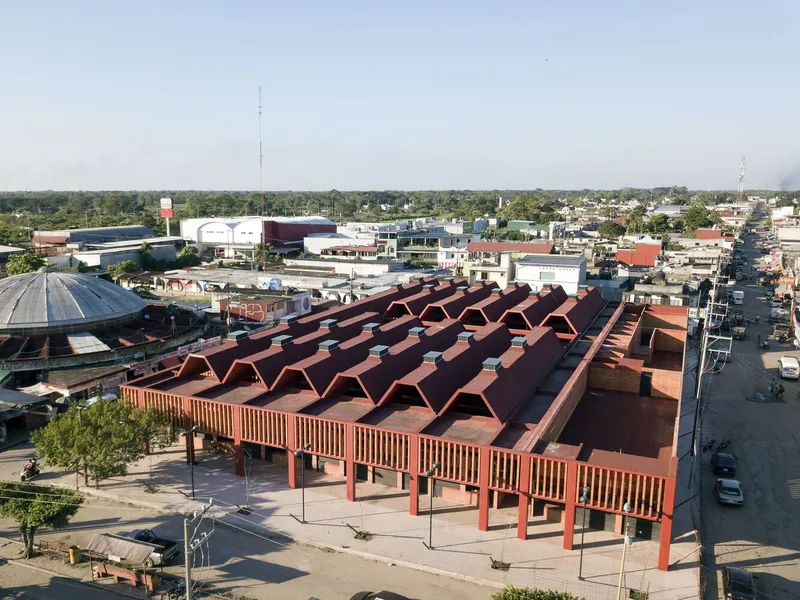
Passive design rarely makes headlines, but the Huimanguillo Market in Tabasco, Mexico, makes a compelling case for its primacy. Designed by 128 Arquitectura y Diseño Urbano as part of Mexico's federal Urban Improvement Program, the project replaces a structurally compromised market — damaged by the region's 95% humidity — with a new structure that addresses that same climate head-on. A rectangular central courtyard splits the building into two ventilated blocks; exposed brick latticework on the perimeter provides shade while enabling cross-ventilation; naturally pigmented concrete echoes Tabasco's vernacular palette.
The market is also a lesson in urban continuity. The original commercial layout was preserved to minimise disruption to long-standing businesses. A new vegetal canopy and commercial corridor extend the building's sustainability logic to the street. Passive, contextual, and deeply rooted in place — this is sustainable architecture without the press release.
7. Urban Trellis — Growing a Greener Future Through Sustainable Architecture

In a city defined by vertical density and minimal ground plane, Agata Mila's Urban Trellis offers a different form of verticality — one that grows food, preserves seeds, and organises community life simultaneously. Shortlisted in the Seed Bank Competition, the project uses an irregular grid of modular wooden structures to create a trellis-like frame that supports organic growth, literally and socially. Vertical farms, research labs, seed preservation rooms, and a ground-level food market are layered through the structure, each programme feeding the others.
The trellis metaphor holds throughout: the building is never finished, always growing, always dependent on what it supports. In an era of food security anxiety and biodiversity loss, Urban Trellis argues that the city itself can be a productive landscape — if architecture gives it the right infrastructure.
8. The Urban Meal Mine — Urban Agriculture Architecture

Where Urban Trellis frames food production as scaffold, Mona Ali Abdelwahab Emam's Urban Meal Mine embeds it as infrastructure. The building is conceived as a continuous connected space — formally inspired by the rhythmic flow of railway tracks — whose dynamic form creates a natural circulation through vertical farms, terraced growing plots, research kitchens, market halls, and public space. Every zone is both productive and permeable.
This shortlisted project for the Urban Agriculture Architecture Competition treats food growing not as an add-on to a building but as its fundamental organising logic. Dedicated vertical farming towers and rooftop terraced fields maximise land-use efficiency in a dense urban context. The building does not just consume the city's resources — it produces them.
9. Suite 9 at TU Delft Campus — Innovative Student Housing Redefined

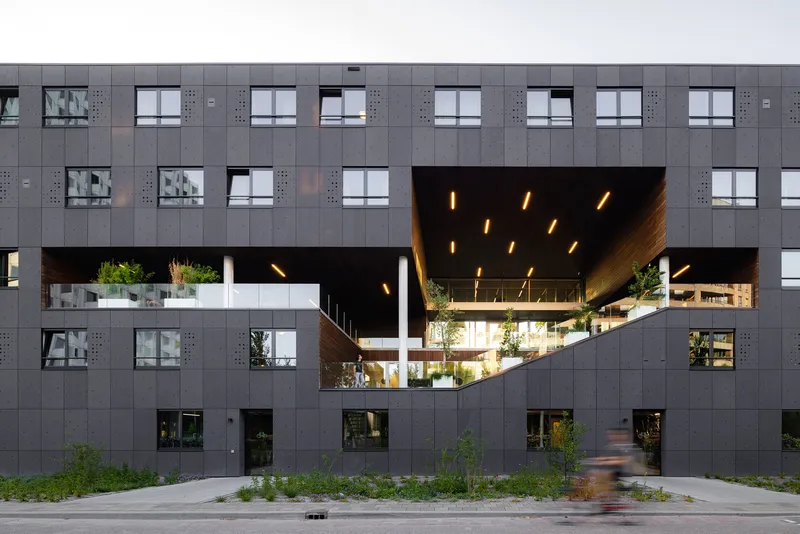
Completed in 2025, Suite 9 at TU Delft is 6,200 m² of student housing designed by Studioninedots that refuses to be anonymous. The building's 'Heart' — a semi-outdoor communal space at its centre — anchors a social ecosystem of shared kitchens, study corners, TV lounges, and laundry facilities. The exterior, clad in graphite Eternit panels with perforated screens, creates shifting light patterns that hint at the interior's density of life.
Sustainability here is spatial, not merely technical. By concentrating shared amenities and designing for spontaneous encounter, Suite 9 reduces individual resource consumption without requiring its residents to make conscious sacrifices. Photography by Sebastian van Damme.
10. Cyber Arena — A Futuristic Landmark in Esports Architecture

Esports may seem an unlikely entry in a sustainable design roundup, but Valentina Torshina's Esport Arena addresses a serious proposition: by 2050, one in three people are expected to engage in esports and virtual reality. In times of environmental crisis, digital experiences offer humanity a way to explore physical realities without consuming them. The arena — shortlisted in The Digital Colosseum Competition — is designed around this philosophical premise, with a form language derived from fluid dynamics and a programme that integrates virtual and physical experience.
The project's sustainability argument is subtle but coherent. If a building can redirect recreational consumption from physically intensive activities to digitally mediated ones, its carbon footprint logic shifts. Cyber Arena is one of the more intellectually ambitious projects on this list — a design that asks whether the most sustainable building is one that reduces the need for other buildings.
Materials & Construction
11. Center for Indigenous Building Crafts — Kath-Khuni Tradition in Shimla

Keyur Shah's proposal for a Centre for Indigenous Building Crafts in Shimla is an act of material archaeology. The Kath-Khuni system — alternating dry stone and seasoned wooden beams, interlocked without mortar — has been refined over centuries in the Himalayan foothills into one of the most earthquake-resistant and climate-responsive construction methods known. The project proposes a centre dedicated to teaching, practicing, and evolving this tradition, embedded within the topography of Himachal Pradesh and built using the very techniques it seeks to preserve.
The design draws from studies of remote villages — Jangoo, Balag, Dhagoli — where Kath-Khuni settlement patterns reveal a layered social complexity. Shah's proposal is not nostalgic. It argues that vernacular intelligence is technical intelligence, and that the future of sustainable construction lies partly in rediscovering what was already known.
12. Amakan House — A Tropical Micro-Architecture Solution for Urban Density

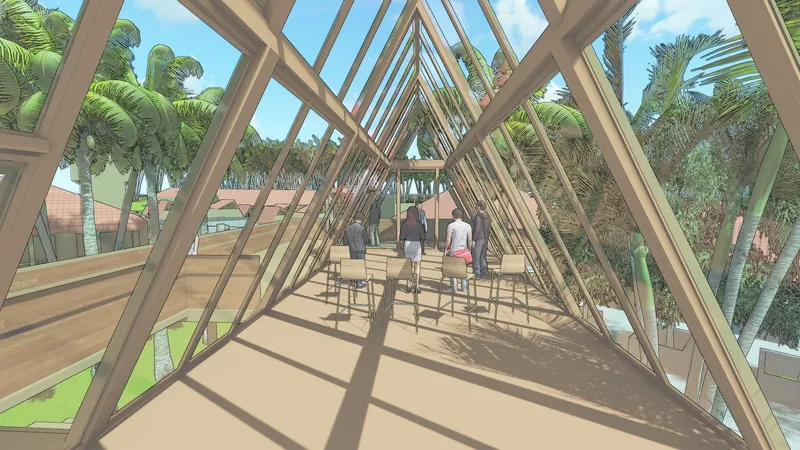
In the densely packed barangay of Sawang Calero in Cebu City, where narrow plots and high land costs create permanent housing pressure, JM Studio and Maureen Chu found their answer in Amakan — a native bamboo weave used as structural cladding. The building's facade is not an aesthetic gesture. It is a breathable skin that regulates humidity, reduces solar gain, and celebrates a material culture that predates concrete by centuries.
Micro-architecture at its best is not about smallness for its own sake — it is about precision in the face of constraint. Amakan House demonstrates that material intelligence and spatial generosity are not in conflict. The bamboo weave is durable, locally sourced, and carbon-negative. The house it covers is designed to outlast the next generation of concrete neighbours.
13. Tierra Tinta Pavilion — A Rustic Ode to Vineyards and Architecture
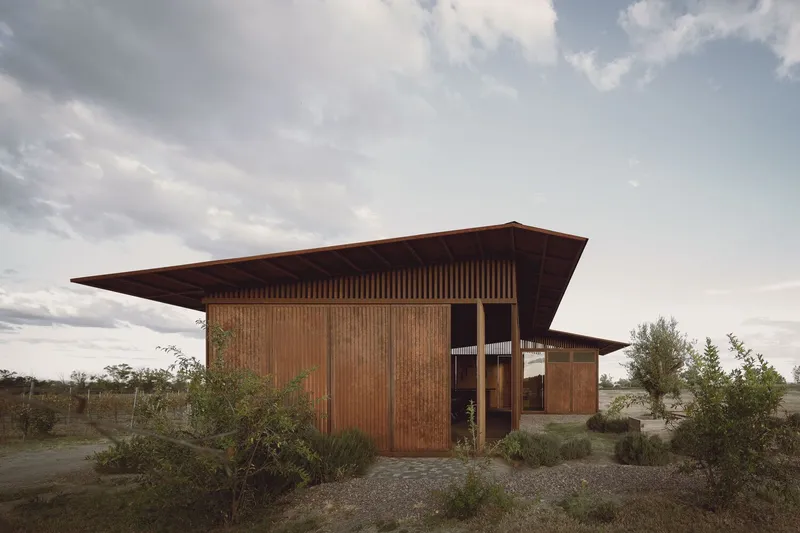
Speed, economy, and material honesty are not usually the terms one associates with award-winning architecture, but they are exactly what CoA Arquitectura delivered at Tierra Tinta in Aguascalientes, Mexico. The pavilion — positioned amid vineyards for a residential development — was designed to be built fast, built cheaply, and built with a palette so reduced it becomes a kind of material argument: steel structural grid, pivoting panels of timber and steel, exposed brick, and pigmented concrete. No finishes. No cladding. No concealment.
The result is a building that reads as both vernacular and contemporary. The pivot panels modulate ventilation and view simultaneously — a passive climate control mechanism so simple it barely qualifies as technology. In an industry that often conflates sustainability with complexity, Tierra Tinta is a usefully quiet counterpoint.
14. Another Way to Accompany — Sustainable Architectural Innovation

Cemeteries are among the most material-intensive building types in existence, yet they rarely appear in sustainability discourse. The design team — Windy, 626727439, and 709592090 — applied biophilic architecture to challenge this convention with 'Another Way to Accompany'. By integrating nature with the built environment of a memorial space, the project transforms the traditional concept of a cemetery into a landscape where the deceased become part of the world around us — the air we breathe, the scenery we admire.
The material logic is circular: biodegradable burial structures, living plant memorials, and topographic design that channels rainfall into irrigation. The design insists that grief and ecology are not incompatible — and that architecture can hold both without diminishing either.
15. Moon Pavilion by Atelier Guo — Minimalism, Nature, and Cultural Reflection

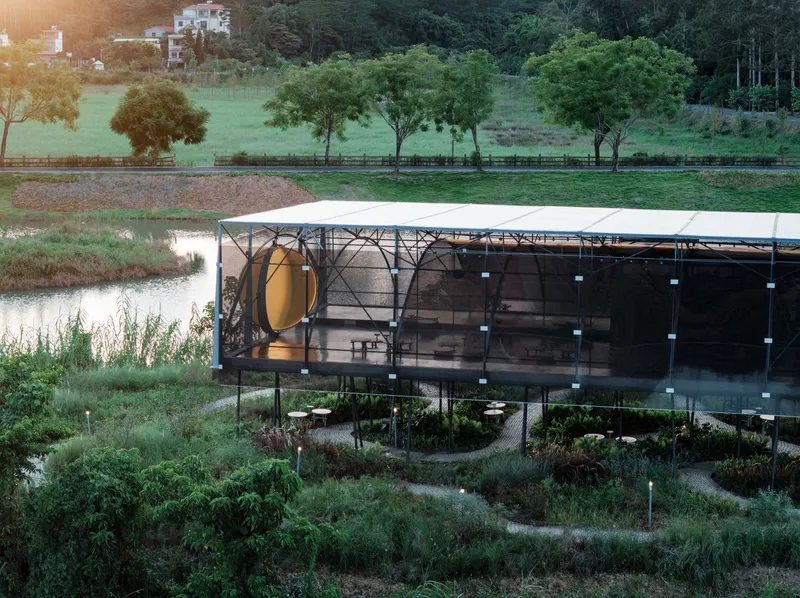
The Moon Pavilion by Atelier Guo in Huizhou, China, is built on a classic Chinese verse — a poet intoxicated amidst blooming flowers — and its architectural translation is appropriately subtle. Rather than literal representation, the pavilion abstracts the verse's themes: a rotatable moon installation on the facade creates a dialogue between the artificial and the natural, reflecting alongside the actual moon in the surrounding pond. The structure itself is a preserved greenhouse: lightweight pin-jointed steel, semi-transparent polycarbonate panels, black netting.
The sustainability of Moon Pavilion is embodied in its restraint. New materials are minimal; existing structure is retained; the landscape mediates between building and water. In a moment when architectural sustainability is often measured by the kilowatt, Atelier Guo makes a quiet case for the kilogram saved.
Biophilic & Green Infrastructure
16. Raga Svara Wellness Center — A Biophilic Haven for Holistic Wellbeing

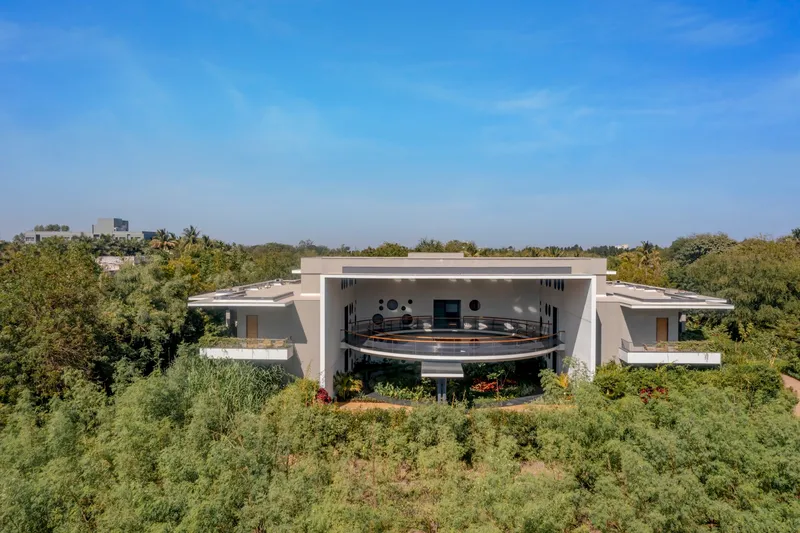
Set within a 25-acre farm in Rajkot, Gujarat, the Raga Svara Wellness Center by Shanmugam Associates is not simply a health retreat — it is a comprehensive argument for biophilic design as therapeutic infrastructure. The design is guided by the linear terrain, existing mature trees, and surrounding agricultural landscape. Greenery cascades from reception roofs to form living curtains; the swimming pool references Gujarat's stepped wells; yoga spaces are carefully oriented around mango groves.
The 20-villa residential component — the Raga Residences — extends this logic into private life: each unit has a dedicated garden, pool, and zen space, connected by a circumambulatory bridge over Moringa cultivation. Interiors are furnished with local craft and natural materials, completing a project that treats ecological sensitivity and human wellbeing as the same design problem.
17. Life Circle — Sustainable Architecture and the Circle of Life

Yutong Zou's 'Life Circle' extends the biophilic cemetery discourse in a different direction. Where 'Another Way to Accompany' focused on material circularity, Life Circle focuses on spatial experience — studying death culture across traditions to create a burial landscape where the boundary between structure and nature dissolves. Tombstones are replaced with biodegradable organic forms; planting evolves around each burial over time; the cemetery becomes a living record of those it holds.
The project's formal resolution is precise and quietly beautiful. Circular earthworks organise the site; water features connect to a broader ecological corridor; built and unbuilt exist in continuous dialogue. Life Circle asks a question that sustainable architecture rarely confronts directly: what does a building owe to the long future, not just the next fifty years?
18. A Market of Vibrant Buffer — Studio D'Arkwave

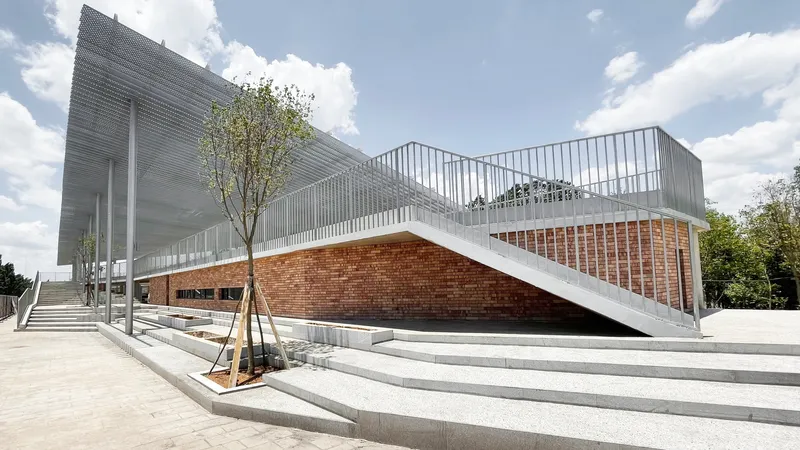
The Jiezi — a traditional open-air street market in Yunnan — has always been more than commerce. In Anning, on the outskirts of Kunming, Studio D'Arkwave designed around this cultural reality: the market operates for half a day, then the same space transforms into a public park for the rest. The 'Park + Market' concept is activated through a 3-metre modular grid structure whose roof becomes a stepped public terrace — a continuous architectural platform that physically connects ground-level market functions with an elevated green landscape.
The project integrates flood-sensitive planting throughout, manages stormwater via permeable surfaces, and celebrates local craft through ground-floor exhibition spaces. It is a building whose ecological intelligence is inseparable from its social intelligence — which is precisely what biophilic urbanism should aspire to.
19. Gushan Fish Market Revitalization — C.M. Chao Architect & Planners

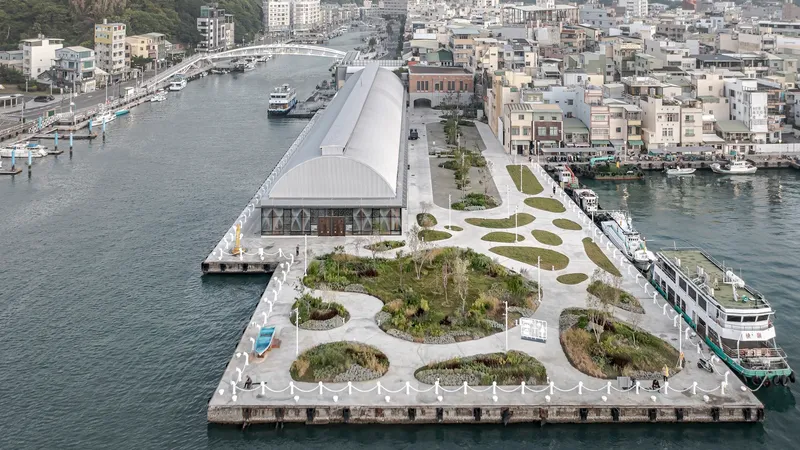
Established in 1927 at the height of Hamasen's maritime prosperity, the Gushan Fish Market in Kaohsiung had fallen into decline as offshore fishing shifted away from the city's traditional harbour. C.M. Chao Architect & Planners' revitalisation transforms the 7,243 m² site into a multi-programmed cultural and commercial destination — fresh seafood market, tourist facilities, cultural exhibition space — unified by a design concept drawn from coastal phenomenology: boats, waves, and flowing light condensed into a 'transparent box' structure.
The architectural transparency is not merely aesthetic. It connects interior activities to the waterfront visually at all times, restoring the building's civic relationship with Kaohsiung Harbour. The project won Silver at the A+ Architecture Awards. It is a reminder that sustainable urban design often begins with the restoration of a broken civic relationship — between a city and its water.
20. Laoyuting Pavilion — Between Forest, Infrastructure, and the Memory of Shelter
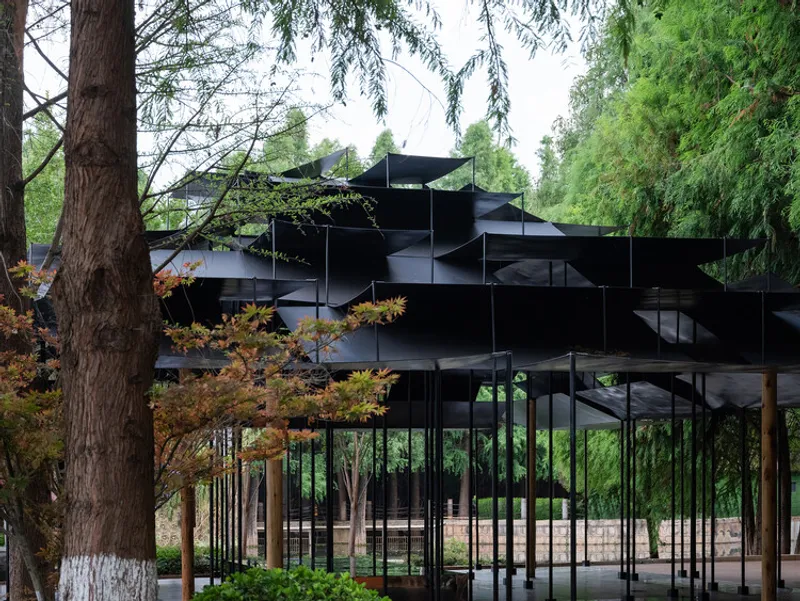
The final entry on this list is also its most quietly radical. The Laoyuting Pavilion, designed by Atelier Deshaus at the Laoyu River Wetland on the edge of Dianchi Lake in Kunming, sits between a busy road and an expansive wetland forest. Originally built as the entrance structure for the Dianchi Art Festival, it was retained permanently — which is itself a form of sustainable thinking: a building so well-placed that its city decided to keep it.
The pavilion's fragmented hipped roof recalls traditional Chinese architecture at a distance, but dissolves into a thatched steel canopy up close. A field of thin columns creates a density that shifts as visitors move through it — sometimes forest, sometimes shelter, always threshold. The Laoyu River Wetland is Kunming's final natural water filtration stage before flow reaches Dianchi Lake. The pavilion marks that boundary without enclosing it. It is, in the end, a building that knows its place in an ecosystem — the rarest and most necessary quality in sustainable design.
Where Sustainable Design Is Heading
What connects these twenty projects across five continents and four thematic threads? Not a single technology, not a single material, not a single formal language. What connects them is intention. Each project begins with an honest account of the problem it is trying to solve — whether that is flood displacement in Kerala, biodiversity loss in Birmingham, or food insecurity in Hong Kong — and builds from there.
The most-read sustainable design stories on uni.xyz in 2025 were not about the most expensive buildings or the most famous architects. They were about the most precise answers to the most pressing questions. That, perhaps, is the most encouraging data point in this entire list.
Explore more sustainable architecture, urban design, and competition entries on uni.xyz journals.
Last updated: April 2025. Engagement data reflects visits, likes, bookmarks, and comments through April 7, 2025.
Popular Articles
Popular articles from the community
Free Architecture Competitions You Can Enter Right Now
No entry fees, real prizes. Here are the best free architecture competitions open for submissions in 2026.
Inverted Architecture Installation by Studio Link-Arc: Exploring the Intersection of Architecture and Living Organisms
Inverted Architecture Installation by Studio Link-Arc blends mycelium, sustainability, inverted design, ecological cycles, and urban adaptive architecture in Shenzhen.
Alton Cliff House: A Harmonious Retreat by f2a Architecture in Lake Country, Canada
Alton Cliff House blends corten steel, prefabrication, and sustainable design, creating a luxurious, energy-efficient retreat perched on Canadian cliffs.
The Ken Roberts Memorial Delineation Competition (Krob)
As the most senior architectural drawing competition currently in operation anywhere in the world, it draws hundreds of entries each year, awarding the very best submissions in a series of medium-based categories.
Similar Reads
You might also enjoy these articles

Split House: A Compact Urban Home Blending Privacy, Light, and Flexible Living in Japan
Compact Japanese home featuring DOMA space, flexible café potential, passive lighting, privacy zoning, and sustainable urban living design.
Colour Burst House by LIJO RENY Architects: A Tropical Home Designed Around Rain, Light, and Courtyard Living
A vibrant tropical home with courtyards, rain-focused design, passive cooling, and seamless indoor-outdoor living in contemporary Indian architecture.
Fifth NRE Jazz Club – De Bever Architecten: Eindhoven’s Revitalized Cultural Hub
Historic gas factory transformed into Fifth NRE Jazz Club blending modern sustainability, jazz culture, dining, and heritage architecture seamlessly.
Three Summits Residence by NÓS: A Multigenerational Mountain Retreat Rooted in Landscape and Architectural Primitivism
Multigenerational mountain residence in Vermont featuring three pavilions, granite bases, dramatic roofs, and seamless integration with forested landscape.
Explore Architecture Competitions
Discover active competitions in this discipline
The International Standard for Design Portfolios
The Global Benchmark for Architecture Dissertation Awards
The Global Benchmark for Graduation Excellence
Challenge to reimagine the Iron Throne


Comments (0)
Please login or sign up to add comments
No comments yet. Be the first to comment!