Typological Architecture Competitions: Pushing the Limits of Existing Design Types (Updated October 2026)
This is the UNI editorial home for architectural typology — the discipline that treats buildings as members of families. Not styles. Not programmes. Types: the courtyard, the tower, the basilica, the cloister, the enfilade, the loggia, the arcade, the plinth, the slab. The intellectual tradition runs from Quatremère de Quincy (1825) through J.N.L. Durand to Aldo Rossi, Rafael Moneo, Anthony Vidler, and Pier Vittorio Aureli. It is one of the oldest and most generative design methods in architecture — and this UNI section is where the community uses it to push existing types into new territory.
What Is Architectural Typology?
Architectural typology is the practice of understanding buildings as members of recurring families based on their underlying spatial structure, rather than their style, decoration, or programme. The word "type" in this sense does not mean "category" or "model." It means something more specific: a spatial logic that persists across centuries and carries collective memory.
The foundational distinction was made by Antoine Quatremère de Quincy in 1825 in his Dictionnaire historique d'architecture:
"The model is to be repeated as it is; the type is an object after which each artist can conceive works that bear no resemblance to each other."
That single sentence is the seed of every modern theory of typology. A model is a fixed template you copy. A type is a generative idea — a spatial logic that designers can transform indefinitely while still speaking the same underlying language. Every courtyard building in history is a variation on the type "courtyard." No two are identical. All are recognizably members of the same family. That is how typology works.
Typology vs Programme vs Style: Three Things Often Confused
Before going further, it is worth clarifying three terms that novice designers often blur:
- Programme is what the building does. A hospital is a programme. A school is a programme. A library is a programme.
- Style is how the building looks. Gothic is a style. Brutalism is a style. Parametric is a style.
- Type is the building's underlying spatial logic. A courtyard is a type. A basilica is a type. A tower is a type. A basilica can be sacred or secular. A courtyard can be residential or civic. The type is neither the function nor the appearance — it is the persistent spatial diagram that outlives both.
This distinction matters because typology is the only one of the three that is fundamentally generative. Style is superficial (you can change it without changing what the building is). Programme is brief-driven (it comes from outside the architecture). Type is intrinsic to the architecture itself — it is how the building organizes space and orients the people moving through it.
The Theoretical Lineage: From Quatremère to Aureli
Typology has a deep intellectual tradition. Every serious participant in this section should know the canon:
- Antoine Quatremère de Quincy (1755-1849): the founder. His Dictionnaire historique (1825) first formalized "type" as an architectural concept distinct from "model." The distinction remains the discipline's foundational insight.
- Jean-Nicolas-Louis Durand (1760-1834): the systematizer. His Précis des leçons d'architecture reduced architecture to combinable spatial units organized on a grid. Durand's comparative plans — temples, basilicas, villas, palaces laid out side-by-side at the same scale — were the first attempt at a true typological atlas. They turned typology into a design tool, not just a classification.
- Aldo Rossi (1931-1997): the central modern figure. The Architecture of the City (1966) made typology the foundation of rational architecture. Rossi argued that building types carry collective memory — they are the DNA of the city itself. His concept of analogical architecture proposed that new buildings should speak the language of historical types without copying them. Rossi's Gallaratese housing block in Milan (1973) and San Cataldo Cemetery in Modena (1971) are the canonical built demonstrations.
- Rafael Moneo (Pritzker 1996): the bridge to contemporary practice. His 1978 essay "On Typology" in Oppositions defined type as "a concept used to describe a group of objects characterized by the same formal structure" that "maintains a close relationship with reality and social behaviour." Moneo's own built work — the Museum of Roman Art in Mérida, the Kursaal Centre in San Sebastián — demonstrates typological thinking at the highest level of contemporary practice.
- Anthony Vidler and the Third Typology (1977): Vidler's essay in Oppositions identified three historical typologies. The first: nature (the primitive hut, Enlightenment rationalism). The second: the machine (Le Corbusier, mass production). The third: the city itself — forms that justify themselves through their own internal architectural logic, with the urban fabric as both source and validator of type. The third typology is Vidler's name for Rossi's project.
- Saverio Muratori and Gianfranco Caniggia: the Italian procedural typology school. Their work on Venice, Rome, and Como showed how cities evolve through continuous modification of persistent types. Muratori and Caniggia gave typology an empirical method — read the city like a text, identify the types, trace their transformations.
- Carlos Martí Arís: his Las Variaciones de la Identidad (Variations of Identity) is the definitive Spanish-language text on contemporary typology. Martí Arís extends Rossi into a theory of how type survives transformation while maintaining identity.
- Pier Vittorio Aureli (contemporary):The Possibility of an Absolute Architecture (2011) revives Rossi's project as a politics of form. Aureli's "absolute architecture" is "an island within the city" — a typological act that is separated from but not free of its urban context. Typology becomes a political commitment.
- Colin Rowe:The Mathematics of the Ideal Villa (1947) performed a typological analysis avant la lettre, comparing Palladio's Villa Malcontenta to Le Corbusier's Villa Garches on the same grid. Rowe showed that typological reading could illuminate both historical and contemporary work simultaneously.
Why Typology Still Matters Today
In an era of parametric architecture, brand-driven form, and AI-generated renderings, typology offers something all of those do not: discipline rooted in collective memory. Here is why the discipline has been quietly reviving for the last decade:
- It resists formal novelty for its own sake. When every building can look like anything, typology offers an alternative: form derived from the logic of use and continuity, not from software preferences or marketing briefs.
- It makes cities legible. Cities are readable when their buildings speak recognizable types. Muratori and Caniggia showed that destroying typological coherence destroys urban memory. Typological thinking is therefore central to urban morphology and heritage conservation.
- It is a working tool in heritage planning. UNESCO designation processes, historic district planning, and urban conservation charters all depend on identifying and protecting type patterns. Typological reading is a professional skill, not just an academic exercise.
- It bridges theory and practice. Unlike pure theory, typology has always been a method architects actually use in the studio. Rossi designed with types. Moneo designs with types. OFFICE Kersten Geers David Van Severen designs with types. The discipline is alive in built work.
- It gives generative AI something to work with. Contemporary parametric and AI-assisted design is rediscovering typology as a seed — an underlying spatial logic the algorithm can vary, not erase. The type becomes a genome, not a prison.
The Core Typological Categories Every Architect Should Know
Typology has an informal canon of recurring types. These are the families every architect inherits and every competition brief implicitly references. Knowing them is basic literacy in the discipline:
The Courtyard
The oldest persistent type in architecture. An outdoor room enclosed by built fabric, producing an interior that is simultaneously public and private, protected and exposed. The courtyard appears in Roman domus, Chinese siheyuan, Islamic riads, Spanish palacios, and contemporary OFFICE KGDVS projects. It is the type that has travelled most widely across cultures.
The Tower
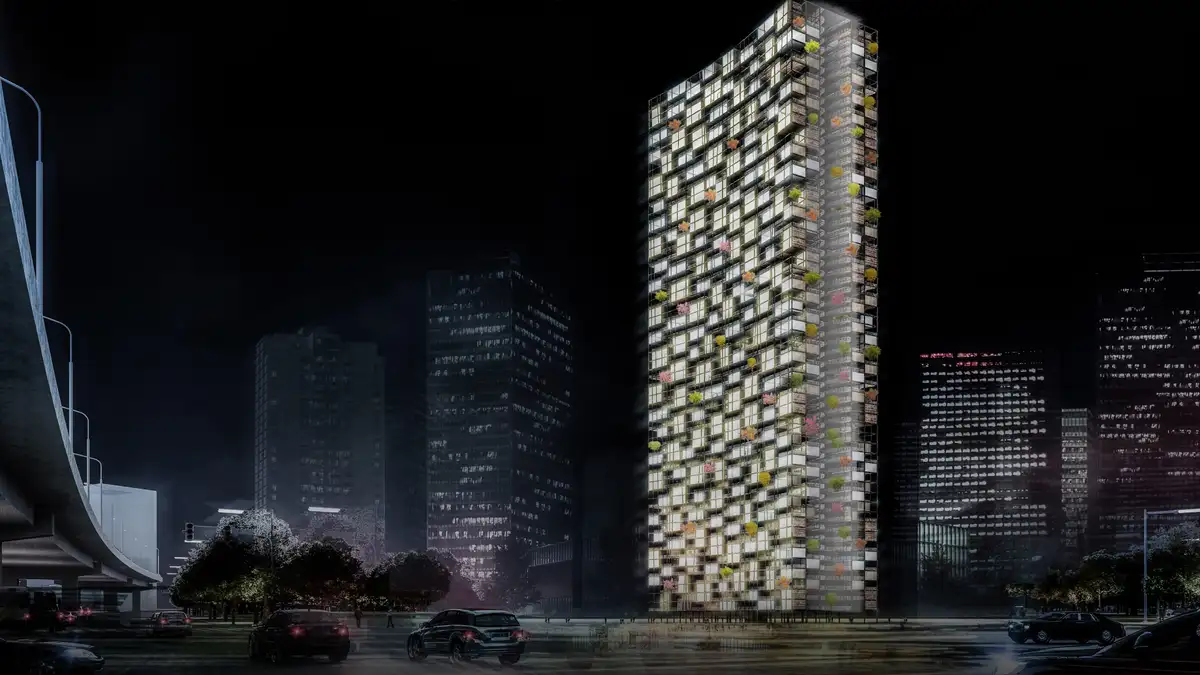
A vertical singularity. From medieval defensive towers to Manhattan skyscrapers, the tower is the type of visibility, symbolism, and compression. Its contemporary descendants include Mies's Seagram, the Shard, and every tall timber tower being built today.
The Plinth
The elevated base. The plinth lifts the building above the ground, mediating between street and interior. From Greek temples to the Bauhaus to the modern museum plinth, the type is about threshold, ground, and the choreography of arrival.
The Slab
The horizontal mass. From Le Corbusier's Unité d'Habitation to Rossi's Gallaratese to contemporary housing blocks, the slab is the type of repetition, the horizon, and the mass of modern life.
The Basilica
The longitudinal hall with nave and aisles. Roman originally, Christian by appropriation, but the type has always been about procession and hierarchy of space. It persists today in cultural halls, transport architecture, and every long public interior that wants to organize movement along an axis.
The Cloister
An enclosed contemplative space, typically a courtyard surrounded by a covered walkway. Monastic in origin, the cloister type persists in universities, hospitals, and meditative public spaces. Louis Kahn's Salk Institute is a secular cloister. The Sainte-Marie-de-La-Tourette is the sacred one.
The Enfilade
A sequence of rooms aligned on a single axis, often with doors perfectly aligned through multiple walls. The type of Baroque palaces (Versailles is the reference) and now of contemporary apartments using the enfilade as a modest domestic version of the baroque march through space.
The Loggia
A covered outdoor room attached to a larger building, open on at least one side. The Italian Renaissance type par excellence. Contemporary loggias appear everywhere from tropical housing to transitional spaces in hospitals.
The Arcade
A covered walkway supported by a row of arches or columns, typically at the edge of a building or lining a street. From the Roman forum to Bologna's 38 kilometres of porticoes to contemporary covered sidewalks, the arcade is the type of the mediating edge between public and private.
Typology as a Design Method: How to Actually Use It
Typology is not just a way of reading existing buildings. It is a generative design method. Here is how Rossi, Moneo, OFFICE KGDVS, and other contemporary practitioners actually use it:
- Start with the type, not the programme. Before you think about "this is a housing block" or "this is a library," ask "what type does this project want to be?" A courtyard? A slab? A cloister? A tower? The type comes first. The programme accommodates itself to it.
- Build a typological matrix. Collect 10-15 historical examples of your chosen type, laid out at the same scale, with the same conventions (all plans north-up, all sections through the same axis). Durand's method. Compare them. Identify the variations. Understand what is essential to the type and what is accidental.
- Use analogy, not copy. Rossi's method. Your new building should speak the language of the type without reproducing any specific historical example. The Gallaratese is unmistakably a Milanese courtyard block, but it is not a copy of any particular courtyard block.
- Transform the type honestly. Every new project adds a variation to the type. Name what your variation is — inversion (flipping the orientation), hybridization (combining two types), reduction (stripping to the essential diagram), amplification (pushing one characteristic to extremes). Making the transformation legible is half the design work.
- Stay loyal to the diagram, free on the details. The type is the diagram. The details are open. Rossi's Gallaratese is a rigorous courtyard diagram rendered in highly specific materials, proportions, and colours. Loyal to the type, free in the execution.
- Read the competition brief typologically. Most briefs describe the programme (what) and the site (where). A typologically literate architect reads the brief to ask: which type is this asking for? Which type would be unexpected but appropriate? Strong competition entries often win by proposing a type the brief did not ask for — but makes the jury realize is the right answer.
- Cite your typological precedent. In your concept statement, name the type and the historical precedents you are working with. Juries reward intellectual honesty about the lineage of an idea.
Open Briefs in This Section Right Now
This section currently curates 27 open briefs that each push an existing architectural or design typology into new territory — from staircases and workstations to stadiums, housing typologies, illustration challenges, and photographic readings of the built environment. A sample of what is currently open:
- PACKit — Packaging challenge - Design meets sustainability
- Envent — Design challenge to reuse E-waste
- Ascend — Designing a staircase for a client
- Arch-Station — Competition to design a workstation for architects
- Of Yore — Illustrate the lost glory of Angkor Wat - Render Challenge
- Simulation — VR headsets Storefront design competition
- Picturing: Non-Architect — Photograph architecture without architects
- Throne — Challenge to reimagine the Iron Throne
- Evolutionise — Design challenge to equip cities with modern furniture
- Hues — Photography competition to picture Art Deco
- On Rail — Challenge to design luxury tourism on rails
- Clad in Clay — Challenge to design mud housing for contemporary communities
Scroll above this section to see the full list of 27 open typological briefs, or browse all ongoing competitions across every discipline on the platform.
Contemporary Practitioners Working With Typology
Typology is not just an academic discipline. It is alive in contemporary practice. Study these names if you want to see what typological thinking looks like when it is actually built:
- OFFICE Kersten Geers David Van Severen (Brussels): the purest contemporary typological practice. Their projects reduce buildings to archetypal diagrams — the courtyard, the pavilion, the hypostyle hall — rendered with unusual rigour. Their monograph issues of 2G and El Croquis are essentially typological studies in built form.
- Tony Fretton (London): typological sensitivity to context. His Camden Arts Centre, Lisson Gallery, and Red House demonstrate how cultural and residential types can be transformed with restraint and intelligence.
- Caruso St John (London): typological legibility in contemporary materials. Brick House, Walsall New Art Gallery, and Newport Street Gallery are all typologically precise while inhabiting contemporary urban contexts.
- Dogma (Brussels, Pier Vittorio Aureli and Martino Tattara): the most theoretically rigorous contemporary typological practice. Their projects are often unbuilt but deeply influential as arguments.
- 6a architects (London): adaptive typological thinking applied to cultural, academic, and residential projects.
- Gion Caminada (Switzerland): vernacular typological transformation at village scale in Graubünden.
- Valerio Olgiati (Switzerland): autonomous architecture grounded in typological thought.
- OMA's early work (1970s-1990s): Rem Koolhaas engaged typology intensely in projects like Parc de la Villette and the Très Grande Bibliothèque before abandoning it for "bigness."
Critique of Typology: The Honest Questions
Typology has critics — and they raise questions every entrant should be able to answer:
- The formalism problem. Manfredo Tafuri and other Marxist critics argued that typological rationalism can become ideology disguised as technique — form divorced from social content. A strong typological project engages this critique, not avoids it.
- Whose types? Whose city? The canonical types were mostly identified from European and Mediterranean cities. Decolonial and feminist critiques point out that indigenous spatial types, women's spaces, and non-Western urban forms are often invisible in the classical typological canon. Expanding the canon is a live contemporary project.
- The generic vs the specific. When does respecting typological continuity become architectural conservatism? This is the contemporary debate between architects who want to protect urban memory and architects who want to rupture it. There is no single answer — both positions have produced good buildings.
- The danger of the retreat from the present. Typology can become an excuse to ignore climate change, new programmes, new technologies, and new social needs. A typological project that cannot respond to contemporary demands is nostalgic, not rigorous.
How UNI's Typological Section Differs From Other Architecture Category Filters
This is not a typology critique hub like The Architectural Review's typology series (which surveys individual building types as historical criticism behind a paywall). It is not an academic journal like Log or El Croquis. It is a practice-facing competition archive — the only place on the internet where typological thinking meets an open, live competition platform. The briefs in this section ask you to transform an existing type, invent a new variation, or push the diagram in an unexpected direction. That is a different kind of engagement from reading criticism. You have to actually design.
The UNI community has submitted thousands of typological responses across the 27 briefs in this section — building a contemporary archive of how the next generation of architects is reinterpreting the classical types. It is a living typology, not a historical one.
How to Prepare a Strong Typological Competition Entry
- Identify the type your project belongs to. Is it a courtyard? A tower? A plinth? A cloister? Name it explicitly in the first sentence of your concept statement.
- Build a precedent page. Show 4-8 historical examples of your type laid out at the same scale with consistent conventions. Durand's method. The precedent page is part of your submission, not a private research exercise.
- Name your transformation. Inversion? Hybridization? Reduction? Amplification? What are you doing to the type that is different from what has been done before? Be explicit.
- Cite your theoretical lineage. Reference Rossi, Moneo, Vidler, Aureli, or whoever informs your work. Juries in this section are typology-literate and reward intellectual honesty.
- Let the type organize your presentation. Section cuts that reveal the typological diagram. Plans that show the relationship of rooms to type. Axonometrics that strip away non-essential detail to show the spatial logic.
- Engage the critique. Whose type? Whose city? Is your project responding to the climate crisis? Social contemporary needs? Strong entries take the honest questions seriously.
- Keep the details rigorous. Rossi's lesson: loyal to the type, free in the execution — but the execution still has to be rigorous. Material, proportion, colour, and detailing all matter.
- Show the transformation in one drawing. The strongest typological entries can summarize their whole argument in a single before-and-after diagram. If you cannot reduce your transformation to one image, you may not have fully understood it yourself.
October 2026 Platform Snapshot
- 27 open briefs currently curated in the typological section — the largest single curated section on UNI
- 41 competitions currently open across all themes on the platform
- 769 total competitions hosted on UNI since 2017
- 7993 total entries submitted across all competitions
- 905 jurors have evaluated work on the platform
- 280K+ architects and designers in the UNI community
- 75 disciplines covered across architecture and design
Frequently Asked Questions About Architectural Typology
What is architectural typology in simple terms?
Architectural typology is the practice of understanding buildings as members of recurring families — "types" — based on their underlying spatial logic rather than their style, function, or appearance. The courtyard is a type. The tower is a type. The basilica is a type. Buildings that share a type share a family resemblance even when they look radically different. Typology is how architects organize the history of architecture so it can be used as a design method.
Who invented architectural typology?
The French theorist Antoine Quatremère de Quincy (1755-1849) first formally introduced "type" into architectural discourse in his 1825 Dictionnaire historique d'architecture. His distinction between "type" (a generative idea) and "model" (a fixed template to copy) is still the foundation of the discipline.
What is the difference between type and model in architecture?
In Quatremère's formulation: "The model is to be repeated as it is; the type is an object after which each artist can conceive works that bear no resemblance to each other." A model is a fixed design you copy exactly. A type is a spatial idea that architects can transform indefinitely while still speaking its underlying language. The courtyard type has generated millions of different courtyards, all recognizably members of the same family.
What did Aldo Rossi mean by "the city as a collection of types"?
In The Architecture of the City (1966), Aldo Rossi argued that cities are best understood not as collections of individual buildings but as collections of recurring building types. The courtyard house, the arcaded street, the central square, the tower, the basilica — these types repeat across centuries and carry the collective memory of their inhabitants. Rossi believed the job of the architect was to respect and transform these persistent types rather than erase them.
What is Rafael Moneo's essay "On Typology" about?
Moneo's 1978 essay in Oppositions magazine is the canonical contemporary statement on typology. He defines type as "a concept used to describe a group of objects characterized by the same formal structure" that "maintains a close relationship with reality and social behaviour." Moneo extended Rossi's thinking into contemporary practice and made typology legible to architects in Spain, the United States, and Latin America. His own built work — the Museum of Roman Art in Mérida, the Kursaal Centre in San Sebastián — demonstrates the method.
What is Vidler's "Third Typology"?
Anthony Vidler's 1977 essay The Third Typology identified three historical typologies: nature (the primitive hut, Enlightenment rationalism), the machine (Le Corbusier, modernist mass production), and the city (Rossi, Vidler's contemporary position). The third typology justifies architectural form through the urban fabric itself — not through natural origins or industrial logic. It is Vidler's name for the typological project Rossi and his Italian contemporaries were building.
What are the most important building typologies in architecture?
The canonical types every architect should know include the courtyard, tower, plinth, slab, basilica, cloister, enfilade, loggia, and arcade. Each has a persistent spatial logic that has travelled across centuries and cultures. These are not the only types, but they are the foundational families, and every good design education teaches them.
How is typology used as a design method?
Typology as a design method works in four steps: (1) identify the type your project belongs to, (2) research historical examples of that type and lay them out comparatively (Durand's method), (3) choose a transformation — inversion, hybridization, reduction, amplification — and (4) design your new building as a variation on the type, speaking its language without copying any specific example (Rossi's analogical method). It is how Rossi, Moneo, OFFICE KGDVS, and many other contemporary architects actually work.
Are typological competitions different from regular architecture competitions?
Yes. In a typological competition, the type itself is the constraint — the brief asks you to design within a specific type (a courtyard house, a cloister, a tower) or to push an existing type into new territory. Juries in typological competitions are typology-literate and evaluate entries on the clarity of the typological argument, not just the visual quality of the renders. The section's 27 current briefs are all variations on this constraint.
How do I reference a typological precedent in a competition entry?
Name the historical precedent explicitly, show a plan and section at the same scale as your proposal, and state what your project is doing differently from the precedent. For example: "This housing proposal is a transformation of Rossi's Gallaratese courtyard typology, reduced from three courtyards to one and inverted so the gallery runs below ground rather than above." Explicit citation is respected by juries; unacknowledged borrowing is not.
Recommended Reading for Typological Architects
Start your library with: Aldo RossiThe Architecture of the City (1966); Rafael Moneo "On Typology" in Oppositions 13 (1978); Anthony Vidler "The Third Typology" in Oppositions 7 (1977); Pier Vittorio AureliThe Possibility of an Absolute Architecture (2011); Colin RoweThe Mathematics of the Ideal Villa and Other Essays; Carlos Martí ArísLas Variaciones de la Identidad; Gianfranco Caniggia and Gian Luigi MaffeiArchitectural Composition and Building Typology; Quatremère de QuincyDictionnaire historique d'architecture (1825, "Type" entry); and J.N.L. DurandPrécis des leçons d'architecture. For contemporary practice, study the OFFICE KGDVS monographs and the Dogma (Aureli + Tattara) projects.
Explore More on UNI
Beyond typology, explore related sections including heritage conservation and adaptive reuse (where typology meets preservation), futuristic and conceptual architecture, narrative and thematic design, temporary and modular architecture, and Cybertecture Masterclass. Browse all ongoing competitions, see what's trending, preview upcoming launches, or study the past competitions archive. Ready to engage typology directly? Explore UNI Membership for unlimited access to every brief on the platform.